Tsuro (鶴): Crane

In Japan, the crane is a national treasure. It is the symbol of longevity and good luck because it was thought to have a life span of a thousand years. Tsuru are also monogamous, therefore, often used for wedding decor. An example of this is seen on formal wedding kimonos, and the uchikake, a decorative kimono that goes over the actual kimono, where beautiful images of tsuru are often embroidered.

The crane is often produced in Japanese origami and artwork. Large colourful necklaces of cranes are also commonly seen outside of Japanese temples.

Another example of the crane used in Japanese culture is the 1,000 origami cranes called senba zuru. As the story goes, during WWII, Sadako Sasaki, a young victim of the atomic bomb in Hiroshima, was diagnosed with leukemia from exposure to radiation. There are many versions of her story; one says she decided to fold 1,000 paper cranes as a symbol of peace and hope but was only able to fold 644 before she died of her injuries. Another says her friend folded the cranes for her in hopes of her recovery. Regardless of who folded the cranes, today people of Japanese ancestry as well as many others, carry on the tradition of folding 1,000 cranes in hopes of health, happiness, and peace. There is a memorial statue of Sadako at theHiroshima Peace Memorial Park with her holding a single crane.

The crane is a majestic bird that is a favorite subject in many Asian paintings. Although there are many species of cranes, in Asia it’s usually the red crown crane that is depicted. The long white neck and torso, contrasting black legs and head is topped with a red crown. Their physical beauty is undeniable.

There is a Japanese idiom that says, “tsuru no hito koe“, 鶴の一声 or つるのひとこえ, which literally translates as, “one word from the crane’, meaning the “voice of authority”, the one who has the final word that isn’t challenged.

Koi (鯉): Carp

Koi means Carp in Japanese, and this fish is a symbol of perseverance due to the fish’s tendency to swim upstream and resist the flow of water. Koi Carp also symbolise faithfulness and marriage in Japan. A design of carp swimming against rapids symbolises the Children’s Day Festival on May 5th. This is to inspire children to work hard in order to succeed.

Koi are a colorful, ornamental versions of the common carp. Though carp domestication is believed to have begun in China as far back as the 4th century, modern Japanese koi are believed to date back to early 19th-century Japan where wild, colorful carp were caught, kept and bred by rice farmers. There are now dozens of different color varieties of koi.

Koi varieties are distinguished by coloration, patterning, and scalation. Some of the major colors are white, black, red, yellow, blue, and cream. Although the possible colors are virtually limitless, breeders have identified and named a number of specific categories. The most notable category is Gosanke, which is made up of the Kohaku, Taisho Sanshoku, and Showa Sanshoku varieties.

  • Kōhaku (紅白) is a white-skinned koi, with large red markings on the top. The name means “red and white”; kohaku was the first ornamental variety to be established in Japan (late 19th century).
  • Taishō Sanshoku (or Taishō Sanke) (大正三色) is very similar to the kohaku, except for the addition of small black markings called sumi (墨). This variety was first exhibited in 1914 by the koi breeder Gonzo Hiroi, during the reign of the Taishō Emperor. In the United States, the name is often abbreviated to just “Sanke”. The kanji, 三色, may be read as either sanshoku or as sanke (from its earlier name 三毛).
  • Shōwa Sanshoku (or Showa Sanke) (昭和三色) is a black koi with red (hi 緋) and white (shiroji 白地) markings. The first Showa Sanke was exhibited in 1927, during the reign of the Shōwa Emperor. In America, the name is often abbreviated to just “Showa”. The amount of shiroji on Showa Sanke has increased in modern times (Kindai Showa 近代昭和), to the point that it can be difficult to distinguish from Taisho Sanke. The kanji, 三色, may be read as either sanshoku or as sanke.

Kame (亀): Turtle

The Japanese word for turtle is kame, and the Japanese believe that the turtle is a symbol for wisdom, luck, protection, and longevity; longevity due to their long lifespan and slow movements. The turtle is magic and unites heaven and earth, with its shell representing heaven and its square underside representing earth.

Images of kame are quite popular. In Japanese mythology kame is a symbol of power and immortality. Kame supports the World Mountain, a refuge of the immortals. One such image is found in the monument to Tokugawa Ieyasu in Ryogoku, Tokyo. Kame have often been pictured by Japanese artists, including one of the most famous artists of Edo era, Hokusai Katsushika.

Kaeru (蛙): Frogs

Among popular Japanese spiritual symbols are frogs. There are many species of frogs in Japan as a result of flooding rice fields in Japanese agriculture. These creatures are often used in poetry and art, and are sometimes carried by travellers to make sure they return home safely from their journeys. The word ‘frog’ in Japanese means ‘return’, which is why the frog is considered a Japanese lucky animal and seen as good fortune in things returning.

Japan is home to 40 species of frogs in five families. The most common is the tiny Japanese tree frog, which is usually green but can change its color to match its background, and the Japanese rain frog.

There are Japanese folk stories of giant toads, two to three meters in height, that found high up on mountain streams. According to legend they can breath out great rainbows and use the rainbows to slide prey into their mouth and are able to walk on their hind legs. They are said to be particularly numerous around in the mountains of the Suo region of Yamaguchi Prefecture.

Chōchō (蝶々): Butterfly

Japan perceives the butterfly to be a ‘soul of the living and the dead’, as a result of the popular belief that spirits of the dead take the form of a butterfly when on their journey to the other world and eternal life.

The butterfly is also often used as a symbol for young girls as they spread their wings and emerge into womanhood, as well as it being believed to symbolise joy and longevity. Additionally, if a symbol contains two butterflies dancing around each other, it’s a symbol of marital happiness.

Eternity —> The meaning of eternity which represented by the butterfly is due to the belief that spirits of the dead take the form of a butterfly on their journey to the other world and eternal life. Or spirits of the dead are guided by butterflies to the afterlife.

Womanhood —> The cycle of transformations through which a butterfly passes in its life is often associated with the transformations through which a girl passes on her way of becoming a young woman. In Japanese culture, the butterfly is associated with femininity, also, because of its grace and beauty.

Love —> In Japanese symbolism, the butterfly is a sign of good luck in love and finding your soul mate. It is a symbol of a happy marriage, and is used as a decorative element for weddings. An old Chinese legend, adopted by most East Asian countries, tells the story of two lovers who turn into butterflies after committing suicide together. This story has been compared as the Romeo and Juliet of Asia, and expresses the eternal love of those two.

Butterfly Motif —> The motif of butterfly is common on Japanese clothing. The motif of a butterfly on yukatas and kimonos is very common because of its meanings, especially on those worn by girls and young women. Also there is the butterfly knot used to tie the women’s obi (long, broad sash tied about the waist over a Japanese kimono).

The Butterfly in the Arts —> Throughout history, the butterfly was a common motif in paintings, paper panels, fans and more. In the Edo period, the butterflies were a very popular subject among ukiyo-e artists, being painted by artists like Utagawa (Ando) Hiroshige, Kudo Shunman, Yanagawa Shiganobu, Totoya Hokkei, Utagawa Toyokuni, Yanagawa Shigenobu, Kitao Masayoshi, and Shirabe Fujie. One of the most famous ukiyo-e paintings belongs Katsushika Hokusai, “Peonies and Butterflies”, whose fan was even Claude Monet.

Samurai Mon (紋) —> The butterfly was often used as a symbol for the mon (emblems used to decorate and identify an individual) of the samurai clans. One of the first clans who used butterfly was Taira clan, one of the most powerful clans in the Heian period.

Origami —> The butterfly is the first form of origami that was ever made, and it was inspired by a poem by Ihara Saikaku in 1680, in which he describes a dream about paper butterflies. Ihara describes two butterflies called Ocho and Mecho. Now there is a tradition in which two paper butterflies are placed on sake bottles used at weddings.
Manga & Anime —> In the modern culture of Japan, anime and manga plays an important role, and the butterfly is present in both. In the anime series Bleach, butterflies are present as the traditional form of guides for the spirits of the dead. In Sailor Moon, the butterfly is the symbol of Princess Kakyuu. In the manga Little Butterfly, it is a symbol of freedom and hope for the two young lovers who want to escape to be together.

Kaiseki-Ryori (会席料理)

Kaiseki-Ryori (会席料理)

Prepared by specialized restaurants and also served at dinner in ryokan (traditional inns), kaiseki typically features between 10 to 12 dishes enjoyed over the course of a couple of hours. From the traditional teahouse-like interiors to the kimono-clad staff and the tranquil atmosphere, it’s a deeply Japanese experience before you even begin to eat. While the course progression and dishes will vary, the focus on seasonal ingredients is always paramount. Dishes appear like works of art and delicately garnished with seasonal motifs like a cherry blossom bud in spring.

At the heart of kaiseki dining is the Japanese principle of shun, or taking ingredients at the peak of their freshness. Dishes are presented simply, without artifice. This is done not only to ensure that the true flavor of each ingredient be expressed, but also to properly display each and every one and the height of their natural beauty, thus creating the perfect synergy between cuisine and artistic expression.

Kaiseki-Ryori is the most refined form of Japanese cuisine, and as such requires the highest etiquette. It is important to observe a few basic formalities:

Show Respect —> Before the meal, be sure to say “itadakimasu” to show respect to the chef, the restaurant staff, and the wonderful bounty itself.

Use Chopsticks Properly —> Chopsticks should not be used to poke or cut food into smaller bites. When not using them, place chopsticks back on the hashi-oki, or chopstick rest, provided rather than placing them across the top of a bowl or sticking them into a dish.

End of the meal —> At the end of the meal, remember to thank the chef and restaurant staff with the common phrase, “Gochiso-sama deshita,” which essentially means, “It was a feast.

Sakizuke

Kaiseki-ryori menus often begin with the sakizuke course – a small appetiser or amuse-bouche.

Suimono

This light, clear soup, presented with minimal garnishes, is served as a refreshing palate-cleanser.

Hassun

The most attractive and artistic of all kaiseki-ryori components, the hassun is a seasonal platter of four or five hors d’oeuvres.

Otsukuri

The otsukuri course is comprised of a selection of sashimi, which varies by season and by region.

Takiawase

A lightly simmered vegetable dish served with fish, meat, or tofu.

Yakimono

A grilled dish that showcases seasonal fish (either fresh-water or from the sea) or meat such as local wagyu (beef).

Agemono

A deep-fried dish, often featuring tempura and served with a dipping sauce or salt seasoning.

Mushimono

This steamed dish can contain fish, chicken or vegetables, and may also include a savoury custard.

Sunomono

The sunomono course is a small vinegar-based dish designed to cleanse the palate. It usually features vegetables or seafood.

Shokuji

A trio of dishes – rice, miso soup and pickles – that are served together towards the end of the meal.

Mizumono

The meal concludes with a dessert, such as seasonal fruit, ice cream or a traditional sweet.

Japanese Table Manners 101

Before you begin eating, say “itadakimasu.”

As a rule, Japanese always say “itadakimasu” before they eat. It literally means “I partake.” There are many stories behind it, but it is considered to be a way of expressing gratitude to the chef, the people who grew/raised the ingredients that make up the meal, and the ingredients themselves since everything on one’s plate was once alive. 

If the chopsticks are disposable chopsticks break the chopsticks by pulling them apart vertically.

Proper etiquette states that the chopsticks should be held horizontally, and pulled apart vertically over your knees.  Do not pull your chopsticks apart horizontally.

If there isn’t a chopstick rest, make one with the paper your chopsticks came in.

Since it is rude to place your chopsticks over your bowls when you’re not using them, if there isn’t a chopstick rest, please make one using the paper sheath. 

When you’re eating rice, hold your rice bowl in front of you in the opposite hand you use for chopsticks.

When you eat rice, make sure to lift your bowl in front of you. Not lifting your bowl is considered poor etiquette.  The same rules apply to soup bowls.

Clean your plate.

Most places in Japan will not let you take food home for hygienic reasons, so please clean your plate.

When you finish eating, put your disposable chopsticks back in the paper and fold the end. After meals, please say “gochisousama deshita.”

“Gochisousama deshita” literally means “I feasted.” It derives from the word “chisou” which means “feast,” and is written with two characters that mean “to run,” it implies that the meal was created as the result of many people running around and working together. “Go” and “sama” are honorifics that take the phrase to politer level that implies thanks to the many people that came together to create this meal.

Many people say “itadakimasu” and “gochisousama deshita” with their hands put together as though in prayer, it’s not required and is often a regional behavior.

If at a restaurant saying “gochisousama deshita” to the staff when you exit is considered to be good manners as well.

Nodaiwa: Unagi Restaurant

CCE5BBA8-AAC2-4868-B2B7-88E2DCED2F57.jpeg

Nodaiwa is a traditional unagi restaurant (grilled freshwater eel) established during the late 18th century in Tokyo. This michelin-star restaurant has 4 locations in Tokyo and one in Paris. Its main location is in Azabu, near Tokyo Tower. The 5th generation chef, KANEMOTO Kanejiro, is running the restaurant.

The building in Kamiyacho is an old style kura (storehouse) brought to Tokyo from Takayama in Gifu Prefecture. the restaurant stands out juxtaposed to the tall office buildings around it. The shop in Azabu dates from the 1970s, but the history of the restaurant goes back 200 years with the first chef opening a restaurant called “Nodaya” in Azabu during the Kansei years (1789-1801). Many articles throw around the year 1850 around as the year of establishment.  The Japanese articles just state late Edo period (1603-1868) or the Kansei years (1789-1801).

The Rakan statues (Kyoto, Japan)

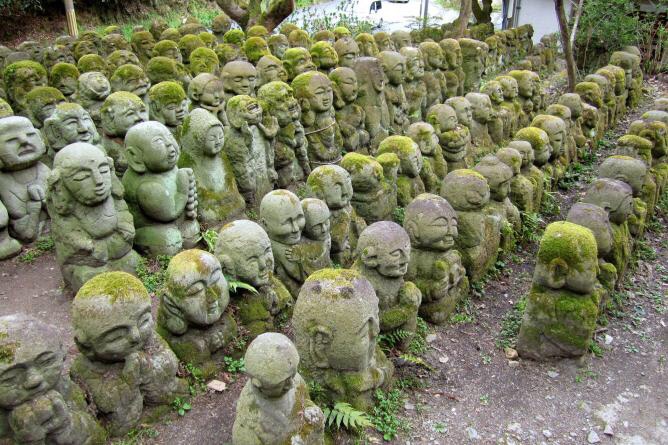
If you visit Arashiyama, the hills lying to the west of Kyoto city, you’ll find the Otagi Nenbutsu-ji temple. Standing all over the temple grounds, are 1,200 statues of rakan, the original disciples and followers of the Buddha, carved from stone and covered with moss. They were carved decades ago by believers who worshipped at the temple, and were donated as a blessing. Due to the many different sculptors involved in the project, many of whom were amateur, all the statues have different expressions, poses, and artistic styles. They may be praying, laughing, holding birds or even goblets. These differences add a touch of whimsy to this lovely temple, making it a true hidden treasure.

Open hours: Mon-Sun 8am-5pm

Address: 2-5 Sagatoriimoto Fukatanicho, Ukyo Ward, Kyoto 616-8439.