Zen Glossary

Bodhisattva – An awakened or enlightened being who renounces the experience of nirvana in order to remain with unenlightened beings and work for the liberation of all.

Ch’an – The Chinese word for zen.

Densho – The large bell used to announce services and lectures.

Dharma – The dharma is thought of variously as the Way, the Path, Cosmic Law and Universal Truth. The dharma is often thought of as the teachings of the Buddha, and this is a legitimate view, but it’s important to note that the Buddha didn’t create the dharma; it was always there.

Dojo – Literally: the room or hall (do-) of the way (-jo). Dojo is often used interchangeably with zendo, however, the ‘way’ referred to by ‘dojo’ does not necessarily have to be zen.

Dokusan – A private interview between a student and a zen teacher or master.

Eightfold Path – The Eightfold path was given by the Buddha as part of the Four Noble Truths and as such, as the main way out of suffering.

right understanding
right thought
right speech
right action
right livelihood
right effort
right mindfulness
right meditation

Four Noble Truths – The Buddha’s motivation for leaving his home and taking up a spiritual life was to understand duhkha (suffering) and find a solution to suffering. The Four Noble Truths are the answer that came to the Buddha as part of his enlightenment.

All life is suffering.
The cause of suffering is desire.
Suffering can be ended.
The way to end suffering is the Noble Eightfold Path.

Gassho – A mudra or bow with palms together, it signifies gratitude.

Gatha – A short sutra.

Jukai – Taking the precepts, taking refuge in the precepts or taking up the way of the bodhisattva

Karma – The Buddhist doctrine of cause and effect. The effect of an action taken today (or thought or word spoken, etc.) might not occur today. The effect, whether good or bad, may come to pass many years from now or even in a subsequent lifetime.

Kensho – An enlightenment or awakening experience.

Kinhin – Walking meditation.

Koan – Originally: a public record. A zen paradox, question or episode from the past that defies logical explanation. Koans are sometimes thought of as zen riddles, but this is not entirely accurate since most riddles are intended to be solved through reason.

Kyosaku – Wake-up stick or encouragement stick. Used during long periods of zazen (mainly during sesshin) to strike practitioners on the back or on the part of the shoulders close to the neck.

Mahayana – Literally: “Great Vehicle”. One of the three main branches of Buddhism.

Mindfulness – Awareness; remembering that all things are interrelated; living in the present moment.

Mokugyo – The red lacquered drum used as a “heartbeat” for chants.

Mondo – A short zen dialogue between master and student, usually from the past. The student asks a question that is troubling him or her, and the master responds not with theory or logic, but instead in a way that encourages the student to reach a deeper level of perception.

Mudra – A position of the body which is symbolic of a certain attitude or activity, such as teaching or protecting. Although mudra technically refers to the whole body and the body does not have to be that of the Buddha, in common usage this term most often refers to the hand positions chosen for statues of the Buddha.

Nirvana – Literally: cessation or extinction. Although nirvana is the ultimate goal of many Buddhists it should never be confused with the Western notion of heaven. Instead, nirvana simply means an end to samsara. In the Mahayana tradition, the bodhisattva eschews nirvana until all sentient beings are saved.

Oryoki – This has come to mean a certain kind of formal, ritualized eating, but the word oryoki actually refers to the specific collection of napkins, utensils and especially bowls used for this style of eating.

Raihai – Also known as deep bows or prostrations.

Rinzai – One of the two main schools of zen still active in Japan,

Rohatsu – The day set aside to commemorate the enlightenment of the Buddha, which traditionally is celebrated on the eighth of December.

Roshi – Venerable master of zen.

Samsara – In Buddhist thought this is the continuing cycle of birth, death and rebirth. All beings are trapped in this unpleasant cycle until they reach enlightenment.

Samu – Work Practice.

Sangha – Zen family, community or group practicing together.

Satori – A very deep state of meditation in which notions of duality, self and indeed all concepts drop away.

Sensei – A recognized teacher of zen.

Sesshin – Most easily translated as a meditation retreat.

Shikantaza – “Just sitting.” An intense form of zazen where no mental aids such as counting the breath are used.

Soto – One of the two main schools of zen in Japan.

Shuso – The head student for a practice period.

Soji – A brief period of mindful work

Sutra – A Buddhist canon written in prose form.

Vesak – The celebration of the Buddha’s birth, which traditionally is set in May on the day of the full moon.

Zabuton – A rectangular, flat cushion used for zazen, usually found underneath the zafu.

Zazen – Seated still meditation, usually on a cushion on the floor. Unlike meditation done in some other spiritual traditions, zazen usually does not involve concentrating one’s mind on a subject, nor is the aim to blank out one’s mind completely.

Zafu – A round cushion used for zazen.

Zendo – Meditation hall.

Zen Journal

3/25/19

BEGINNER’S MIND.  In the beginner’s mind there are many possibilities, but in the expert’s there are few.”

“People say that practicing Zen is difficult, but there is a misunderstanding as to why. It is not difficult because it is hard to sit in the cross-legged position, or to attain enlightenment. It is difficult because it is hard to keep our mind pure and our practice pure in its fundamental sense. The Zen school developed in many ways after it was established in China, but at the same time, it became more and more impure. But I do not want to talk about Chinese Zen or the history of Zen. I am interested in helping you keep your practice from becoming impure.”

~ Shunryu Suzuki, from “Zen Mind, Beginner’s Mind.” 1970.

3/26/19

Most people are afraid of suffering. But suffering is a kind of mud to help the lotus flower of happiness grow.
There can be no lotus flower without the mud.”

When we suffer, we tend to think that suffering is all there is at that moment, and happiness belongs to some other time or place. People often ask, “Why do I have to suffer?” Thinking we should be able to have a life without any suffering is as deluded as thinking we should be able to have a left side without a right side. The same is true of thinking we have a life in which no happiness whatsoever is to be found. If the left says, “Right, you have to go away. I don’t want you. I only want the left”—that’s nonsense, because then the left would have to stop existing as well. If there’s no right, then there’s no left. Where there is no suffering, there can be no happiness either, and vice versa.”

~ Thích Nhất Hạnh, from “No Mud, No Lotus.” 2014.

3/27/19

A teacher visited during this time, and I remember her saying to me, “When you have made good friends with yourself, your situation will be more friendly too.”

”I had learned this lesson before, and I knew that it was the only way to go. I used to have a sign pinned up on my wall that read: “Only to the extent that we expose ourselves over and over to annihilation can that which is indestructible be found in us.” Somehow, even before I heard the Buddhist teachings, I knew that this was the spirit of true awakening. It was all about letting go of everything.”

~ Pema Chödrön, from “When Things Fall Apart.” 1997.

3/30/19

WE ARE IN a unique period of human history. For the first time, the major threats to our existence are not the natural disasters that were the biggest fears for our predecessors a thousand years ago, but human-created dangers.”

“This places us at a critical time in evolution, a time that could decide the fate of both the human race and the planet we all share. The most compelling paradox we are encountering is that, on the one hand, we possess a degree of knowledge and technological capability hardly dreamed of only decades ago. We understand complex data about the furthest reaches of space and the most subtle workings of minute fragments of atoms. On the other hand, millions of us starve. Our enviroment is polluted. The earth’s natural resources are being plundered at an alarming rate, and the spectre of global ecological catastrophe raises the possibility of the extinction of our species and all life. In spite of our understanding so much about the universe and its functioning, we’ve barely begun to scratch the surface of understanding who we are, what our life is, and what our relationship is with the “ten thousand things” that comprise phenomenal existence.”

~ John Daido Loori, Roshi. “Teachings of the Earth: Zen and the Environment.” 1999.

3/31/19

Often, when we say, “I love you” we focus mostly on the idea of the “I” who is doing the loving and less on the quality of the love that’s being offered.”

“This is because we are caught by the idea of self. We think we have a self. But there is no such thing as an individual separate self. A flower is made only of non-flower elements, such as chlorophyll, sunlight, and water. If we were to remove all the non-flower elements from the flower, there would be no flower left. A flower cannot be by herself alone. A flower can only inter-be with all of us… Humans are like this too. We can’t exist by ourselves alone. We can only inter-be. I am made only of non-me elements, such as the Earth, the sun, parents, and ancestors. In a relationship, if you can see the nature of interbeing between you and the other person, you can see that his suffering is your own suffering, and your happiness is his own happiness. With this way of seeing, you speak and act differently. This in itself can relieve so much suffering.”

~ Thích Nhất Hạnh

4/13/19

YOUR BREATHING ROOM is a sacred place. You don’t need any furniture, maybe just a cushion or two, and perhaps an altar or a table with fresh flowers. If you want, you can have a bell to help you with the practice of stopping and mindful breathing.

Think about the setup of this room or corner carefully. How much we enjoy being in a certain place very much depends on the energy that is generated within it. A room can be well decorated but feel cold and unfriendly; another can lack color and furniture but can feel simple, spacious, and comfortable. If you live with other people, you should design and decorate this space together, perhaps with flowers, pebbles, or photographs. Don’t put a lot in this area. The most important elements are a place to sit and a feeling of peace.”

~ Thích Nhất Hạnh, from “A Beginner’s Guide to Meditation”

4/14/19

Prayer of the Bodhisattva

“As long as space endures,
As long as sentient beings remain,
Until then, may I too remain
and dispel the miseries of the world.”

~ Shantideva, “Bodhicaryavatara” (Way of the Bodhisattva), 8th Century

4/15/19

We can observe emptiness and interbeing everywhere in our daily life. If we look at a child, it’s easy to see the child’s mother and father, grandmother and grandfather, in her. The way she looks, the way she acts, the things she says. Even her skills and talents are the same as her parents’. If at times we cannot understand why the child is acting a certain way, it is helpful to remember that she is not a separate self-entity. She is a continuation. Her parents and ancestors are inside her. When she walks and talks, they walk and talk as well. Looking into the child, we can be in touch with her parents and ancestors, but equally, looking into the parent, we can see the child. We do not exist independently. We inter-are. Everything relies on everything else in the cosmos in order to manifest—whether a star, a cloud, a flower, a tree, or you and me.”

~ Thích Nhất Hạnh, from “The Art of Living.” 2017

4/16/19

Creativity is our birthright. It is an integral part of being human, as basic as walking, talking, and thinking. 

Throughout our evolution as a species, it has sparked innovations in science, beauty in the arts, and revelation in religion. Every human life contains its seeds and is constantly manifesting it, whether we’re building a sand castle, preparing Sunday dinner, painting a canvas, walking through the woods, or programming a computer.

The creative process, like a spiritual journey, is intuitive, nonlinear, and experiential. It points us toward our essential nature, which is a reflection of the boundless creativity of the universe.”

~ John Daido Loori, from “The Zen of Creativity.” 2004

Zen Humor: Vow of Silence

Remember that story about the fellow who wanted to become a Zen Buddhist monk. So he flew to Japan and he had an interview with the head Roshi. And the Roshi gave him instructions and accepted him and he said, “By the way, there is one thing I forgot to tell you. We have a vow of silence here. You can only speak three words every ten years.” So he said, “Okay” and he went to his quarters.

Ten years passed. And he had an interview with the Roshi. And the Roshi said, “Do you have anything to say?” And he said, “The food sucks!” And he went back to his quarters.

Ten more years passed. He had an interview with the Roshi. The Roshi said, “Do you have anything to say?” And he said, “The bed’s hard!” And he went back to his quarters.

Ten more years passed. He had an interview with the Roshi and the Roshi said, “Have you got anything to say?” He said, “Yes I quit!” And the Roshi said, “I can’t blame you, you’ve been bitching ever since you got here.”

Thích Nhất Hạnh Faces Death With Dignity and A Lesson in Mindfulness

“Please do not build a stupa (shrine) for me. Please do not put my ashes in a vase, lock me inside and limit who I am. I know this will be difficult for some of you. If you must build a stupa though, please make sure that you put a sign on it that says, ‘I am not in here.’ In addition, you can also put another sign that says, ‘I am not out there either,’ and a third sign that says, ‘If I am anywhere, it is in your mindful breathing and in your peaceful steps.’”
~ Thich Nhat Hanh

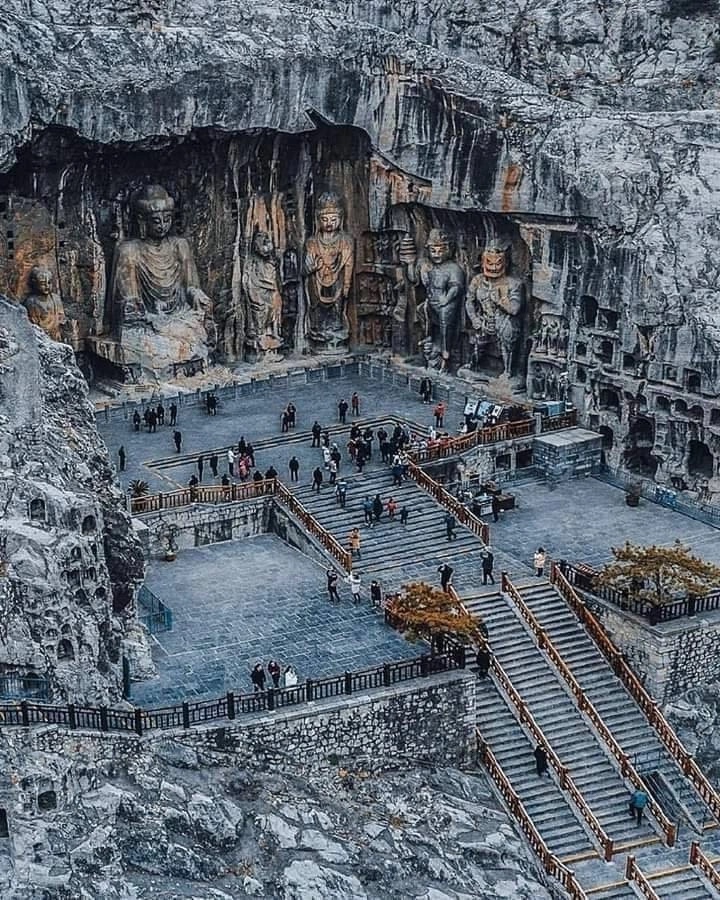
Longmen Caves – (龍門 石窟) Henan, China

The Longmen caves (in Chinese: 龍門 石窟, which means “dragon door caves”) are a series of rock sanctuaries located in Henan province, China. These caves dot the Xiangshan and Longmenshan mountains, and represent one of the best examples of Chinese Buddhist art. The construction of the caves began in 493. The complex consists of 2,345 caves and over 100,000 statues of the Buddha and his disciples. There are also 2,800 inscriptions, 43 pagodas and different steles. Some of the caves date back to the Wei dynasty, but most of them were built at the behest of the Tang dynasty. In 2000 Longmen caves were included in the UNESCO World Heritage List.

Dambulla Cave Temple

Dambulla cave temple, also known as the Golden Temple of Dambulla is a World Heritage Site in Sri Lanka. Dambulla is the largest and best-preserved cave temple complex in Sri Lanka. Major attractions are spread over five caves, which contain statues and paintings. These paintings and statues are related to Gautama Buddha and his life. There are a total of 153 Buddha statues, three statues of Sri Lankan kings and four statues of gods and goddesses. The latter include Vishnu and the Ganesha. The murals cover an area of 2,100 square metres (23,000 sq ft). Depictions on the walls of the caves include the temptation by the demon Mara, and Buddha’s first sermon.

The temple is composed of five caves of varying size and magnificence. The caves, built at the base of a 150m high rock during the Anuradhapura (1st century BC to 993 AD) and Polonnaruwa times (1073 to 1250), are by far the most impressive of the many cave temples found in Sri Lanka. Access is along the gentle slope of the Dambulla Rock, offering a panoramic view of the surrounding flat lands, which includes the rock fortress Sigiriya, 19 km away. Hindu deities are also represented here, as are the kings Valagamba and Nissankamalla, and Ananda – the Buddha’s most devoted disciple.

#GoldenTempleOfDambulla #Buddhism #SriLanka

The Five Giant Buddha’s of Asia

Spring Temple Buddha

Mount Yao, Henan, China

Built: 2008

Height: 420 feet

Total height: 502 feet

The copper Spring Temple Buddha stands on a 66-foot lotus throne, which itself is on an 82-foot pedestal. Visitors are welcome to hug the statue’s toes, which are all taller than your standard adult human.

Laykyun Sekkya

Khatakan Taaung, Myanmar

Built: 2008

Height: 381 feet

Total height: 427 feet

Laykyun Sekkya’s golden-robed Buddha took 12 years to build. It stands on a 44-foot throne, behind a reclining Buddha that’s equally huge and equally golden. Both statues gaze toward the gilded stupa of the Aung Sakkya Pagoda.

Ushiku Daibutsu

Ushiku, Japan

Built: 1993

Height: 393 feet

Total height: 394 feet

Standing on a lotus throne atop a pedestal, the Ushiku Daibutsu is a bronze standing Buddha with a four-level museum inside. New Age music, low lighting, and incense induce a state of calm on your way up to the observation deck, located in the Buddha’s chest, and with observation windows built into its chest.

The Great Buddha of Thailand

Ang Thong, Thailand

Built: 2008

Total Height: 302 feet

Thailand’s golden seated Great Buddha, the tallest in the country and 18 years in the making, was built on top of a single-story museum. It’s made of cement, with a layer of gold painted on top. Stop by the temple’s Buddhist hell garden to see sculpted sinners being sawn in half or forced through a meat grinder.

Leshan Giant Buddha

Sichuan, China

Built: 803 CE

Height: 223 feet

Total height: 233 feet

The Leshan Giant Buddha is carved out of a stone cliff on a tributary of the Yangtze River. Created in the Tang dynasty (7th–10th century), it is the tallest pre-modern statue on Earth.

The Two Great Seeds

The Two Great Seeds

*** This writing comes after a two hour meditation on the trinity of Prajna (Sanskrit) which means wisdom, Shila (Sanskrit) which means morality, and Samadhi (Sanskrit) which means mental discipline or concentration. This is the path that has opened up in my life through deep consideration, meditation and internal debate. This in no way is supposed to be a critique of your personal beliefs or faith, although I am sure some will take it that way. I hope you’ll understand if you read it fully with an open heart that I mean no disrespect only an expression of my journey. ***

I am not vain enough to claim there is one way to truth, but this is a record of my intimate experience. Each of us is born with two great seeds: the seed of spiritual contemplation and the seed of doubt. Which of these, if either, takes root determines the path, the trajectory of your spiritual path. I was born into a Christian family, mostly Presbyterian and for many years, as with most people, all my answers were written in the text I was raised with though as with most I never read it cover to cover. The turning point where the seed of doubt overwhelmed me was when I was sixteen, the year of my great trauma. The details of that trauma do not matter, what matters is the seed of spiritual contemplation took root at that moment.

I took the challenge of reading the Bible cover to cover for the first of four times in my life in search of an intimate truth, in search of the answers only my heart could question, questions I couldn’t fathom asking out loud. The solace I sought was not to be forthcoming, instead more questions were germinated in my heart. I did not have the words to put it in at the time, but I had already given up on the notion of moral relativism that is so prevalent to this day especially in academic circles and liberalism. For example ethnic cleansing, genocide, infanticide, filicide, etc. are always on the wrong side of morality. Always. What I found reading the Bible was a God that embraced all those things.

I was living in a spiritual void, if I could not believe in the faith of my fathers where did I have to turn? For several years I embraced the quote, “Philosophy is questions that may never be answered. Religion is answers that may never be questioned.” Logically I started in the Western tradition with Socrates and Plato. I devoured them reading them much too fast for their arguments fully to be realized. Through my high school years I systematically worked my way through to Nietzsche and Marx. While there were concepts I could incorporate into my own life, there was not a philosophical system that answered all the questions which plagued my heart.

Beginning my freshman year in college I decided to slowly expand my search to other religious traditions. I had taken a class on Indian Philosophy my first semester and the obvious became clear I had ignored the eastern traditions. I recognized the serenity my Christian friends found in their faith. I felt I owed the faith of my fathers one more investigation again reading the Bible cover to cover, medieval commentaries such as those of the Christian mystics such as Saint Catherine of Siena, Hildegard von Bingen, St. Teresa of Avila, etc. I was finally able to vocalize my question that could not be answered, what is the meaning of our existence? Is it to simply move from one pleasure to the next: birth, food, wealth, sex, marriage, family, etc.?

The answers I sought must be elsewhere, after all I was not the first to ask these questions. I burned through the Talmud, the Koran, the Vedic religions of India, the Bhagavad-Gita, Hinduism, and finally to Buddhism. Here I found a man 2500 years ago asking the exact same questions that plagued me. It brought me back to the central crux I have of all faiths, oral tradition. The Buddha was not written about for nearly the first 500 years after his death. The gospels of Jesus some 70, 80, or 90 years after the death of Jesus. Our human history is dotted with sages who after their passing go through the process of their lives becoming legend, then, myth, and finally faith inflating their words and deeds. We don’t need to go back to the time of Jesus or the Buddha to see this in action we can look at the case of Mother Teresa. To become a catholic saint you must perform two miracles, her first was to cure a Bengali woman of a stomach tumor when she gazed at a picture of Mother Teresa. This miracle has come under great scrutiny as doctors have come forward who treated her and claim that it was not a tumor at all, but a cyst that was cured through a drug treatment she underwent. For most this first miracle is already legendary and not questioned and the further we pass from the actual events the more legendary it will become. Had her canonization not been expedited, a process which on average takes 181 years, who knows what evidence would have come forward. My intent is not to denigrate Mother Teresa, but to illustrate the legend to myth to faith process occurs to this very day.

My introduction to Buddhism came through reading “Zen Mind, Beginners Mind.” It spoke to me in ways that no other tradition had in the past. The answers were not outward in some ancient text, but could only be realized by turning inward. There are innumerable Buddhist texts to help you along your path, point you in the right direction. Two new questions plagued me could I believe in the concepts of rebirth and karma that are so integrated into Buddhist tradition? Could I believe in an orthodoxy of one of the Buddhist traditions steeped in ritual, legend, myth, and faith. Did the Buddha really live? It was the same question I had about Christianity and Jesus. The answer I came to in meditation that unlike Christianity it did not matter. Christianity falls apart without the actual act of Jesus dying for your sins, but the Buddha whether simply legend or real man it does not matter. The Buddha showed the path to enlightenment, to the answer to the question that had plagued me since I was a teenager, was this all there is to life.

I needed guidance of some sort in my spiritual awakening and living in Montana at the time there were not a lot of options. I desired a teacher to posit my questions to, to guide me right when I was veering left. I found my teacher in modern texts of the Zen masters, YouTube, audio books, etc. I was embarking on what I term DIY Zen Buddhism. It was not the choice I wanted to make, it was the option that was forced upon me. I still very much rely on DIY Zen Buddhism, although I have had several teachers from such places as Seattle, Paris, and Jacksonville Florida as I’ve moved around. Over the years I have practiced both Soto and Rinzai Zen. Am I any closer to enlightenment than I was when I was sixteen and only knew of Buddhism by name I’m not sure. I do know I see the compassion and comfort in the answers to their spiritual contemplation in the dharma talks and writings of Thich Nhat Hanh, John Daido Loori, and other Zen practitioners. The questions still plague me and the seed of doubt is strong in the notions of rebirth and karma. I do not know if I will ever be completely satisfied with my spiritual contemplation. I know that in my life I have learned deeply from asking the same questions a simple man asked 2500 years ago. He found comfort in the answers he discovered and it is my hope to eventually do the same. I find more comfort in the life of a mere human than I have been able to find in the dictates of the innumerable gods humans have worshipped throughout our history.

Mindfulness Training

Other than meditation how should I practice mindfulness?

 Walking Practice

  • “Kinhin” is Sanskrit
  • Slowly walk, a step on a three count
  • “Walking not in order to arrive, but just to walk.”

~ Thich Nhat Hanh

Chanting

  • Mantras or whole Sutras are chanted
    • Attunes the mind and body

 Bowing

  • Expression of respect or veneration
  • Greeting, thank you, or to take leave
    • Palm-to-palm, slight bow from the waist
  • Gratitude
    • Bow at waist, drop to knees, forehead to floor
  • Prostrations
    • Full Body Bow
      • “The act of unself-conscious prostration before a Buddha is … possible under the impetus of reverence and gratitude. Such “horizontalizings of the mast of ego”cleanse the heart-mind, rendering it flexible and expansive, and open the way to an understanding and appreciation of the exalted mind and manifold virtues of the Buddha and patriarchs. So there arises within us a desire to express our gratitude and show our respect before their personalized forms through appropriate ritual” 

                        ~ Phillip Kapleau

Zen Practices of Mindfulness:

  • Akido A dynamic defensive activity involving body movement and sparrinh with a short staff or sword.
  • Brush Painting The fully engaged process of tapping and releasing energy to create an especially powerful composition.
  • Haiku A seventeen-syllable poem (3 lines of 5-7-5) capturing the essence of a subject.
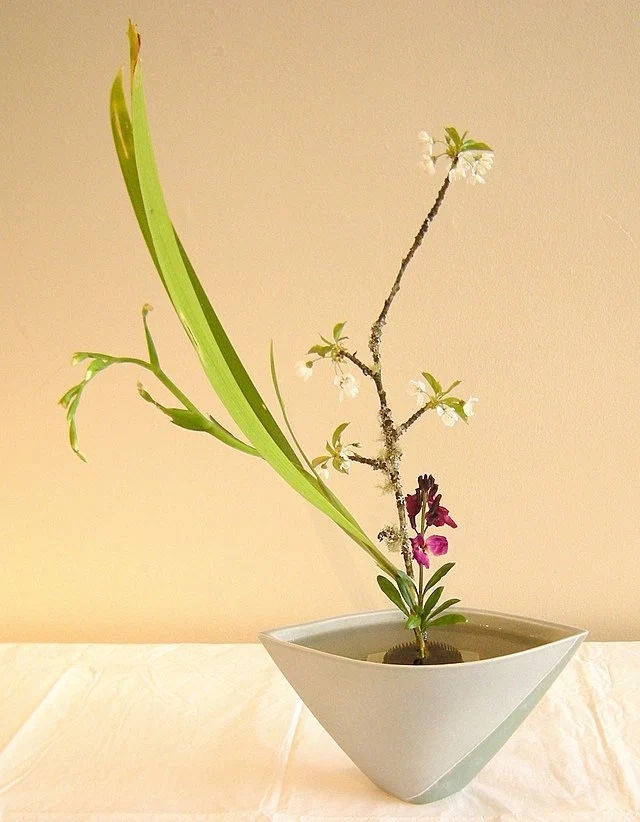
  • Ikebana The arrangement of flowers in a spiritually and aesthetically satisfying manner.
  • Karate A weaponless form of self-defense aimed at disarming an opponent or rendering his hostile motions harmless.
  • Kyudo A form of archery combining spiritual and physical training.
  • No Drama A style of theatre aimed at the direct communication of experience and emotion.
  • Pottery Making An approach to making pottery that conveys special respect for the materials and process.
  • Shakuhaci The playing of a bamboo flute in harmony with the breath and the emotional force moving the breath.
  • Tea Ceremony An especially graceful and aware preparation of tea and management of the tea-partaking interchange between host and guest.
  • Zen Gardening A meditative approach to creating, tending, and enjoying a garden.