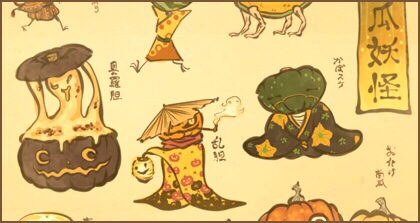
Tōfu kozō (豆腐小僧 / とうふこぞう)

Translation: little tofu boy
Habitat: urban areas
Diet: omnivorous; loves tofu

Appearance: Tōfu kozō are small yokai who closely resemble human children except for their large heads and clawed fingers and toes. They wear little boys’ kimonos and wide-brimmed hats — the typical outfit of a tōfu-selling young boy of the Edo period. They are usually depicted with two eyes, but in some illustrations they appear as having only one eye. They are usually found in urban areas in close proximity to people.

Behavior: Tōfu kozō are timid and weak yokai, and are not known to be aggressive towards humans. On rare occasions, a tōfu kozō may follow a human home on a rainy night, but for the most part they shy away from any confrontation.

Interactions: Tōfu kozō are first and foremost servant yokai. Even among other yokai, they are often bullied and teased for their lack of strength. They get no respect from those above them; at most, they act as menial servants to more powerful yokai.

Origin: Prior to the Edo period there are no known stories about tōfu kozō, and so their origin is a mystery. Some say that they are just one of many forms taken by an itachi, a shape-shifting weasel yokai. Others say that they are the offspring of a mikoshi-nyūdō and a rokuro-kubi. Another possibility is that they are an invention of a creative artist looking to sell illustrated storybooks. Stories of tōfu kozō first appeared in the penny-novels and pulp fiction of Edo in the 1770’s, and became incredibly popular among the Edo upper class. These silly stories helped to spawn the explosion of yokai-related fiction that appeared in the later half of the 18th century.

Tōfu kozō bears a very strong resemblance to another yokai called hitotsume kozō — the chief difference being that hitotsume kozō has only one eye and a very large tongue, while tōfu kozō has two eyes and carries a plate of tofu. Both of these yokai are somewhat weak, child-like creatures who act as messengers to more powerful monsters. In some literature the two yokai are used interchangeably for each other, therefore it has been suggested that tōfu kozō may be closely related to, or may even have been copied from hitotsume kozō. However, there is not enough evidence either way to say where this yokai comes from.

Shoki (鍾馗 or しょうき)

Appearance: Shōki (also known by the Chinese rendering of his name, Zhong Kui) is a legendary hero and deity from ancient China. He is ugly, with a large, hulking body, a long, flowing beard, and fearsome, piercing eyes. He is usually shown carrying a sword and wearing a court official’s cap. Shōki is known as “the demon queller” for his ability to vanquish, exorcise, and even control oni and other demons. He is so feared by oni that even his image is said to scare them away. The demons he defeats sometimes become his servants. It is said that he commands 80,000 demons.

Origin: Shōki originated in ancient China during the 700’s. His story reached Japan by the late Heian period, and his popularity reached its height during the Edo period. Paintings and statues of him are still used as a good luck charms. His image appears on flags, folding screens, and hanging scrolls. Small statues of him can sometimes be seen on the roofs of older houses in Kyoto as well. Shōki is strongly associated with Boys’ Day, a holiday in May. He is revered as a god of protection from demons and sickness (particularly smallpox, which was believed to be spread by evil spirits), and also as a god of scholarship.

Legends: Shōki lived in Shanxi Province in China during the Tang dynasty. His life’s goal was to become a physician in the court of Emperor Xuanzong. Shōki was a smart and diligent student. He trained hard and passed all of the exams to become a physician. He placed first out of all of the applicants and should have easily received the position. However, Shōki was a very ugly man. When the emperor saw his face, he immediately rejected Shōki’s application even though he was the most qualified for the job.

Shōki was devastated. His dreams shattered, he committed suicide on the steps of the imperial palace. The emperor was moved by Shōki’s dedication. He felt great regret for denying the application of such a talented and brilliant man on account of his looks. The emperor ordered that Shōki should receive a state burial of the highest rank—usually only reserved for royalty—and posthumously awarded him the title “Doctor of Zhongnanshan.”

Years later, the emperor became gravely ill. Delirious with fever, he dreamed that he saw two oni. The larger one was wearing the clothing of a court official. It grabbed the smaller oni, killed it, and ate it. Then, it turned to the emperor and introduced itself as Shōki. He vowed to protect the emperor from evil. When the emperor woke up, his fever was gone.

Xuanzong commissioned the court painter to make an painting of Shōki based on his dream. Shōki became a popular deity across China (and later, Japan). He was revered as a god of scholarship for his great devotion to his studies, and as a protector against disease and evil spirits.

Myōbu (命婦 / みょうぶ)

Myōbu (命婦 / みょうぶ)
Translation: a high ranking title for court ladies
Alternate names: byakko (white fox)
Habitat: shrines and places sacred to Inari
Diet: carnivorous

Appearance: Myōbu are celestial fox spirits with white fur and full, fluffy tails. They are holy creatures, and bring happiness and blessings to those around them.

Myōbu statues are most often found at Inari* shrines, taking the place of the koma inu which adorn other shrines. These foxes act as both guardians and symbols of good luck and blessing. People often leave offerings of holy sake, sekihan (red rice and red beans), inarizushi, and fried tofu at these shrines. These foods are all said to be foxes’ favorites.

Origin: Foxes were considered holy animals since long before recorded history began in Japan. The farmers of ancient Japan revered foxes, which preyed on the mice and rats which destroy crops. Foxes have long been associated with Inari, the god of the harvest. Inari is said to use foxes as servants and messengers, and the majority of the foxes in his employ are the holy, white-furred kind known as myōbu.

Myōbu statues are commonly found at Inari shrines. They often carry sacred objects in their mouths, such as the round jewel often carried by koma inu in other shrines. Myōbu can also be seen carrying spiral keys, sheaves of grain, and scrolls. These all carry special significance in Inari worship. The round jewel represents both the soul of Inari, and its form is a symbol of a grain storehouse. The spiral key is an archaic design of the keys used with traditional farm warehouses. The key represents the desire to unlock the storehouse; i.e. soul of Inari. The sheaves of grain represent the five grains (wheat, rice, beans, awa millet, and kibi millet) which are important in East Asian traditions. Finally, the scroll represents knowledge and wisdom.

* Inari (稲荷) is the Japanese kami of prosperity, rice, and tea, and protector of foxes. A complex deity widely worshiped throughout Japan, Inari is variously portrayed as male, female and androgynous.

Makuwauri No Bakemono (真桑瓜の化物 or まくわうりのばけもの)

Translation: oriental melon monster

Appearance: Makuwauri no bakemono is a bizarre and mysterious yokai found in the Buson yōkai emaki. It looks like an oriental melon (Cucumis melo) with the body of a samurai sprouting from it.

Origin: Buson yōkai emaki is a famous yōkai picture scroll painted by Yosa Buson, a poet and artist who lived from 1716 to 1784. He is considered one of the greatest poets of the Edo Period. In the 1750’s, while studying painting at Kenshōji in Miyazu, Kyōto, Buson painted a scroll containing eight graffiti-like doodles of bizarre yōkai. His doodles are presented as pictures with names and no stories, so the true origin of these yōkai remains a mystery. They are believed to be based upon local legends that Buson picked during on his travels.

The illustration of this yōkai in Buson’s painting notes that it comes from the river ferry in what is today Yamashiro village in Kizugawa City, Kyōto. Whatever specific connection this yōkai had with the area is unfortunately lost. The region was historically famous for it’s melons, so it is only natural that it may have had melon yōkai as well.

Koto Furunushi (琴古主 or ことふるぬし)

Translation: old koto master

Appearance: The Koto furunushi looks like a koto—a long, harp-like instrument that is the national instrument of Japan—transformed into a wild beast.

Behavior: A koto which was once played frequently but later forgotten about and stored away can transform into the koto furunushi. These yōkai may look like wild beasts, but they remember every song that was ever played on them. Koto furunushi play when no one is around, causing everyone to wonder where the music is coming from. They prefer to play old, forgotten tunes that have fallen out of style and vanished from people’s memory.

Kappa (河童 / かっぱ)

Kappa (河童 / かっぱ)

Translation: river child

Habitat: rivers, lakes, ponds, waterways, cisterns, wells; found throughout Japan

Diet: omnivorous; prefers cucumbers and human entrails

Distinctive Features: Beak-like mouth; Tortoise-like shell on back; Frog-like, removable skin; Water-filled depression on top of head; Three anuses and strong “fishy” odor”

Details: Kappa are aquatic, reptilian humanoids who inhabit the rivers and streams flowing over Japan. They are at home in the water, thriving during the warm months. Kappa are the size and shape of a human child. Kappa bodies are built for swimming; they have webbed, thumbless hands and feet, a turtle-like beak and shell, and an elastic, waterproof skin that reeks of fish and is said to be removable.

Other inhuman traits include three anuses that allow them to pass three times as much gas as humans, and forearms attached to one another inside of their shells—pulling on one arm lengthens it while the other arm contracts. Their most distinguishing characteristic is a dish-like depression that lies on top of their skulls. This dish is the source of a kappa’s power and must be kept filled with water at all times. Should the water be spilled and the dish dry up, the kappa will be unable to move. It may even die.

While younger kappa are frequently found in family groups, adult kappa live solitary lives. It is common for kappa to befriend other yōkai and sometimes even people. Possessed of a keen intelligence, kappa are one of the few yōkai able to learn human languages. They are highly knowledgeable about medicine and the art of setting bones. According to legend, friendly kappa taught these skills to humans. For fun, they love causing mischief, practicing martial arts like sumo wrestling, and playing games of skill. Kappa are proud and stubborn, but also fiercely honorable; they never break a promise. Kappa will eat almost anything, but they are particularly fond of two foods: cucumbers and raw innards—particularly human anuses.

Kappa are revered in Shinto as a kind of water god. It is not uncommon to see offerings of cucumbers made at riverbanks by humans. In return, kappa help people by irrigating fields, befriending lonely children, or competing with adults in sports and games.

Kappa can also be crass and dangerous. Lakes and rivers where they live are often marked with warning signs. Kappa particularly despise cows and horses, and will attack the animals for no reason. A kappa’s preferred method of attack is to drown its victims, or bite them to death under water. Kappa also devour humans alive. Usually they go for the rear end to get at the shirikodama, a mythical ball of flesh located just inside the anus.

Kappa Cuisine: The popular sushi dish kappa maki (cucumber roll) takes its name from this yōkai.

Itsumade (以津真 / 天いつまで)

Translation: “until when?”
Alternate names: itsumaden
Diet: the lamentation of the dead

Appearance: Itsumade are kaichō, or strange birds. They have the face of a human with a pointed beak, and the body of a snake with wings, and terrible claws. Their wingspan is 4.8 meters.

Behavior: Itsumade appear in the night sky during times of trouble—such as plagues and disasters, or flying over battlegrounds where many have died. In particular, they fly over places where there is suffering or death, yet little has been done to alleviate the pain of the living or pacify the spirits of the dead. The strange birds fly about in circles all night long, crying out in a terrible voice.

Origin: Itsumade make their first recorded appearance in the Taiheiki, a fictional history of Japan written in the 14th century. According to the Taiheiki, a terrible plague spread during the fall of 1334. The suffering of the plague victims is what summoned the itsumade.

Itsumade’s name is not written in the Taiheiki; it was added later by Toriyama Sekien. He named this yōkai for its horrible cry of “Itsumademo?” which means, “Until when?” The birds appear to be asking those below how long will this suffering go unnoticed. It is thought that the spirits of the dead and suffering form into onryō which take the shape of these birds. They demand recognition of their suffering and torment.

Legends: One night during the fall of 1334, the itsumade suddenly appeared above the hall for state ceremonies, crying out, “Itsumademo? Itsumademo?” Panic erupted amongst the people of the capital. The same creature came back the next night, and every night thereafter. Finally, the imperial court decided that something had to be done. They recalled Minamoto no Yorimasa’s triumph against the nue many years earlier, and decided to summon the warrior Oki no Jirouzaemon Hiroari. Hiroari was an expert archer. He used a signal arrow that let off a loud whistle as it flew, and shot the monster out of the sky. Afterwards, Hiroari was given the name Mayumi, meaning true bow.

Mayumi Hiroari went on to become a famous warrior, and settled down in what is now Mayumi, Miyama City, Fukuoka Prefecture, where his grave still stands. The area was renamed in his honor after he died.

Hone Onna (骨女 or ほねおんな)

Translation: bone woman
Habitat: dark streets, alleys, graveyards
Diet: none; though has a large sexual appetite

Appearance: Not all who die turn into vengeful beings of grudge and jealousy. Hone onna retain an undying love that persists long after their flesh has rotted away. This allows them to continue to be with the object of their affection despite having died. These ghosts appear as they did in life—young, beautiful women in their prime. Only those unclouded by love or with strong religious faith are able to penetrate their disguise and see their true form: a rotting, fetid, skeletal corpse returned from the grave.

Interactions: At night, a hone onna rises from the grave and wanders to the house of her former lover. Her appearance shocks those who believed her to be dead. This shock quickly turns into a joy that blinds the hone onna’s lover to any clues that something might be wrong. Even the hone onna herself may not know of her condition. She is driven only by love. She exists as a ghost only to continue the love she had in life. The hone onna spends the night and leaves in the morning. This unholy coupling can continue for days, or even weeks, without being noticed. However, there is a price to be paid. Each night she drains some of her lover’s life force, and he grows ever sicker and weaker. Without intervention, he will eventually die, joining his lover forever in death’s embrace.

In most cases, a friend or a servant of her lover will see through the hone onna’s illusion and alert someone to her true identity. Though her human lover may be repulsed by her when the truth is revealed to him, the ghost may not realizes her condition and continue to visit every night. A home can be warded with prayers and magic charms against entry by ghosts, but they only work as long as the master of the house wills them to. As the hone onna’s body decays further, her enchanting allure only increases. Eventually most men succumb and let her into their homes one last time, sacrificing their own lives to the ghost of the woman they loved.

Legends: Perhaps the most famous hone onna is Otsuyu from Botan dōrō, or The Tale of the Peony Lantern. Botan dōrō was introduced to Japan in the 17th century from an old Chinese ghost story. Over the centuries, it has been adapted into puppet shows, kabuki plays, rakugo, and films, and remains an influential ghost story today.

Hiderigami (魃 or ひでりがみ)

Translation: drought spirit
Alternate names: batsu, kanbo (“drought mother”), shinchi
Habitat: mountains
Diet: moisture

Appearance: Hiderigami is a grotesque, hairy humanoid which stands between two and three feet tall. It has a single eye on the top of its head. It only has a single arm and a single leg, although it can run as fast as the wind. All hiderigami are female.

Behavior: Hiderigami are rarely encountered by humans. They live deep in the mountains and only rarely travel out into human-inhabited lands, but when they do their presence can be strongly felt over a wide area. A hiderigami’s body exerts such a strong heat that everywhere it goes the ground dries up, clouds fail to form, and rain cannot fall. Despite the incredible danger that they pose, it is said that throwing a hiderigami into a toilet will kill it.

Origin: Hiderigami originated in southern China, and come from a goddess. Their origin is recorded in some of the oldest ancient Chinese records. When the legendary Yellow Emperor of China fought the warlord Chi You, he summon a powerful goddess named Batsu to aid him in battle. Batsu contained an supernatural heat inside of her, and when she released her power, the battle was quickly and decisively won in the emperor’s favor; however, she had used so much of her power up that she was unable to return to Heaven or contain her heat. While Batsu was nearby, the waters all dried up and rain would not fall, and so her presence became a terrible problem for the emperor. Unable to kill her or to send her back to heaven, the emperor exiled the goddess to a far-away mountain and forbade her to return. Whether Batsu became the mother of the hiderigami or became corrupted and transformed into this yokai herself is unknown.

Hashihime (橋姫 / はしひめ)

Translation: lady of the bridge
Habitat: very old, very long bridges
Diet: none

Appearance: Hashihime are intensely jealous goddesses who inhabit bridges — in particular, very old and very long bridges. As goddesses, hashihime may take different forms depending on occasion, however they are commonly depicted wearing white robes, white face-paint, an iron trivet, and carrying five candles. This is a ceremonial outfit used to perform curses.

Interactions: Hashihime ferociously guard the bridges they inhabit. As with most gods connected to a location, they are very competitive and jealous. If one praises or speaks positively about another bridge while on top of a hashihime’s bridge, or if one recites lines from certain Noh plays that feature a woman’s wrath as the main theme, something terrible is likely to happen to that person.

Despite their fearsome nature, they are highly honored by the people who live nearby, and shrines are established in their honor near the bridges they inhabit. In times of war, residents will beseech their local hashihime to guard the bridge against invaders. In times of peace, hashihime are goddess of separation and severing, and are asked to aid people in things such as break-ups, divorce, and severing bad luck. So strong is their power of severing that it is considered taboo for lovers to pass in front of a hashihime shrine together, or for wedding processions to pass in front of one. If newlyweds need to cross a bridge inhabited by a hashihime, they will instead pass underneath it on a boat rather than risk cursing their marriage.

Surviving an Encounter: The Hashihime is particularly fond of targeting happy couples. If you encounter one, your only chance to avoid a painful death is to swear to break up with your significant other.

The Hashime Shrine: There is a shrine to the Hashihime in the city of Uji, which is often visited by those who wish to cut ties with someone in their lives.

The Hashime Library: Hashihime is the title of one of the chapters of the Tale of Genji, the world’s first novel, written circa the year 1000 by a courtesan named Murasaki Shikibu.

The most famous hashihime story comes from Tsurugi no Maki, in The Tale of the Heike, and is retold in the noh play Kanawa.

A woman visited the the Kifune-jinja in Kyoto at the hour of the ox (roughly 2 am), filled with rage and jealousy towards her ex-husband who had thrown her away for another woman. Night after night she visited the shrine, praying to the gods enshrined there to turn her into a powerful demon. The woman wanted nothing else other than to see her ex-husband destroyed, even at the cost of her own life. After seven nights of pilgrimage, her prayers were answered: the gods told her that if she immersed herself in the Uji river for twenty-one nights, she would become a living demon.

The woman did as she was bid. She donned a white robe and tied her hair up into five horns. She painted her face and covered her body in crimson dye. She placed an upturned trivet on her head and attached torches to each foot. She lit a torch on both ends and placed it in her mouth. She immersed herself in the Uji river and for twenty-one days she kindled the hatred in her heart. Then, just as the gods told her, after twenty-one days she transformed into a terrible kijo with supreme power. She had become the hashihime of Uji.

That night, her husband awoke from a horrible dream with a premonition of danger. He quickly sought out the famous onmyōji, Abe-no-Seimei. Seimei recognized the dream as a sign that the man’s former wife would come and destroy the couple that very night, and promised to save them. He went to their house, recited magical prayers, and crafted two katashiro — magical paper doll representations of the man and his wife, meant to be used as substitutionary targets for the kijo’s rage. That night, as Seimei had predicted, the demon appeared. She attacked the two katashiro instead of the real couple, and Seimei’s magic worked: her power was reflected back upon her and she was driven away. The demon woman, realizing that she could not overcome Abe-no-Seimei’s magic, vanished, threatening that she would come back another time.