Louisiana Code Noir

In 1741, four African slaves lived in the colony for every 1.2 free white. This imbalanced population combined with high mortality, the threat of conflict with Native Americans, shortages of food and goods, and isolation produced a colony in which African, French, and Spanish cultures blended to create a unique culture known as Creole. Because most of the Africans who first arrived in Louisiana were of one nation, the Bambara, they succeeded in preserving their language and culture and, through their solidarity, ultimately acted as an Africanizing influence on Louisiana. European colonists, aware of their precarious position in the colony, were inclined to work together with slaves and afford them some rights under the Code Noir.

While the system was certainly brutal for African slaves, the harsh conditions of life in Louisiana resulted in difficulties for all settlers. Since many of the colonists were themselves rejected by French society and forced into exile in Louisiana as criminals or debtors, historian Gwendolyn Midlo Hall states, “Africans arrived in an extremely fluid society where a socio-racial hierarchy was ill defined and hard to enforce.” Hall expertly sums up the situation in colonial Louisiana, “Desperation transcended race and even, to some extent, status, leading to cooperation among diverse peoples.” Though the arrival of Anglo-Americans with the Louisiana Purchase resulted in stricter laws governing slavery and narrower views in terms of race, Louisiana society would remain more diverse, fluid, and racially ambiguous than the other Southern slave states.

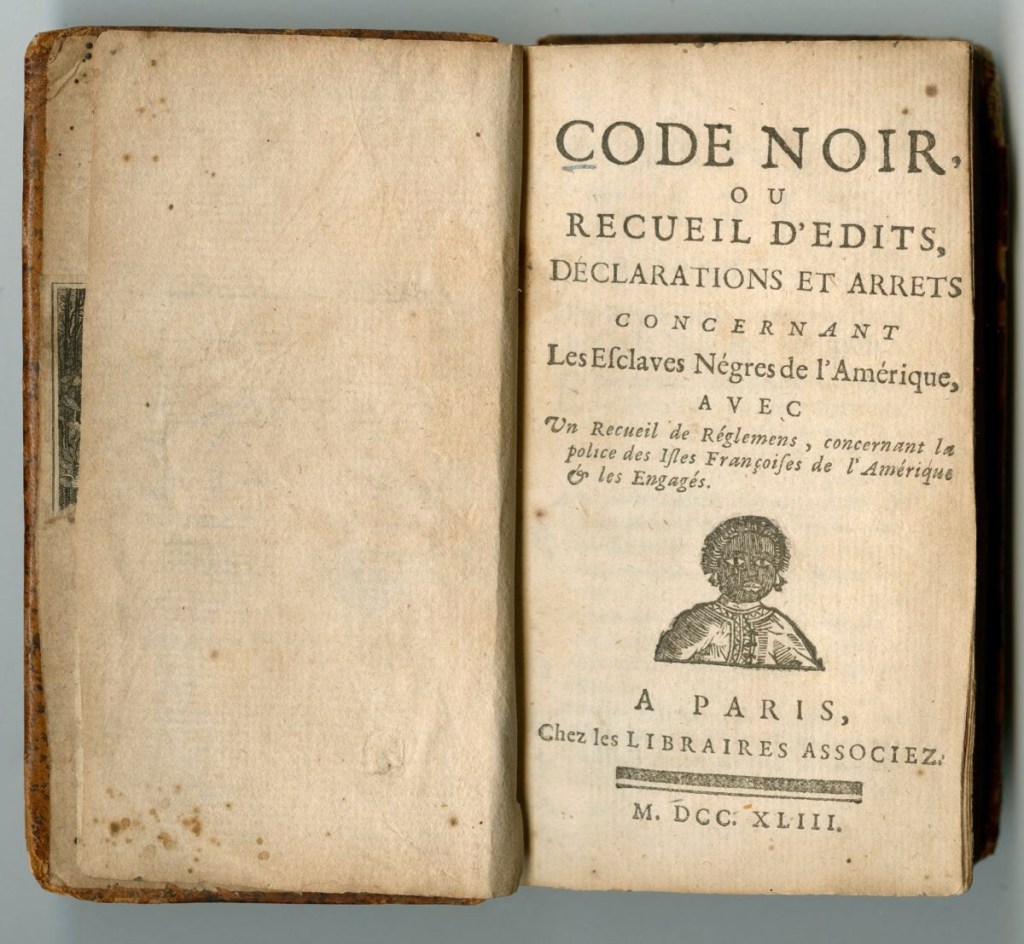
The Code Noir was established in 1724 to regulate slavery in colonial Louisiana. The Code Noir stated that slaves were to be instructed in the Catholic faith, given food and clothing allowances, and allowed to rest on Sundays and the right to petition a public prosecutor if they were mistreated. Also, young children had to be sold with their mothers. The Code Noir prohibited slaves from owning property or testify against whites.

Baron Samedi

Baron Samedi, “The Master of the dead” in Voodoo, occupies a popular place as the guardian of cemetries, and the spirit responsible for an individual’s transportation to the underworld. One of the more prevalent loas in Haitian voodoo is Baron Samedi. He fills a vital role in Haitian voodoo as the master of the dead, ushering the newly deceased into the afterlife. Who is Baron Samedi? In Haitian voodoo, Baron Samedi is the head of the Guede family of loa.

His name is often translated as Baron Saturday, Baron Samdi, Bawon Samedi, or Bawon Sanmdi. The last name of Saturday comes from the French translation of Samedi. Baron leads the Guede family, a group of loas with strong links to magic, ancestor worship, and death. The loas in the family consist primarily of lesser spirits, dress the same as Baron, have rude (even crude) attitudes, but lack the charm of their master. Baron is portrayed in Haitian voodoo wearing a top hat, black tuxedo, dark glasses, and cotton plugs in his nostrils. His image is often said to resemble that of a corpse that has been dressed and prepared for burial in traditional, Haitian manner. His face is said to resemble a skull, and he uses a nasal voice.

Baron spends the majority of his time in the invisible realm of Haitian voodoo spirits. His behaviour is described as outrageous. He is known to spend his time drinking rum and smoking cigars, swearing profusely, and making filthy jokes to the other loas. The other spirits in the Guede family are said to behave in the same manner, without the suave ability of Baron Samedi.

The Baron needs that suave nature because he is believed to chase mortal women, despite being married to the loa, Maman Brigitte. Baron’s time is spent lingering at the crossroads of life and death in the human world. When someone dies, Baron is said to dig their grave and meet their soul as it rises from the grave. He guides them into the underworld. Only Baron Samedi has the power to accept an individual into the world of the dead.

It is also said that Baron ensures that all those who have died rot in the ground as they should, ensuring that no soul can come back as a brainless zombie. He will demand payment for this act, which varies depending upon his mood at the time. On many occasions, he is content to accept gifts of cigars, rum, black coffee, or grilled peanuts.

The Originals (2013-2018)

The Originals is the first spin-off from the supernatural drama The Vampire Diaries, and it further expands the universe by providing a rich background story to many of the characters first met in the parent series.

In particular, we learn more about Klaus Mikaelson and his family, the first vampires to ever exist.

Their story unfolds in the French Quarter of New Orleans, a neighborhood they built and once ruled over but has since been taken over by Klaus’ own protege, Marcel.

Klaus is determined to regain control, but must also fight to keep his daughter safe from external threats against his family and the entire supernatural world.

American Horror Story: Coven (2013-2014)

In a city with a culture rich with ties to the occult, it’s no surprise that there’s a TV series about witches.

From Ryan Murphy’s renowned American Horror Story franchise is its third season subtitled Coven, which follows a secret institution of young witches who are descendants of those persecuted during the Salem witch trials in the late 1600s.

The girls are learning to harness and strengthen their powers at a boarding school run by witch Cordelia Foxx.

However, that also means they’re all contending to become the next Supreme, the most powerful witch, while battling external threats from voodoo practitioners as well as interior threats.

Treme (2010-2013)

Hurricane Katrina was identified as a Category 3 hurricane by the time it made landfall in Louisiana on August 29, 2005. The resulting damage on the state was devastating, particularly in New Orleans where floods swept the entire city.

HBO’s drama series Treme takes place in the aftermath of the disaster, in a neighborhood called Treme (based on the real-life neighborhood of the same name).

Having suffered their own tragedies brought on by Katrina, the residents of Treme strive to rebuild not just their homes but their entire lives.

As survivors, it seems more important now than ever to uphold the music and culture that gives their community its unique identity.

Hoodoo in Savannah

The Geechee culture is a remnant from what was once a society of black slaves. The area they call home stretches from Savannah southward to an area just below the Ogeechee River, from which they draw their name. Often times this culture is mistakenly called ‘Gullah’, but in actuality the Gullah people exist in an area to the north of Savannah, between Daufuskie Island and Charleston, South Carolina. The two peoples are similar, but not interchangeable: both are rooted in slavery, but the Geechee people have a history and tradition all their own.

Freed after the Civil War, these Island people would often group near the coast where both fishing and farming was plentiful. The community developed their own dialect. In addition to what amounted to their own language (also called ‘Geechee’), this culture also had an elaborate belief system through their African descent. These beliefs are centered on a deep spirituality, believing in both ghosts and in a type of magic cast by charms, potions and amulets.

This magical ability to cast spells is called ‘conjuring’, or ‘casting roots’. A magic spell itself is called a ‘conjure’. The spell is often cast by burying a bag or bundle on the property of the unsuspecting victim. There are also ways of conjuring involving secret potions to drink, powders, nail clippings, and that most powerful of talismans—graveyard dirt. Someone skilled in the art of casting spells is called a root doctor, or a witch doctor. They can be employed if you feel that magic is being used against you.

A witch doctor is very different from a witch, which is often called a ‘boo-hag’. Not to be confused with the Hollywood version, witches in this tradition look no different from regular people. Witches are more akin to vampires, because the belief is that they steal the breath and life-force or essence of the victim. To have your essence stolen by a witch is known as ‘being rid’ or ‘ridden’. If someone looks poor or sickly, the assumption is that a boo-hag stole that person’s energy in the middle of the night; they are being “rid by a witch.”

Voodoo Hoodoo in New Orleans

The term Voodoo hoodoo is commonly used by Louisiana locals to describe our unique brand of New Orleans Creole Voodoo. It refers to a blending of religious and magickal elements. Voodoo is widely believed by those outside of the New Orleans Voodoo tradition to be separate from hoodoo magick. However, the separation of religion from magick did not occur in New Orleans as it did in other areas of the country. The magick is part of the religion; the charms are medicine and spiritual tools that hold the inherent healing mechanisms of the traditional religion and culture. Voodoo in New Orleans is a way of life for those who believe.

Still, there are those who separate Voodoo and hoodoo. Some hoodoo practitioners integrate elements of Voodoo, and some do not. Some incorporate elements of Catholicism or other Christian religious thought into their practice, while others do not. How much of the original religion a person decides to believe in and practice is left up to the individual. Some people don’t consider what they do religion at all, preferring to call it a spiritual tradition or African American folk magic. The term Voodoo hoodoo is in reference to the blend of the two aspects of the original religion as found in New Orleans Voodoo and as a way of life. A fellow New Orleans native and contemporary gris gris man Dr. John explains it this way:

In New Orleans, in religion, as in food or race or music, you can’t separate nothing from nothing. Everything mingles each into the other—Catholic saint worship with gris gris spirits, evangelical tent meetings with spiritual church ceremonies—until nothing is purely itself but becomes part of one fonky gumbo. That is why it is important to understand that in New Orleans the idea of Voodoo—or as we call it gris gris—is less a distinct religion than a way of life.

~ Dr. John

Source: The Voodoo Hoodoo Spellbook

Mount Vernon: 16 Sided Barn

One of George Washington’s masterful farming innovations was a 16-sided barn designed for treading wheat—his most important cash crop. Traditionally, wheat was threshed by hand, a slow and arduous process of beating the wheat to break the grain out of the straw. Sometimes horses treaded wheat by trampling it on the ground, but that practice was unsanitary and exposed the grain to weather. Washington decided to move the threshing process indoors and in 1793 built a barn for this purpose. It was completed two years later. Horses trotted in a circle on the second floor, treading on grain that then fell to the first floor through narrow gaps in the flooring. Although Washington was in Philadelphia serving as president while the barn was under construction, he supervised the work from afar. He even calculated (correctly) that the number of bricks needed to complete the first floor would be 30,820.

The barn at the Farm site is an exact replica of the original, based on careful examination of Washington’s drawings and plans from the 1790s as well as on a mid-19th-century photograph showing the barn in a semi-ruined state.

Mount Vernon: Study

After George Washington’s return to Mount Vernon at the end of the Revolutionary War in 1783, the Study became his retreat from ever-present family and visitors; a place where he could quietly and privately tend to business. Reportedly, no one was allowed in this room without Washington’s invitation. From here, he directed the management of his Estate, receiving reports from overseers, making daily diary entries, and posting his accounts.

The Study was also where Washington bathed, dressed, and kept his clothes. Each morning, he rose between 4 and 5 am and went to the study, using the private staircase that led down from the bedchamber. According to the recollections of his step-grandson George Washington (Washy) Parke Custis, he lit his own fire and dressed himself. Washington used this quiet time to write letters or review reports until breakfast at 7 am, after which he usually rode out to his farms. In the evening, unless he had a social obligation or lingered talking to visitors after dinner, he returned here to read or confer with his secretary until around 9 pm, when he went to bed.

In this room you will find a fan chair similar to Washington’s, which helped him to stay cool on hot summer’s days; Washington’s chair that he used as President, a portrait of Lawrence Washington, bookcases, a secretary, and other artifacts from Washington’s life.

Mount Vernon: Piazza

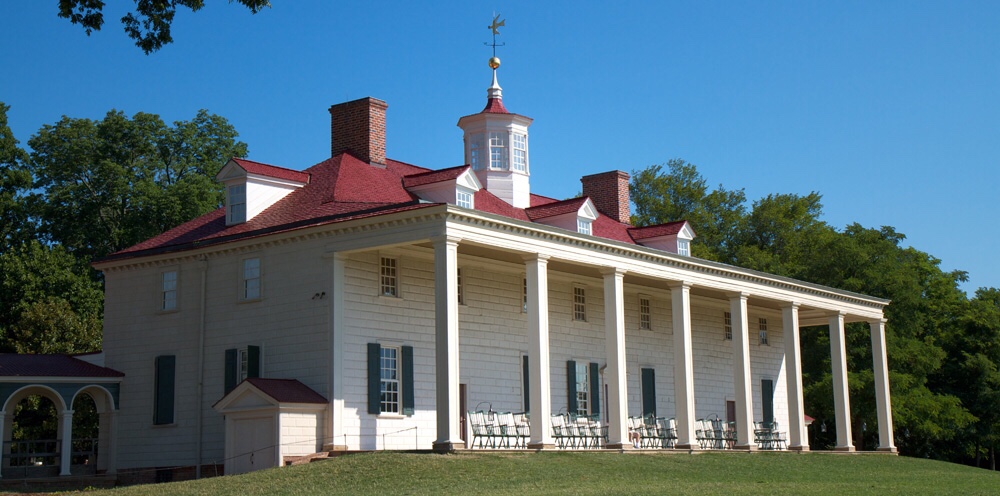
The two-story piazza is the Mansion’s most distinctive architectural feature. Extending the full length of the back of the house, it also has a practical function—catching the river breezes on a hot and humid Virginia day. The Washingtons treated the piazza as an outdoor room, serving afternoon tea here to visitors and family members seated in simple Windsor chairs.

From the piazza, visitors observe a thickly wooded area which was an 18-acre deer park, a common feature on large estates of that time. Washington stocked his with tame deer from nearby and from England for the delight of family and visitors. The trees between the Mansion and the river were carefully pruned to emphasize the view of the Potomac, creating a so-called “hanging wood.”