Faun

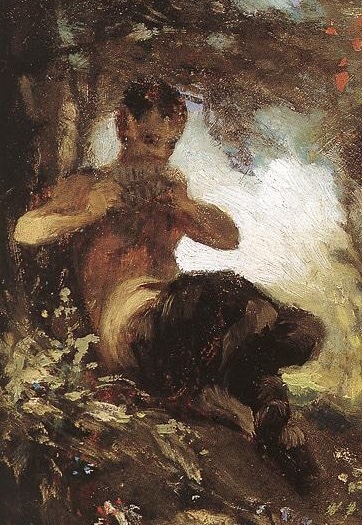
Fauns are mythical creatures with both human and goat features. They are notorious for their love of the forest, music, and beautiful women, and they are generally charming to the people they encounter as they trot along their happy, woodland paths.

Fauns are a peculiar, chimeric race: half goat, half human. With horns, hairy legs, hooves, and a twitchy tail, they might not sound like the loveliest characters, but they have their own undeniable charm. You can’t help but love their faces, which combine pointy ears and a head full of woolly curls with youthful features, sparkling eyes, and a roguish smile.

Above the waist, these woodland creatures have handsome male bodies with lithe limbs. Below the waist, they have two goat legs, which make them extremely nimble dancers. While they’re not especially fond of clothing, they like to adorn themselves with crowns of leaves and berries from their woodland home, especially before one of their legendary parties.

Fauns are merry creatures, and they have a talent for brightening the hearts of others. If you are waylaid by a group of them, you can be sure that you’re not going to get away any time soon. The little creatures will lure you into their festivities with their dancing, jokes, and delicious food.

Of course, they are best known for their flute playing. With just a small, wooden flute, they can hypnotize you with fantastic melodies. Hardly anyone can resist a Faun with a flute, and in truth, the power of their flutes has led some of them to act up, luring travelers into the forest, where they get lost, or stealing the hearts of beautiful maidens away from the rest of the world.

In Greek culture, Fauns are associated with Pan, the god of shepherds, mountain wilds, meadowlands, wooded groves, fertility, and rustic music. They join Pan in his merrymaking and act as his servants when he needs aid. In return, Pan has gifted them with his trademark musical instrument, the pan-flute. Like many Greek gods, Pan was eventually handed down into Roman culture under a new name, Faunus. His troop of Fauns made this transition with him.

Fauns and satyrs are commonly confused because they have some striking similarities in appearance and personality. However, they are separate creatures. Satyrs are followers of Dionysus, the god of harvest, wine-making, and ecstasy. Like Fauns, they love music, women, and parties, but they are far less innocent than their light-hearted cousins. Satyrs are crafty creatures, and they can be downright destructive when they are bent on enjoying themselves, no matter the cost. They are also less physically charming than their woodland cousins. Their faces are less human, and their lower bodies are mightier, more like a horse or a donkey than a harmless, furry goat.

Fauns were popular characters in both Greek and Roman mythology. They are mentioned in ancient texts that describe the gods’ grandest parties, and they are frequently written into the entourage of lovers who pursue nymphs. For example, they follow in the march of Bacchus, a half-god who wandered the earth teaching men how to cultivate vineyards before making a glorious march home to Greece, and in the myth of Vertumnus and Pomona, they are competitors against Vertumnus for the beautiful Pomona’s heart.

During the Hellenistic period, the mythical revelers became popular models for statues. In some of these statues, they were portrayed without any goat-like features, appearing as soft, romantic young men with flutes or beautiful women. The most famous of these statues is the Barberini Faun, which shows a young, handsome man exhausted after a long party.

Fauns were revitalized during the Romantic period, when fairytales gained wild popularity. They were separated from the old Gods of Greek and Roman mythology and became independent, magical creatures of the forest.

One of the Romantic period’s most famous authors, Nathaniel Hawthorne, nodded to the mythical creatures with his acclaimed novel The Marble Faun, while poet Stephane Mallarme composed a masterpiece around the charming chimera with “L’apres-midi d’un Faune.” This poem later inspired both a symphony composition and a ballet.

Remarkably, Fauns have changed very little from their early Greek play-days to their appearances in modern literature. Although they seem to have gotten out from under Pan’s thumb, they still have the same rustically charming appearance, fun-loving temper, and musical talent.

Today’s most famous Faun is Mr. Tumnus, a flute-playing creature who welcomes Lucy Pevensie to the world of Narnia. Mr. Tumnus captures an age-old personality, acting both as an agent of mischief and as a kind-hearted guide for Lucy, the human girl who has captured his fancy.
Shtriga

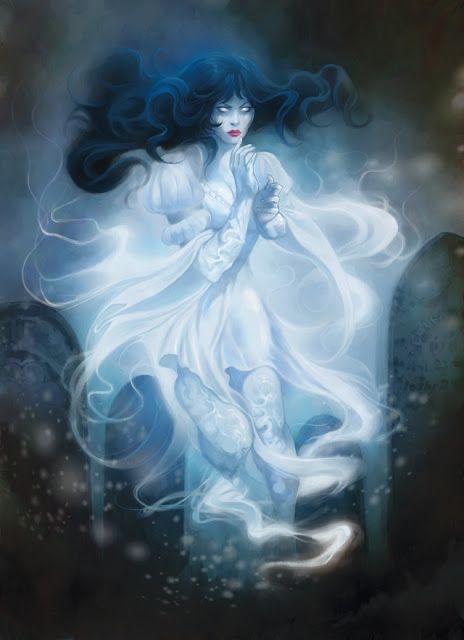
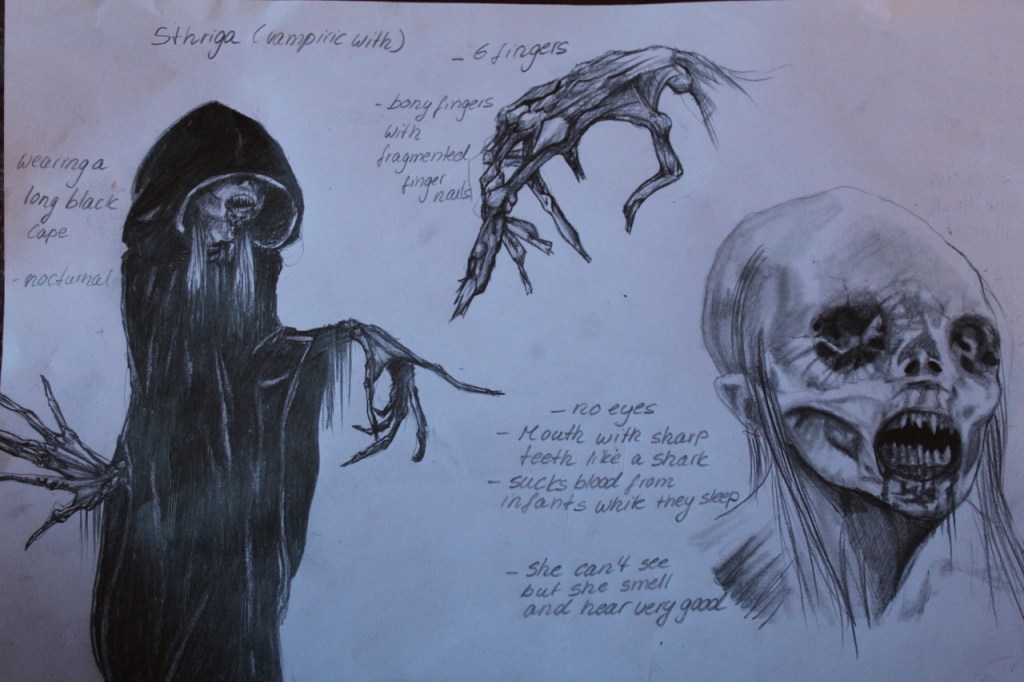
The Shtriga was a vampire-like witch that was found in Albania. The creature was similar to the Strigon, which was a witch found among the southern Slavs, the strigoi of Romania, and the vjeshtitza of Montenegro.

The Shtriga usually took the form of a woman who lived undetected in the community. She was difficult to identify, although a sure sign was a young girl’s hair turning white.

The vampire witch attacked her prey at night, usually in the form of an animal, such as a moth, fly, or bee.

In order to catch a Shtriga, two methods can be attempted:

~ On a day when the community gathered in the church, a cross made of pig bones could be fastened to the doors. Any Shtriga inside would be trapped and unable to pass the barrier.

~ If one followed a suspected Shtriga at night, one could see her vomit blood at some point after she sucked the blood of her victims. The vomited blood could be bottled and turned into an amulet to ward against witches.

Legend of the Shtriga:

According to legend, only the shtriga herself could cure those she had drained (often by spitting in their mouths), and those who were not cured inevitably sickened and died.

The name can be used to express that a person is evil. According to Northern Albanian folklore, a woman is not born a witch; she becomes one, often because she is childless or made evil by envy.   A strong belief in God could make people immune to a witch as He would protect them.

Usually, shtriga were described as old or middle-aged women with grey, pale green, or pale blue eyes (called white eyes or pale eyes) and a crooked nose. Their stare would make people uncomfortable, and people were supposed to avoid looking them directly in the eyes because they have the evil eye.  To ward off a witch, people could take a pinch of salt in their fingers and touch their (closed) eyes, mouth, heart and the opposite part of the heart and the pit of the stomach and then throw the salt in direct flames saying “syt i dalçin syt i plaçin” or just whisper 3–6 times “syt i dalçin syt i plaçin” or “plast syri keq.”

In some regions of Albania, people have used garlic to send away the evil eye or they have placed a puppet in a house being built to catch the evil. Newborns, children or beautiful girls have been said to catch the evil eye more easily, so in some Albanian regions when meeting such a person, especially a newborn, for the first time, people might say “masha’allah” and touch the child’s nose to show their benevolence and so that the evil eye would not catch the child.

Edith Durham recorded several methods traditionally considered effective for defending oneself from shtriga. A cross made of pig bone could be placed at the entrance of a church on Easter Sunday, rendering any shtriga inside unable to leave. They could then be captured and killed at the threshold as they vainly attempted to pass. She further recorded the story that after draining blood from a victim, the shtriga would generally go off into the woods and regurgitate it. If a silver coin were to be soaked in that blood and wrapped in cloth, it would become an amulet offering permanent protection from any shtriga.

In Catholic legend, it is said that shtriga can be destroyed using holy water with a cross in it, and in Islamic myth it is said that shtriga can be sent away or killed by reciting verses from the Qur’an, specifically Ayatul Kursi 225 sura Al-Baqara, and spitting water on the shtriga.

The Slavic Vampire

The Slavic vampire was not always the symbol of evil that it came to be in the nineteenth century European literature.

The Slavic vampire was originally the product of an irregularity within community life, such as problems with burial practices, death, or birth. People who had a violent death, people who committed suicide, or people who died of an accident became vampires.

Most Slavic cultures had a set of ritual activities that were to be followed after a death for for days following the death. Deviation of that ritual could result in the deceased becoming a vampire.

People who were excommunicated or deviated from the church would cause vampirism.

Problems at birth could also cause vampirism. In the Slavic culture, certain days of the year frowned upon intercourse, and children conceived on these days would become a vampire. Bulgarians believed that children who died before baptism would become an ustrel, which is a vampire who would attack and drink the blood of livestock. The Kashubs believed that children born with teeth or a caul would become a vampire after death.

The Slavic society offered many causes of vampires, and the belief the community members could become a vampire after being attacked or brought on by waves brought about vampire hysteria.

If a person is suspected to become a vampire, the community could take pre-burial actions to prevent the vampire from awakening. Religious objects were placed in the coffin. Plants such as the mountain ash would be left in the grave. Seeds were spilled in the grave, on top of the grave, and on the road from the graveyard. In extreme cases, the body was pierced with thorns or a stake. A wooden block may be placed under the chin to prevent the vampire from eating its burial clothes, or the clothes may be nailed on the outside of the coffin.

If a dead person was thought to be a vampire, the body would be dug up and examined for signs of a vampire. If the dead was a vampire, the body would appear lifelike, the joints would be pliable, blood would ooze from the mouth or other body openings, hair and fingernail growth would be seen, and the body may appear bloated (being filled with blood).

In order to destroy a vampire, the body would be staked with wood or metal. The object would be driven into the head, heart, or stomach of the body. In severe cases, the body would be decapitated. A priest, would also, repeat the ritual activities of the funeral service, sprinkling holy water on the body, or performing an exoricism.

The Dagda

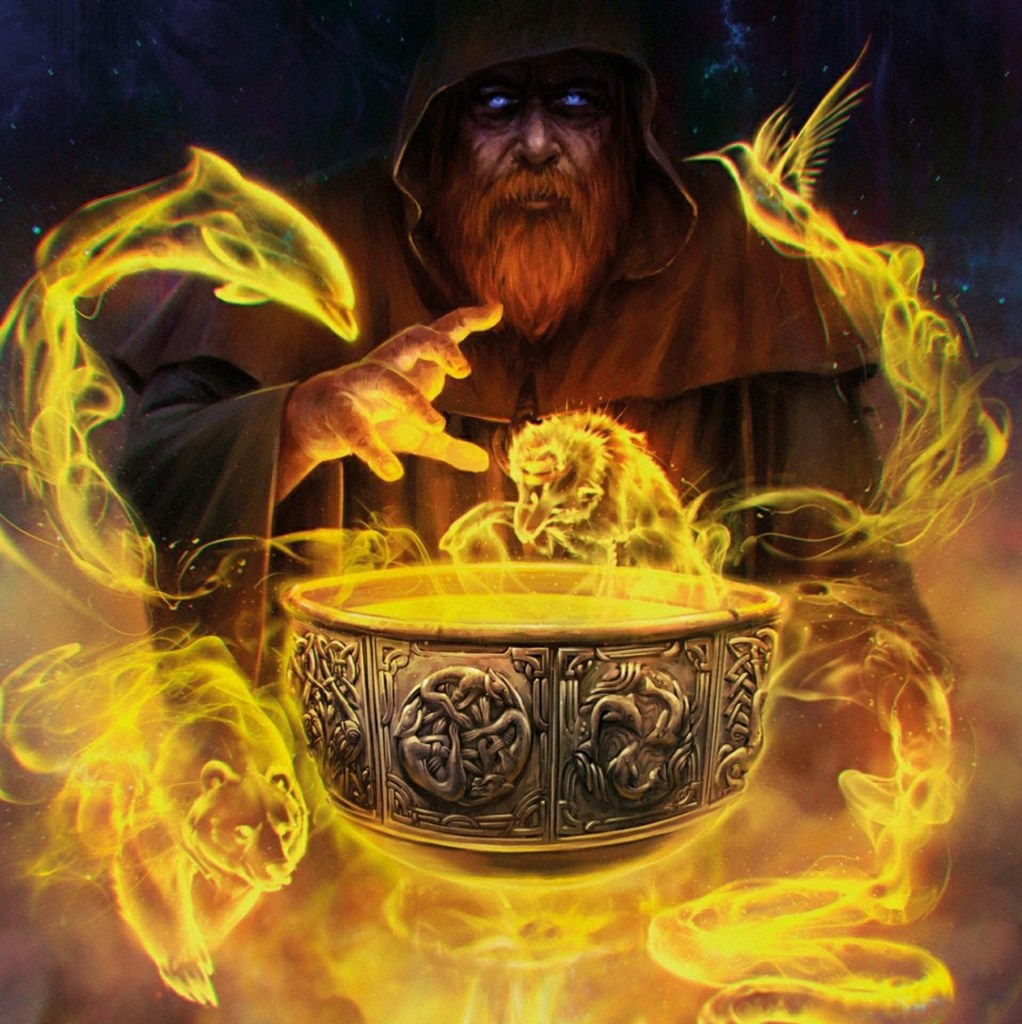
The Dagda was chief of the Tuatha dé Danann, the foremost of the Irish ancestral gods or faeries. Highly skilled and wise beyond measure, he was not only the god of life and death, but of seasons, agriculture, fertility, magic, and druidry as well. He wielded three sacred treasures: a cauldron of plenty, a club of life and death, and a harp that controlled men and seasons alike.

His children were plentiful, as were his lovers. His dwelling place was Brú na Bóinne.

The Dagda often carried three sacred relics with him that defined several of his many talents:

The coire ansic, a cauldron that could produce a bountiful feast; one could never be found wanting in the company of the Dagda. This particular relic was one of the Four Treasures of the Tuatha dé Danann, which were crafted in Murias.

The lorg mór, a mighty club (or staff) that possessed two distinct powers; its head had the power to slay nine men in a single swing while its handle could revive the slain with but a touch.

The uaithne, an ornate harp carved of oak. This harp could place the seasons in the proper order and command the wills and emotions of men. With these potent abilities, the Dagda was often seen as a god of order putting everything in its place, every time in its season, and every man to their rightful action.

In additions to these items, the Dagda owned two pigs—one always growing, the other always roasting—and an orchard that bore perennial sweet fruit.

The Dagda’s primary dwelling was at Brú na Bóinne, a series of Neolithic mounds on the banks of the River Boyne in County Meath. These ancient mounds were constructed around 3200 BCE, and as such are older than famous landmarks such as Stonehenge and the Great Pyramids. A mound called Newgrange aligned with the rising sun during winter solstice, representing the Dagda’s significance as lord of seasons and his mastery over day and night.

The Lebor Gabála Érenn laid out the coming of the Tuatha dé Danann, the fifth group of settlers to arrive in mythical Ireland. This group hailed from four cities north of the Emerald Isle, where they had learned the arts and sciences of their time, including magic. At this time, the Dagda was their chief. Though he did not hold the title of king, he was consulted and respected by many as if he was one.

The Dagda was also compared to the Germanic Odin and the Roman Dis Pater, as they bore certain similarities to him.


Three Styles of Thinking in DBT (Dialectical Behavioral Therapy)

Three Styles of Thinking in DBT

Marsha Linehan outlines three states of mind, or ways we have of thinking about things: the reasoning self, the emotional self, and the wise self.

The Reasoning Self:

The reasoning self: the part of ourselves that we use when we’re thinking logically or reasoning something out. When we use this part of ourselves, there are few or no emotions involved. If there are emotions present, they don’t significantly influence how we behave. Rather, the focus is on thinking logically about something: organizing your day at work, leaving instructions for the babysitter, deciding whether you should drive or take the subway to work, taking minutes at a meeting, and so on. It may take a while and you may need to help, but you can usually come up with at least one example.

The Emotional Self:

Usually we have more difficulties coming up with examples of times when we’ve acted from their emotional self—the part that often gets us into trouble, as our behaviors are controlled by the emotion we’re feeling in the moment. Some general examples, such as feeling angry and lashing out at someone, feeling anxious and avoiding whatever is causing the anxiety, or feeling depressed and withdrawing and isolating. Try to come up with some examples of your own: When have you acted from your emotional self? Usually you can relate to this thinking style and examples come rather easily.

The Wise Self:

The difficulty often lies in being able to see that you have a wise self, which is the combination of the reasoning self, the emotional self, and intuition.  In other words, we feel our emotions and are still able to think straight, and we weigh the consequences of our actions and choose to act in a way that’s in our best interests in the long run, even if that means behaving in a way that’s quite difficult. Again, some examples: You’re having an argument with your partner, and instead of saying something hurtful that comes to mind, you bite your tongue because you know you’ll regret it later. You have an urge to drink, but part of you recognizes this as an ineffective way of coping, so you call your mother or go to an AA meeting instead.

It’s also important to understand that acting from your wise self doesn’t necessarily entail a humongous achievement. Some smaller examples: You wake up in the morning and feel down; it’s cold, it’s still dark outside, and your first impulse is to call in sick. But instead you roll over, turn off the alarm, and get out of bed. This is your wise self. Or say it’s 5:00 p.m., your “partner’s going to be home from work soon, and you promised you would cook dinner, but you’re exhausted and don’t feel like it. Yet you do it anyway. This is your wise self.

Sometimes you’ll say something like, “But I have to go to work because I have to pay the bills; that’s not acting wisely.  But the truth is, no one has to go to work, we choose to go to work. We could choose to not go and the bills wouldn’t get paid. When you make a choice to get out of bed and go to work, that choice comes from your wise self. You weighed the consequences and decided what would be more effective in the long run, even though it wasn’t necessarily the easy thing to do.

Sources: DBT Made Simple by Sheri Van Dijk

Days of the Week & Phases of the Moon for Botanical Magic

Days of the Week & Phases of the Moon for Magic

Here are the best days of the week to perform each type of magic:

Sunday—personal empowerment, success, generosity, luck

Monday—spirituality, virtue, emotional security and well-being

Tuesday—drive, confidence, ambition, victory, vitality

Wednesday—knowledge, change, charm, communication

Thursday—luck, power, protected growth, accomplishment, money, honor

Friday—beauty, grace, the arts, love, fertility, bonding, sex appeal

Saturday—the law, loss, endings, transforming, banishings, interrupting”

To give your magic a boost, try timing it with the phase of the moon. For things that won’t wait, go with the day of the week that works best:

Waxing moon—growing toward full. Do magic for increase, prosperity, health, wellness, love.

Full moon—alignment of moon, earth, and sun (sometime resulting in an eclipse), all purpose, use the extra boost for the metaphysical heavy lifting, court cases, protection.

Waning moon—shrinking toward the new moon. Practice magic of decrease; bringing things to a close; removing bad habits, negative people, debt, illness.

New moon—first light. New growth, beginning projects, set ideas in motion. Set goals for the month.

Dark moon—the absence of light. Do magic surrounding intuition, turning inward, cleansing, banishing or binding both people and addictions.

Blue moon—the second full moon in a calendar month. Do magic for wishes.

Black moon—the second new moon in a calendar month. Do magic for serious binding, banishing, stalkers, serious illness, addiction. Heavy lifting.

Moon Phases:

You may have seen a triple moon symbol; it looks like this )0(. It’s not just a clever design; this is the waxing, full, and waning moon depicted. So, if you look up into the sky and the moon is pointing to the left, it is waxing. If it is pointing to the right, it is waning.

Sources: Blackthorn’s Botanical Magic, The Homemade Apothecary


Hill of Crosses (Meškuičiai, Šiauliai – Lithuania)

Hill of Crosses (Meškuičiai, Šiauliai – Lithuania)

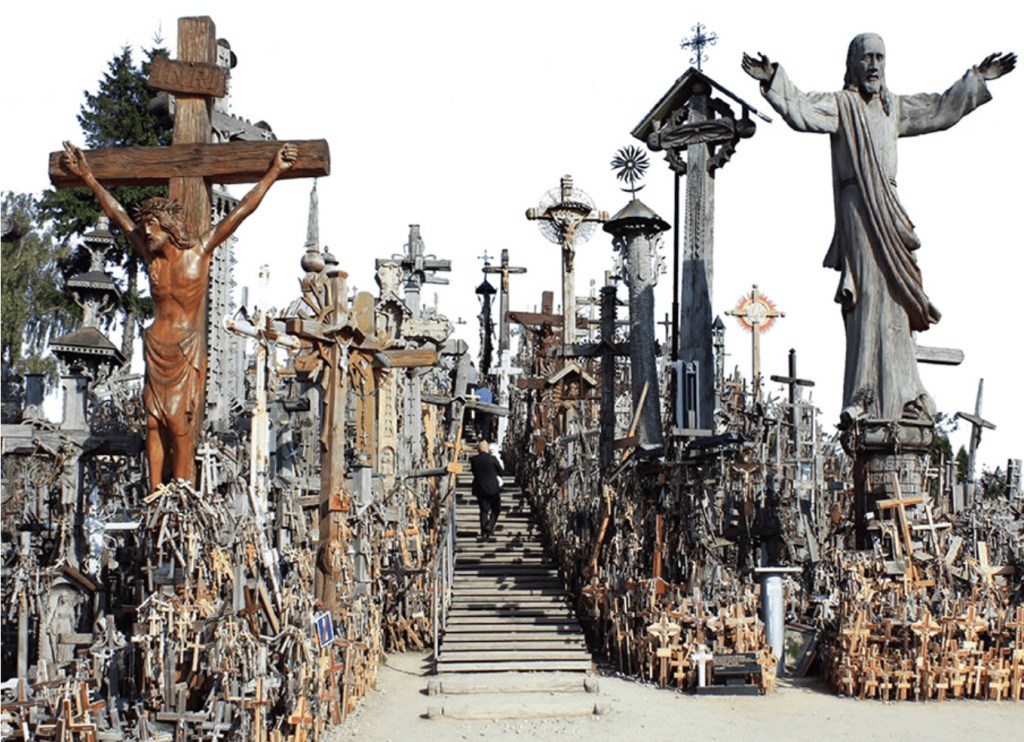
Crosses have been accumulating on this small hill since the 14th century, when Teutonic Knights of the Holy Roman Empire occupied the nearby city of Šiauliai. New crosses tend to appear during periods of occupation or unrest as symbols of Lithuanian independence. This was particularly evident during a peasant uprising against Russian control in 1831, when people began placing crucifixes in remembrance of missing and dead rebels. By 1895, there were 150 large crosses on the site. In 1940, the number had grown to 400.

During the Soviet occupation, which lasted from 1944 to 1991, the Hill of Crosses was bulldozed three times. Each time, locals and pilgrims returned to put up more crosses. The site achieved worldwide fame when Pope John Paul II visited in 1993 to thank Lithuanians for their enduring symbol of faith.

There are now approximately 100,000 crosses on the hill. The faithful are welcome to add their contribution, in whatever form they wish—a crucifix made of Legos recently joined the collection.

Sources: Atlas Obscura


William Shakespeare on Religion

On this date in 1564, William Shakespeare was born in England. He died in 1616. The “master” playwright was eulogized by 19th century agnostic orator Robert Green Ingersoll. In one of his famous lectures, Ingersoll said that when he read Shakespeare, “I beheld a new heaven and a new earth.” (The Works of Robert G. Ingersoll, Interviews, Vol. IV, p. 39.) “All well-educated ministers know that the Bible suffers by a comparison with Shakespeare.” (Vol. VIII, p. 297) “If Shakespeare could be as widely circulated as the Bible . . . nothing would so raise the intellectual standard of mankind. Think of the different influence on men between reading Deuteronomy and ‘Hamlet’ and ‘King Lear’ . . . The church teaches obedience. The man who reads Shakespeare has his intellectual horizon enlarged.”

No one knows Shakespeare’s personal religious views, although he certainly was not orthodox, and put many different types of sentiments into the mouths of his characters. His philosophy seems most succinctly described in the famous “Seven Ages of Man” speech from “As You Like It,” which begins: “All the world’s a stage/ And all the men and women merely players:/ They have their exits and their entrances;. . .” ending with “mere oblivion./ Sans teeth, sans eyes, sans taste, sans everything.” Below are several of Shakespeare’s most famous irreverencies. D. 1616.

“In religion, what damned error but some sober brow will bless it, and approve it with a text, . . .?”
~ “The Merchant of Venice,” Act III, Sc. II

Peter Watson

On this date in 1943, author Peter Watson was born in Birmingham, England. An intellectual historian and investigative journalist, he was educated at the universities of Durham, London and Rome, later living in the United States. He has written for The Observer, The New York Times, Punch and The Spectator, and is the author of fiction, as well as many books on art history, biography, psychology, and true crime. His books include: The Medici Conspiracy: The Illicit Journey of Looted Antiquities from Italy’s Tomb Raiders to the World’s Greatest Museums (2006, with Cecilia Todeschini), Ideas: A History of Thought and Invention, from Fire to Freud (2005), Modern Mind: An Intellectual History of the 20th Century (2001) (also published as A Terrible Beauty), Sotheby’s: The Inside Story (1998), Landscape of Lies (1989) and The Caravaggio Conspiracy (1984). In Ideas: A History of Thought and Invention, Watson seeks a new way to tell the history of the world from prehistory to modern day, asserting that human knowledge is divided into two realms: inward (philosophy and religion) and outward (observation and science). His stance supports the latter. Twins: An Uncanny Relationship? (1982), explores behavior patterns shared by identical twins, “to offer a rational alternative to mumbo jumbo for explaining many of the coincidences reported in twin studies, ” according to a Los Angeles Times review. “A few saints and a little charity don’t make up for all the harm religion has done over the ages,” he has said (CBC News, May 5, 2007).

When asked about the good that religion has done in the world in an interview by The New York Times Magazine (December 11, 2005), Watson replied: “I lead a perfectly healthy, satisfactory life without being religious. And I think more people should try it.” He went on to say, “I do not believe in the inner world. I think that the inner world comes from the exploration of the outer world–reading, traveling, talking. I do not believe that meditation or cogitation leads to wisdom or peace or the truth.” Since 1998, Watson has been a research associate at the McDonald Institute for Archaeological Research, at the University of Cambridge. He lives in London, England.

“Religion has kept civilization back for hundreds of years, and the biggest mistake in the history of civilization, is ethical monotheism, the concept of the one God. Let’s get rid of it and be rational.”
~ Peter Watson interview, CBC News (May 5, 2007)

The Devil Heads (Želízy, Czech Republic)

The Devil Heads (Želízy, Czech Republic)

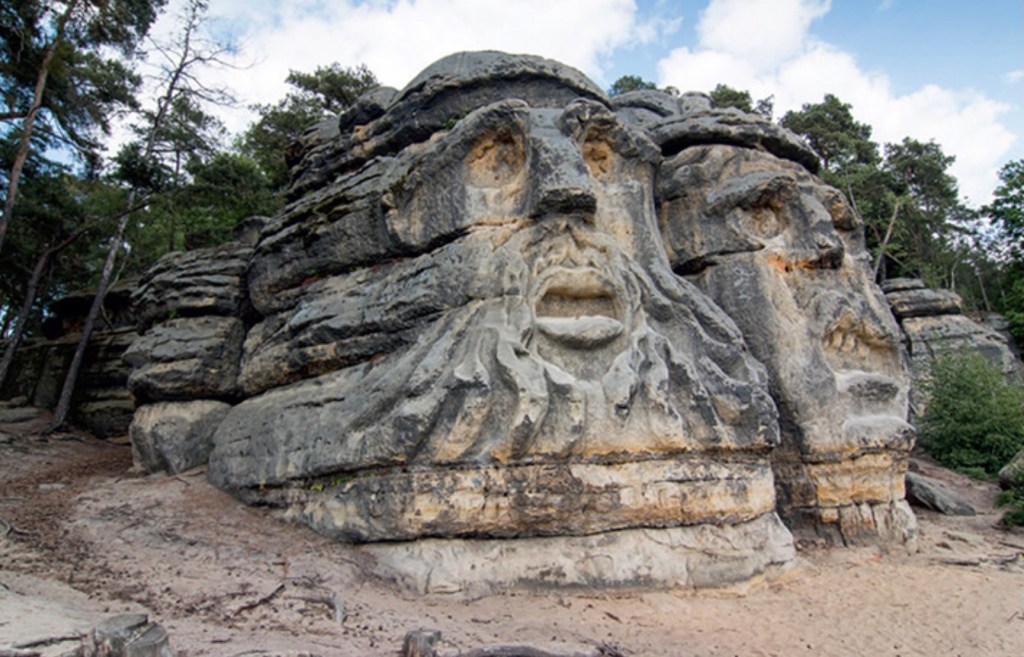
A disturbing sight awaits hikers exploring the forest above the village of Želízy in Czechia. Looking out over the Kokořínsko nature reserve, two enormous demonic faces carved from the native stone stare back with empty eyes.

Created by the renowned Czech sculptor Václav Levý in the mid-19th century, the nearly 30-foot-tall sandstone heads are known as Certovy Hlavy, or “the Devil Heads,” and they have been a local attraction for generations. Now suffering slightly from the ravages of time and weather, the monstrous faces have grown less distinct over time—but no less creepy.