Ancient Egyptian Concept of the Soul

To the Ancient Egyptians, the soul was the most important part of a person and it was separated into different parts making up it’s vehicle (the human, in this case).  There was one physical form and eight semi-divine parts which made up one’s soul. These parts are as follows:

~ Kha: The physical body of the human which decayed after death, according to the Egyptians, only if it was not mummified and persevered properly.

~ Ka: The double that lingered on in the tomb inhabiting the body or even statues of the dead, but was also independent of the deceased body and could move, eat and drink at will.

~ Akhu: This was the immortal part, the radiant and shining being that lived on in the Sahu, the intellect, will and intentions of the deceased that transfigured death and ascended to the heavens to live with the gods.

~ Sahu: The incorruptible spiritual body of man that could exist in the heavens, appearing from the physical body after the judgement of the dead was passed (if successful) with all of the mental and spiritual abilities of a living body.

~ Sekhem : This was the incorporeal personification of the life force of man, which lived in heaven with the Akhu, after death.

~ Khaibit: The shadow of a man, it could partake of funerary offerings and was able to detach itself from the body and travel at will, though it always was thought to stay near the Ba.

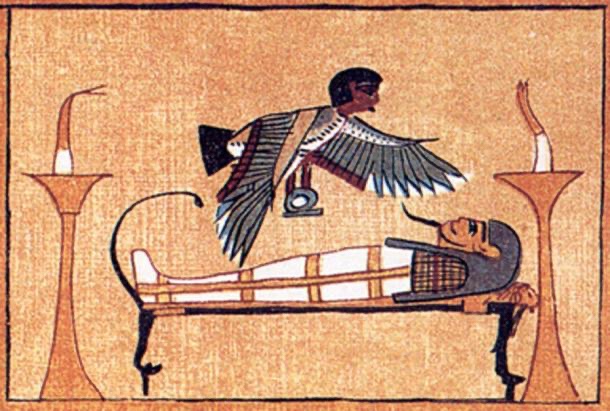
~ Ba: The human headed bird flitted around in the tomb during the day bringing air and and food to the deceased, but traveled with Ra on the Solar Barque during the evenings.

~ Ab: The heart, this was the source of good and evil within a person, the moral awareness and center of thought that could leave the body at will, and live with the gods after death, or be eaten by Ammut as the final death if it failed to weigh equally against Ma’at.

~ Ren: The true name, a vital part to man on his journey through life and the afterlife, a magical part that could destroy a man if his name was obliterated or could give power of the man if someone knew his Ren.

Duat: Ancient Egyptian Underworld

In ancient Egyptian mythology, the Duat is the underworld or the realm of the dead. It is the home of the god Osiris, Anubis, Thoth, Horus, Hathor, and Ma’at, and many grotesque spirits controlled by them. Ra, the sun god, also travels through the Duat every night and battles the serpent monster Apep.

The most important function of the Duat however is that it is where people’s souls go for judgment after death. Their tombs were viewed to be entrances into the Duat, and they could travel back and forth from the underworld through these burial chambers.

Within the Duat are many impressive geographical features. There are normal features like islands, fields, caverns, rivers, and mounds – but also unrealistic structures like lakes of fire, trees of turquoise, and walls of iron. Once someone had passed away, it was up to them to navigate this tricky landscape to become an akh, or blessed spirit. They had to pass through a series of gates protected by grotesque spirits with human bodies and heads of animals, knives, torches, or insects. Along the way were also mounds and caverns filled with animals or gods who would threaten the dead as they passed.

Once the dead passed all of these unpleasant spirits, if they did, they would reach the Weighing of the Heart. This ritual involved weighing the heart of the deceased against a feather, representing Ma’at – the goddess of truth and justice. This ritual was performed by Anubis. If the heart was out of balance, due to failure to follow Ma’at, then the heart would be devoured by Ammit, the Devourer of Souls. Those who did pass would travel to the paradise of Aaru.

** All we know about the Duat and the afterlife comes from funerary texts like the Book of the Dead, Pyramid Texts, Coffin Texts. **

Tsuro (鶴): Crane

In Japan, the crane is a national treasure. It is the symbol of longevity and good luck because it was thought to have a life span of a thousand years. Tsuru are also monogamous, therefore, often used for wedding decor. An example of this is seen on formal wedding kimonos, and the uchikake, a decorative kimono that goes over the actual kimono, where beautiful images of tsuru are often embroidered.

The crane is often produced in Japanese origami and artwork. Large colourful necklaces of cranes are also commonly seen outside of Japanese temples.

Another example of the crane used in Japanese culture is the 1,000 origami cranes called senba zuru. As the story goes, during WWII, Sadako Sasaki, a young victim of the atomic bomb in Hiroshima, was diagnosed with leukemia from exposure to radiation. There are many versions of her story; one says she decided to fold 1,000 paper cranes as a symbol of peace and hope but was only able to fold 644 before she died of her injuries. Another says her friend folded the cranes for her in hopes of her recovery. Regardless of who folded the cranes, today people of Japanese ancestry as well as many others, carry on the tradition of folding 1,000 cranes in hopes of health, happiness, and peace. There is a memorial statue of Sadako at theHiroshima Peace Memorial Park with her holding a single crane.

The crane is a majestic bird that is a favorite subject in many Asian paintings. Although there are many species of cranes, in Asia it’s usually the red crown crane that is depicted. The long white neck and torso, contrasting black legs and head is topped with a red crown. Their physical beauty is undeniable.

There is a Japanese idiom that says, “tsuru no hito koe“, 鶴の一声 or つるのひとこえ, which literally translates as, “one word from the crane’, meaning the “voice of authority”, the one who has the final word that isn’t challenged.

Koi (鯉): Carp

Koi means Carp in Japanese, and this fish is a symbol of perseverance due to the fish’s tendency to swim upstream and resist the flow of water. Koi Carp also symbolise faithfulness and marriage in Japan. A design of carp swimming against rapids symbolises the Children’s Day Festival on May 5th. This is to inspire children to work hard in order to succeed.

Koi are a colorful, ornamental versions of the common carp. Though carp domestication is believed to have begun in China as far back as the 4th century, modern Japanese koi are believed to date back to early 19th-century Japan where wild, colorful carp were caught, kept and bred by rice farmers. There are now dozens of different color varieties of koi.

Koi varieties are distinguished by coloration, patterning, and scalation. Some of the major colors are white, black, red, yellow, blue, and cream. Although the possible colors are virtually limitless, breeders have identified and named a number of specific categories. The most notable category is Gosanke, which is made up of the Kohaku, Taisho Sanshoku, and Showa Sanshoku varieties.

  • Kōhaku (紅白) is a white-skinned koi, with large red markings on the top. The name means “red and white”; kohaku was the first ornamental variety to be established in Japan (late 19th century).
  • Taishō Sanshoku (or Taishō Sanke) (大正三色) is very similar to the kohaku, except for the addition of small black markings called sumi (墨). This variety was first exhibited in 1914 by the koi breeder Gonzo Hiroi, during the reign of the Taishō Emperor. In the United States, the name is often abbreviated to just “Sanke”. The kanji, 三色, may be read as either sanshoku or as sanke (from its earlier name 三毛).
  • Shōwa Sanshoku (or Showa Sanke) (昭和三色) is a black koi with red (hi 緋) and white (shiroji 白地) markings. The first Showa Sanke was exhibited in 1927, during the reign of the Shōwa Emperor. In America, the name is often abbreviated to just “Showa”. The amount of shiroji on Showa Sanke has increased in modern times (Kindai Showa 近代昭和), to the point that it can be difficult to distinguish from Taisho Sanke. The kanji, 三色, may be read as either sanshoku or as sanke.

Kame (亀): Turtle

The Japanese word for turtle is kame, and the Japanese believe that the turtle is a symbol for wisdom, luck, protection, and longevity; longevity due to their long lifespan and slow movements. The turtle is magic and unites heaven and earth, with its shell representing heaven and its square underside representing earth.

Images of kame are quite popular. In Japanese mythology kame is a symbol of power and immortality. Kame supports the World Mountain, a refuge of the immortals. One such image is found in the monument to Tokugawa Ieyasu in Ryogoku, Tokyo. Kame have often been pictured by Japanese artists, including one of the most famous artists of Edo era, Hokusai Katsushika.

Kaeru (蛙): Frogs

Among popular Japanese spiritual symbols are frogs. There are many species of frogs in Japan as a result of flooding rice fields in Japanese agriculture. These creatures are often used in poetry and art, and are sometimes carried by travellers to make sure they return home safely from their journeys. The word ‘frog’ in Japanese means ‘return’, which is why the frog is considered a Japanese lucky animal and seen as good fortune in things returning.

Japan is home to 40 species of frogs in five families. The most common is the tiny Japanese tree frog, which is usually green but can change its color to match its background, and the Japanese rain frog.

There are Japanese folk stories of giant toads, two to three meters in height, that found high up on mountain streams. According to legend they can breath out great rainbows and use the rainbows to slide prey into their mouth and are able to walk on their hind legs. They are said to be particularly numerous around in the mountains of the Suo region of Yamaguchi Prefecture.

Chōchō (蝶々): Butterfly

Japan perceives the butterfly to be a ‘soul of the living and the dead’, as a result of the popular belief that spirits of the dead take the form of a butterfly when on their journey to the other world and eternal life.

The butterfly is also often used as a symbol for young girls as they spread their wings and emerge into womanhood, as well as it being believed to symbolise joy and longevity. Additionally, if a symbol contains two butterflies dancing around each other, it’s a symbol of marital happiness.

Eternity —> The meaning of eternity which represented by the butterfly is due to the belief that spirits of the dead take the form of a butterfly on their journey to the other world and eternal life. Or spirits of the dead are guided by butterflies to the afterlife.

Womanhood —> The cycle of transformations through which a butterfly passes in its life is often associated with the transformations through which a girl passes on her way of becoming a young woman. In Japanese culture, the butterfly is associated with femininity, also, because of its grace and beauty.

Love —> In Japanese symbolism, the butterfly is a sign of good luck in love and finding your soul mate. It is a symbol of a happy marriage, and is used as a decorative element for weddings. An old Chinese legend, adopted by most East Asian countries, tells the story of two lovers who turn into butterflies after committing suicide together. This story has been compared as the Romeo and Juliet of Asia, and expresses the eternal love of those two.

Butterfly Motif —> The motif of butterfly is common on Japanese clothing. The motif of a butterfly on yukatas and kimonos is very common because of its meanings, especially on those worn by girls and young women. Also there is the butterfly knot used to tie the women’s obi (long, broad sash tied about the waist over a Japanese kimono).

The Butterfly in the Arts —> Throughout history, the butterfly was a common motif in paintings, paper panels, fans and more. In the Edo period, the butterflies were a very popular subject among ukiyo-e artists, being painted by artists like Utagawa (Ando) Hiroshige, Kudo Shunman, Yanagawa Shiganobu, Totoya Hokkei, Utagawa Toyokuni, Yanagawa Shigenobu, Kitao Masayoshi, and Shirabe Fujie. One of the most famous ukiyo-e paintings belongs Katsushika Hokusai, “Peonies and Butterflies”, whose fan was even Claude Monet.

Samurai Mon (紋) —> The butterfly was often used as a symbol for the mon (emblems used to decorate and identify an individual) of the samurai clans. One of the first clans who used butterfly was Taira clan, one of the most powerful clans in the Heian period.

Origami —> The butterfly is the first form of origami that was ever made, and it was inspired by a poem by Ihara Saikaku in 1680, in which he describes a dream about paper butterflies. Ihara describes two butterflies called Ocho and Mecho. Now there is a tradition in which two paper butterflies are placed on sake bottles used at weddings.

Manga & Anime —> In the modern culture of Japan, anime and manga plays an important role, and the butterfly is present in both. In the anime series Bleach, butterflies are present as the traditional form of guides for the spirits of the dead. In Sailor Moon, the butterfly is the symbol of Princess Kakyuu. In the manga Little Butterfly, it is a symbol of freedom and hope for the two young lovers who want to escape to be together.

COVID-19 and your mental health

The COVID-19 pandemic has likely brought many changes to how you live your life, and with it uncertainty, altered daily routines, financial pressures and social isolation. You may worry about getting sick, how long the pandemic will last, whether you’ll lose your job, and what the future will bring. Information overload, rumors and misinformation can make your life feel out of control and make it unclear what to do.

During the COVID-19 pandemic, you may experience stress, anxiety, fear, sadness and loneliness. And mental health disorders, including anxiety and depression, can worsen.

Surveys show a major increase in the number of U.S. adults who report symptoms of stress, anxiety and depression during the pandemic, compared with surveys before the pandemic. Some people have increased their use of alcohol or drugs, thinking that can help them cope with their fears about the pandemic. In reality, using these substances can worsen anxiety and depression.

People with substance use disorders, notably those addicted to tobacco or opioids, are likely to have worse outcomes if they get COVID-19. That’s because these addictions can harm lung function and weaken the immune system, causing chronic conditions such as heart disease and lung disease, which increase the risk of serious complications from COVID-19.

For all of these reasons, it’s important to learn self-care strategies and get the care you need to help you cope.

Self-care strategies

Self-care strategies are good for your mental and physical health and can help you take charge of your life. Take care of your body and your mind and connect with others to benefit your mental health.

Take care of your body

Be mindful about your physical health:

Get enough sleep. Go to bed and get up at the same times each day. Stick close to your typical schedule, even if you’re staying at home.

Participate in regular physical activity. Regular physical activity and exercise can help reduce anxiety and improve mood. Find an activity that includes movement, such as dance or exercise apps. Get outside in an area that makes it easy to maintain distance from people, such as a nature trail or your own backyard.

Eat healthy. Choose a well-balanced diet. Avoid loading up on junk food and refined sugar. Limit caffeine as it can aggravate stress and anxiety.

Avoid tobacco, alcohol and drugs. If you smoke tobacco or if you vape, you’re already at higher risk of lung disease. Because COVID-19 affects the lungs, your risk increases even more. Using alcohol to try to cope can make matters worse and reduce your coping skills. Avoid taking drugs to cope, unless your doctor prescribed medications for you.

Limit screen time. Turn off electronic devices for some time each day, including 30 minutes before bedtime. Make a conscious effort to spend less time in front of a screen — television, tablet, computer and phone.

Relax and recharge. Set aside time for yourself. Even a few minutes of quiet time can be refreshing and help to quiet your mind and reduce anxiety. Many people benefit from practices such as deep breathing, tai chi, yoga or meditation. Soak in a bubble bath, listen to music, or read or listen to a book — whatever helps you relax. Select a technique that works for you and practice it regularly.

Take care of your mind

Reduce stress triggers:

• Keep your regular routine. Maintaining a regular schedule is important to your mental health. In addition to sticking to a regular bedtime routine, keep consistent times for meals, bathing and getting dressed, work or study schedules, and exercise. Also set aside time for activities you enjoy. This predictability can make you feel more in control.

• Limit exposure to news media. Constant news about COVID-19 from all types of media can heighten fears about the disease. Limit social media that may expose you to rumors and false information. Also limit reading, hearing or watching other news, but keep up to date on national and local recommendations. Look for reliable sources, such as the U.S. Centers for Disease Control and Prevention (CDC) and the World Health Organization (WHO).

Stay busy. A distraction can get you away from the cycle of negative thoughts that feed anxiety and depression. Enjoy hobbies that you can do at home, identify a new project or clean out that closet you promised you’d get to. Doing something positive to manage anxiety is a healthy coping strategy.

Focus on positive thoughts. Choose to focus on the positive things in your life, instead of dwelling on how bad you feel. Consider starting each day by listing things you are thankful for. Maintain a sense of hope, work to accept changes as they occur and try to keep problems in perspective.

Use your moral compass or spiritual life for support. If you draw strength from a belief system, it can bring you comfort during difficult times.

Set priorities. Don’t become overwhelmed by creating a life-changing list of things to achieve while you’re home. Set reasonable goals each day and outline steps you can take to reach those goals. Give yourself credit for every step in the right direction, no matter how small. And recognize that some days will be better than others.

Connect with others

Build support and strengthen relationships:

Make connections. If you need to stay at home and distance yourself from others, avoid social isolation. Find time each day to make virtual connections by email, texts, phone, or FaceTime or similar apps. If you’re working remotely from home, ask your co-workers how they’re doing and share coping tips. Enjoy virtual socializing and talking to those in your home.

Do something for others. Find purpose in helping the people around you. For example, email, text or call to check on your friends, family members and neighbors — especially those who are elderly. If you know someone who can’t get out, ask if there’s something needed, such as groceries or a prescription picked up, for instance. But be sure to follow CDC, WHO and your government recommendations on social distancing and group meetings.

Support a family member or friend. If a family member or friend needs to be isolated for safety reasons or gets sick and needs to be quarantined at home or in the hospital, come up with ways to stay in contact. This could be through electronic devices or the telephone or by sending a note to brighten the day, for example.

Recognizing what’s typical and what’s not

Stress is a normal psychological and physical reaction to the demands of life. Everyone reacts differently to difficult situations, and it’s normal to feel stress and worry during a crisis. But multiple challenges daily, such as the effects of the COVID-19pandemic, can push you beyond your ability to cope.

Many people may have mental health concerns, such as symptoms of anxiety and depression during this time. And feelings may change over time.

Despite your best efforts, you may find yourself feeling helpless, sad, angry, irritable, hopeless, anxious or afraid. You may have trouble concentrating on typical tasks, changes in appetite, body aches and pains, or difficulty sleeping or you may struggle to face routine chores.

When these signs and symptoms last for several days in a row, make you miserable and cause problems in your daily life so that you find it hard to carry out normal responsibilities, it’s time to ask for help.

Get help when you need it

Hoping mental health problems such as anxiety or depression will go away on their own can lead to worsening symptoms. If you have concerns or if you experience worsening of mental health symptoms, ask for help when you need it, and be upfront about how you’re doing. To get help you may want to:

• Call or use social media to contact a close friend or loved one — even though it may be hard to talk about your feelings.

• Contact a minister, spiritual leader or someone in your faith community.

• Contact your employee assistance program, if your employer has one, and get counseling or ask for a referral to a mental health professional.

• Call your primary care provider or mental health professional to ask about appointment options to talk about your anxiety or depression and get advice and guidance. Some may provide the option of phone, video or online appointments.

• Contact organizations such as the National Alliance on Mental Illness (NAMI) or the Substance Abuse and Mental Health Services Administration (SAMHSA) for help and guidance.

If you’re feeling suicidal or thinking of hurting yourself, seek help. Contact your primary care provider or a mental health professional. Or call a suicide hotline. In the U.S., call the National Suicide Prevention Lifeline at 1-800-273-TALK (1-800-273-8255) or use its webchat at suicidepreventionlifeline.org/chat.

Continue your self-care strategies

You can expect your current strong feelings to fade when the pandemic is over, but stress won’t disappear from your life when the health crisis of COVID-19 ends. Continue these self-care practices to take care of your mental health and increase your ability to cope with life’s ongoing challenges.

Sources: McLean Hospital, The Mayo Clinic, NAMI

Kaiseki-Ryori (会席料理)

Kaiseki-Ryori (会席料理)

Prepared by specialized restaurants and also served at dinner in ryokan (traditional inns), kaiseki typically features between 10 to 12 dishes enjoyed over the course of a couple of hours. From the traditional teahouse-like interiors to the kimono-clad staff and the tranquil atmosphere, it’s a deeply Japanese experience before you even begin to eat. While the course progression and dishes will vary, the focus on seasonal ingredients is always paramount. Dishes appear like works of art and delicately garnished with seasonal motifs like a cherry blossom bud in spring.

At the heart of kaiseki dining is the Japanese principle of shun, or taking ingredients at the peak of their freshness. Dishes are presented simply, without artifice. This is done not only to ensure that the true flavor of each ingredient be expressed, but also to properly display each and every one and the height of their natural beauty, thus creating the perfect synergy between cuisine and artistic expression.

Kaiseki-Ryori is the most refined form of Japanese cuisine, and as such requires the highest etiquette. It is important to observe a few basic formalities:

Show Respect —> Before the meal, be sure to say “itadakimasu” to show respect to the chef, the restaurant staff, and the wonderful bounty itself.

Use Chopsticks Properly —> Chopsticks should not be used to poke or cut food into smaller bites. When not using them, place chopsticks back on the hashi-oki, or chopstick rest, provided rather than placing them across the top of a bowl or sticking them into a dish.

End of the meal —> At the end of the meal, remember to thank the chef and restaurant staff with the common phrase, “Gochiso-sama deshita,” which essentially means, “It was a feast.

Sakizuke

Kaiseki-ryori menus often begin with the sakizuke course – a small appetiser or amuse-bouche.

Suimono

This light, clear soup, presented with minimal garnishes, is served as a refreshing palate-cleanser.

Hassun

The most attractive and artistic of all kaiseki-ryori components, the hassun is a seasonal platter of four or five hors d’oeuvres.

Otsukuri

The otsukuri course is comprised of a selection of sashimi, which varies by season and by region.

Takiawase

A lightly simmered vegetable dish served with fish, meat, or tofu.

Yakimono

A grilled dish that showcases seasonal fish (either fresh-water or from the sea) or meat such as local wagyu (beef).

Agemono

A deep-fried dish, often featuring tempura and served with a dipping sauce or salt seasoning.

Mushimono

This steamed dish can contain fish, chicken or vegetables, and may also include a savoury custard.

Sunomono

The sunomono course is a small vinegar-based dish designed to cleanse the palate. It usually features vegetables or seafood.

Shokuji

A trio of dishes – rice, miso soup and pickles – that are served together towards the end of the meal.

Mizumono

The meal concludes with a dessert, such as seasonal fruit, ice cream or a traditional sweet.

Japanese Table Manners 101

Before you begin eating, say “itadakimasu.”

As a rule, Japanese always say “itadakimasu” before they eat. It literally means “I partake.” There are many stories behind it, but it is considered to be a way of expressing gratitude to the chef, the people who grew/raised the ingredients that make up the meal, and the ingredients themselves since everything on one’s plate was once alive. 

If the chopsticks are disposable chopsticks break the chopsticks by pulling them apart vertically.

Proper etiquette states that the chopsticks should be held horizontally, and pulled apart vertically over your knees.  Do not pull your chopsticks apart horizontally.

If there isn’t a chopstick rest, make one with the paper your chopsticks came in.

Since it is rude to place your chopsticks over your bowls when you’re not using them, if there isn’t a chopstick rest, please make one using the paper sheath. 

When you’re eating rice, hold your rice bowl in front of you in the opposite hand you use for chopsticks.

When you eat rice, make sure to lift your bowl in front of you. Not lifting your bowl is considered poor etiquette.  The same rules apply to soup bowls.

Clean your plate.

Most places in Japan will not let you take food home for hygienic reasons, so please clean your plate.

When you finish eating, put your disposable chopsticks back in the paper and fold the end. After meals, please say “gochisousama deshita.”

“Gochisousama deshita” literally means “I feasted.” It derives from the word “chisou” which means “feast,” and is written with two characters that mean “to run,” it implies that the meal was created as the result of many people running around and working together. “Go” and “sama” are honorifics that take the phrase to politer level that implies thanks to the many people that came together to create this meal.

Many people say “itadakimasu” and “gochisousama deshita” with their hands put together as though in prayer, it’s not required and is often a regional behavior.

If at a restaurant saying “gochisousama deshita” to the staff when you exit is considered to be good manners as well.