Traditional Pie Crust: Butter & Shortening Dough

2½ cups all-purpose flour, unbleached
½ teaspoon salt
8 tablespoons butter, cut into tablespoon-size pieces
8 tablespoons vegetable shortening
½ cup ice water plus 1–2 tablespoons more as needed
Additional flour for rolling out dough

Add all ingredients but the ice water in a large bowl.

Quickly work the mixture together with your hands until the ingredients look like cracker crumbs with lumps the size of peas.

Sprinkle ice water over the mixture and stir lightly with a fork.

Squeeze a handful of dough to see if it holds together. Mix in more water as needed.

Divide the dough in half and make two  discs about 5 inches across.

Wrap the discs separately in plastic wrap and chill for an hour.

Roll the dough until is is approximately 1 to 2 inches larger than your pie pan, brush off the extra flour.

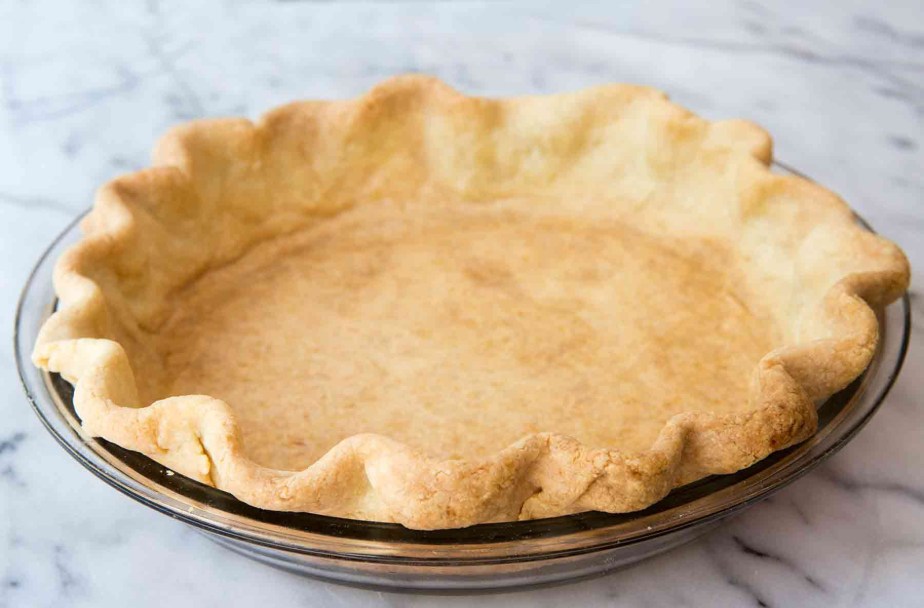
Lay the dough in the pie pan carefully.  Don’t worry if the crust has cracks or even a small hole. Brush a little water where it needs to be patched and glue on the patch piece.

Put the filling in the pie and repeat the process with the other piece of dough.

Traditional Pie Crust: All Butter Dough

2½ cups all-purpose flour, unbleached
½ teaspoon salt
14 tablespoons butter, cut into tablespoon-size pieces
½ cup ice water + 1–2 tablespoons more as needed
Additional flour for rolling out dough

Add all the ingredients but the ice water in a large bowl.

Quickly work the mixture together with your hands until the ingredients look like cracker crumbs with lumps the size of peas.

Sprinkle ice water over the mixture and stir lightly with a fork.

Squeeze a handful of dough to see if it holds together. Mix in more water as needed.

Divide the dough in half and make two discs about 5 inches across.

Wrap the discs separately in plastic wrap, and chill for about an hour.

Roll the dough until is is approximately 1 to 2 inches larger than your pie pan, brush off the extra flour.

Lay the dough in the pie pan carefully.  Don’t worry if the crust has cracks or even a small hole. Brush a little water where it needs to be patched and glue on the patch piece.

Put the filling in the pie and repeat the process with the other piece of dough.
Traditional Pie Crust: Leaf Lard & Butter Dough

FOR ONE DOUBLE-CRUST PIE OR TWO SINGLE-CRUST PIES

Ingredients

  • 2½ cups all-purpose unbleached flour
  • ½ teaspoon salt
  • 8 tablespoons (punsalted butter, in tablespoon-size pieces
  • 8 tablespoons rendered leaf lard, in tablespoon-size pieces *
  • ½ cup ice water plus 1–2 tablespoons more as needed
  • Flour for rolling out dough

* Leaf lard is available at most butcher shops, some farmers’ markets, and also Online.

Directions

  • Add all ingredients except the ice water to a large bowl.
  • Quickly mix the mixture together with your hands or a pastry blender with an up and down motion, until the ingredients appear like cracker crumbs with lumps the size of peas.
  • Sprinkle ice water over the mixture and stir lightly with a fork until a handful of dough holds together. Add more water as needed.
  • Divide the dough in two and make two discs about 5 inches across.
  • Wrap the dough in two plastic wrap packages, and chill for about an hour.
  • Take out the dough and allow to warm slightly  until they feel slightly soft to the touch and easy to roll out.
  • Unwrap one and place it on a well-floured board or pastry cloth.  Sprinkle some flour on top. Hit the dough with your rolling pin several times. Turn it over and hit the other side.
  • Sprinkle more flour onto the dough as needed to keep the pin from sticking, and roll the crust out from the center in all directions.
  • Roll the dough until is is approximately 1 to 2 inches larger than your pie pan, brush off the extra flour.
  • Lay the dough in the pie pan carefully.  Don’t worry if the crust has cracks or even a small hole. Brush a little water where it needs to be patched and glue on the patch piece.
  • Put the filling in the pie and repeat the process with the other piece of dough.
Note: You may add a teaspoon or two of sugar if you prefer a sweeter dough.

Country Ham Red Eye Gravy

Purportedly Andrew Jackson once told a hung-over cook to prepare him a plate of ham and gravy “as red as your eyes.”

1 tablespoon bacon grease or unsalted butter
4 cooked thick-cut country ham slices
1½ cups strong brewed coffee
1½ teaspoons dark brown sugar
Salt and freshly ground black pepper

Melt the bacon grease in a large cast-iron skillet over medium heat. Fry the ham slices for 3 to 4 minutes per side until hot.  Remove the ham and keep warm.

Reserve 1 tablespoon of the rendered fat in the skillet. Add the coffee and brown sugar, stirring to scrape up the browned bits from the bottom of the pan. Cook until reduced by half. The gravy will be thin. Season with salt and pepper to taste, but keep in mind the country Ham is salty. Serve with ham slices and warm biscuits.

Joseph Campbell on “Society”

“You can tell what’s informing a society by what the tallest building is. When you approach a medieval town, the cathedral is the tallest thing in the place. When you approach an eighteenth-century town, it is the political palace that’s the tallest thing in the place. And when you approach a modern city, the tallest places are the office buildings, the center of economic life.”

~ Joseph Campbell

#FavoriteQuotes #JosephCampbell

The Wolf Song – Nordic Lullaby

This version of the lullaby from “Ronja Rövardotter / Ronia the robbers daugther” written by beloved Swedish writer, Astrid Lindgren, whose books have been read for children all over the world:

Lyrics in Swedish and English:

Vargen ylar i nattens skog
(The wolf is howling in the forest of the night)
Han vill men kan inte sova
(He wants to, but cannot sleep)
Hungern river i hans varga buk
(The hunger tears his wolven stomach)
Och det är kallt i hans stova
(And it’s cold in his burrow)

Du varg du varg, kom inte hit
(Wolf, wolf, don’t you come here)
Ungen min får du aldrig
( I will never let you take my child)

Vargen ylar i nattens skog
(The wolf is howling in the forest of the night)
Ylar av hunger o klagar
(Howling out of hunger and moaning)
Men jag ska ge’n en grisa svans
(But I will give him a pig tail)
Sånt passar i varga magar
(Which suits a wolven stomach)

Du varg du varg, kom inte hit
(Wolf, wolf, don’t you come here)
Ungen min får du aldrig
( I will never let you take my child)

…(First verse again)

Southern Larder

Southern Larder

  • Butter: Buy the best quality butter you can find, Yes its that important. Unless otherwise indicated, I use unsalted butter because it’s generally a superior product. Also salted butter has an unpredictable amount of salt, it’s easier to control the overall salt level in a dish by using unsalted butter. This should go without saying, but I never use margarine as a substitute for butter.
  • Buttermilk: If you’re buying it at the grocery store know what you’re getting, it’s more than likely just cultured milk and bears little to no resemblance to the tart liquid that runs off a batch of fresh butter. Seek out the real thing from a local dairy if possible, your biscuits and cornbread will thank you.
  • Cane Syrup: Once a Southern staple, cane syrup has mostly fallen by the wayside. Now the best known syrup is unquestionably Steen’s from Abbeville, Louisiana. Steen’s Syrup has been around for over 106 years bringing to mind hot glazed hams, popcorn balls, pecan pies, biscuits, pancakes and syrup. Golden brown, sweet, molasses-like flavor without the bitterness, not too thick with an almost maple syrup viscosity.
  • Duke’s Mayonnaise: If you’re going to use prepared mayonnaise use the best. Invented in Greenville, South Carolina. Duke’s is the only big-name mayonnaise with no added sugar, which means its vinegar tang sings loud and clear when slathered on a tomato sandwich.
  • Family Size Teabags: A family-size tea bag, of basic black tea, not green, is the equivalent of three or four regular tea bags and perfect for making gallons of sweet tea to keep in your fridge in case guests stop by.
  • Hot Sauces: Hot sauces are an institution in the South with many people extremely devoted to their variety. Louisiana–made Crystal on fried seafood po’ boys. Bayou Tabasco in a Bloody Mary. Texas Pete, which is actually from North Carolina, is perfect for North Carolina barbecue, both eastern or western. This isn’t to mention the small-batch options around, made with unusual regional chiles like Chesapeake fish peppers and datil peppers from St. Augustine, Florida.
  • Jarred Pimento Peppers: One 4-ounce jar of diced pimentos is all you need to make a batch of pimento cheese if guests stop by. It’s worth keeping a few jars on hand at all times.
  • Panko Breadcrumbs: Japanese panko bread crumbs produce a lighter, crispier crust on breaded foods.
  • Peanut Oil: I prefer peanut oil (or grapeseed oil) and it’s high smoke point (440 degrees) as compared to canola oil and especially olive oil. If you think this doesn’t matter fry some chicken or a small bird in canola and peanut, the peanut oil fried chicken will have a much less oily and “greasy” taste. I still have olive oil on hand for other uses.
  • Quality Stone Ground Grits: We are talking about the real thing here, not instant grits that have nothing in common with stone ground grits. I’ll use quick grits on occasion if I’m making a grits casserole, but whenever possible take the time to use the real thing, the ones your grandmother remembers.Invest in grits milled from good crop, like those from South Carolina’s Anson Mills or Alabama’s McEwen & Sons. Store yourgrits in the freezer to keep them nearly as fresh as the day they were ground.
  • Quality Cornmeal: Much Of the same rules apply to cornmeal as do to grits. Buy the best quality ground cornmeal and store in the freezer.
  • Sorghum Syrup: Chancesare if you don’t live in the South you’ve never heard of this absolutely delicious concoction. Sorghum is cane syrup’s darker, more complex cousin. It is the pressed juice of sorghum cane, reduced into a sweet syrup. Pour over buttered biscuits and use as a substitute for cane syrup or honey, you won’t be disappointed. If you don’t live in the South the internet is a wonderful resource. So what do I do with it once I have it? Sorghum butter is a must! Mix the two up together and spread it on fresh biscuits or a warm square of cornbread. Glazes for ham, sweet potatoes, carrots. Drizzle on toast and ice cream. Pair it with cheese and use it to sweeten cocktails.
  • Southern Sodas: Nehi (Originally Columbus, Georgia), Blenheim Ginger Ale (Blenheim, South Carolina), Cheerwine (Salisbury, North Carolina), Grapico (Birmingham, Alabama), Ale-8-One (Louisville, Kentucky), Dublin Vanilla Cream (San Antonio, Texas)
  • Winter Wheat Flour: This is all about making biscuits, well not only but that is reason enough. Few, if any, other brands can compete with White Lily of Memphis, Tennessee. Made from low-protein, low-gluten soft winter wheat flour, which gives Southern buttermilk biscuits that light-on-the-inside, crisp-on-the-outside texture. Buy a bag you won’t be disappointed.

Easy Sweet Potato Fries

2 pounds orange-fleshed sweet potatoes
2 tablespoons canola oil or olive oil
1½ teaspoons kosher or fine sea salt *

Preheat the oven to 375 degrees.

Peel the sweet potatoes, if desired, and cut them into slabs, batons, wedges, coins, half-moons, whatever your heart desires. They can be any size, really, as long as they are not less than ¼ inch and not more than 1 inch thick.

Place them in a large bowl and drizzle with the oil. Season with salt and your choice of spices *, if using, and toss to coat. (Use about 1½ teaspoons salt if you’re not using additional seasoning; adjust salt content depending on your preferred spice mix.)

Add the sweet potatoes onto the baking sheet, scraping out any seasoning or fat clinging to the bowl, and arrange them in a single layer.

Roast, turning once if their bottoms darken quickly, until tender and browned, 15 to 25 minutes, depending on size.

* Try adding a teaspoon or two of any of your favorite seasonings. Got some herbes de Provence? Toss it in there. Spanish paprika? Definitely. Za’atar, curry powder Cajun seasonings, Old Bay?  Why not.

Sorghum Glazed Baby Carrots

1 cup hard apple cider
½ cup sorghum
Juice of 1 lemon
Juice of 1 orange
3 tablespoons unsalted butter
2 bunches baby carrots (about 1 pound)
Kosher salt
Freshly ground black pepper

Combine the cider, sorghum, lemon juice, orange juice, and butter in a skillet. Bring to a simmer, then add the carrots in a single layer. You may need to cook them in batches, depending on the size of your pan.

Lightly season the carrots with salt and pepper and cook until tender, approximately 10 minutes. Remove with a slotted spoon and continue to simmer the sauce until it is reduced to a thin glaze.

Before serving, put the carrots back in the pan and reheat them in the glaze.