The Plague at Athens (430 – 427 B.C.)

36FD1B99-0E6A-48EF-8976-C6BBAC9AF1DD.jpeg
Ancient Athens
The Plague at Athens (430 – 427 B.C.):

“In the 2nd year of the Peloponnesian War, 430 BCE, an outbreak of plague erupted in Athens. The illness would persist throughout scattered parts of Greece and the eastern Mediterranean until finally dying out in 426 BCE. The origin of the epidemic occurred in sub-Saharan Africa just south of Ethiopia. The disease swept north and west through Egypt and Libya across the Mediterranean Sea into Persia and Greece. The plague entered Athens through the city’s port of Piraeus. The Greek historian Thucydides recorded the outbreak in his monumental work on the Peloponnesian war (431-404 BCE) between Athens and Sparta. According to various scholars, by its end, the epidemic killed upwards of 1/3 of the population; a population which numbered 250,000-300,000 in the 5th century BCE. By most accounts, the plague which struck Athens was the most lethal episode of illness in the period of Classical Greece history.”

~ John Horgan “Ancient History Encyclopedia, https://www.ancient.eu”

A6F36F37-3F73-4110-8B2E-A04701939ECE.jpeg
The Plague of Athens
“Violent heats in the head; redness and inflammation of the eyes; throat and tongue quickly suffused with blood; breath became unnatural and fetid; sneezing and hoarseness; violent cough’ vomiting; retching; violent convulsions; the body externally not so hot to the touch, nor yet pale; a livid color inkling to red; breaking out in pustules and ulcers.”

~ Thucydides (c. 460 – 399 B.C.)

Phryne the Thespian

Phryne the Thespian:

Phryne the Thespian was a notable hetaira, or courtesan, of Athens, who has been remembered throughout the millennia for her dramatic trial which she won by baring her breasts.

According to Athenaeus, Phryne was prosecuted on a capital offense, and was defended by the orator Hypereides, one of her lovers. Athenaeus does not specify the nature of the charge, though some other historical sources state that she was accused of profaning the Eleusinian Mysteries.

Although there is great debate among scholars about what really happened that day in court, Athenaeus wrote that Hypereides tore off Phryne’s dress in the middle of the courtroom to show the judges her beautiful body. His reasoning was that only the gods could sculpt such a perfect body; thus killing or imprisoning her would be seen as blasphemy and disrespect to the gods.

What appeared to be an unfavorable verdict for Phryne turned into a glorious victory for her after the inspired action of Hypereides. Phryne walked out the court triumphant, and her story went on to inspire many works of art, including the iconic painting Phryne before the Areopagus by Jean-Léon Gérôme (1861).

Measurements and Currency Of Ancient Greece

Measurements and Currency Of Ancient Greece:

Length and Distance:
finger: c. 1.9 cm (a finger’s breadth, not the length of a finger)
palm: 4 fingers, c. 7.6 cm
hand: 5 fingers, c. 9.5 cm
foot: 16 fingers, c. 32 cm (this is the Olympic foot, supposedly based on the length of Heracles’ foot; the Attic foot was c. 30 cm)
pygon: 20 fingers, c. 38 cm
cubit: 24 fingers, c. 46 cm
royal cubit: 27 fingers, c. 52 cm
fathom: 6 feet, c. 1.9 m
plethron: 100 feet, c. 30 m
stade: 600 feet, c. 192 m
parasang: (Persian) equivalent to 30 stades, c. 5.5 km
schoenus: (Egyptian) variously equivalent to 30, 60 or 120 stades in Egypt; outside Egypt it was most commonly equivalent to 30 stades

Volume:
cotyle: varies between 210 and 330 ml
choenix: 4 cotylae; in Athens, it measured a single man’s daily ration of grain
medimnus: 48 choenixes
amphora: (of liquid) equivalent to 144 cotylae
Laconian quart: (of liquid) estimated at anything between 9 and 25 litres

Currency:
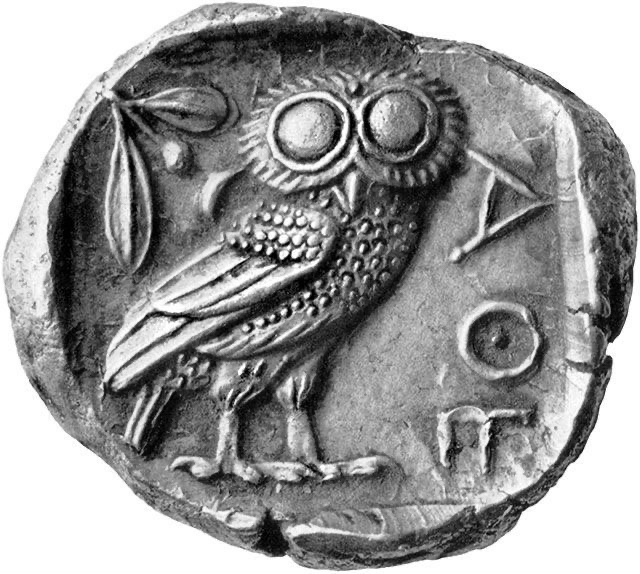
drachma: a silver coin roughly equivalent to the daily wage for a skilled worker
stater: a silver coin worth variously 2 or 4 drachmas”
Daric stater: a Persian gold coin, worth roughly ten times its silver equivalent
mina: (originally a Near Eastern unit of weight) equivalent in Greece to 100 drachmas
talent: a bar of silver, the value of which depended on the locality issuing it; it also served as a measurement of mass
The Euboïc talent was worth 6,000 drachmas and weighed 26 kg; its Babylonian equivalent weighed in at 30 kg. Herodotus himself gives an exchange rate for the Euboic and Babylonian talents.

Sword Types: Xiphos

E4277850-C4DD-402D-9F8F-98BE50CA095C

The ancient Greek xiphos (/ˈksiːfoʊs/ KSEE-fohss; Greek: ξίφος) was a pointed and double edged short sword, typically with a two foot long leaf-shaped blade, that was used for both cutting and thrusting. Designed for single-handed use, the xiphos was favored by the Greeks and was carried by them as standard equipment. The design has most likely been in existence since the appearance of the first swords. Blades in bronze and iron are suitable for a leaf shape due to the softness of the metals in comparison to steel. Bronze swords are cast and are thus more easily formed into a leaf shape than iron swords, which need to be forged. Xiphoi were initially made of bronze. Thus, getting the leaf shape for a bronze sword was simply a matter of pouring molten bronze into a leaf shaped mold. By the 7th and 6th centuries BC, iron supplanted bronze in making xiphoi.

4C7FB64F-1165-46C1-A706-C1DFAF5FF1A1.jpeg
Greek soldier with  Xiphos
It was a secondary battlefield weapon for the Greek armies after the dory or javelin. The classic blade was generally about 50–60 cm long, although the Spartans used a much shorter blade sometimes as short as one foot. The xiphos was generally used only when the spear was discarded for close combat. Xiphoi were usually carried in a baldric (a belt for a sword or other piece of equipment, worn over one shoulder and reaching down to the opposite hip) and hung under the user’s left arm. As ancient Greek warfare revolved around the phalanx, which was a spear-based formation, the xiphos was a secondary weapon, employed in close combat for situations in which the spear was ineffective or not ideal.

76F1427E-E0E4-41EF-864A-0646F2AE4DB0

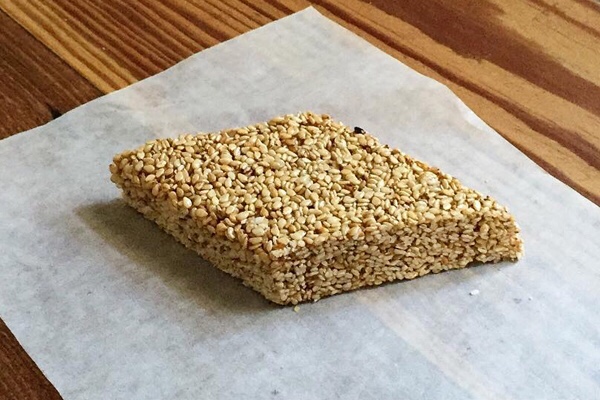
Ancient Greek Food: Sesame Honey Candy (Pasteli)

In Greek: παστέλι, pronounced pah-STEH-lee

In markets these days you can find sesame honey bars. The main difference is that the ancient Greeks did not have refined sugar. The sugar used today helps to harden the bars and make them crunchy. The ancient version was chewier, but simple to make with only two ingredients: sesame seeds and honey.

Warning: The quality and taste of the honey will have an effect on the final product.

Pasteli can be eaten as a candy at any time, or as an energy booster, and it is a wonderful accompaniment to tea.

Ingredients:

  • 1 1/3 cups honey
  • 3 cups hulled white sesame seeds
  • Optional: 1 strip lemon peel (about 1/4 x 1 inch)

Steps:

In a saucepan, bring honey and lemon peel, if using, to a boil. Add sesame seeds, stirring continuously and continue to cook while stirring to mix completely and thoroughly. When the seeds are fully mixed in and the mixture has boiled again, remove from heat. Remove lemon peel and discard.

Place a piece of baking parchment on a cool work surface and spread out the hot mixture thinly and evenly (about 1/4 inch high).

When the pasteli cools to room temperature, refrigerate on the parchment paper (it doesn’t need to be covered). Chill for at least 2 to 3 hours.

With kitchen shears, cut the pasteli together with parchment paper into small pieces, and serve.

To eat, peel off the parchment paper. Store in the refrigerator.

Oracle of Delphi

4D353C64-BC13-4F81-B092-4BEAF7971DBE

Delphi (Greek: Δελφοί) is famous as the ancient sanctuary that grew rich as the seat of Pythia, the oracle who was consulted about important decisions throughout the ancient classical world. Moreover, the Greeks considered Delphi the navel, or center, of the world, as represented by the stone monument known as the Omphalos of Delphi.

Illustration from ÒAn Encyclopedia outline of Masonic, Hermetic, Quabbalistic and Rosicrucian Symbolical PhilosophyÓ by Manly P. Hall Illustration by J. Augustus Knapp titled ÒConsulting the Oracle of DelphiÓ, Mythology, Greek, myths, Delphic, wisdom, be

Delphi is perhaps best known for its oracle, the Pythia, the sibyl or priestess at the sanctuary dedicated to Apollo. According to Aeschylus in the prologue of the Eumenides, the oracle had origins in prehistoric times and the worship of Gaea. Gaea is the personification of the Earth and one of the Greek primordial deities. Gaea is the ancestral mother of all life: the primal Mother Earth goddess.

07151BEE-9D07-4670-8C83-9411FF6CB9E8

Apollo spoke through his oracle. She had to be an older woman of blameless life chosen from among the peasants of the area. Alone in an enclosed inner sanctum she sat on a tripod seat over an opening in the earth (the “chasm”). According to legend, when Apollo slew Python (Python was the serpent, sometimes represented as a medieval-style dragon, living at the centre of the earth, believed by the ancient Greeks to be at Delphi.) its body fell into this fissure and fumes arose from its decomposing body. Intoxicated by the vapours, the sibyl would fall into a trance, allowing Apollo to possess her spirit. In this state she prophesied. The oracle could not be consulted during the winter months, for this was traditionally the time when Apollo would live among the Hyperboreans. Dionysus would inhabit the temple during his absence.

B1A2796E-3F48-4C74-BBF6-0C66D15DB658

The site was first settled in Mycenaean times in the late Bronze Age (1500-1100 BCE) but took on its religious significance from around 800 BCE. The original name of the sanctuary was Pytho after the snake which Apollo was believed to have killed there. Votive offerings at the site from this period include small clay statues (the earliest), bronze figurines, and richly decorated bronze tripods.

Delphi was also considered the centre of the world, for in Greek mythology Zeus released two eagles, one to the east and another to the west, and Delphi was the point at which they met after encircling the world. This fact was represented by the omphalos (or navel), a dome-shaped stone which stood outside Apollo’s temple and which also marked the spot where Apollo killed the Python.

C15452DF-CA45-4DF6-938B-FECDD1222349

Perhaps the most famous consultant of the Delphic oracle was Croesus, the fabulously rich King of Lydia who, faced with a war against the Persians, asked the oracle’s advice. The oracle stated that if Croesus went to war then a great empire would surely fall. Reassured by this, the Lydian king took on the mighty Cyrus. However, the Lydians were routed at Sardis and it was the Lydian empire which fell, a lesson that the oracle could easily be misinterpreted by the unwise or over-confident.

The first temple in the area was built in the 7th century BCE and was itself a replacement for less substantial buildings of worship which had stood before it. The focal point of the sanctuary, the Doric temple of Apollo, was unfortunately destroyed by fire in 548 BCE. A second temple, again Doric in style, was completed in c. 510 BCE with the help of the exiled Athenian family, the Alcmeonids. Measuring some 60 by 24 metres, the facade had six columns whilst the sides had 15. This temple was destroyed by earthquake in 373 BCE and was replaced by a similarly proportioned temple in 330 BCE. This was constructed with poros stone coated in stucco. Marble sculpture was also added as decoration along with Persian shields taken at the Battle of Marathon. This is the temple which survives, albeit only partially, today.

Other notable constructions at the site were the theatre (with capacity for 5,000 spectators), temples to Athena (4th century BCE), a tholos with 13 Doric columns (c. 580 BCE), stoas, stadium (with capacity for 7,000 spectators), and around 20 treasuries, which were constructed to house the votive offerings and dedications from city-states all over Greece. Similarly, monuments were also erected to commemorate military victories and other important events. For example, the Spartan general Lysander erected a monument to celebrate his victory over Athens at Aegospotami. Other notable monuments were the great bronze Bull of Corcyra (580 BCE), the ten statues of the kings of Argos (c. 369 BCE), a gold four-horse chariot offered by Rhodes, and a huge bronze statue of the Trojan Horse offered by the Argives (c.413 BCE). Lining the sacred way, which wound from the sanctuary gate up to the temple of Apollo.

The site was ‘re-discovered’ with the first modern excavations being carried out in 1880 CE by a team of French archaeologists. Notable finds were splendid metope sculptures from the treasury of the Athenians (c. 490 BCE) and the Siphnians (c. 525 BCE) depicting scenes from Greek mythology.  In addition, a bronze charioteer in the severe style (480-460 BCE), the marble Sphinx of the Naxians (c. 560 BCE), the twin marble archaic statues – the kouroi of Argos (c. 580 BCE) and the richly decorated omphalos stone (c. 330 BCE) – all survive as testimony to the cultural and artistic wealth that Delphi had once enjoyed.

#ClassicalHistory #AncientGreece #OracleOfDelphi #Appolo