Agbe (or Agwe): Vodun of the Sea

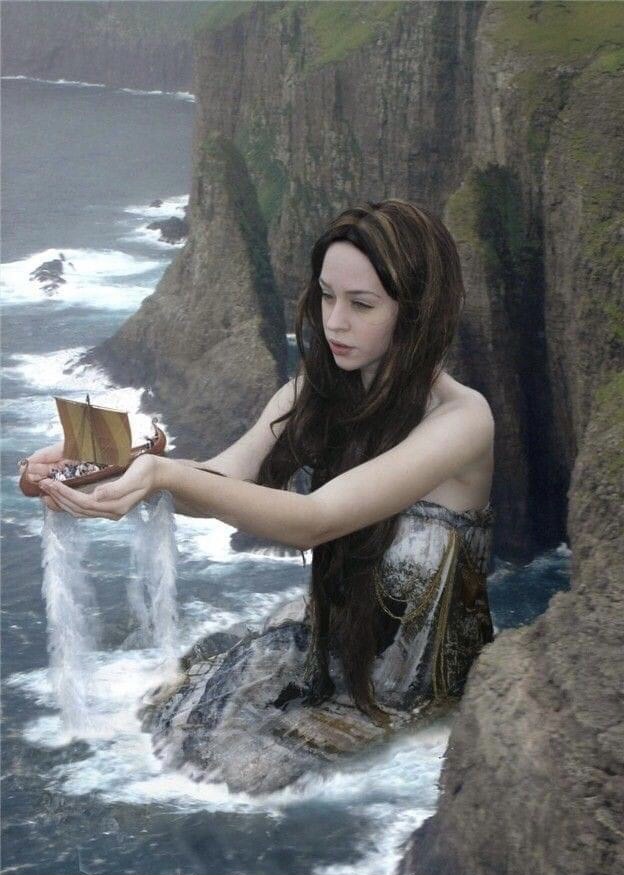
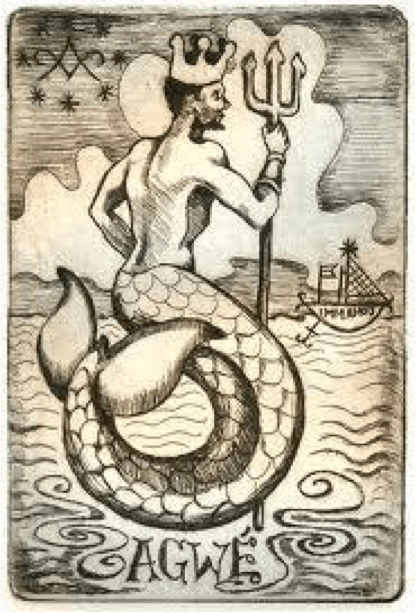
Agbe is the third-born son of Mawu and Lisa. He is the one who is given dominion over the seas and sea life. There aren’t many stories based on Agbe, but as we look back to Mawu’s creation of the world, Agbe’s role within the world becomes obvious. When Mawu built the world, she was afraid that the earth would drown from the added weight, so her snake came in to save it. However, the waters can still be unpredictable, rough, and sometimes cause a whole host of problems.

The land is resting on an outline of great waters, waters that can engulf the land when disturbed. So Agbe functions to keep the waters at bay, provide safety, and protect from powerful storms. Agbe also has some effects on the land that the people experience. For instance, when earthquakes happen, they can be explained by his activity–he has made the water do something that makes the land shake. The serpent is primarily there to keep the world from sinking. The Fon being a fishing people, might have also worshipped Agbe for his luck.

So we see Agbe as the protector, provider, and calmer of seas. He’s not the only one who performs these roles, but he is one of the most powerful to do so. Again, we see how together each god’s roles feed on each other or strengthen each other. While Sakpata pushes for progress, Agbe is the one holding forces that threaten peace and the very land we live on intact.

You can pray to him for protection, maintenance, and calm in your life. These are, in a nutshell, where the spirit excels. But when displeased, it may be a source of chaos, destruction, especially the kind that upends people’s lives. So he is a potent spirit.

Source: Vodun. Monique Joiner Siedlak

Sakpata: Vodun of Earth

When Mawu was dividing the world between her children, Sakpata was given dominion over the earth, at the displeasure of his sister Sogbo. Sakpata came down from heaven with plants, crops, tools, and skills that humans could use for development. Because he had taken so much with him, he did not have space for other necessary elements like water and fire, which were stolen later.

Humans were excited when Sakpata descended from the heavens with these tools of wealth. There was a lot of promise in them, and they hoped they would see their lives improve. Legba, Sakpata’s youngest sibling, told Sogbo, who was given control of the skies, to withhold rain in the sky. Knowing that their mother noticed, Legba went to Mawu and told her water would not be enough for everyone on earth, including the plants. Alarmed, Mawu ordered Legba to tell Sogbo to withhold the rains, which he had already done.

Sakpata soon realized that his crops needed rain, but none came. A drought ensued that caused everything to become dry and brittle. Humans began getting angry with Sakpata. They harassed him and cursed him for lying to them about the prosperity and convenience he had promised. Legba came down and found his brother in a messy state. That was when he told Sakpata he would talk to Mawu on his behalf. He told Sakpata to watch for a messenger, wututu bird, who would say to him what to do when the time came. When the bird returned, it told Sakpata to instruct the others to light a great fire, so the smoke could rise to heaven, signaling their distress.

Because it was so dry, everything caught fire very quickly, and the fire leaped into the sky. When Legba saw, he went to Mawu and told her that the earth was burning and the fire was so high and powerful it might spread to the heavens. Alarmed, Mawu told Legaba to order Sogbo to release the rain. The rain put out the flames and returned fertility to the land. It was decided that although Sogbo controlled the sky, people can call for rain when needed.

What does this story reveal? In this context, it describes the role and power of the spirit of the earth, Sakpata. Sakpata is not the Vodun of Agriculture or fertility, but he is the god of progress and elevating society. When the spirit comes to rule over men, he brings them the tools of trade, crops they can domesticate, and abilities such as woodworking and carpentry skills. These are ways in which this spirit facilitates that mission of progress and growth by equipping humans with the capabilities to prosper, the right tools, and the right environment to do so.

Source: Vodun. Monique Joiner Siedlak

Xevioso: Vodun of Thunder

Xevioso is the god or lord of thunder. A god of thunder is one of the most common in cultures around the world. In Yoruba’s version, he is considered the strongest. He represents wrath, aggression, and punishment. In other words, Xevioso is understood as primarily a spirit of explosive, uncontrollable emotion like anger, violence, and tremendous power. This is a double-edged sword as he can protect those who honor him, but if they offend him in any way, he will likely turn on them.

This is the spirit you turn to when you are looking for justice. Still, anger is usually a sign that something isn’t as it should be, or there has been a violation of some agreement or law.

In most cases, spirits host and govern over the earth, and there is a set of agreements we have towards one another: a type of an unspoken agreement. We go into the world having agreed on a particular set of rules like not stealing from or hurting each other, and so forth. And when someone steals from us, we feel violated, and we have a right to be angry about it, even more so if we know they are getting away with it. Your anger is a sign that someone is not playing by the rules, an injustice has been done. Given this, it is not illogical to suggest that exercising your anger would restore justice and, therefore, balance the world. In other words, Xevioso is the protector and dispenser of justice. Through his acts, he enforces and keeps relations between the gods in check and us. It is not senseless, aimless, unexplainable anger, or fury. Although we may not understand it sometimes, it adds up on a cosmic scale.

Source: Vodun. Monique Joiner Siedlak

James Edward Oglethorpe and the Founding of Georgia

James Edward Oglethorpe was born on December 22, 1696 in London England. He was one of ten children born to Eleanor and Theophilus Oglethorpe. James had a comfortable childhood, since his father owned land in different parts of England. The political nature of James Oglethorpe’s family had great influence on him. In 1698, Theophilus, James’ father, was elected to the House of Commons. While not much is know about Oglethorpe’s childhood, it is known that beginning in 1714 he was admitted to Corpus Christi College at Oxford University. Oglethorpe soon dropped out of school and joined the English military. He had a very successful campaign against the Turks. He returned to school after, but never graduated. Even though in 1731 Corpus Christi College awarded him an M.A. In 1722, Oglethorpe followed his father’s footsteps and was elected House of Commons where he focused on the domestic and international policies of England. At that time, in England, people could be jailed for their debt. This was the case with Robert Castell, one of Oglethorpe’s close friends. Due to the death of his friend in prison, as a result of bad prison conditions, Oglethorpe launched a campaign to improve prison conditions which earned him national notoriety.

It was during this time that Oglethorpe formed a plan to deal with all the poverty in England. His idea was to take all the “worthy poor” and move them to a new colony in the Americas where they could become farmers and merchants. Oglethorpe was also set on the idea that the structure of the social classes in England, which caused so much poverty, should be avoided in the new colony. This meant no one person would be allowed to hold much land and slavery would be prohibited. After he revealed his idea to King George II, he was given clearance to begin the colony of Georgia. Oglethorpe was also named one of the twenty-one trustees who would govern the colony. Unfortunately, when the new colonists were being selected, the original idea of picking people with debts was lost and the selection focused more on skills and usefulness.

In November 1732, 114 people left for Georgia to make their home there. Oglethorpe was on this first boat load of settlers. As a trustee, Oglethorpe worked hard, and at times, even broke the law, in order to allow Jews and other persecuted religious groups to settle in Georgia. He was strongly opposed to slavery. He did his best to make fair treaties with Native Americans and protect them from white traders. Though he was not officially a “governor”, because as a trustee he was not allowed to hold office, many considered him Georgia’s first governor for his clear leadership over the colony.

Georgia was agreed upon partially because it was a place the English could protect their colonies in America against the Spanish. It was because of this situation that Oglethorpe convinced the king to make him a Colonel. Oglethorpe launched a preemptive attack on the Spanish, which failed. The Spanish counter-attacked but Oglethorpe’s regiment managed to push back the Spanish in the Battle of Gully Hole Creek. In the Battle of the Bloody Marsh, Oglethorpe managed to beat the Spanish badly enough that they decided the heavy losses sustained were not worth the fight. Oglethorpe had successfully defended Georgia.

In 1744, Oglethorpe returned to England and married Elizabeth Wright. He settled in the small Essex town of Cranham. Oglethorpe remained a Trustee, but the other trustees in Georgia relaxed their restrictions on alcohol, slavery and land ownership. Oglethorpe lived to see the colony that he had made become part of the United States of America. After a brief sickness, Oglethorpe died on June 30, 1785.

Carolina Colony Founded

In August 1669 three ships left with the first settlers. Each family had paid 500 Pounds for their part of the settlement. They founded the settlement of Charlestown. Within two years there were 271 men and 69 women in the settlement

The proprietors of the settlement set up a system of government that was called “the Fundamental Constitution of the Carolinas”. One of the authors of the Constitution was John Locke. It provided for an independent parliament in the colony, which gave greater power to the owners of large lands.

The growth of the Carolina colony was slow. The coastal land was swampy and many of the early inhabitants came down with malaria. The proprietors of the colony wanted to offer large land holdings to a small number of settlers. This limited the number of settlers and slowed down the growth of the colony.

The settlement of northern and southern Carolina were very different. Settlers from Virginia seeking more land, while settlers in the Southern part of the colony were coming from the West Indies and Europe mostly settled Northern Carolinas. Settlers in the northern part grew tobacco, while the settler in the Southern part of the colony grew rice. The parts of the colony grew apart and finally, in 1712 they separated and became North and South Carolina.

Jamestown Founded

The British Monarchy did not have enough money to organize settlement activity in North America. Instead, they assigned that role to independent companies that raised money from merchants to accomplish this goal. King James gave the charter to settle the area around Virginia Company of London

On December 20th 1606, 105 settlers set sail to the New World to establish a colony for the London Virginia company. The group included 35 gentlemen, a minister, a doctor, 40 soldiers and a mixture of artisans and laborers. They arrived off the coast of Virginia in late April 1607. Captain Newport, who commanded the expeditions, was given instructions to find a site that was safe from Spanish attack, but gave access to the sea. Newport sailed up the James River. He found a site 50 miles up the river that was joined to the mainland by a small natural passageway, and thus defensible. He decided on that site and claimed it for James I. He called the new settlement “Jamestown”.

The settlers began by clearing the land and building a fortified settlement. They built small one and two room timber cottages and cleared additional land for planting crops. Initially, they found the Native Americans friendly and willing to trade, but relations with the native Indians remained uneven. Soon some of the negatives of the location of became apparent, as settlers began to die of disease– some from diseases they had brought from England and others from diseases they encountered in the mosquito infested swamp that they found initially in Jamestown. By winter, it was clear that not enough crops had been grown to survive the winter, a winter that turned out to be devastating. Despite trading with the Natives, by the end of the winter only 30 of the original settlers survived.

In the spring of 1608, Captain John Smith, who was a natural leader, took control of the settlement. Smith overcame one of the major problems of the settlement, the unwillingness of many of the noblemen to work. He made a simple rule: no work … no food.

Baron Samedi

Baron Samedi, “The Master of the dead” in Voodoo, occupies a popular place as the guardian of cemetries, and the spirit responsible for an individual’s transportation to the underworld. One of the more prevalent loas in Haitian voodoo is Baron Samedi. He fills a vital role in Haitian voodoo as the master of the dead, ushering the newly deceased into the afterlife. Who is Baron Samedi? In Haitian voodoo, Baron Samedi is the head of the Guede family of loa.

His name is often translated as Baron Saturday, Baron Samdi, Bawon Samedi, or Bawon Sanmdi. The last name of Saturday comes from the French translation of Samedi. Baron leads the Guede family, a group of loas with strong links to magic, ancestor worship, and death. The loas in the family consist primarily of lesser spirits, dress the same as Baron, have rude (even crude) attitudes, but lack the charm of their master. Baron is portrayed in Haitian voodoo wearing a top hat, black tuxedo, dark glasses, and cotton plugs in his nostrils. His image is often said to resemble that of a corpse that has been dressed and prepared for burial in traditional, Haitian manner. His face is said to resemble a skull, and he uses a nasal voice.

Baron spends the majority of his time in the invisible realm of Haitian voodoo spirits. His behaviour is described as outrageous. He is known to spend his time drinking rum and smoking cigars, swearing profusely, and making filthy jokes to the other loas. The other spirits in the Guede family are said to behave in the same manner, without the suave ability of Baron Samedi.

The Baron needs that suave nature because he is believed to chase mortal women, despite being married to the loa, Maman Brigitte. Baron’s time is spent lingering at the crossroads of life and death in the human world. When someone dies, Baron is said to dig their grave and meet their soul as it rises from the grave. He guides them into the underworld. Only Baron Samedi has the power to accept an individual into the world of the dead.

It is also said that Baron ensures that all those who have died rot in the ground as they should, ensuring that no soul can come back as a brainless zombie. He will demand payment for this act, which varies depending upon his mood at the time. On many occasions, he is content to accept gifts of cigars, rum, black coffee, or grilled peanuts.

Mami Wata

Mami Wata is a water-spirit, sometimes described as a mermaid figure, who can found throughout the western coastal regions and into central Africa. Mami Wata is described as having long dark hair, very fair skin and compelling eyes. Although she may appear to her devotees (in dreams and visions) as a beautiful mermaid, complete with tail, she is also said to walk the streets of modern African cities in the guise of a gorgeous but elusive woman. She is interested in all things contemporary: some of her favorite offerings include sweet, imported perfumes, sunglasses and Coca-Cola. Nonetheless, the spirit appears to be related to other water spirits who have a much longer history on the continent. Mami Wata’s colors are red and white. Those she afflicts with visions and temptations, and who experience her as an obsession or an illness, may wear the red of sickness and dangerous heat. Others who have a more positive orientation towards the spirit may show their blessings by wearing white. Most devotees wear a combination of red and white clothing.

Mami Wata is also said to have a number of avatars on earth–mortal women who have the same look as the deity and who act as her “daughters.” Mami Wata may give wealth to her devotees, her “daughters” or to her (male) spouses, but she is never known to give fertility. Some Igbo stories suggest that the fish under the waters are her children, and that she uses them as firewood. Mami Wata is sometimes seen as a metaphor for modern African conditions — having the knowledge of global wealth and the desire for large-scale consumption, but lacking the actual wealth or access to the world’s wealth that would enable Africans to participate in that system. A number of Africanist art historians have written about Mami Wata, notably Henry Drewal, as have anthropologists like myself. She is the subject of local poetry, song, paintings, carvings and now film.

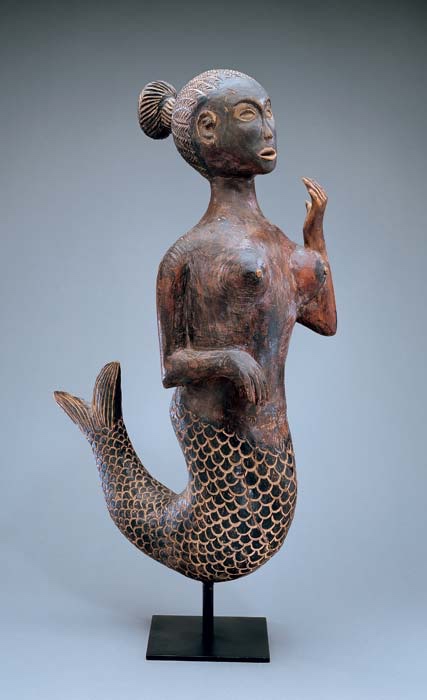
Mami Wata is depicted as a mermaid, with a woman’s torso and the legs of either a fish or serpent. Sometimes Mami Wata is depicted as a whole woman carrying a large snake or snakes wrapped around her body. While she is often depicted as a mermaid or half woman–half snake, Mami Wata actually represents a whole pantheon of spirits and deities in West Africa. Mami Wata is the African ambassador to all the spirits of the waters: La Sirene, the Haitian Vodou loa who is similarly depicted as a mermaid; Yemoja, the Yoruban Mother of the Seven Seas; and Yemayá in Santeria and Ifá. Mami Wata remains an important spirit in the New Orleans Voudou pantheon.

Aegir and Ran

In Norse mythology, Aegir and Ran are a married couple that lives under the sea. Ran is a sea goddess, and her husband Aegir is a jotünn, and together they have nine daughters who all are named after the waves of the sea.

Their names are bloody-hair (Blóðughadda), wave (Bylgja), foaming sea (Dröfn), pitching wave (Dúfa), the lifting one (Hefring), transparent wave (Himinglæva), welling wave (Hronn), cold wave (Kolga) and frothing wave (Uðr). They are sometimes referred to as the spirits of the waves or the nine billow maidens.

Ran whose name means robbery, loves to spend her day catching and dragging drowning sailors with her huge fishing net down into her realm on the bottom of the sea.

This is the same fishing net as the trickster Loki once borrowed because he wanted to capture the dwarf Andvari who had turned himself into a pike.

Aegir means “sea” in Old Norse, is not a sea god, but he is a jötunn. Even Though Aegir is a jötunn (giant) the couple has befriended the Aesir, they are actually very well-liked among them, and they are often invited to the feasts in Asgard.

Aegir and Ran are often the hosts of the feasts themselves, and they send out invitations to the Aesir to visit them in their great hall in their underwater realm. The Norse gods never decline an invitation, they love to come and visit and drink the beer that Aegir brews.

For you see, Aegir is very well-known for his astonishing beer throughout the nine realms. He might be using his magic as his secret ingredient when he is brewing the beer in his huge cauldron.

His immense knowledge in the art of magic is known among the Aesir, probably one of the reasons why Odin wants to be around him. Odin does not come to the feasts for the beer, he only likes wine, but he probably comes to learn some of Aegir’s magic.

Mummy Brown

Until relatively recently, Egyptian mummies, believe it or not, were used to produce a type of paint, which was called Mummy Brown, Mommia, or Momie. The main ingredient of this paint was, as you may have already guessed, ground up Egyptian mummies. This powder was mixed with white pitch and myrrh to produce a rich brown pigment. It was first made in the 16th century, and became a popular color amongst the Pre-Raphaelite painters of the mid-19th century.

For instance, it has been recorded that the British portraitist, Sir William Beechey, kept stocks of Mummy Brown. The French artist Martin Drölling also reputedly used Mummy Brown made with the remains of French kings disinterred from the royal abbey of St. Denis in Paris. It has been suggested that his L’interieur d’une cuisine is an example of extensive use of the pigment, while the mesmerizing painting by Edward Burne-Jones, entitled The Last Sleep of Arthur in Avalon, is also believed to have been painted using Mummy Brown.

Apothecary: Using Ground Mummies to Cure Disease

Art supplies were not the only things that ground bones of mummies were used for. More surprisingly, perhaps, is their use for medicinal purposes. This was due to the belief that mummies contained bitumen, which was used by the ancient Greeks to cure a variety of diseases. Apparently, in the absence of real bitumen, the so-called bitumen from a mummy would do just as well. Keep in mind that the word mummy itself is derived from the Persian word for bitumen, mum or mumiya.

As a result of this belief in the medicinal properties of Mummy powder, Egyptian mummies were exported to Europe, ground down, and sold in apothecaries throughout the continent. Part of the craze for Mummy powder was due to the claim that mummies had a mysterious life force that was transferrable to whoever ingested it. Hence, ground mummies were consumed by Europeans well into the 18th century.

Sources: Ancient Origins, “The Gruesome History of Eating Corpses as Medicine” in Smithsonian Magazine, “Ground Up Mummies Were Once an Ingredient in Paint” in Smithsonian Magazine.