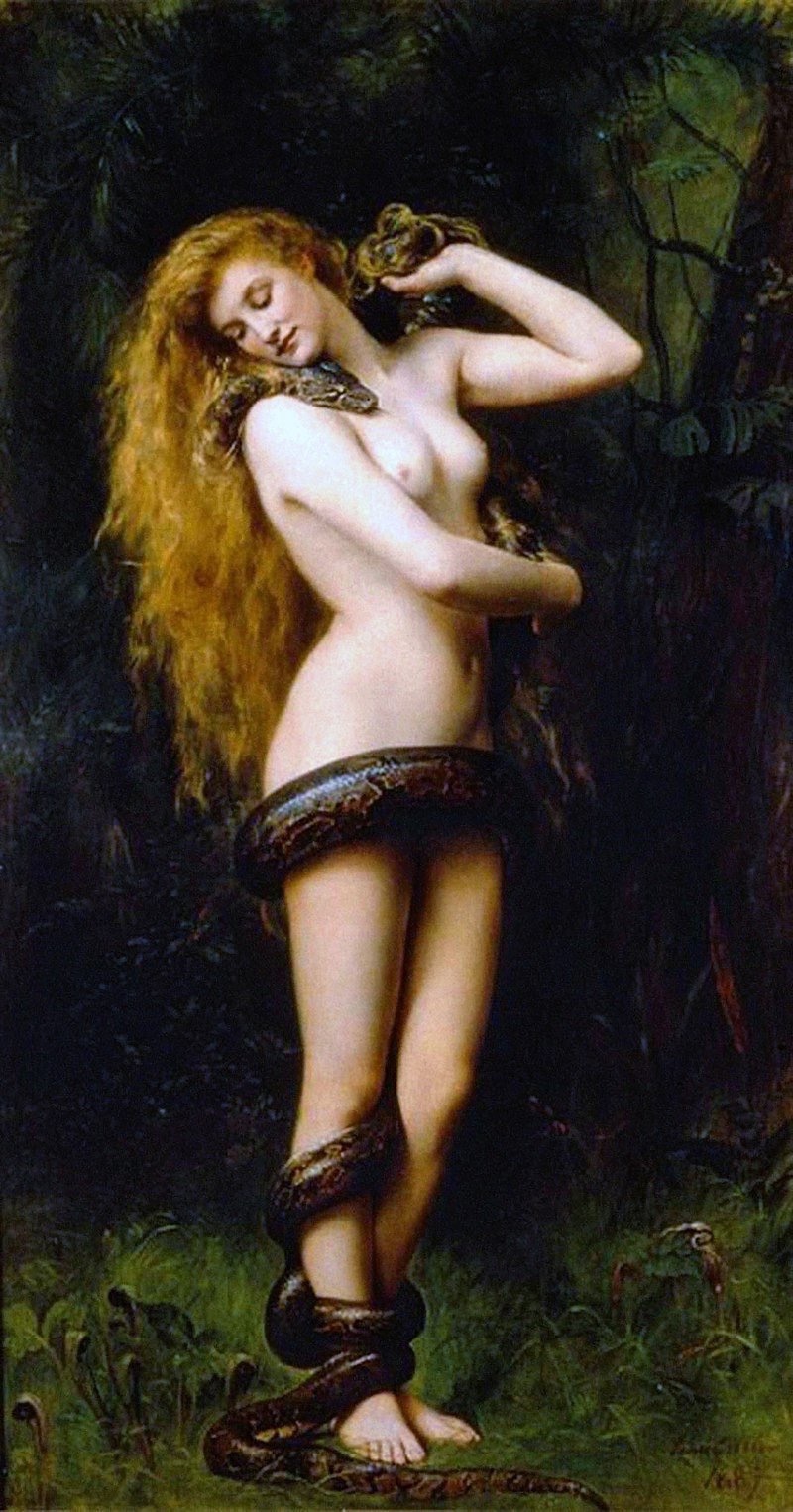
In Jewish folklore, Lilith was thought to be Adam’s first wife in Eden. She refused to be subservient to him and left the garden. She “coupled” with the archangel Samael and became a demon of the night.
(John Collier painting)

In Jewish folklore, Lilith was thought to be Adam’s first wife in Eden. She refused to be subservient to him and left the garden. She “coupled” with the archangel Samael and became a demon of the night.
(John Collier painting)

Asgard: Home of the Gods
In the middle of the world, high up in the sky is Asgard (Old Norse: “Ásgarðr”). It’s the home of the Gods and Goddesses. The male Gods in Asgard, are called Aesir, and the female Gods are called Asynjur. Odin is the ruler of Asgard and the chief of the Aesir. Odin is married to Frigg; and she is the Queen of the Aesir. Inside the gates of Asgard is Valhalla; it’s the place where half of the Vikings “Einherjer” that died in battle will go for the afterlife, the other half goes to Fólkvangr.

Alfheim: Home of the Light Elves
Alfheim (Old Norse: “Álfheimr or Ljósálfheimr”) is right next to Asgard in the heaven. The light elves are beautiful creatures. They are considered the “guardian angels” The God Freyr, is the ruler of Alfheim. The Light elves are minor Gods of nature and fertility; they can help or hinder humans with their knowledge of magical powers. They also often delivered an inspiration to art or music.
Midgard: Home of the Humans
Midgard (Old Norse: “Miðgarðr”) “middle earth” is located in the middle of the world, below Asgard. Midgard and Asgard are connected by Bifrost the Rainbow Bridge. Midgard is surrounded by a huge ocean that is impassable.
The Ocean is occupied by a huge sea serpent, the Midgard Serpent. The Midgard serpent is so huge that it encircles the world entirely, and biting its own tail. Odin and his two brothers Vili and Ve created the humans from an Ash log, the man and from an elm log, the woman.
Muspelheim: The Land of Fire
Muspelheim (Old Norse: “Múspellsheimr”) was created far to the south of the world in Norse mythology. Muspelheim is a burning hot place, filled with lava, flames, sparks, and soot. Muspelheim is the home the of fire giants, fire demons and ruled by the giant Surtr. He is a sworn enemy of the Aesir. Surtr will ride out with his flaming sword in his hand at Ragnarok “Ragnarök” “the end of the world” Surtr will then attack Asgard, “the home of the Gods” and turn it into a flaming inferno.
Vanaheim: Home of the Vanir
Vanaheim (Old Norse: “Vanaheimr”) is the home of the Vanir Gods. The Vanir Gods is an old branch of Gods. The Vanir are masters of sorcery and magic. They are also widely acknowledged for their talent to predict the future. Nobody knows where exactly the land, Vanaheim is located, or even how it looks like. When the war between the Aesir and the Vanir ended, three of the Vanir came to live in Asgard, Njord and his children Freya and Freyr.
Niðavellir/ Svartalfheim: Home of the Dwarves
Svartalfheim (Old Norse: “Niðavellir or Svartálfaheimr”) is the home of the dwarves, they live under the rocks, in caves and underground who are also synonymous with the Dark Elves (“Dökkálfar”) and Black Elves (“Svartálfar”). Hreidmar was the king of Svartalfheim, Svartalfheim means Dark fields. The dwarves are masters of craftsmanship. The Gods of Asgard have received many powerful gifts. Like , the magical ring Draupnir and also Gungnir, Odin’s spear.
Jotunheim: Home of the Giants
Jotunheim (Old Norse: “Jötunheimr or Útgarðr”) is the home of the giants (also called Jotuns). They are the sworn enemies of the Aesir. Jotunheim consists mostly of rocks, wilderness, and dense forests, and it lies in the snowy regions on the outermost shores of the ocean. Because of this, the giants live mostly from the fish from the rivers, and the animals from the forest, because there is no fertile land in Jotunheim.
The giants and the Aesir are constantly fighting, but it also happens from time to time, that love affairs will occur. Odin, Thor and a few others, had lovers who were giants. Loki also came from Jotunheim, but he was accepted by the Aesir and lived in Asgard. Jotunheim is separated from Asgard by the river Iving, which never freezes over. Mimir’s well of wisdom is in Jotunheim, beneath the Midgard root of the ash tree Yggdrasil. The stronghold of Utgard is so big that it is hard to see the top of it. And there the feared Jotun king Utgard-Loki lives. Utgard is carved from blocks of snow and glistening icicles.
Niflheim: The World of Fog and Mist
Niflheim (Old Norse: “Niðavellir”) and it means (“Mist home” or “Mist World”) is the darkest and coldest region in the world according to Norse mythology. Niflheim is the first of the nine worlds and Niflheim is placed in the northern region of Ginnungagap. The eldest of the three wells are located in Niflheim which is called Hvergelmir “bubbling boiling spring” and it is protected by the huge dragon called Nidhug (Níðhöggr).
It is said that all cold rivers come from the well called Hvergelmir, and it is said to be the source of the eleven rivers in Norse mythology. The well Hvergelmir is the origin of all living and the place where every living being will go back. Elivagar “ice waves” are the rivers which existed in Niflheim at the beginning of the world. They were the streams floating out of Hvergelmir. The water from Elivagar flowed down the mountains to the plains of Ginnungagap, where it solidified to frost and ice, which gradually formed a very dense layer. This is the reason that it is very cold in the northern plains. As the world tree Yggdrasil started to grow, it stretched one of its three large roots far into Niflheim and drew water from the spring Hvergelmir.
Helheim: Home of the dishonorable dead
This is where all the dishonorable dead, thieves, murderers and those the Gods and Goddesses feel is not brave enough to go to Valhalla or Folkvangr. Helheim is ruled by Hel, Helheim is a very grim and cold place, and any person who arrives here will never feel joy and happiness again. Hel will use all the dead in her realm at Ragnarök to attack the Gods and Goddesses, which will be the end of the world.

The Torment of Tantalus
Confined to the underworld for attempting to deceive the gods, Tantalus reaches above his head to a branch that bares fruit though he cannot successfully pluck the food from the bough to sate his hunger. Water rises to his neck, but he is unable to drink to quench his thirst.

Hylas and the Nymphs
Hylas and the Nymphs is not one of John William Waterhouse’s most well known works, however it is a prime example of his skill as an artist and therefore has received very little negative comment since its completion in 1896.
Taken from the story of Jason and the Argonauts, Hylas was an Argonaut warrior and the assistant and lover of Herlkas. He was also known to be a very handsome youth.
When Jason’s boat landed on an island during his search for the Golden Fleece, Hylas was sent to fetch water for the camp. Finding a pool in a clearing, he reached down and put his pitcher into the water. Before he could lift his pitcher he looked up to discover water nymphs encircling him. Drawn by his beauty, one of the nymphs reached up to kiss Hylas.
The tale stops there and Hylas disappeared without trace from that moment, it was said that Herlkas searched the island for his beloved, in fact such a time passed that the boat left without him.

5 Fun Facts about the Acropolis:
1. During the Ottoman occupation, the Parthenon was a mosque and the Erechtheion next to it a harem. When the Ottoman occupation ended, the new king Otto wanted to build his palace on the Acropolis hill. Luckily, his father, who was very fond of the ancient Greek civilization, talked him out of it.
2. It is believed that Socrates was one of the stonemasons working on the monument’s construction.
3. Every column required 19,000 man-hours, which is the number of man-hours needed to construct a medium sized apartment block today.
4. The Parthenon’s sculptural decoration was finished by the 150 stonemasons and 50 sculptors who created it at the first place. Of those workmen, 20% were slaves, 30% Athenians and 50% metics (free, non-citizen residents).
5. The most important sculpture of the Parthenon was not outside but inside. There is evidence that the temple was built to measure in order to accommodate the chryselephantine statue of Athena by Pheidias.
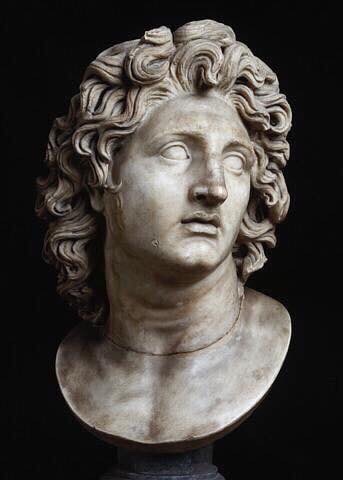
Lysippos was a Greek sculptor of the 4th century BC. Together with Scopas and Praxiteles, he is considered one of the three greatest sculptors of the Classical Greek era, bringing transition into the Hellenistic period. Here is an example of his work above.
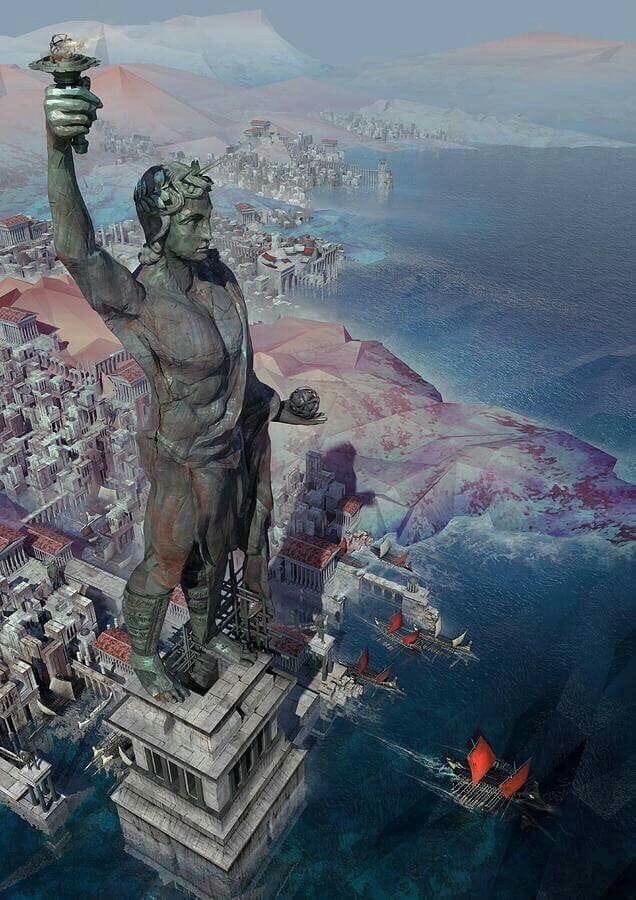
The Colossus of Rhodes was a statue of the Greek sun-god Helios, on the island of Rhodes in 280 BC. One of the Seven Wonders of the Ancient World, it was constructed to celebrate Rhodes’ victory over the ruler of Cyprus in 305 BC.
According to most contemporary descriptions, the Colossus stood approximately 33 metres (108 feet) high—the approximate height of the modern Statue of Liberty from feet to crown—making it the tallest statue of the ancient world.
Unfortunately It collapsed during an earthquake in 226 BC; although parts of it were preserved, it was never rebuilt. Fast forward to today and there are tentative plans to rebuild the Colossus at Rhodes Harbour although the exact position of the original is unknown.

“In the 2nd year of the Peloponnesian War, 430 BCE, an outbreak of plague erupted in Athens. The illness would persist throughout scattered parts of Greece and the eastern Mediterranean until finally dying out in 426 BCE. The origin of the epidemic occurred in sub-Saharan Africa just south of Ethiopia. The disease swept north and west through Egypt and Libya across the Mediterranean Sea into Persia and Greece. The plague entered Athens through the city’s port of Piraeus. The Greek historian Thucydides recorded the outbreak in his monumental work on the Peloponnesian war (431-404 BCE) between Athens and Sparta. According to various scholars, by its end, the epidemic killed upwards of 1/3 of the population; a population which numbered 250,000-300,000 in the 5th century BCE. By most accounts, the plague which struck Athens was the most lethal episode of illness in the period of Classical Greece history.”
~ John Horgan “Ancient History Encyclopedia, https://www.ancient.eu”

~ Thucydides (c. 460 – 399 B.C.)

Phryne the Thespian:
Phryne the Thespian was a notable hetaira, or courtesan, of Athens, who has been remembered throughout the millennia for her dramatic trial which she won by baring her breasts.
According to Athenaeus, Phryne was prosecuted on a capital offense, and was defended by the orator Hypereides, one of her lovers. Athenaeus does not specify the nature of the charge, though some other historical sources state that she was accused of profaning the Eleusinian Mysteries.
Although there is great debate among scholars about what really happened that day in court, Athenaeus wrote that Hypereides tore off Phryne’s dress in the middle of the courtroom to show the judges her beautiful body. His reasoning was that only the gods could sculpt such a perfect body; thus killing or imprisoning her would be seen as blasphemy and disrespect to the gods.
What appeared to be an unfavorable verdict for Phryne turned into a glorious victory for her after the inspired action of Hypereides. Phryne walked out the court triumphant, and her story went on to inspire many works of art, including the iconic painting Phryne before the Areopagus by Jean-Léon Gérôme (1861).
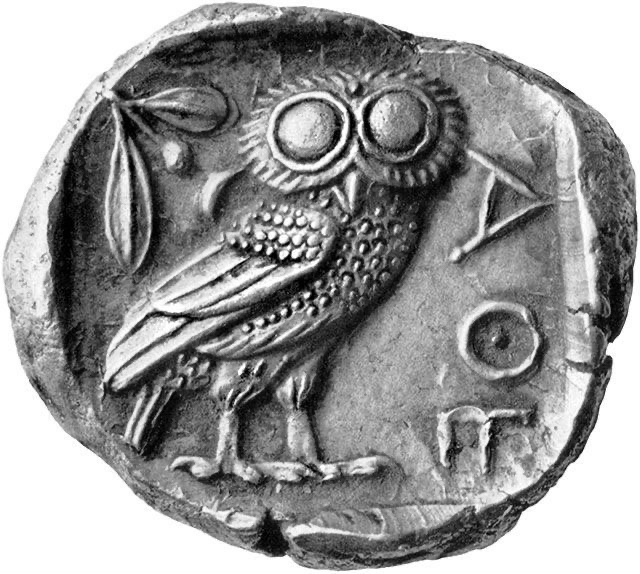
Measurements and Currency Of Ancient Greece:
Length and Distance:
finger: c. 1.9 cm (a finger’s breadth, not the length of a finger)
palm: 4 fingers, c. 7.6 cm
hand: 5 fingers, c. 9.5 cm
foot: 16 fingers, c. 32 cm (this is the Olympic foot, supposedly based on the length of Heracles’ foot; the Attic foot was c. 30 cm)
pygon: 20 fingers, c. 38 cm
cubit: 24 fingers, c. 46 cm
royal cubit: 27 fingers, c. 52 cm
fathom: 6 feet, c. 1.9 m
plethron: 100 feet, c. 30 m
stade: 600 feet, c. 192 m
parasang: (Persian) equivalent to 30 stades, c. 5.5 km
schoenus: (Egyptian) variously equivalent to 30, 60 or 120 stades in Egypt; outside Egypt it was most commonly equivalent to 30 stades
Volume:
cotyle: varies between 210 and 330 ml
choenix: 4 cotylae; in Athens, it measured a single man’s daily ration of grain
medimnus: 48 choenixes
amphora: (of liquid) equivalent to 144 cotylae
Laconian quart: (of liquid) estimated at anything between 9 and 25 litres
Currency:
drachma: a silver coin roughly equivalent to the daily wage for a skilled worker
stater: a silver coin worth variously 2 or 4 drachmas”
Daric stater: a Persian gold coin, worth roughly ten times its silver equivalent
mina: (originally a Near Eastern unit of weight) equivalent in Greece to 100 drachmas
talent: a bar of silver, the value of which depended on the locality issuing it; it also served as a measurement of mass
The Euboïc talent was worth 6,000 drachmas and weighed 26 kg; its Babylonian equivalent weighed in at 30 kg. Herodotus himself gives an exchange rate for the Euboic and Babylonian talents.
 Mark Bere Peterson’s Counterculture, Urban Legends, Paganism & Witchcraft