Opening of Tutankhamun’s Tomb

468D332F-1D80-4659-8255-71FD8AC3B223.jpeg
Knot of King Tutankhamun’s Tomb
1922: Howard Carter and Lord Carnarvon became the first people to enter the tomb of Pharaoh Tutankhamun since the young ruler was buried in 1323 BCE. Below is a four minute video about the discovery. Here’s the famous story of the tomb’s opening:

“Carter returned to the Valley of Kings, and investigated a line of huts that he had abandoned a few seasons earlier. The crew cleared the huts and rock debris beneath. On 4 November 1922, their young water boy accidentally stumbled on a stone that turned out to be the top of a flight of steps cut into the bedrock. Carter had the steps partially dug out until the top of a mud-plastered doorway was found. The doorway was stamped with indistinct cartouches (oval seals with hieroglyphic writing). Carter ordered the staircase to be refilled, and sent a telegram to Carnarvon, who arrived two-and-a-half weeks later on 23 November.

On 26 November 1922, Carter made a “tiny breach in the top left hand corner” of the doorway, with Carnarvon, his daughter Lady Evelyn Herbert, and others in attendance, using a chisel that his grandmother had given him for his 17th birthday. He was able to peer in by the light of a candle and see that many of the gold and ebony treasures were still in place. He did not yet know whether it was “a tomb or merely a cache”, but he did see a promising sealed doorway between two sentinel statues. Carnarvon asked, “Can you see anything?” Carter replied with the famous words: “Yes, wonderful things!” Carter had, in fact, discovered Tutankhamun’s tomb (subsequently designated KV62).”

King Tutankhamun’s Tomb

4069CF30-F4D4-4BC3-90C7-FCAF5EC4A0A9

Various items found in King Tutankhamun’s tomb including his funerary bed and sarcophagus:

Tutankhamun (also known as Tutankhamen ruled c. 1332–1323 BC) is the most famous and instantly recognizable Pharaoh in the modern world. His golden sarcophagus is now a symbol almost synonymous with Egypt. His name means `living image of the god Amun’. He was born in the year 11 of the reign of Pharaoh Amenhotep IV (better known as Akhenaten) c. 1345 BCE and died, some claim mysteriously, in 1327 BCE at the age of 17 or 18. He became the celebrity pharaoh he is today in 1922 CE when the archaeologist Howard Carter discovered his almost-intact tomb in the Valley of the Kings. While it was initially thought that Tutankhamun was a minor ruler, whose reign was of little consequence, opinion has changed as further evidence has come to light. Today Tutankhamun is recognized as an important pharaoh who returned order to a land left in chaos by his father’s political-religious reforms and who would no doubt have made further impressive contributions to Egypt’s history if not for his early death.

D904690A-6C48-4756-BF10-FAE9BD32885BF7BCDC0D-8C95-45CD-8099-5D83FDFD93198FF26A26-8111-4DA9-91A2-7C46B29AC769B1BF6DF7-7943-4F57-9BAC-3415E16467F578DDC240-3D3B-49F0-8650-B9790F9A845CEED842C7-2A25-4453-8195-D0EC9AFEE46C220AD9CE-03A1-4E5A-9841-4032EA48C7E9D03A7FEA-1844-4CDF-9BE9-EB53F7D305DE201299B7-82F5-4E61-99A7-6C3EA31753152CE1FB2B-F547-4BC7-8A8F-91B4B4E7F1D534EE4E81-6A96-4999-90BE-A341AA9678454F3AF573-4CF6-410A-B119-B372D265E18567DF4121-87F9-4672-95DF-4EE95B39867EAF6F5FD3-8D53-4351-8208-AEAE50C13CB4

Sword Types: Xiphos

E4277850-C4DD-402D-9F8F-98BE50CA095C

The ancient Greek xiphos (/ˈksiːfoʊs/ KSEE-fohss; Greek: ξίφος) was a pointed and double edged short sword, typically with a two foot long leaf-shaped blade, that was used for both cutting and thrusting. Designed for single-handed use, the xiphos was favored by the Greeks and was carried by them as standard equipment. The design has most likely been in existence since the appearance of the first swords. Blades in bronze and iron are suitable for a leaf shape due to the softness of the metals in comparison to steel. Bronze swords are cast and are thus more easily formed into a leaf shape than iron swords, which need to be forged. Xiphoi were initially made of bronze. Thus, getting the leaf shape for a bronze sword was simply a matter of pouring molten bronze into a leaf shaped mold. By the 7th and 6th centuries BC, iron supplanted bronze in making xiphoi.

4C7FB64F-1165-46C1-A706-C1DFAF5FF1A1.jpeg
Greek soldier with  Xiphos
It was a secondary battlefield weapon for the Greek armies after the dory or javelin. The classic blade was generally about 50–60 cm long, although the Spartans used a much shorter blade sometimes as short as one foot. The xiphos was generally used only when the spear was discarded for close combat. Xiphoi were usually carried in a baldric (a belt for a sword or other piece of equipment, worn over one shoulder and reaching down to the opposite hip) and hung under the user’s left arm. As ancient Greek warfare revolved around the phalanx, which was a spear-based formation, the xiphos was a secondary weapon, employed in close combat for situations in which the spear was ineffective or not ideal.

76F1427E-E0E4-41EF-864A-0646F2AE4DB0

Sword Types: Gladius

“GLADIUS” – The sword that conquered the known world back then used by the Roman Army.

~ The gladius was a miniature form of a sword, having a short blade, about 20 to 25 inches long.

~ This was one of the basic weapons of the Roman foot soldiers, used primarily for stabbing the enemy.

~ Gladius had two sharp cutting-edges and a sharp-pointed end, designed specially to have a lethal impact on the enemy, when stabbed.

~ The gladius remained the standard weapon of the Romans up to nearly the middle of the second century A.D., when it was replaced by a larger and longer sword.

Ancient Sumerian Games: Game Of Ur

5662CD5E-5C51-47BA-A16B-5C8DD37B9287.jpeg

This is the Ancient Royal Game of Ur – Will We Ever Understand It, how it’s played?

The Royal Game of Ur is a Sumerian version of the ancient Middle Eastern game generically called The Game of Twenty Squares, in Royal Tombs of Ur in Iraq by Sir Leonard Woolley in the 1926-1927, and is dated to roughly to 2500 BCE. One of the copies from Ur is kept in the British Museum.

The original rules of the Royal Game of Ur are unknown, but have been reconstructed by a few different historians based on a cuneiform tablet found in 1880 in Iraq, which is now located in the British Museum.  The tablet was written in 177-176 BCE by a Babylonian Scribe Itti-Marduk-balatu.

E3D7C27C-45DE-4770-B039-297C36A0C7B7

The problem with most rules proposed by historians, such as RC Bell and Irving Finkel is that the game is boring and not challenging. Considering that different versions of this game were found in many Mediterranean and Middle Eastern countries with over 100 examples found archaeologically, we can assume that the game was popular and I interesting.

Historians who reconstructed rules of play lumped the Royal Game of Ur together with Egyptian Aseb, Jiroft Game of 20 Squares, and Shahr-i Sokhta Game of 20 Squares, which used the same board, but did not have any of the square markings, and since the boards are all similar looking and contain 20 squares. However, The Royal Game of Ur board is so much more elaborately designed than Aseb, Jiroft, and Shahr-i Sokhta that it would make more sense that this game is a similar type of game, but the rules are different.

Ancient Egyptian Games: Senet

BEE3A61C-CAAE-4C21-B0C6-829B9F2A84A0

The statues and pyramids, the Nile river and the desert, the hieroglyphics and the Rosetta Stone get all the press, but the ancient Egyptians enjoyment of play and especially games from athletic demonstrations of strength to board games which we’ll focus upon the most popular one here.  They had toys made of clay and wood and fashioned balls out of leather. They loved to dance and also loved to swim in the Nile River. Board games and pictures depicting people dancing in circles have been found in tombs dating back thousands of years.

CF92B167-13AD-4E86-A9A9-6CCB5EA3927C

Senet was the most popular game of the ancient Egyptians.  The oldest hieroglyph resembling a senet game dates to around 3100 BC.  The full name of the game meant the “game of passing” in ancient Egyptian.  One of the oldest known Senet board representations ever found was a painting from 2,686 B.C. in the tomb of Hesy-Ra. The board game had three rows of ten squares. Some of the squares had symbols which represented bad and good fortune. Two sets of pawns were used to play the game. The object of the game was to be the first player to pass into the afterlife unscathed by bad fortunes along the way.  People are depicted playing senet in a painting in the tomb of Rashepes, as well as from other tombs of the Fifth and Sixth Dynasties (c. 2500 BC).   The oldest intact senet boards date to the Middle Kingdom, but graffiti on Fifth and Sixth Dynasty monuments could date as early as the Old Kingdom.

34EAE098-13BB-4C97-9D29-62979905591C.jpeg

At least by the time of the New Kingdom in Egypt (1550–1077 BC), senet was conceived as a representation of the journey of the ka (the vital spark) to the afterlife. This connection is made in the Great Game Text, which appears in a number of papyri, as well as the appearance of markings of religious significance on senet boards themselves. The game is also referred to in chapter XVII of the Book of the Dead.  Senet also was played by people in neighboring cultures, and it probably came to those places through trade relationships between Egyptians and local peoples.

F7919423-31CF-47AB-9438-76EFC89C1CF0

The senet gameboard is a grid of 30 squares, arranged in three rows of ten. A senet board has two sets of pawns (at least five of each).The movement of the counters was decided by throwing four two-sided sticks or, in some cases, knucklebones.  Although details of the original game rules are a subject of some conjecture, senet historians Timothy Kendall and R. C. Bell have made their own reconstructions of the game.  These rules are based on snippets of texts that span over a thousand years, over which time gameplay is likely to have changed. Therefore, it is unlikely these rules reflect the actual course of ancient Egyptian gameplay.   Their rules have been adopted by sellers of modern senet sets.

Ancient Egyptian Games: Hounds and Jackals

9BB8EC97-7A5E-4CE9-826E-E18A46225192
1956 movie The 10 Commandments
The statues and pyramids, the Nile river and the desert, the hieroglyphics and the Rosetta Stone get all the press, but the ancient Egyptians enjoyment of play and especially games from athletic demonstrations of strength to board games which we’ll focus upon the most popular one here.  They had toys made of clay and wood and fashioned balls out of leather. They loved to dance and also loved to swim in the Nile River. Board games and pictures depicting people dancing in circles have been found in tombs dating back thousands of years.

Hounds and Jackals is an ancient Egyptian game, which came into existence during the Middle Kingdom (circa 2135 – 1986 BCE).  It is a racing game, in the same category as Senet, Aseb, and the Royal Game of Ur.

x-default

The game was originally discovered by William Mathew Flinders Petrie and published by him in 1890. Since then over 40 examples of the game have been found in Egypt, Israel, Syria, Iran and around the Levant and Mediterranean.

The original name of the game is unknown. Petrie called The Game of 58 Holes, since the game board that he found contained two sets of 29 holes. Later, when Howard Carter discovered the fanciest known copy of the game, the modern name was invented,The Game of Hounds and Jackals, since the playing pieces had heads of dogs and jackals on them.  Carter found one complete gaming set in a Theban tomb that dates to the 13th Dynasty. A third, least common, common name for the game was Shen for the Egyptian hieroglyph which was written on some of the examples, around the big hole at the top of the game.

838051C4-AA37-4887-94B3-211951873FDF

The original rules for Hounds and Jackals are unknown. There have been many reconstruction attempts by historians and archaeologists. Gaming pieces are ten small sticks with either jackal or dog heads. The aim of the game was perhaps to start at one point on the board and to reach with all figures another point on the board. Players navigate their ivory pegs through the holes on the surface by rolling sticks, dice or knuckle-bones. To win, a player must be the first one to move all of their five pieces off the board.  In the 1956 movie The 10 Commandments, Pharaoh Seti and Nefretiri are depicted playing the game.

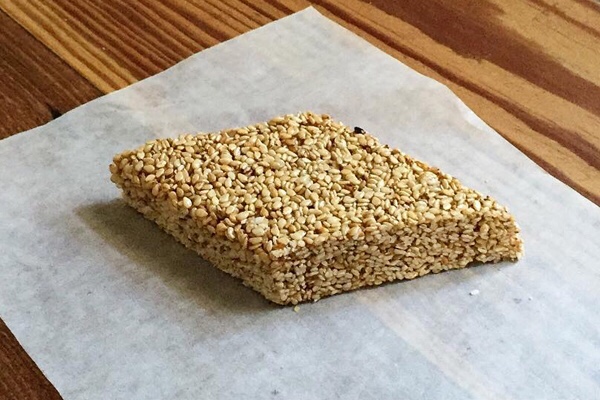
Ancient Greek Food: Sesame Honey Candy (Pasteli)

In Greek: παστέλι, pronounced pah-STEH-lee

In markets these days you can find sesame honey bars. The main difference is that the ancient Greeks did not have refined sugar. The sugar used today helps to harden the bars and make them crunchy. The ancient version was chewier, but simple to make with only two ingredients: sesame seeds and honey.

Warning: The quality and taste of the honey will have an effect on the final product.

Pasteli can be eaten as a candy at any time, or as an energy booster, and it is a wonderful accompaniment to tea.

Ingredients:

  • 1 1/3 cups honey
  • 3 cups hulled white sesame seeds
  • Optional: 1 strip lemon peel (about 1/4 x 1 inch)

Steps:

In a saucepan, bring honey and lemon peel, if using, to a boil. Add sesame seeds, stirring continuously and continue to cook while stirring to mix completely and thoroughly. When the seeds are fully mixed in and the mixture has boiled again, remove from heat. Remove lemon peel and discard.

Place a piece of baking parchment on a cool work surface and spread out the hot mixture thinly and evenly (about 1/4 inch high).

When the pasteli cools to room temperature, refrigerate on the parchment paper (it doesn’t need to be covered). Chill for at least 2 to 3 hours.

With kitchen shears, cut the pasteli together with parchment paper into small pieces, and serve.

To eat, peel off the parchment paper. Store in the refrigerator.