Masters of War – Bob Dylan

Masters of War

Bob Dylan / 4:31

Musician: Bob Dylan: vocals, guitar

Recording Studio: Columbia Recording Studios / Studio A, New York: April 23, 1963

Bob Dylan wrote “Masters of War” during the winter of 1962–63, right after the Cuban missile crisis of October 1962. He sang “Masters of War” in public at Gerde’s Folk City for the first time on January 21, 1963, and published the lyrics soon after in February in Broadside (number 20) along with drawings by Suze Rotolo, two months before the official recording session with Columbia.

Ironically, when the readers of Broadside read the lyrics and when the public at large discovered it, the repercussions were considerable. Very rarely—perhaps never—had Americans ever heard such a bitter and determined condemnation of war.

For many people, this was a misunderstanding. “Masters of War” is not an ode to pacifism—even if students quickly turned it into a hymn against American involvement in Vietnam, but rather an aggressive attack on the warmongers, on those who have vested interests in seeing the world explode into conflict and, as the song says so eloquently, “hide behind desks.” The songwriter was alluding to the American military-industrial complex, which was first denounced by Dwight D. Eisenhower himself in his farewell address from the Oval Office on January 17, 1961. In an interview granted to USA Today on September 10, 2001, Dylan was explicit: “[‘Masters of War’] is not an antiwar song. It’s speaking against what Eisenhower was calling a military-industrial complex as he was making his exit from the presidency. That spirit was in the air, and I picked it up”

Come, you masters of war

You that build the big guns

You that build the death planes

You that build all the bombs


You that hide behind walls

You that hide behind desks

I just want you to know

I can see through your masks


You that never done nothin’

But build to destroy

You play with my world


Like it’s your little toy

You put a gun in my hand

And you hide from my eyes

And you turn and run farther


When the fast bullets fly

Like Judas of old

You lie and deceive

A world war can be won


You want me to believe

But I see through your eyes

And I see through your brain

Like I see through the water


That runs down my drain


You fasten all the triggers

For the others to fire


Then you sit back and watch

While the death count gets higher

You hide in your mansion

While the young peoples’ blood


Flows out of their bodies

And is buried in the mud


You’ve thrown the worst fear


That can ever be hurled

Fear to bring children

Into the world

For threatenin’ my baby


Unborn and unnamed

You ain’t worth the blood

That runs in your veins


How much do I know

To talk out of turn?

You might say that I’m young

You might say I’m unlearned


But there’s one thing I know

Though I’m younger than you

That even Jesus would never

Forgive what you do


Let me ask you one question

Is your money that good?

Will it buy you forgiveness?


Do you think that it could?

I think you will find

When your death takes its toll

All the money you made


Will never buy back your soul

And I hope that you die

And your death will come soon

I’ll follow your casket

On a pale afternoon

I’ll watch while you’re lowered

Down to your deathbed

And I’ll stand over your grave

‘Til I’m sure that you’re dead

Source: Bob Dylan: All The Songs

The Day the Music Died

Today in History —> It was this day in 1959 that became “the day the music died,” as rock musicians Buddy Holly, Ritchie Valens, and J. P. “The Big Bopper” Richardson were killed in a plane crash near Clear Lake, Iowa. Waylon Jennings was also on the tour, and it’s likely that he gave up his seat to The Big Bopper at the last moment. The crash is of course was immortalized in the song “American Pie” by Don McLean.

Above the wreckage of “the day the music died.”

#MusicHistory #DayTheMusicDied #AmericanPie

Graffiti Terms

Angel

Graffiti term ‘angel’ is most commonly used when referring to a famous or highly respected graffiti artist who has passed away.

King

‘King’ (or ‘queen’ for female writers) is a graffiti writer who is especially respected among other writers. Some people refer to different writers as kings of different graffiti styles, and the term is regionally subjective.

Married Couple

In graffiti world, the term ‘married couple’ refers to two simultaneous train cars painted next to each other with a single painting evenly spread across both cars.

Heaven Spot

‘Heaven spot’, or ‘heaven’ in short, is a graffiti term which refers to dare devil graffiti pieces that are painted in places that are hard to reach, such as rooftops, overpasses and freeway signs, thus making them hard to remove.

Piece

The graffiti term ‘piece’, short of masterpiece, is used to describe a large, complex, time-consuming and labor-intensive graffiti painting, usually painted by skilled and experienced writers.

Tag

Tag is the most basic and the most prevalent form of graffiti. Graffiti tag is usually written with marker or spray paint and in one color, which is sharply contrasted with its background. Tag is a stylized personal signature and contains graffiti writer’s name, also known as a moniker.

Back to Back

The term ‘back to back’ refers to graffiti piece that is painted all the way across a wall, from end to end.

Throw-Up

‘Throw-up’ or ‘throwie’ is a widely referenced graffiti term, most commonly used to describe tag-like drawings of bubble letters designed for quick execution (we all know why) of graffiti words, and usually consisting of artist’s name and only two colors.

Whole Train

The meaning of the term ‘whole train’ is quite self-explanatory in the graffiti world. It is used to describe train cars which have been completely covered in graffiti, from the first to the last car of the train composition.

Viking Art: Antler, Bone & Ivory

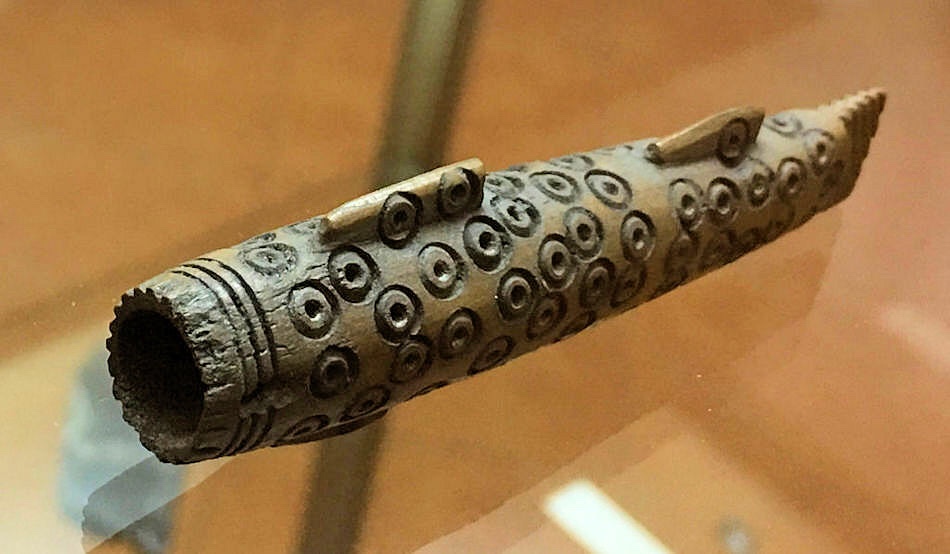
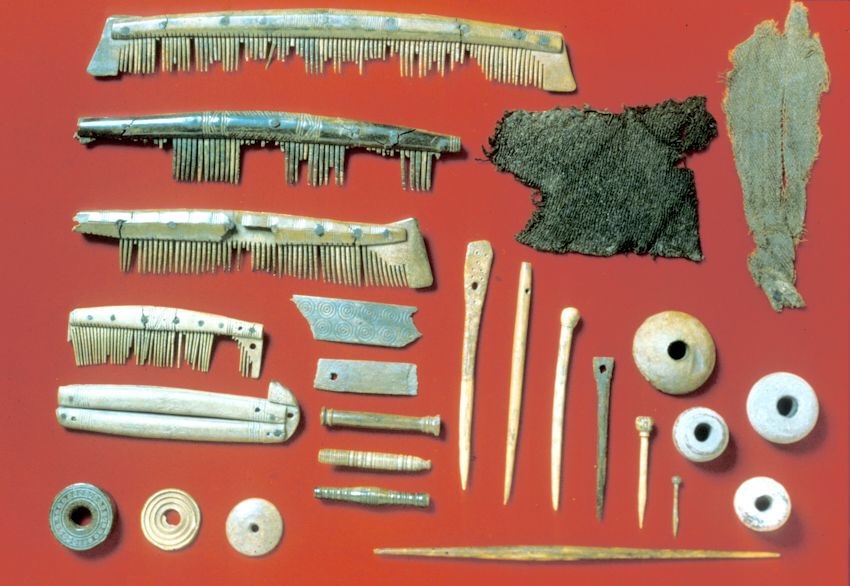
Bone and antler objects occur throughout the Viking world. Bones of pigs, cattle, horses, goats were used, and antler came from deer or elk. 

Needles and pins could be produced in a different shapes and sizes to serve a variety of purposes such as sewing clothes, nalbinding (a Scandinavian technique for making a strong, elastic fabric), net-making, securing a cloak, etc. 

Other products included spindle whorls, weaving tablets, needle cases made from small long hollow bones, knife handles, strap ends, gaming pieces, bone flutes, and ice skates. 

Combs were also made and could be quite basic, or very ornate and decorated. Even the basic combs required considerable work, as the teeth can to be cut separately into bone plates which were fitted into the handle pieces. 

Whale bone could be used for special objects such as the decorated linen smoother from the Scar boat burial. While whale teeth and walrus ivory could be used for objects such as the Lewis Chessmen.

Source: the Viking Archaeology News Blog

Viking Era Jewelry

Most of our knowledge of Viking Age jewelry comes graves and hoards. Because accompanied burials ceased after the conversion to Christianity, we know more about earlier Viking Period jewelry than we do of the later Viking era.

Viking age jewelry tends to be dated according to the art style that is used for decoration.

Jewelry was worn by both men and women. It was a means of fastening cloaks, belts and dresses, And it was an adornment and a means of displaying visible wealth, even as a means of carrying wealth. It could be used as a means of exchange, and as a means of cementing an alliance.

Gold was used for the most prestigious jewelry, but gold was relatively scare in Scandinavia, so most jewelry was made of silver or gilded bronze. Gold and silver items would have been individually made, but bronze jewelry would have been mass produced, using clay moulds from a single master prototype.

In addition to brooches and buckles, silver neck and arm rings were common items of jewelry. Many were made from melted down silver Arabic coins, and were made to standard weights so that their value was easily assessed.

”Silver arm-rings were by far the commonest products of the Hiberno-Viking tradition…Over one hundred are known from silver hoards in Ireland, where they were sometimes cut into fragments which could later melted down and recycled. Several different types have been identified, the most important in terms of sheer numbers being the broad-band type. Like the neck-rings, they seem to have been manufactured for the storage and circulation of silver, and their target weight of 26.15 grams (0.92 ounces) is very close to the most important weight unit of the lead scale-weights from tenth-century Dublin. Their purity was obviously a matter of concern, because they sometimes display small nicks and pecks.”

Source: Netherton, R. and Owen Crocker, G. R. (eds) (2006), “Medieval Clothing and Textiles vol 2″

Lavender Wands

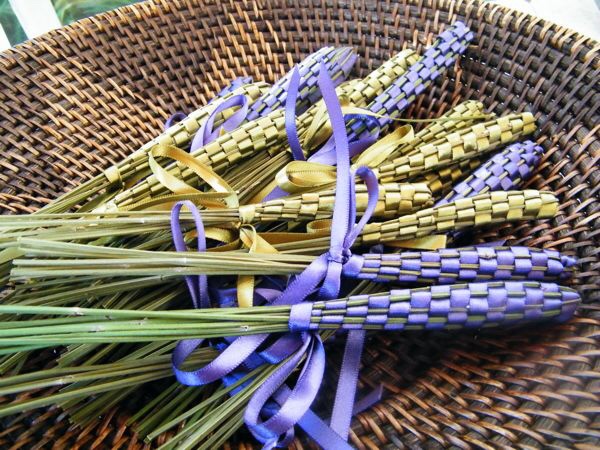
The wand is made by weaving a ribbon over and under adjacent stalks, so you must use an odd number of stalks. (I suggest using 13). Harvest only the most robust and straight flower stalks.

• 6 feet 1/4-inch satin ribbon
• 13 stalks fresh, straight, long-stemmed lavender
• Heavy thread
• Clippers
• Scissors

1. Align the flower heads and wrap the thread tightly below the flowers, including one end of the ribbon. Knot the thread and trim the ends; leave 1/4 inch tail of the ribbon.

2. Turn the wand so the flowers point downward. One at a time, bend the stalks over the thread. (Pressing your thumbnail into the stalk above the thread as you bend it prevents breakage if the stalks have dried out a little.) Space stalks evenly like the spines of an umbrella.

3. Bring the ribbon to the outside of the umbrella and begin to weave over and under adjacent stalks. As you weave, pull on the ribbon fairly hard and make sure the flowers inside are covered. As the pulling causes the stalks to twist, realign them after weaving three rounds so they are once again straight and evenly spaced. Repeat this step if necessary after the sixth round.

4. After weaving beyond the flower heads, form a handle by weaving the ribbon tightly for 4 to 5 inches. Tie it off in a bow. After the wand dries, reweave the ribbon on the now shrunken handle and retie the bow.

Source: Mother Earth Living

The Wolf Song – Nordic Lullaby

This version of the lullaby from “Ronja Rövardotter / Ronia the robbers daugther” written by beloved Swedish writer, Astrid Lindgren, whose books have been read for children all over the world:

Lyrics in Swedish and English:

Vargen ylar i nattens skog
(The wolf is howling in the forest of the night)
Han vill men kan inte sova
(He wants to, but cannot sleep)
Hungern river i hans varga buk
(The hunger tears his wolven stomach)
Och det är kallt i hans stova
(And it’s cold in his burrow)

Du varg du varg, kom inte hit
(Wolf, wolf, don’t you come here)
Ungen min får du aldrig
( I will never let you take my child)

Vargen ylar i nattens skog
(The wolf is howling in the forest of the night)
Ylar av hunger o klagar
(Howling out of hunger and moaning)
Men jag ska ge’n en grisa svans
(But I will give him a pig tail)
Sånt passar i varga magar
(Which suits a wolven stomach)

Du varg du varg, kom inte hit
(Wolf, wolf, don’t you come here)
Ungen min får du aldrig
( I will never let you take my child)

…(First verse again)

A Portrait of the Artist as a Young Man

Today in 1916 – “A Portrait of the Artist as a Young Man,” the first novel by James Joyce, was first published as a book by an American publishing house B. W. Huebschis after it had been serialized in The Egoist (1914–15).

A so-so copy of the first edition of that book will run you around $3800, but that’s not nearly as much as a first edition of Ulysses, which will cost you about $40,000 unsigned and $150,000 signed (only 1000 copies were printed).