What is Sous Vide?

Even If you’re not sure what sous vide exactly is, chances are you’ve tried it whether at that fancy French restaurant you save for special occasions or the egg bites you have with your latte at Starbucks.

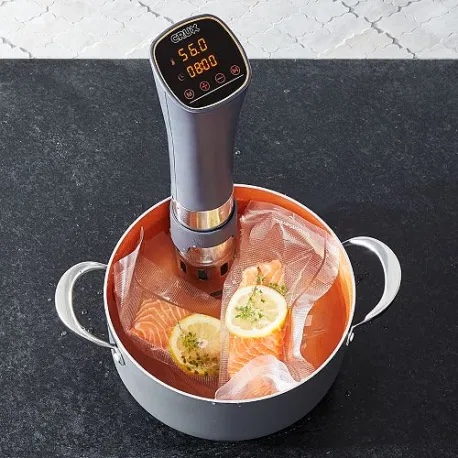
A sous vide machine or immersion circulator is used to preheat a water bath to a precise temperature. Food is sealed in plastic bags, though you can also sous vide in glass jars and eggs can be cooked in their shells, and immersed in the bath. The food eventually reaches the same temperature as the water, which is often set to the ideal serving temperature of the final dish.

For meat, poultry, and fish, there is usually a quick searing step before serving. As opposed to conventional stovetop and oven methods, in which the heat used is much higher than the serving temperature of the food, making it imperative to remove the food at just the right moment, when it’s done but not overcooked.

Using sous vide there’s usually no risk of overcooking, making it a tempting technique, especially for temperature-sensitive foods such as fish or steak. The low cooking temperature ensures meat remains juicy; it’s never dry. And dialing in the precise temperature creates exceptionally consistent results that can’t be achieved with traditional methods.

Molecular Gastronomy : Agar, Agar

Agar, Agar (Often abbreviated Agar) is derived from red algae or seaweed.  Agar is a natural vegetable counterpart to gelatin which is animal based and completely vegetarian.  For vegetarians, it makes foods like marshmallows, jelly beans, and gummy bears possibleIt forms rigid, brittle gels.  White and semi-translucent, it is sold in packages as washed and dried strips or more commonly in powdered form.  It can be used to make jellies, puddings, custards, and aspics.

Agar is the primary ingredient in one of Asia’s new fad diets.  Kanten (The Japanese word for Agar, Agar) triples in size and absorbs water, thus you feel fuller.

Kanten Basic Diet

7 Ounces Water

2 Grams Kanten (Agar, Agar)

Fruit or Seasoning (Optional)

Bring water to a simmer and add kanten.  Simmer for 2 minutes stirring constantly.  Pour into a heat resistant container.  Add fruit or seasonings if desired.  Cool and allow to set.

Agar, Agar is genrally added to cool liquids and then heated to a boil.  The gel sets once it cools to 95° F and must be reheated to 185° before it melts again.

Agar, Agar uses and recipes:

Add to soup as a thickener.

Add to puddings and chill.

Balsamic Vinegar Gel

6.8 Ounces Balsamic Vinegar

2 Grams Agar Agar

Simple Syrup to taste

Bring vinegar to a boil and add Agar Agar.  Simmer for 2 minutes.  Season to taste with simple syrup.  Pour into container and allow to set.  Add jelly to a blender and blend until smooth.  Strain mixture through a chinois.  Pour into a squeeze bottle.  Refrigerate until needed.

Balsamic Vinegar Pearls

7 Ounces Balsamic Vinegar

1.5 Grams Agar Agar

1 Cup of Oil

place the oil in a tall glass in the freezer for at least 30 minutes.  put the balsamic vinegar in a saucepan, dissolve the agar agar and bring it to the boil, stirring constantly.  Take off heat.  Wait a few minutes until the temperature drops to 120-130˚ F.  Fill a syringe with the hot balsamic agar solution and expel it drop by drop into the cold oil.  Wait a few minutes and then carefully remove them from the oil bath using a slotted spoon and rinse them in water.  Serve on salads, etc.

Molecular Gastronomy : Intro

What is molecular gastronomy?  Why molecular gastronomy?  When did molecular gastronomy start?  Is molecular gastronomy real food?  Who practices molecular gastronomy?  Is molecular gastronomy foods safe to eat?  These are but a few of the questions about molecular gastronomy that are commonly asked.  Along with such statements as: I don’t like molecular gastronomy.  Molecular gastronomy is not real cooking.  Molecular gastronomy is a fad.  Molecular gastronomy is poor cooking.  I’ll attempt to touch on some of these topics.

Molecular gastronomy is a sub-discipline of food science that seeks to investigate, explain and make practical use of the physical and chemical transformations of ingredients that occur while cooking, as well as the social, artistic and technical components of culinary and gastronomic phenomena in general.

Blah, blah, blah…

Everyone probably reading this already knows that, but might not have put it into such terms.  Let’s instead look at the objectives of molecular gastronomy as stated by one of its pioneers the French chemist Hevré This.

Original Objectives (1990’s) :

  1. Investigating culinary and gastronomical proverbs, sayings, and old wives’ tales.
  2. Exploring existing recipes.
  3. Introducing new tools, ingredients and methods into the kitchen.
  4. Inventing new dishes.
  5. Using molecular gastronomy to help the general public understand the contribution of science to society.

Updated Objectives :

Looking for the mechanisms of culinary transformations and processes in three areas…

  1. the social phenomena linked to culinary activity.
  2. the artistic component of culinary activity.
  3. the technical component of culinary activity.

What does all of this mean?  A few examples is probably the easiest way to demonstrate what This and other molecular gastronomers were and are investigating:

  • How ingredients are changed by different cooking methods.
  • How all the senses play their own roles in our appreciation of food.
  • The mechanisms of aroma release and the perception of taste and flavor.
  • How and why we evolved our particular taste and flavor sense organs and our general food likes and dislikes.
  • How cooking methods affect the eventual flavor and texture of food ingredients.
  • How new cooking methods might produce improved results of texture and flavor.
  • How our brains interpret the signals from all our senses to tell us the      “flavor” of food.
  • How our enjoyment of food is affected by other influences, our environment, our      mood, how it is presented, who prepares it.

Now that all that technical background is out of the way, what does it mean to me as a foodie, cook, diner, etc.?  In the late 1990’s the term molecular gastronomy was adapted away from the merely scientific to describe a new style of cooking which focused on technical advances in equipment, natural gums, hydrocollids, etc.  A number of famous chef’s focus on this type of cuisine among them: Grant Achatz, Feran Adria, Jose Andres, Richard Blais, Heston Blumenthal, Wylie Dufresne, etc.  Many of these chefs do not like the term molecular gastronomy and prefer terms such as:

  1. Avant-garde cuisine
  2. Culinary constructivism
  3. Experimental cuisine
  4. Forward-thinking movement
  5. Modernist cuisine
  6. Progressive cuisine
  7. And many others.

Several chefs associated with the movement (Ferran Adria of El Bulli, Heston Blumenthal of the Fat Duck, Thomas Keller of the French Laundry) released a joint statement in 2006 stating that the term “molecular gastronomy” was coined in 1992 for a single workshop that did not influence them, and that the term does not describe any style of cooking.

Some ingredients used in molecular gastronomy :

  1. Carbon dioxide source, for adding bubbles and making foams.
  2. Liquid nitrogen, for flash freezing and shattering.
  3. Maltodextrin – can turn a high-fat liquid into a powder.
  4. Sugar substitutes.
  5. Enzymes.
  6. Lecithin – an emulsifier and non-stick agent.
  7. Hydrocolloids such as starch, gelatin, pectin, and natural gums – used as thickening agents, gelling agents, emulsifying agents, and stabilizers, sometimes needed for foams.
  8. Transglutaminase – a protein binder, called meat glue.

Some tools used in molecular gastronomy :

  1. Ice cream maker, often used to make unusual flavors, including savory.
  2. Anti-griddle, for cooling and freezing.
  3. Thermal immersion circulator for sous-vide (low temperature cooking).
  4. Food dehydrator.
  5. Syringe, for injecting unexpected fillings.
  6. Edible paper made from soybeans and potato starch, for use with edible fruit inks and an inkjet printer.