Sylvia Plath

One of my favorite writers was born on this day in 1932, Sylvia Plath:

Sylvia Plath was an American poet, novelist, and short story writer. Born in Boston, Massachusetts she studied at Smith College and Newnham College. She married poet Ted Hughes in 1956 and had two children Frieda and Nicholas. After a long struggle with depression she committed suicide in 1963. To this day controversy surrounds both her life and death, as well as her writing and legacy. She along with some of her contemporaries (Anne Sexton and Robert Lowell among others) advanced the genre of confessional poetry. She is best known for her two collections of poetry “The Colossus and Other Poems,” and “Ariel,” as well as her semi-autobiographical novel “The Bell Jar.” In 1982 she became the first poet to win the Pulitzer Prize posthumously for “The Collected Poems of Sylvia Plath.”

Growing up in Winthrop, Massachusetts an eight year old Plath published her first poem in the children’s section of the “Boston Herald.” In addition to her writing, she showed a lot of promise as an artist winning an award for her painting from The Scholastic Art & Writing Awards in 1947. Her father died when she was eight due to untreated diabetes and led to her having a loss in faith and remained ambivalent about religion for the rest of her life. In 1942 her mother moved the family to Wellesley, Massachusetts.

In 1950 while attending Smith College she wrote to her mother, “The world is splitting open at my feet like a ripe, juicy watermelon.” The summer after her third year of college she spent a month in New York City as a guest editor of “Mademoiselle” magazine. It did not go as well as planned. That summer she was refused admission to the Harvard writing seminar and began an emotional downward spiral. In August 1953 she made her first suicide attempt by crawling under her house and taking her mother’s sleeping pills. She was not found for three days. Later she would write of the experience, “blissfully succumbed to the whirling blackness that I honestly believed was eternal oblivion.” She would spend the next six months at McLean Psychiatric Hospital. While under the care of Dr. Ruth Beuscher she would receive insulin and electric shock treatments. She appeared to recover and returned to Smith College.

Plath and English poet Ted Hughes were married on June 16th, 1956. Plath described Hughes as, “a singer, story-teller, lion and world-wanderer with a voice like the thunder of God.” In 1957 they moved to the United States with Plath first teaching at Smith College, and then moving to Boston in 1958 where she worked as a receptionist in the psychiatric unit at Massachusetts General Hospital while in the evening attending a creative writing class by Robert Lowell (Anne Sexton was also in attendance). During this time both Lowell and Sexton encouraged her to write from her own experience. She openly discussed her depression with Lowell, and her suicide attempt with Sexton. At this time she began to see herself as a more serious and focused poet and storyteller. She also began a lifetime friendship with the poet W. S. Merwin. In December she resumed her treatment with Dr. Ruth Beuscher.

In December of 1959 Plath and Ted Hughes moved to London. She remained anxious about writing confessional poetry from her own experience. Around this time she would explain that she learned, “to be true to my own weirdnesses.” In 1960 she released her first book of poetry. In 1961 her second pregnancy ended in a miscarriage, severely of her poems address this including, “Parliament Hill Fields.” In January of 1962 her son Nicholas was born. In June she was in a car accident which she would explain as one of her many suicide attempts. That July she would discover Ted Hughes was having an affair and they would separate in September.

Beginning in October of 1962 she would enter into the greatest burst of creativity of her career. It is at this time she would write almost all of the poems for which she is remembered and released posthumously in the collection “Ariel.” Her novel “The Bell Jar” came out in January 1963 to critical indifference. On February 11th, 1963 Plath was found dead having committed suicide by carbon monoxide poisoning in the kitchen with her head in the oven and the gas turned on. Hughes was devastated and in a letter wrote, “That’s the end of my life. The rest is posthumous.”

In the years following her death there were many accusations that Hughes had been abusive to Plath. The feminist poet Robin Morgan published a poem which openly accused Hughes of assault and her murder. In 1989 Hughes wrote an article in “The Guardian,” with this quote, “In the years soon after [Plath’s] death, when scholars approached me, I tried to take their apparently serious concern for the truth about Sylvia Plath seriously. But I learned my lesson early. […] If I tried too hard to tell them exactly how something happened, in the hope of correcting some fantasy, I was quite likely to be accused of trying to suppress Free Speech. In general, my refusal to have anything to do with the Plath Fantasia has been regarded as an attempt to suppress Free Speech […] The Fantasia about Sylvia Plath is more needed than the facts. Where that leaves respect for the truth of her life (and of mine), or for her memory, or for the literary tradition, I do not know.”

Hughes inherited the Plath estate and has been condemned in some circles for burning Plath’s last journal. He lost another journal and an unfinished novel and instructed a collection of her papers and journals should not be released until 2013. In 1998 he would publish a collection of poems called, “Birthday Letters,” which consists of 88 poems about his relationship with Plath. It would go on to win the Forward Poetry Prize, T.S. Eliot Prize for poetry, and the Whitebread Poetry Prize. He would die later that year of cancer.

A couple of quotes :

“If you expect nothing from anybody, you’re never disappointed.”

“Perhaps when we find ourselves wanting everything, it is because we are dangerously close to wanting nothing.”

“Death must be so beautiful. To lie in the soft brown earth, with the grasses waving above one’s head, and listen to silence. To have no yesterday, and no to-morrow. To forget time, to forgive life, to be at peace.”

~ Sylvia Plath

Tulips – By Sylvia Plath

The tulips are too excitable, it is winter here.

Look how white everything is, how quiet, how snowed-in

I am learning peacefulness, lying by myself quietly

As the light lies on these white walls, this bed, these hands.

I am nobody; I have nothing to do with explosions.

I have given my name and my day-clothes up to the nurses

And my history to the anaesthetist and my body to surgeons.

They have propped my head between the pillow and the sheet-cuff

Like an eye between two white lids that will not shut.

Stupid pupil, it has to take everything in.

The nurses pass and pass, they are no trouble,

They pass the way gulls pass inland in their white caps,

Doing things with their hands, one just the same as another,

So it is impossible to tell how many there are.

My body is a pebble to them, they tend it as water

Tends to the pebbles it must run over, smoothing them gently.

They bring me numbness in their bright needles, they bring me sleep.

Now I have lost myself I am sick of baggage —-

My patent leather overnight case like a black pillbox,

My husband and child smiling out of the family photo;

Their smiles catch onto my skin, little smiling hooks.

I have let things slip, a thirty-year-old cargo boat

Stubbornly hanging on to my name and address.

They have swabbed me clear of my loving associations.

Scared and bare on the green plastic-pillowed trolley

I watched my teaset, my bureaus of linen, my books

Sink out of sight, and the water went over my head.

I am a nun now, I have never been so pure.

I didn’t want any flowers, I only wanted

To lie with my hands turned up and be utterly empty.

How free it is, you have no idea how free —-

The peacefulness is so big it dazes you,

And it asks nothing, a name tag, a few trinkets.

It is what the dead close on, finally; I imagine them

Shutting their mouths on it, like a Communion tablet.

The tulips are too red in the first place, they hurt me.

Even through the gift paper I could hear them breathe

Lightly, through their white swaddlings, like an awful baby.

Their redness talks to my wound, it corresponds.

They are subtle: they seem to float, though they weigh me down,

Upsetting me with their sudden tongues and their colour,

A dozen red lead sinkers round my neck.

Nobody watched me before, now I am watched.

The tulips turn to me, and the window behind me

Where once a day the light slowly widens and slowly thins,

And I see myself, flat, ridiculous, a cut-paper shadow

Between the eye of the sun and the eyes of the tulips,

And I hve no face, I have wanted to efface myself.

The vivid tulips eat my oxygen.

Before they came the air was calm enough,

Coming and going, breath by breath, without any fuss.

Then the tulips filled it up like a loud noise.

Now the air snags and eddies round them the way a river

Snags and eddies round a sunken rust-red engine.

They concentrate my attention, that was happy

Playing and resting without committing itself.

The walls, also, seem to be warming themselves.

The tulips should be behind bars like dangerous animals;

They are opening like the mouth of some great African cat,

And I am aware of my heart: it opens and closes

Its bowl of red blooms out of sheer love of me.

The water I taste is warm and salt, like the sea,

And comes from a country far away as health.

#SylviaPlath #Poet #Author #MentalHealth #ABellJar

Marguerite Porete

Marguerite Porete (?-1310)

Marguerite Porete was a French mystic and the author of “The Mirror of Simple Souls.” It is a Christian Spiritual work concerning divine love. When she refused to remove her book form circulation and recant her views she was burned at the stake as a heretic in 1310. Little is known of her life except through her trial for heresy and it is certainly biased and incomplete. She has been a rather obscure figure until recent years as until 1946 her work had been published anonymously since her death.

Porete was officially warned by the Church that her works were heretical and they were publically burned by the Bishop of Cambrai. She had written her book in Old French as opposed to Latin and was ordered not to circulate her ideas ever again. She was eventually arrested by the local inquisitor. Twenty-one theologians scoured her book for evidence of heresy. In the end three bishops passed final judgment on her. After a year and a half in prison in Paris her trial began. She refused to recant her ideas or cooperate with the authorities. Because she did not recant she was found guilty and burnt at the stake. As she died the crowd is said to have been moved to tears by her calmness.

“The Mirror of Simple Souls,” is an allegorical conversation between Love, Reason, Soul, and Truth. It deals with Porete’s belief that when the soul is full of God’s love it is united with God and in a union which transcends the contradictions of the world. In this state one cannot sin because the soul is united with God’s will and incapable of such. A few quotes:

“O Truth, says this Soul, for god’s sake, do not say
That of myself I might ever say something of Him,
save through Him;
And this is true, do not doubt it,
And if it pleases you to know whose I am,
I will say it through pure courtesy:
Love holds me so completely in her domain,
That I have neither sense, nor will,
Nor reason to do anything,
Except through her, as you know.”

“Theologians and other clerks,
You won’t understand this book,
— However bright your wits —
If you do not meet it humbly,
And in this way, Love and Faith
Make you surmount Reason, for
They are the protectors of Reason’s house. ”

“God has nowhere to put his goodness, if not in me no place to put himself entire, if not in me. And by this means I am the exemplar of salvation, and what is more, I am the salvation itself of every creature, and the glory of God.”
~ Marguerite Porete

Hildegard of Bingen

Hildegard of Bingen (circa 1098-1179)

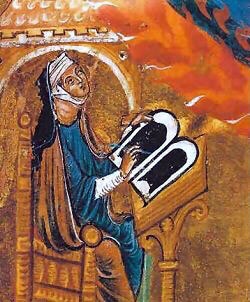
Hildegard of Bingen was a German writer, composer, philosopher, Christian mystic, Benedictine abbess, visionary and polymath (a person whose expertise spans a significant number of different subject areas. An example of another famous polymath would be Leonardo da Vinci). She wrote theological, botanical, and medicinal texts, as well as letters, liturgical songs, poems, a morality play, also supervising over miniature illuminated manuscripts. Her morality play is the oldest surviving example of its form. In 1136 she was elected a magistra (teacher) by her fellow nuns. In 1150 she founded the monastery of Rupertsberg and in 1165 Eibingen.

It is believed she was born about 1098, but the exact date of her birth is unknown. She was the tenth child of a family of free nobles and was sickly from birth. From a very young age Hildegard experienced visions. Perhaps due to her visions her parents offered her as a tithe to the church. Her enclosure date is cloudy and there is no written record of the next twenty-four years of her life in the convent. She was enclosed with another girl Jutta who also had visions and attracted many visitors. Jutta taught her to read and write, but not how to interpret biblical meaning. The two of them likely prayed, meditated, read scripture and did some type of handwork together. It is also believed it was at this time she learned to play the ten string psaltery. Upon Jutta’s death in 1136 Hildegard was unanimously elected magistra of her community by her fellow nuns. She wanted more independence and requested Abbot Kuno to be able to move the convent to Rupertsberg. This was to be a move towards poverty. She was denied. Hildegard in return went over his head and was granted permission from the archbishop. In 1150 Hildegard and twenty nuns made the move and were granted their own monastery.

At age 43 she received a vision from God to write down all that she had seen. Her first book the “Scivias” (Know the Ways) was the result. In it she described her struggles from within:
“But I, though I saw and heard these things, refused to write for a long time through doubt and bad opinion and the diversity of human words, not with stubbornness but in the exercise of humility, until, laid low by the scourge of God, I fell upon a bed of sickness; then, compelled at last by many illnesses, and by the witness of a certain noble maiden of good conduct [the nun Richardis von Stade] and of that man whom I had secretly sought and found, as mentioned above, I set my hand to the writing. While I was doing it, I sensed, as I mentioned before, the deep profundity of scriptural exposition; and, raising myself from illness by the strength I received, I brought this work to a close – though just barely – in ten years. […] And I spoke and wrote these things not by the invention of my heart or that of any other person, but as by the secret mysteries of God I heard and received them in the heavenly places. And again I heard a voice from Heaven saying to me, ‘Cry out therefore, and write thus!”

In addition to her writing she composed sixty-nine musical compositions including the oldest surviving morality play “Ordo Virtutum.” This is one of the largest outputs among all medieval composers. She also wrote over 400 letters to people ranging from Popes, Emperors, abbots, and abbesses. In addition she wrote two volumes on natural medicines and cures, an invented language called, “Lingua ignota,” a gospel commentary, two works of hagiography (writings about holy people such as saints), and finally three volumes of visionary theology : the “Scivias (Know the Ways)”, “Liber vitae meritorum (Book of Life’s Merits)” and “Liber divinorum operum (Book of Divine Works)”. In each of these texts she first describes the vision and then interprets them throughout the Bible. The books were celebrated in the Middle Ages in part because of the approval given by Pope Eugenius III. She also wrote “Physica” and “Causae at Curae”. Well known for her healing ability in these texts she describes the natural world including the cosmos, animals, plants, stones and minerals. She particularly focused on the healing abilities of plants, animals and stones. She also created her own alphabet with abridged words of a form of Latin. It is believed she used this alphabet to increase solidarity among her nuns.

Her belief was man and woman had complimentary roles and wrote:

“Man and woman are in this way so involved with each other that one of them is the work of the other. Without woman, man could not be called man; without man, woman could not be named woman. Thus woman is the work of man, while man is a sight full of consolation for woman. Neither of them could henceforth live without the other. Man is in this connection an indication of the Godhead while woman is an indication of the humanity of God’s Son”
~ Hildegard of Bingen

Christine de Pizan

Christine de Pizan (1363-circa 1430)

Christine de Pizan (or Pisan) was a Venetian born late medieval woman poet. She was highly regarded in her own day and during her thirty year career as Europe’s first professional woman writer completing forty-one works. She tirelessly challenged misogyny and the stereotypes of the late medieval period. She was widowed by age twenty-four and much of her motivation for her writing came from her need to earn a living for not only herself but her children. Her early poetry was of the courtly genre and marked by her knowledge of aristocratic custom and fashion of the day involving women and the practice of chivalry. In recent decades her works have once again returned to prominence through the scholarly efforts of those such as Simone de Beauvoir among others. There is some argument among scholars as whether to see her as an early feminist or that her beliefs were not progressive enough.

In 1390 with the death of her husband she was faced with the prospect of being left to support her mother, a niece and her two children. She began writing love ballads which garnered the attention of several patrons within the court who commissioned her to compose texts of their romantic exploits as they were intrigued by the novelty of having a woman writer. It is estimated that between 1393 and 1412 she was quite prolific having composed over three-hundred ballads and shorter poems. In 1401-1402 she engaged in a debate over Jean de Meun’s portrayal of women as nothing much more than seducers in his work “Romance of the Rose.” The result of the debate was more profound for her than the actual conclusions as it established her reputation as a female intellectual in a male dominated realm.

By 1405 she had completed her most successful literary works, “The Book of the City of Ladies,” and “The Treasure of the City of Ladies.” In these two works she argued and showed the importance of women’s past contributions to society and then attempted to illustrate and teach women how to cultivate qualities to counteract the growth of misogyny. She argues that women must recognize and promote their ability to make peace between their husband and his subjects. She believed that slanderous speech destroys the sisterly bond among women, “skill in discourse should be a part of every woman’s moral repertoire.” The works give a fascinating portrait of women in the 1400’s offering advice for women’s lives from the lady in the castle to the servant, peasant and even the prostitute. Through all of this she asserts than woman’s influence is realized when her speech unifies value to chastity, virtue and restraint.

Simone de Beauvoir in 1949 described her as, “the first time we see a woman take up her pen in defense of her sex.” Perhaps this makes her the western world’s first feminist.

A few quotes :

“Just as women’s bodies are softer than men’s, so their understanding is sharper.”

“I say it to thee again, and doubt never the contrary, that if it were the custom to put the little maidens to the school, and they were made to learn the sciences as they do to the men-children, that they should learn as perfectly, and they should be”

“Ah, child and youth, if you knew the bliss which resides in the taste of knowledge, and the evil and ugliness that lies in ignorance, how well you are advised to not complain of the pain and labor of learning.”

“Not all men (and especially the wisest) share the opinion that it is bad for women to be educated. But it is very true that many foolish men have claimed this because it displeased them that women knew more than they did.”
~ Christine de Pizan

Charlotte Perkins Gilman

Charlotte Perkins Gilman (1860-1935)

She is best known today for her short story “The Yellow Wallpaper,” a semi-autobiographical account of a severe bout of postpartum psychosis. She was a Utopian Feminist (women’s suffrage as well as women’s economic independence) and a prominent sociologist, novelist, writer of short-stories, non-fiction and poetry. Her book “Women and Economics : A Study of the Economic Relation Between Men and Women as a Factor in Social Evolution,” was published in 1898 and considered by many her greatest work. Her contention was that humans were the only species in which women were dependent upon the male for survival. They paid for this dependence through domestic services of “sex functions”. Here belief that this awkward distribution of power within the sex roles were detrimental to both genders. Her novel “Herland” published in 1915 is a utopian novel describing an isolated society entirely of women who reproduced asexually and thus had an idea social order – free of war, conflict and domination. Perhaps her greatest literary achievement was self-publishing a magazine, “The Forerunner”, for seven years (1909-1916), she wrote the entirety of every issue – editorials, critical articles, book reviews, essays, poems, stories, and six serialized novels including “Herland” and the sequel “With Her In Ourland.”

She married twice, separating from her first husband in 1888 and finally divorcing 1894. She bore one child with her first husband, Katherine. She married her second husband in 1900 and they remained happily married until 1934 when he died of a sudden cerebral hemorrhage. In 1932 she learned she had incurable breast cancer. She was an advocate for the right-to-die and thus on August 17th, 1935 she committed suicide by taking an overdose of chloroform. Both her autobiography and suicide note stated she “chose chloroform over cancer.” One of her more famous quotes comes from her suicide note…

“Human life consists in mutual service. No grief, pain, misfortune, or broken heart, is excuse for cutting off one’s life while any power of service remains. But when all usefulness is over, when one is assured of an unavoidable and imminent death, it is the simplest of human rights to choose a quick and easy death in place of a slow and horrible one.”
~ Charlotte Perkins Gilman

“There is no female mind. The brain is not an organ of sex. Might as well speak of a female liver.”