
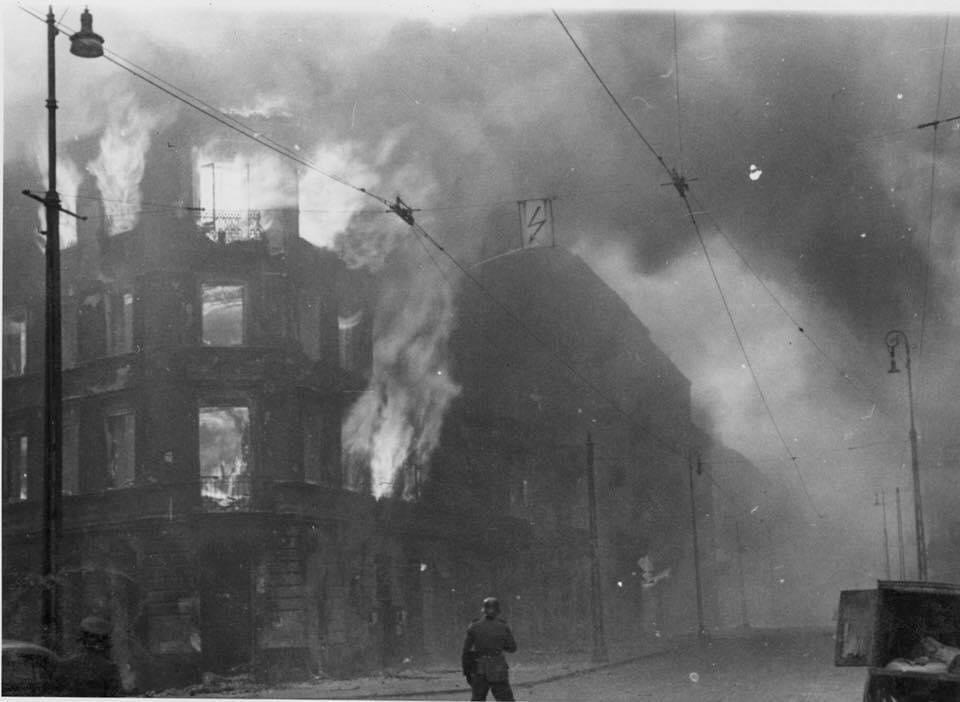

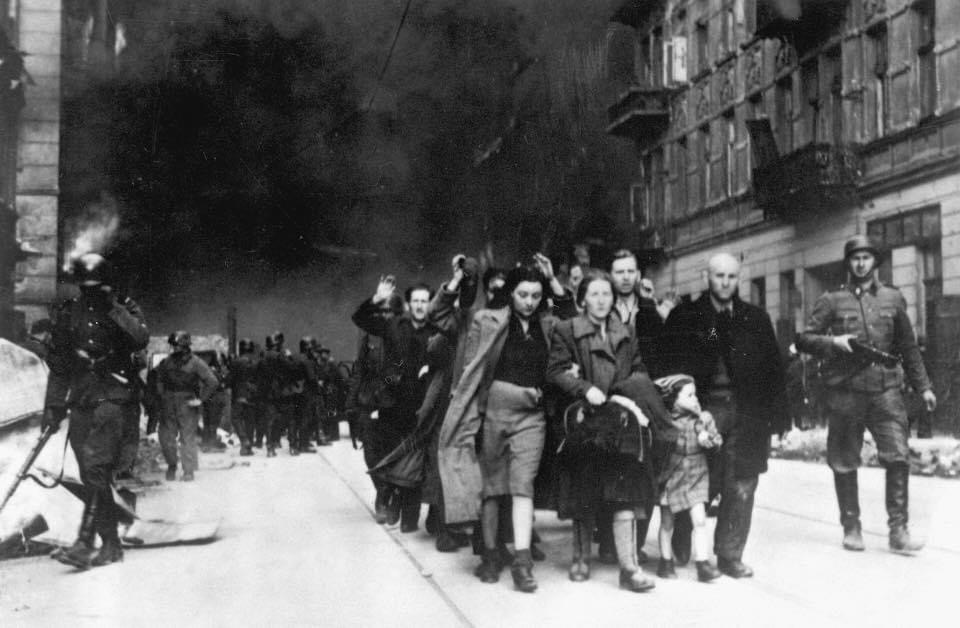
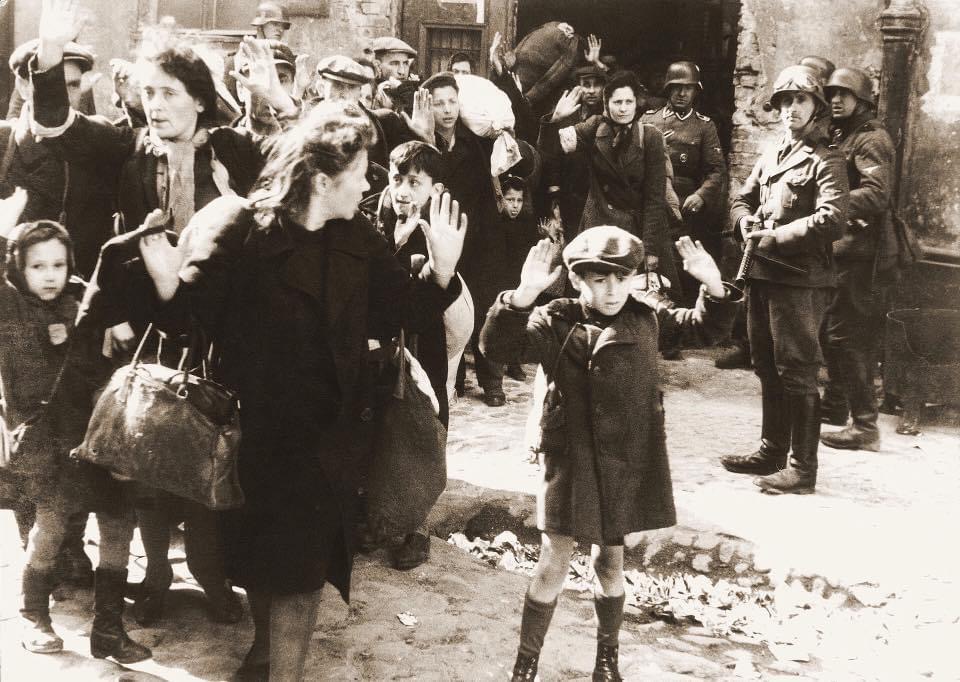
On April 19th 1943, the Warsaw Ghetto Uprising began. It was the 1943 act of Jewish resistance that arose within the Warsaw Ghetto in German-occupied Poland during World War II, and which opposed Nazi Germany’s final effort to transport the remaining Ghetto population to Treblinka. The uprising started on 19 April when the Ghetto refused to surrender to the police commander SS-Brigadeführer Jürgen Stroop, who then ordered the burning of the Ghetto, block by block, ending on 16 May. A total of 13,000 Jews died, about half of them burnt alive or suffocated. German casualties are not known, but were not more than 300. It was the largest single revolt by Jews during World War II.
On 19 April 1943, on the eve of Passover, the police and SS auxiliary forces entered the Ghetto. They were planning to complete the deportation action within three days, but were ambushed by Jewish insurgents firing and tossing Molotov cocktails and hand grenades from alleyways, sewers, and windows. The Germans suffered 59 casualties and their advance bogged down. Two of their combat vehicles (an armed conversion of a French-made Lorraine 37L light armored vehicle and an armored car) were set on fire by insurgent petrol bomb. Following von Sammern-Frankenegg’s failure to contain the revolt, he lost his post as the SS and police commander of Warsaw. He was replaced by SS-Brigadeführer Jürgen Stroop, who rejected von Sammern-Frankenegg’s proposal to call in bomber aircraft from Kraków and proceeded to lead a better-organized and reinforced ground attack.
The longest-lasting defense of a position took place around the ŻZW stronghold at Muranowski Square, where the ŻZW chief leader, Dawid Moryc Apfelbaum, was killed in combat. On the afternoon of 19 April, a symbolic event took place when two boys climbed up on the roof of a building on the square and raised two flags, the red-and-white Polish flag and the blue-and-white banner of the ŻZW. These flags remained there, highly visible from the Warsaw streets, for four days. After the war, Stroop recalled:
“The matter of the flags was of great political and moral importance. It reminded hundreds of thousands of the Polish cause, it excited them and unified the population of the General Government, but especially Jews and Poles. Flags and national colours are a means of combat exactly like a rapid-fire weapon, like thousands of such weapons. We all knew that – Heinrich Himmler, Krüger, and Hahn. The Reichsfuehrer [Himmler] bellowed into the phone: ‘Stroop, you must at all costs bring down those two flags!’”
~ Jürgen Stroop, 1949
#WarsawGhettoUprising #JewishResistance #Holocaust

 Mark Bere Peterson’s Counterculture, Urban Legends, Paganism & Witchcraft