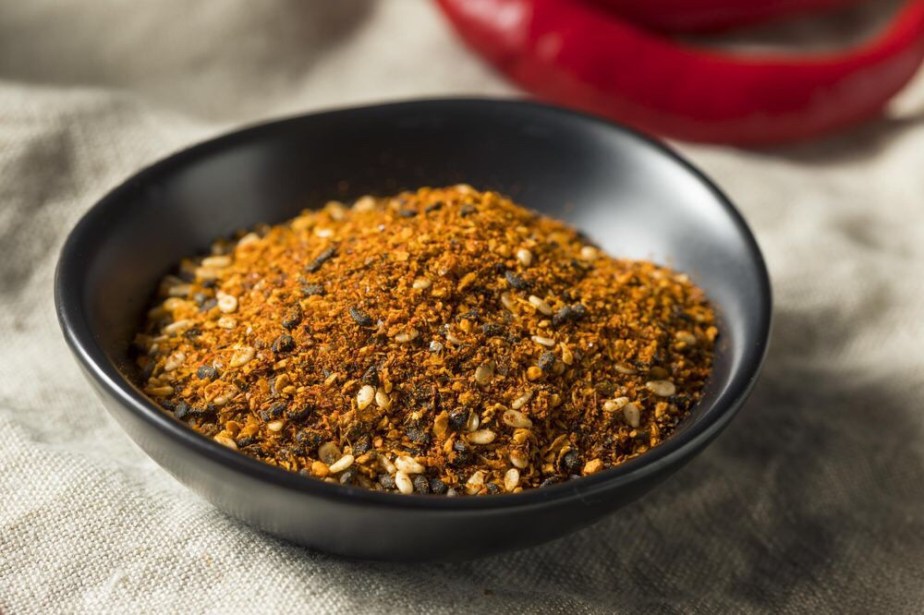
Shichimi Tōgarashi (七味唐辛子): Seven Flavor Chili Pepper

2 tablespoons sanshō or finely ground Szechuan pepper
2 tablespoons dried yuzu peel or orange or lemon peel
4 tablespoons chili powder (the Korean variety if possible)
2 tablespoons aonoriko (nori seaweed flakes)
2 teaspoons black sesame seeds
2 tsp teaspoons hemp seeds
2 teaspoons garlic powder

Mix everything together and store in an airtight container.  These amounts are just a guideline and adjust seasonings to your taste.

Mushiki (蒸し器): Bamboo Steamer

Bamboo steamers consist of interlocking baskets that stack on top of each other, with a lid on top. The entire setup is placed over a wok or pot of simmering water, and the steam rises through the open ridges at the bottom of each basket, up through the layers to cook whatever’s inside. Steaming, as a cooking method, is as important in Japanese and Asian cuisine in general as baking or roasting is in American or European cooking. A bamboo steamer can steam not just buns and dumplings, but also breads, vegetables, rice, proteins, and cakes and other desserts.

How to use a bamboo steamer:

Fill your wok or pot with water

Place the bamboo steamer into your wok and fill it with enough water to come up above the bottom rim of the steamer by about a quarter inch to half an inch. The water must come up high enough to submerge the bottom rim of the steamer in water and prevent it from scorching.

Line the steamer

If you’re placing food directly on the steamer bed (as is the case with buns or dumplings, for instance), you will need something to line it with to prevent the food from sticking to the bamboo. You can use large, soft napa cabbage leaves, lettuce leaves, layers of cheesecloth, or even squares of parchment paper. When steaming meats, especially with sauces use a heatproof bowl or plate.

Place food in your bamboo steamer

When placing dumplings, buns, etc. in the steamer, do not overcrowd them. Always leave 1 inch between dumplings, and about 1 1/2 inches between larger buns. If you’d like to steam something in a bowl or plate, there is no need to line the steamer. Make sure that there’s enough open space around the bowl or plate to allow the steam to rise up and circulate around the food.

Steaming food

You can place steamer in cooking vessel either over lightly boiling water or over cold water. In general your default is the latter. Once the water in the pot is simmering, it will start to evaporate. Allow the food to steam for as long as the recipe indicates, but keep an eye on it and add boiling water as needed.

Care for your bamboo steamer

To clean your bamboo steamer, wash with a sponge and mild dish soap, immediately rinse thoroughly. Let the steamer air dry for at least 2 days before storing to prevent any mildew. Do not put your bamboo steamer in the dishwasher. Do not soak it in water in the sink for more than 5 minutes.

Makisu (巻き簾): Bamboo Sushi Mat

The makisu is a kind of small bamboo mat made by weaving fine bamboo stems with a cotton string. Makisu is used mainly for the preparation of maki sushi, but also tamagoyaki or to drain the leaves of spinach after cooking.

If you wish to buy these utensils, for your preparations or as a gift, you will find your happiness in the artisans shops of the Kappabashi district in Tokyo.

The makisu mat will allow you to wrap the Maki during preparation. You can also use it to prepare vegetables like spinach or compress tamagoyaki (Japanese omelette) to give it a square shape.

Hangiri (半切 or 飯切)

A Hangiri (or sushi oke) is a traditional Japanese wooden tub that is used in the final steps of preparing sushi rice. Its wide flat bottom aids in spreading out the hot rice to help it cool quickly after pouring in the sushi seasoning while simultaneously fanning and mixing the rice with a rice paddle. This helps to give the sushi rice a slightly shiny appearance and speeds up evaporation and absorption so the rice doesn’t get mushy.

A quality one is normally made of uncoated cypress wood or cedar and is bound by two copper bands. They can come in sizes ranging from 1 foot to 3 feet, but for general home use 16 inches in diameter and 4 inches high is ideal. This size is good for 10 to 12 cups of rice.

A good Hangiri can be moderately expensive. One that is around 1 foot should cost about $75.00. The best ones are made out of cypress or cedar, are bound by real copper bands and are made in Japan. If the one you are looking at is less than $50.00 then it is probably a cheap knock-off that is made out of pine with the copper the bands that are actually made of plastic. You will be replacing this one in a year or two at most if you make sushi rice of any kind on a regular basis. The cost of an authentic hangiri is definitely worth the price if you are more than an occasional sushi rice maker.

Seasoning your Hangiri:

Think of seasoning your Hangiri as being similar to seasoning your cast iron skillet; except you use water and rice vinegar instead of bacon grease or lard. It is also necessary if you want to do everything properly and treat it right from the very beginning.

To season, fill it with water and 1/4 cup of rice vinegar and let it sit overnight. The next day pour the water out and dry it well before putting it away.

Before each use:

Fill the hangiri with water and let it sit while your rice cooks or for at least 30 minutes before you plan to use it. Pour out all of the water before putting any hot rice in it. It is probably a good idea to turn it over to drain for a few minutes so there won’t be so much water in it that the rice can soak it up and get mushy.

Since most quality ones are made of untreated cypress, if rice were put in it without first soaking it in water the rice would stick to the wood. The water has a non-stick affect on the wood and also keeps the tub from soaking up too much of the rice vinegar, sugar, and salt mixture. While you’re soaking the tub, do like the pros do and soak your wooden rice paddle and at least one scent free kitchen towel to cover the prepared sushi rice.

After each use, wash and dry your Hangiri thoroughly:

If there is rice stuck to it when you get done, then put warm water in it and let it sit. It is ok to use a sponge or brush to remove stubborn spots, but don’t use any kind of steel or wire brush; it will damage the wood.

After washing, dry thoroughly with a towel and then turn it upside down in a dish drainer or prop it on the side of a bowl to get air flow underneath. If stored while still wet the hangiri may develop mold spots. Don’t dry the tub in the sun, it may warp. If seasoned and cleaned thoroughly after each use, a good quality hangiri will give you many, many years of service.

Preparing Japanese Rice Properly (米の炊き方)

Rice is an essential food for the Japanese. Rice is not just a side dish, rice is as important as the rest of the meal. More than 300 varieties are grown in Japan, but those that are short-grained and high in starch are preferred. For this exercise we’re preparing four servings.

4 Servings
300 g (12¾ oz), or 2 gou, of Japanese white rice
430 ml (15 fl oz/1¾ cups) water

The gou is a Japanese unit of measurement: 1 gou equals 150 g (5½ oz) of rice or 180 ml (6 fl oz) of water. The amount needed for a bowl of rice for 1 person is 75 g (2¾ oz), or 90 ml (3 fl oz), so 1 gou is the ideal quantity for 2 people. To make this step easier, find a glass that holds 1 gou, you’ll need 11/5 glasses of water for each glass of rice. The weight of rice increases by 2.5 times when cooked, thus 75 g (2¾ oz) rice becomes about 190 g (6¾ oz).

Washing
Place the rice in a large bowl. Pour in some water and mix with your hands, then immediately discard the water. Sharpen the rice. This is the Japanese term for removing the excess starch by washing the grains. Cup your hand and plunge your cupped hand into the rice and turn it about 20 times, in small circles. Pour more water into the bowl; it will turn cloudy. Discard this water immediately and “sharpen” the rice again. Pour in some water and discard. Repeat this process 3 to 4 times until the water in the bowl is clear.

Draining
Drain the rice in a strainer and let it rest for 30 minutes.

Soaking in water
Place the rice in a heavy-based saucepan with a lid, so the rice doesn’t burn. Pour in the required amount of water. Let the rice soak briefly so it absorbs some water before cooking.

Cooking
Cover the saucepan and bring to a boil on medium heat. Lower the heat to low and cook for about 12–13 minutes (do not remove the lid after reducing the heat). Take the pan off the heat and let the rice rest for 10 minutes. This ensures that the rice swells up properly. Remove the lid and use a spatula to stir the rice, going right to the bottom of the pan without mashing the grains—if the grains stick, wet the spatula.

Rice Cooker
If you want to buy a rice cooker, choose a Japanese model, because Chinese rice cookers are generally designed to cook Chinese rice, which has lower levels of starch and water.

Kaiseki-Ryori (会席料理)

Kaiseki-Ryori (会席料理)

Prepared by specialized restaurants and also served at dinner in ryokan (traditional inns), kaiseki typically features between 10 to 12 dishes enjoyed over the course of a couple of hours. From the traditional teahouse-like interiors to the kimono-clad staff and the tranquil atmosphere, it’s a deeply Japanese experience before you even begin to eat. While the course progression and dishes will vary, the focus on seasonal ingredients is always paramount. Dishes appear like works of art and delicately garnished with seasonal motifs like a cherry blossom bud in spring.

At the heart of kaiseki dining is the Japanese principle of shun, or taking ingredients at the peak of their freshness. Dishes are presented simply, without artifice. This is done not only to ensure that the true flavor of each ingredient be expressed, but also to properly display each and every one and the height of their natural beauty, thus creating the perfect synergy between cuisine and artistic expression.

Kaiseki-Ryori is the most refined form of Japanese cuisine, and as such requires the highest etiquette. It is important to observe a few basic formalities:

Show Respect —> Before the meal, be sure to say “itadakimasu” to show respect to the chef, the restaurant staff, and the wonderful bounty itself.

Use Chopsticks Properly —> Chopsticks should not be used to poke or cut food into smaller bites. When not using them, place chopsticks back on the hashi-oki, or chopstick rest, provided rather than placing them across the top of a bowl or sticking them into a dish.

End of the meal —> At the end of the meal, remember to thank the chef and restaurant staff with the common phrase, “Gochiso-sama deshita,” which essentially means, “It was a feast.

Sakizuke

Kaiseki-ryori menus often begin with the sakizuke course – a small appetiser or amuse-bouche.

Suimono

This light, clear soup, presented with minimal garnishes, is served as a refreshing palate-cleanser.

Hassun

The most attractive and artistic of all kaiseki-ryori components, the hassun is a seasonal platter of four or five hors d’oeuvres.

Otsukuri

The otsukuri course is comprised of a selection of sashimi, which varies by season and by region.

Takiawase

A lightly simmered vegetable dish served with fish, meat, or tofu.

Yakimono

A grilled dish that showcases seasonal fish (either fresh-water or from the sea) or meat such as local wagyu (beef).

Agemono

A deep-fried dish, often featuring tempura and served with a dipping sauce or salt seasoning.

Mushimono

This steamed dish can contain fish, chicken or vegetables, and may also include a savoury custard.

Sunomono

The sunomono course is a small vinegar-based dish designed to cleanse the palate. It usually features vegetables or seafood.

Shokuji

A trio of dishes – rice, miso soup and pickles – that are served together towards the end of the meal.

Mizumono

The meal concludes with a dessert, such as seasonal fruit, ice cream or a traditional sweet.

Japanese Table Manners 101

Before you begin eating, say “itadakimasu.”

As a rule, Japanese always say “itadakimasu” before they eat. It literally means “I partake.” There are many stories behind it, but it is considered to be a way of expressing gratitude to the chef, the people who grew/raised the ingredients that make up the meal, and the ingredients themselves since everything on one’s plate was once alive. 

If the chopsticks are disposable chopsticks break the chopsticks by pulling them apart vertically.

Proper etiquette states that the chopsticks should be held horizontally, and pulled apart vertically over your knees.  Do not pull your chopsticks apart horizontally.

If there isn’t a chopstick rest, make one with the paper your chopsticks came in.

Since it is rude to place your chopsticks over your bowls when you’re not using them, if there isn’t a chopstick rest, please make one using the paper sheath. 

When you’re eating rice, hold your rice bowl in front of you in the opposite hand you use for chopsticks.

When you eat rice, make sure to lift your bowl in front of you. Not lifting your bowl is considered poor etiquette.  The same rules apply to soup bowls.

Clean your plate.

Most places in Japan will not let you take food home for hygienic reasons, so please clean your plate.

When you finish eating, put your disposable chopsticks back in the paper and fold the end. After meals, please say “gochisousama deshita.”

“Gochisousama deshita” literally means “I feasted.” It derives from the word “chisou” which means “feast,” and is written with two characters that mean “to run,” it implies that the meal was created as the result of many people running around and working together. “Go” and “sama” are honorifics that take the phrase to politer level that implies thanks to the many people that came together to create this meal.

Many people say “itadakimasu” and “gochisousama deshita” with their hands put together as though in prayer, it’s not required and is often a regional behavior.

If at a restaurant saying “gochisousama deshita” to the staff when you exit is considered to be good manners as well.

Nodaiwa: Unagi Restaurant

CCE5BBA8-AAC2-4868-B2B7-88E2DCED2F57.jpeg

Nodaiwa is a traditional unagi restaurant (grilled freshwater eel) established during the late 18th century in Tokyo. This michelin-star restaurant has 4 locations in Tokyo and one in Paris. Its main location is in Azabu, near Tokyo Tower. The 5th generation chef, KANEMOTO Kanejiro, is running the restaurant.

The building in Kamiyacho is an old style kura (storehouse) brought to Tokyo from Takayama in Gifu Prefecture. the restaurant stands out juxtaposed to the tall office buildings around it. The shop in Azabu dates from the 1970s, but the history of the restaurant goes back 200 years with the first chef opening a restaurant called “Nodaya” in Azabu during the Kansei years (1789-1801). Many articles throw around the year 1850 around as the year of establishment.  The Japanese articles just state late Edo period (1603-1868) or the Kansei years (1789-1801).