Antigone’s Fate

Antigone and Oedipus

In Greek mythology, Antigone was the daughter of Oedipus by his own mother, Jocasta, and the sister of Eteocles, Polyneices, and Ismene. When her father went into exile she accompanied the blind man as his guide.

Two versions exist of Antigone’s fate after she defied King Creon. In the first, the subject of the tragedy Antigone by Sophocles, Creon ordered that she be immured as a punishment, but rather than face burial while alive she hanged herself; Haemon, the son of Creon to whom she was betrothed, committed suicide alongside her. In the second version, Creon turned Antigone over to Haemon for punishment, but he smuggled her away, and she later bore him a son. When Creon refused to forgive them, Haemon killed both himself and Antigone.  

Aristophanes (c. 448-385 B.C.)

Aristophanes

Aristophanes (c. 448-385 B.C.) is the only representative of Old Comedy whose work we have in complete form. Aristophanes wrote political satire and his humor is often coarse. His sex-strike and anti-war comedy, Lysistrata, continues to be performed today in connection with war protests. Aristophanes presents a contemporary picture of Socrates, as a sophist in the Clouds, that is at odds with Plato’s Socrates.

Eleven of his forty plays survive virtually complete. These, together with fragments of some of his other plays, provide the only real examples of a genre of comic drama known as Old Comedy, and are used to define it.

Also known as “the Father of Comedy” and “the Prince of Ancient Comedy”, Aristophanes has been said to recreate the life of ancient Athens more convincingly than any other author. His powers of ridicule were feared and acknowledged by influential contemporaries; Plato singled out Aristophanes’ play The Clouds as slander that contributed to the trial and subsequent condemning to death of Socrates, although other satirical playwrights had also caricatured the philosopher.

His plays include: The Acharnians, Assemblywomen, The Birds, The Clouds, The Frogs, The Knights, Lysistrata, Peace, Plutus, Thesmophoriazusae, The Wasps

#ClassicalWisdom #ClassicalComedy #AncientGreece #Aristophanes

Aeschylus (c.525 – 456 B.C.)

Aeschylus

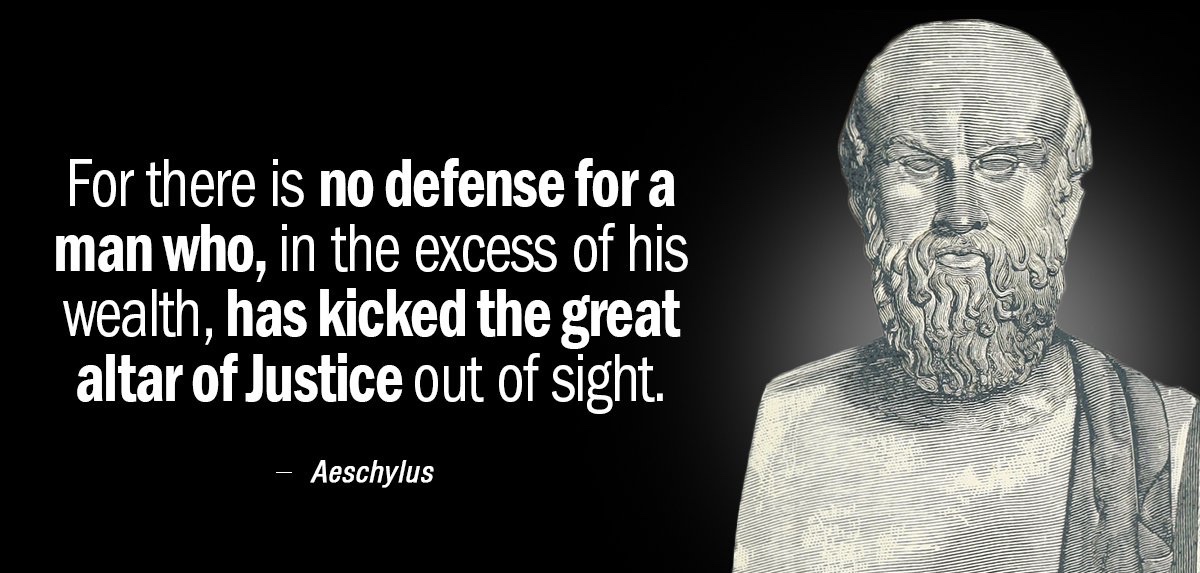
Aeschylus (c.525 – 456 B.C.) was the first great tragic poet. He introduced dialogue, the characteristic tragic boot (cothurnus) and mask. He established other conventions, like the performance of violent acts offstage. Before he became a tragic poet, Aeschylus, who wrote a tragedy about the Persians, fought in the Persian War in the battles of Marathon, Salamis, and Plataea.

Only seven of his estimated seventy to ninety plays have survived, and there is a long standing debate regarding his authorship of one of these plays, “Prometheus Bound”, which some believe his son Euphorion actually wrote.

Only seven tragedies have survived intact: The Persians, Seven against Thebes, The Suppliants, the trilogy known as The Oresteia, consisting of the three tragedies Agamemnon, The Libation Bearers and The Eumenides, together with Prometheus Bound.

The only complete trilogy of Greek plays by any playwright still extant (save a few missing lines in several spots) is the Oresteia (458 BC), although the satyr play that originally followed it, Proteus, is lost except for some fragments. The trilogy consists of Agamemnon, The Libation Bearers (Choephoroi), and The Eumenides. Together, these plays tell the bloody story of the family of Agamemnon, King of Argos.

#ClassicalWisdom #ClassicalTragedy #AncientGreece #Aeschylus