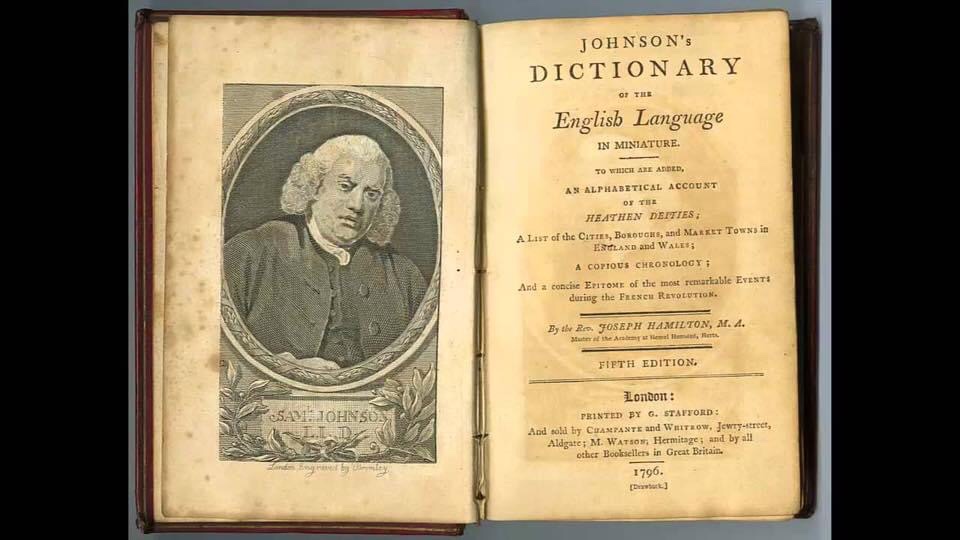
Samuel Johnson’s “A Dictionary of the English Language”

Today in 1755 Samuel Johnson’s “A Dictionary of the English Language” was published in London. It was a mammoth undertaking, requiring almost a decade of work and it remained the definitive authority until the Oxford Dictionary was completed nearly two centuries later. It had been deliberately commissioned as pre-existing dictionaries were relatively poor and incomplete. Johnson’s dictionary is a little different from the relatively dry descriptions and meticulously researched etymologies that we are used to today, for example:

Cough: A convulsion of the lungs, vellicated by some sharp serosity. It is pronounced coff

Excise: a hateful tax levied upon commodities and adjudged not by the common judges of property but wretches hired by those to whom excise is paid

As it was, Johnson’s dictionary was so large and expensive that it cost more to print than Johnson’s entire remuneration on the project and sold at around 200 copies per year for the next three decades. Although it was hardly without flaw or error, it was hugely influential for more than a century.

#SamuelJohnson #Dictionary

Christopher Hitchens

On this date in 1949, writer and columnist Christopher Hitchens was born in Portsmouth, England. He attended Cambridge and graduated from Oxford in 1970, reading in philosophy, politics and economics. From 1971-1981 he worked as a book reviewer for The Times. In 1981 he emigrated to the United States. Hitchens wrote “Minority Report,” a column for The Nation, from 1982-2002. He then wrote for Slate, The Daily Mirror, as a contributing editor to The Atlantic Monthly and Vanity Fair, and also wrote for Harpers and many other U.S. newspapers and journals. As a foreign correspondent, he covered events in 60 countries on all five continents. Hitchens wrote a host of books, but is best-known in freethought circles for authoring God Is Not Great (2007). His criticisms of Clinton and pro-Iraqi war views made Hitchens increasingly controversial among progressive readership, but he remained a stalwart atheist and iconoclast. In “Papal Power: John Paul II’s other legacy” (Slate.com, April 1, 2005), Hitchens pointed out that the pope “was a part of the cover up and obstruction of justice that allowed the child-rape scandal to continue for so long.” Hitchens became a U.S. citizen in 2007. D. 2011.

“Gullibility and credulity are considered undesirable qualities in every department of human life—except religion . . . Why are we praised by godly men for surrendering our ‘godly gift’ of reason when we cross their mental thresholds? . . . Atheism strikes me as morally superior, as well as intellectually superior, to religion. Since it is obviously inconceivable that all religions can be right, the most reasonable conclusion is that they are all wrong.”

~ Christopher Hitchens, “The Lord and the Intellectuals,” Harper’s (July 1982), cited by James A. Haught in 2,000 Years of Disbelief (1996)

Samuel Barclay Beckett

Samuel Barclay Beckett (13 April 1906 – 22 December 1989) was born, an Irish avant-garde novelist, playwright, theatre director, and poet, who lived in Paris for most of his adult life and wrote in both English and French. He is widely regarded as among the most influential writers of the 20th century.

Beckett’s work offers a bleak, tragicomic outlook on human existence, often coupled with black comedy and gallows humour, and became increasingly minimalist in his later career. He is considered one of the last modernist writers, and one of the key figures in what Martin Esslin called the “Theatre of the Absurd”.

Beckett was awarded the 1969 Nobel Prize in Literature “for his writing, which—in new forms for the novel and drama—in the destitution of modern man acquires its elevation.”

#SamuelBeckett #NobelPrizeLiterature

Top 10 Most Challenged Books of 2020

The ALA Office for Intellectual Freedom tracked 156 challenges to library, school, and university materials and services in 2020. Of the 273 books that were targeted, here are the most challenged, along with the reasons cited for censoring the books:

  1. George by Alex Gino. Reasons: Challenged, banned, and restricted for LGBTQIA+ content, conflicting with a religious viewpoint, and not reflecting “the values of our community”
  2. Stamped: Racism, Antiracism, and You by Ibram X. Kendi and Jason Reynolds. Reasons: Banned and challenged because of author’s public statements, and because of claims that the book contains “selective storytelling incidents” and does not encompass racism against all people
  3. All American Boys by Jason Reynolds and Brendan Kiely. Reasons: Banned and challenged for profanity, drug use, and alcoholism, and because it was thought to promote anti-police views, contain divisive topics, and be “too much of a sensitive matter right now”
  4. Speak by Laurie Halse Anderson. Reasons: Banned, challenged, and restricted because it was thought to contain a political viewpoint and it was claimed to be biased against male students, and for the novel’s inclusion of rape and profanity
  5. The Absolutely True Diary of a Part-Time Indian by Sherman Alexie. Reasons: Banned and challenged for profanity, sexual references, and allegations of sexual misconduct by the author
  6. Something Happened in Our Town: A Child’s Story About Racial Injustice by Marianne Celano, Marietta Collins, and Ann Hazzard, illustrated by Jennifer Zivoin. Reasons: Challenged for “divisive language” and because it was thought to promote anti-police views
  7. To Kill a Mockingbird by Harper Lee. Reasons: Banned and challenged for racial slurs and their negative effect on students, featuring a “white savior” character, and its perception of the Black experience
  8. Of Mice and Men by John Steinbeck. Reasons: Banned and challenged for racial slurs and racist stereotypes, and their negative effect on students
  9. The Bluest Eye by Toni Morrison. Reasons: Banned and challenged because it was considered sexually explicit and depicts child sexual abuse
  10. The Hate U Give by Angie Thomas. Reasons: Challenged for profanity, and it was thought to promote an anti-police message

Charles Fourier

Today in history —> French philosopher Charles Fourier was born on this day in 1772. Although he was considered a radical in his time for his philosophy of utopian socialism, many of his ideas have now become mainstream. For instance, Fourier was a fervent believer in gender equality and is credited with coining the term “feminism” in 1837.

#FrenchPhilosophers #CharlesFourier #Feminism

Vourdalak

In western sources the Vourdalak is a vampire from Russian mythology. It is said that this vampire is a beautiful and evil woman. The vampire was able to lure young men to do its bidding and drink from.

In actuality a Vourdalak is a vampire in the Slavic folklore mythology. Some Western sources define it as a type of “Russian vampire” that must consume the blood of its loved ones and convert its whole family. This notion is based apparently on Alexey K. Tolstoy’s novella The Family of the Vourdalak, telling the story of one such (actually, Serbian) family.

In Russia the common name for vampire (or wurdulac) is “upyr” (Russian: упырь). Nowadays the three terms are regarded as synonymous, but in 19th century they were seen as separate, although similar entities. The Russian upyr was said to be a former witch, werewolf or a particularly nasty sinner who’d been excommunicated from the church. In Ukraine the upyrs were also feared as the vampires who could bring about droughts and epidemics.

In Russian language the word “wurdulac” (Russian: вурдалак) first appeared in early 19th century, and became common due to Alexander Pushkin’s 1836 poem of the same name, part of the Songs of the Western Slavs cycle. It is the corrupt form of the West Slavic word “volkodlak” (Russian: волкодлак), meaning literally “wolf-fur” or “wolf-hide” (i.e., it denotes someone “wearing” a wolf’s skin; a werewolf).

Emile Zola

On this date in 1840, Emile Zola was born in Paris. The novelist pioneered naturalistic writing, believing ugly problems could not be solved as long as they stayed hidden. As a struggling young writer, Zola supported himself as a clerk. Legend has it he sometimes resorted to trapping birds on his windowsill in order to eat. Zola also moonlighted as a political reporter and critic. He was fired from a publishing house after an early autobiographical novel created notoriety. His breakthrough novel was Therese Raquin (1867). By the time his book L’Assammoir (“The Drunkard,” 1878) appeared, Zola was France’s most famous writer, yet he was barred his entire life from the Academy. His book Germinal (1885), about conditions in a coal mine leading to a strike, was denounced by the rightwing. Nana (1880) examined sexual exploitation.

Zola’s most enduring work is his open letter “J’Accuse,” about the Dreyfus case. He campaigned with Clemenceau to free the the French Jewish army officer falsely accused of spying. Zola was sentenced to imprisonment for writing “J’Accuse” in 1898, escaping to England until he could safely return after Dreyfus’ name had been cleared. Zola, who was baptized Catholic, was a notable critic of the Roman Catholic Church (and vice versa). The Church particularly condemned his books Lourdes, Rome, and Paris (1894-98). The agnostic was an honorary associate of the British Press Association in England. D. 1902.

“When truth is buried underground it grows, it chokes, it gathers such an explosive force that on the day it bursts out, it blows up everything with it.”

“The truth is on the march, and nothing shall stop it.”

~ Emile Zola, “J’Accuse!” L’Aurore, Jan. 13, 1898

Amos Oz on Fanaticism

“Fanaticism dates back much earlier than Islam. Earlier than Christianity and Judaism. Earlier than all the ideologies in the world. It is an elemental fixture of human nature, a “bad gene.” People who bomb abortion clinics, murder immigrants in Europe, murder Jewish women and children in Israel, burn down a house in the Israeli-occupied territories with an entire Palestinian family inside, desecrate synagogues and churches and mosques and cemeteries—they are all distinct from al-Qaeda and ISIS in the scope and severity of their acts, but not in their nature. Today we speak of “hate crimes,” but perhaps a more accurate term would be “zealotry crimes,” and such crimes are carried out almost daily, including against Muslims.

Genocide and jihad and the Crusades, the Inquisition and the gulags, extermination camps and gas chambers, torture dungeons and indiscriminate terrorist attacks: none of these are new, and almost all of them preceded the rise of radical Islam by centuries.

As the questions grow harder and more complicated, people yearn for simpler answers, one-sentence answers, answers that point unhesitatingly to a culprit who can be blamed for all our suffering, answers that promise that if we only eradicate the villains, all our troubles will vanish.

“It’s all because of globalization!” “It’s all because of the Muslims!” “It’s all because of permissiveness!” or “because of the West!” or “because of Zionism!” or “because of immigrants!” or “because of secularism!” or “because of the left wing!” All one needs to do is cross out the incorrect entries, circle the right Satan, then kill that Satan (along with his neighbors and anyone who happens to be in the area), thereby opening the gates of heaven once and for all.

More and more commonly, the strongest public sentiment is one of profound loathing—subversive loathing of “the hegemonic discourse,” Western loathing of the East, Eastern loathing of the West, secular loathing of believers, religious loathing of the secular. Sweeping, unmitigated loathing surges like vomit from the depths of this or that misery. Such extreme loathing is a component of fanaticism in all its guises.

For example, concepts that only half a century ago seemed innovative and exciting—multiculturalism and identity politics—quickly morphed, in many places, into the politics of identity hatred. What began with an expansion of cultural and emotional horizons is increasingly deteriorating into narrower horizons, isolationism, and hatred of the other. In short, a new wave of loathing and extremism assails us from all sides.”

~ Amos Oz, from “Dear Zealots.” 2002.

Virginia Woolf Suicide Note

Virginia Woolf died 80 years ago on this day in 1941:

“Dearest, I feel certain that I am going mad again. I feel we can’t go through another of those terrible times. And I shan’t recover this time. I begin to hear voices, and I can’t concentrate. So I am doing what seems the best thing to do. You have given me the greatest possible happiness. You have been in every way all that anyone could be. I don’t think two people could have been happier till this terrible disease came. I can’t fight any longer. I know that I am spoiling your life, that without me you could work. And you will I know. You see I can’t even write this properly. I can’t read. What I want to say is I owe all the happiness of my life to you. You have been entirely patient with me and incredibly good. I want to say that—everybody knows it. If anybody could have saved me it would have been you. Everything has gone from me but the certainty of your goodness. I can’t go on spoiling your life any longer. I don’t think two people could have been happier than we have been. V.”

~ Virginia Woolf’s suicide letter to her husband

#VirginiaWoolf #FavoriteAuthors #MentalHealth