Red Comet by Heather Clark

I’ve been waiting more than two months for this book to come out. It was released on Sylvia Plath’s birthday (Oct. 27th). I picked it up yesterday and it is amazing so far, but it’s long at 937 pages. Instead of the focus being on her suicide it is on the amazing art of the written form she composed during her lifetime.

The author spent eight years researching, given access to previously unseen journals, letters, stories and poetry. Highly recommend for anyone who wants to see through the mythology of Sylvia Plath and see the real woman and artist.

Here’s the NYT review:

https://www.nytimes.com/2020/10/27/books/review/red-comet-heather-clark-sylvia-plath.html

Book Review: The Eight Gates Of Zen

This volume has had a profound influence upon my life as I keep returning to it over and over again.  After my illness (liver transplant) I had lost a lot of my faith in Zen and was only practicing once in a while.  A received this gift from a friend who had lived at Zen Mountain Monastery for a time.  I placed in my queue of books to read and there it sat for a few month, but I kept having this nagging feeling that reading this volume would have an immediate impact on my life.

I finally read it through in a couple of days and I have never regretted that decision, as a matter of fact it was one of the best decisions I have made.  The book presents an, “accessible introduction to the philosophy and practice of Zen Buddhism includes a program of study that encompasses practically every aspect of life.”  Soon after I finished reading it I found myself seeking a teacher.  Living in Jacksonville, Florida that task proved difficult as I could not find someone that met my requirements.  I ended up turning to the internet and listening to the dharma talks of Thich Nhat Hanh, John Daido Loori, and others.  This in no way is  a substitute for having a teacher, but it was the best solution available for me.

This small volume has taught me much and when I find my faith wandering I pick it up and read either excerpts or the whole book again.  I recently was going through one of these spells and decided to read the book.  Since completing it I have found myself a sangha, started this website and am rededicated to walking the path.  I have never felt stronger about my beliefs and I owe a debt of gratitude to John Daido Loori and his book.

The program of study developed by John Daido Loori at Zen Mountain Monastery, from their website:

Zazen

Zazen is the cornerstone of Zen training. Za means “sitting.” Zen—which derives from the Sanskritdhyana—means meditation. In its beginning stages, zazen is a practice of concentration, with a focus on following or counting the breath. More than just meditation, however, zazen is a powerful tool of self-inquiry, boundless in its ability to reveal the true basis of reality. Through zazen, we realize the unity of the self with the ten thousand things, which has the potential to transform our lives and those of others.

Study with a Teacher

Zen is an ancestral lineage that traces itself back to Shakyamuni Buddha. Because it relies on the mind-to-mind transmission of its teachings, personal study with an authentic teacher is pivotal to training. Although fundamentally, teachers have nothing to give, they are indispensable in helping students navigate the difficulties we encounter along the way, directly pointing to our original perfection. In dokusan, private interview, students deal with the questions and insights that emerge out of zazen.

Buddhist Study

The founder of Zen, Bodhidharma, said that Zen does not rely on words and letters. However, most western Buddhist practitioners are not familiar with the historical, philosophical and psychological underpinnings of the tradition, so Buddhist Study is critical to establishing a sound religious practice. Though words are not the same as the reality they describe, when used skillfully, they can act as a medium for direct realization.

Liturgy

Liturgy makes visible the invisible, bringing into awareness the shared experience of a group. In theistic religions, liturgy reaffirms our relationship with God. Zen, by contrast, is nontheistic, so its emphasis is on realizing our Buddha nature, or the nature of the self. All of Zen’s rituals point to the intimacy between the self and the ten thousand things. For an introduction to Zen liturgy, see Celebrating Everyday Life by Daido Roshi.

Right Action

Right Action is the study and practice of the Buddhist Precepts, the moral and ethical teachings of the Buddha. Though the Precepts are based on the experience of no-self, they are designed to function in the world of differences. Thus they define how a Buddha lives in the world. See Daido Roshi’s book on the moral and ethical teachings of Zen Buddhism, The Heart of Being.

Art Practice

From its inception, training at Zen Mountain Monastery has taken up both the traditional Zen arts as well as contemporary arts to deeply study the self. Art practice encompasses the entire creative process: artist and tools, the relationships between artist and subject, artist and object, and object and audience. Together, these interactions show us that creativity is an inherent human process. See Daido Roshi’s book The Zen of Creativity.

Body Practice

Our physical body is our vehicle of self-realization, an experience that encompasses our whole being. The search for self-knowledge is often reduced to a purely mental pursuit. Body practice helps us to unify body, breath and mind through activities ranging from refined practices like Tai Chi to mundane activities like washing our face or eating breakfast.

Work Practice

Work Practice is a reminder that our spiritual practice must move off the cushion and translate into the sacred activity of living and working in the world. A daily caretaking period and formal work practice give us the opportunity to explore labor that is nourishing to ourselves and others. Starting with simple, repetitive tasks, and gradually increasing their complexity, we learn to see how our minds respond to the task at hand.


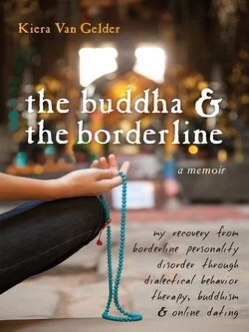
Book Review: Buddha & The Borderline

This book is atypical of the type I will normally review or discuss, but it is a phenomenal book that tangentially discusses Buddhism.  The book is really about a woman who suffers from borderline personality disorder and her journey through the depths of the disease and into recovery.  Buddhism plays a fundamental role in her recovery, but if you are looking for a deep discussion of Buddhist thought look elsewhere.  What you will find here is an inspiring story that will make you laugh out loud for real, cringe and possibly cry in spots.  There are parts of the true story that are just plain ugly and scary.  This is one of my favorite quick reads which gives you a sense of the importance of Buddhism in the life of a pained individual as she struggle to redefine herself.

The Buddha and the Borderline is a cross between Girl, Interrupted and Bridget Jones’s Diary.While reading it, I found myself admiring Kiera’s talent for vividly describing borderline hopelessness and pain while keeping me laughing with her tales of life as a ‘lonely and increasingly horny receptionist.’ While this book has something for everyone, Kiera’s detailed account of how she recovered from this deadly disorder will be enormously inspiring to people with borderline personality disorder and their family members.” (Randi Kreger)

“Kiera’s book is destind to become a classic in the growing literature on borderline personality disorder. I expected to get a somber account of a transformation from suffering to enlightenment,but the book I read was not only entirely entertaining and revealing, but also had me up way past my bedtime in stitches. The Buddha and the Borderline is seriously funny, authentic, and sublime in its wisdom. The book embodies the Four Noble Truths of Buddhism and integrates the world of core unrelenting suffering with the world of freedom from suffering. Transcendent stuff.” (Blaise Aguirre,MD, medical director of the Adolescent Dialectical Behavior Therapy Residential Program at McLean Hospital in Belmont, MA)

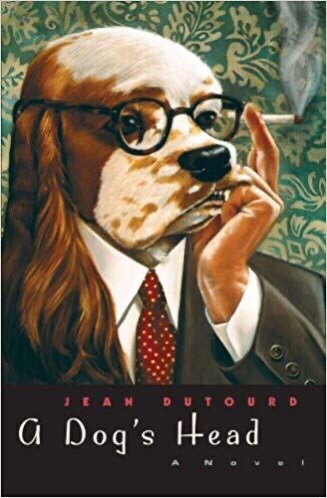
Book Review: A Dog’s Head by Jean Dutourd

“Jean Dutourd’s A Dog’s Head is a wonderful piece of magical realism, reminiscent of Voltaire, Borges and Kafka. With biting wit, Dutourd presents the story of Edmund Du Chaillu, a boy born, to his bourgeois parents’s horror, with the head of a spaniel. Edmund must endure his school-mate’s teasing as well as an urge to carry a newspaper in his mouth. This is the story of his life, trials, and joys as he searches for a normal life of worth and love.”

~From The Back Cover

Aristophanes (c. 448-385 B.C.)

Aristophanes

Aristophanes (c. 448-385 B.C.) is the only representative of Old Comedy whose work we have in complete form. Aristophanes wrote political satire and his humor is often coarse. His sex-strike and anti-war comedy, Lysistrata, continues to be performed today in connection with war protests. Aristophanes presents a contemporary picture of Socrates, as a sophist in the Clouds, that is at odds with Plato’s Socrates.

Eleven of his forty plays survive virtually complete. These, together with fragments of some of his other plays, provide the only real examples of a genre of comic drama known as Old Comedy, and are used to define it.

Also known as “the Father of Comedy” and “the Prince of Ancient Comedy”, Aristophanes has been said to recreate the life of ancient Athens more convincingly than any other author. His powers of ridicule were feared and acknowledged by influential contemporaries; Plato singled out Aristophanes’ play The Clouds as slander that contributed to the trial and subsequent condemning to death of Socrates, although other satirical playwrights had also caricatured the philosopher.

His plays include: The Acharnians, Assemblywomen, The Birds, The Clouds, The Frogs, The Knights, Lysistrata, Peace, Plutus, Thesmophoriazusae, The Wasps

#ClassicalWisdom #ClassicalComedy #AncientGreece #Aristophanes

Aeschylus (c.525 – 456 B.C.)

Aeschylus

Aeschylus (c.525 – 456 B.C.) was the first great tragic poet. He introduced dialogue, the characteristic tragic boot (cothurnus) and mask. He established other conventions, like the performance of violent acts offstage. Before he became a tragic poet, Aeschylus, who wrote a tragedy about the Persians, fought in the Persian War in the battles of Marathon, Salamis, and Plataea.

Only seven of his estimated seventy to ninety plays have survived, and there is a long standing debate regarding his authorship of one of these plays, “Prometheus Bound”, which some believe his son Euphorion actually wrote.

Only seven tragedies have survived intact: The Persians, Seven against Thebes, The Suppliants, the trilogy known as The Oresteia, consisting of the three tragedies Agamemnon, The Libation Bearers and The Eumenides, together with Prometheus Bound.

The only complete trilogy of Greek plays by any playwright still extant (save a few missing lines in several spots) is the Oresteia (458 BC), although the satyr play that originally followed it, Proteus, is lost except for some fragments. The trilogy consists of Agamemnon, The Libation Bearers (Choephoroi), and The Eumenides. Together, these plays tell the bloody story of the family of Agamemnon, King of Argos.

#ClassicalWisdom #ClassicalTragedy #AncientGreece #Aeschylus

Plato’s The Allegory of the Cave

E6B23110-FD67-49CF-BA74-A55501E69029.jpeg

Plato’s The Allegory of the Cave

The Allegory of the Cave, or Plato’s Cave, was presented by the Greek philosopher Plato in his work Republic (514a–520a) to compare “the effect of educationand the lack of it on our nature”. It is written as a dialogue between Plato’s brother Glaucon and his mentor Socrates, narrated by the latter.

~ Plato realizes that the general run of humankind can think, and speak, etc., without (so far as they acknowledge) any awareness of his realm of Forms.

~ The allegory of the cave is supposed to explain this.

~ In the allegory, Plato likens people untutored in the Theory of Forms to prisoners chained in a cave, unable to turn their heads. All they can see is the wall of the cave. Behind them burns a fire.  Between the fire and the prisoners there is a parapet, along which puppeteers can walk. The puppeteers, who are behind the prisoners, hold up puppets that cast shadows on the wall of the cave. The prisoners are unable to see these puppets, the real objects, that pass behind them. What the prisoners see and hear are shadows and echoes cast by objects that they do not see. Here is an illustration of Plato’s Cave:

B9559BBB-E879-40B5-B5B4-11FBE8F8D82F

~ Such prisoners would mistake appearance for reality. They would think the things they see on the wall (the shadows) were real; they would know nothing of the real causes of the shadows.

~ So when the prisoners talk, what are they talking about? If an object (a book, let us say) is carried past behind them, and it casts a shadow on the wall, and a prisoner says “I see a book,” what is he talking about?

He thinks he is talking about a book, but he is really talking about a shadow. But he uses the word “book.” What does that refer to?

~ Plato gives his answer at line (515b2). The text here has puzzled many editors, and it has been frequently emended. The translation in Grube/Reeve gets the point correctly:

And if they could talk to one another, don’t you think they’d suppose that the names they used applied to the things they see passing before them?”

~ Plato’s point is that the prisoners would be mistaken. For they would be taking the terms in their language to refer to the shadows that pass before their eyes, rather than (as is correct, in Plato’s view) to the real things that cast the shadows.

~ If a prisoner says “That’s a book” he thinks that the word “book” refers to the very thing he is looking at. But he would be wrong. He’s only looking at a shadow. The real referent of the word “book” he cannot see. To see it, he would have to turn his head around.

~ Plato’s point: the general terms of our language are not “names” of the physical objects that we can see. They are actually names of things that we cannot see, things that we can only grasp with the mind.

D9AC059C-EF45-420D-85BD-0D9746E79EB2.jpeg

~ When the prisoners are released, they can turn their heads and see the real objects. Then they realize their error. What can we do that is analogous to turning our heads and seeing the causes of the shadows? We can come to grasp the Forms with our minds.

~ Plato’s aim in the Republic is to describe what is necessary for us to achieve this reflective understanding. But even without it, it remains true that our very ability to think and to speak depends on the Forms. For the terms of the language we use get their meaning by “naming” the Forms that the objects we perceive participate in.

~ The prisoners may learn what a book is by their experience with shadows of books. But they would be mistaken if they thought that the word “book” refers to something that any of them has ever seen.

Likewise, we may acquire concepts by our perceptual experience of physical objects. But we would be mistaken if we thought that the concepts that we grasp were on the same level as the things we perceive.

Sources: Philosophy 320: History of Philosophy (University of Washington)

The Republic by Plato

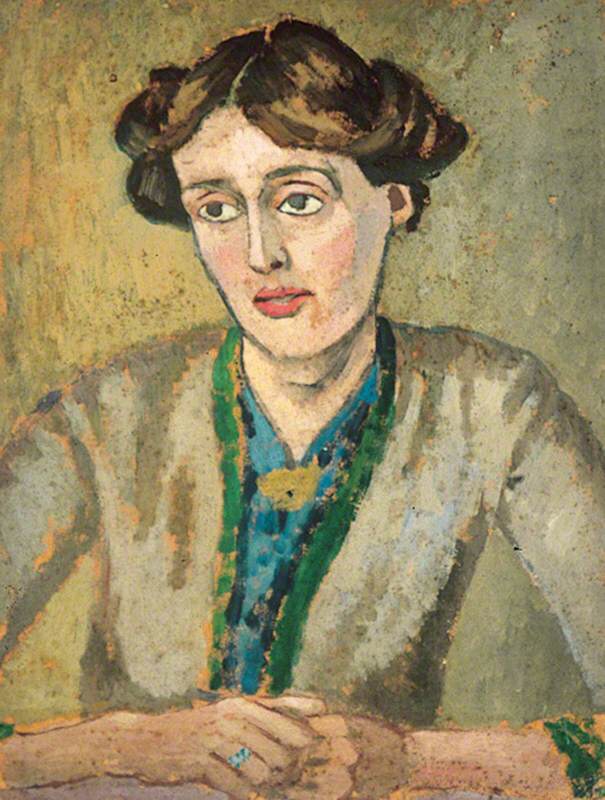
Virginia Woolf

Virginia Woolf (1882-1941)

Adeline Virginia Woolf is well known as one of the major literary figures of the twentieth century. The English author, novelist, essayist, biographer, feminist, publisher and writer of short stories is best known for her novels “Mrs. Dalloway,” “To The Lighthouse,” “Orlando,” and her book length essay, “A Room Of One’s Own.” From this essay she is often quoted, “A woman must have money and a room of her own if she is to write fiction.”

She began writing professionally in 1900 with an article about Haworth, the home of the Bronte family for the Times Literary Supplement. Her first novel “The Voyage Out” was published in 1915 by her half-brother. She would go on to publish novels and essays as an intellectual to both critical and popular success. Much of her work was self-published through the Hogarth Press. Her work was often criticized for its narrow portrayal of the upper middle class intellectuals and lacked anything of ethical or emotional relevance for the common reader. She is often criticized as well for being perceived as an anti-Semite despite the fact she was happily married to a Jewish man and condemned Christianity as self-righteous egotism and in a letter to her friend Ethel Smyth, “my Jew has more religion in one toe nail—more human love, in one hair.” Additionally her distaste for fascism and its ties to anti-Semitism is quite plainly spelled out in her book, “Three Guineas.” Her final work, “Between the Acts,” aptly expresses some of her main themes : transformation of life through art, sexual ambivalence, and the flux of time throughout one’s life at the same time being a deterioration and renewal.

Throughout her life Virginia suffered from several “breakdowns” as a result of having symptoms that conform to bipolar disorder, the first occurring by the sudden death of her mother when she was thirteen. Her most significant episode occurred after the death of her father in 1904 and was in turn briefly institutionalized after her first suicide attempt. Modern scholars have suggested her recurring depressive periods were a result of sexual abuse both her and her sister were subjected to by her half-brothers. She vividly recounts this in an autobiographical essay, “A Sketch of the Past,” which can be now read in “Moments of Being” a collection of posthumously-published autobiographical essays. She wrote of the event, “I can remember the feel of his hands going under my clothes; going firmly and steadily lower and lower, I remember how I hoped that he would stop; how I stiffened and wriggled as his hand approached my private parts. But he did not stop.”

Throughout her life she struggled with periodic mood swings and associated illnesses. Though this often affected her social life, her literary career and productivity continued with very few breaks. After the completion of “Between the Acts” she fell into a deep depression. The onset of World War II and the destruction of her London home in the bombing only deepened it. On March 28th, 1941 she filled the pockets of her overcoat with stones and drowned herself in the River Ouse which runs through the counties of West and East Sussex near her home. In her last note to her husband she wrote :

“Dearest, I feel certain that I am going mad again. I feel we can’t go through another of those terrible times. And I shan’t recover this time. I begin to hear voices, and I can’t concentrate. So I am doing what seems the best thing to do. You have given me the greatest possible happiness. You have been in every way all that anyone could be. I don’t think two people could have been happier ’til this terrible disease came. I can’t fight any longer. I know that I am spoiling your life, that without me you could work. And you will I know. You see I can’t even write this properly. I can’t read. What I want to say is I owe all the happiness of my life to you. You have been entirely patient with me and incredibly good. I want to say that – everybody knows it. If anybody could have saved me it would have been you. Everything has gone from me but the certainty of your goodness. I can’t go on spoiling your life any longer. I don’t think two people could have been happier than we have been.”
~ Virginia Woolf

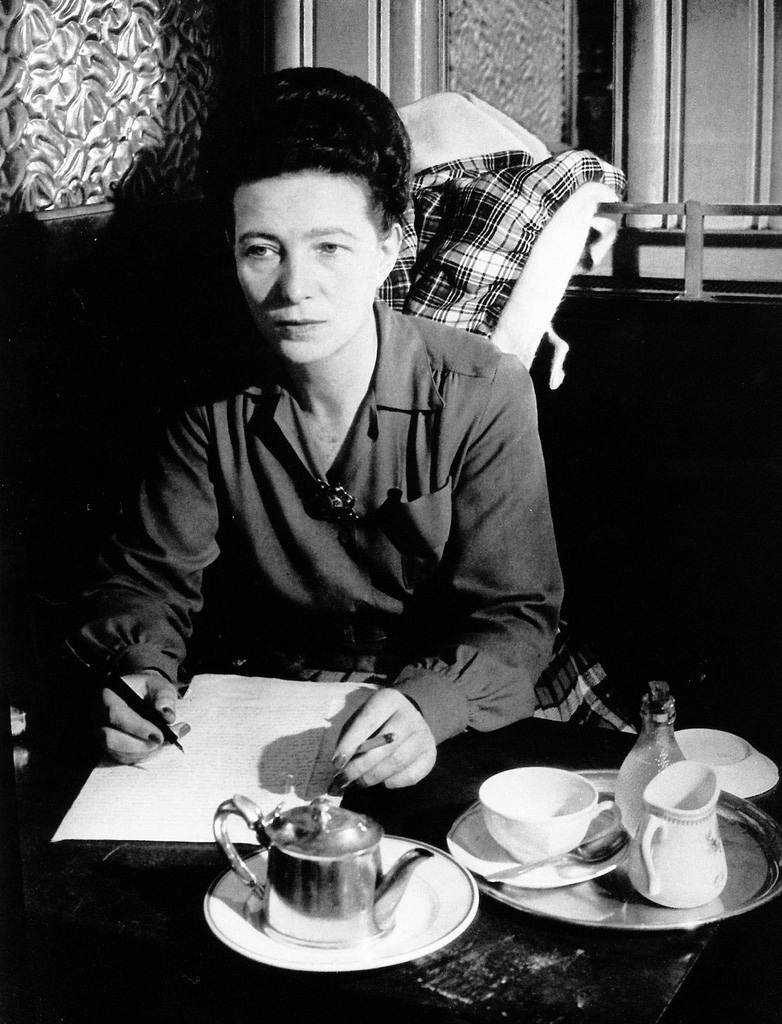
Simone de Beauvoir

Simone de Beauvoir (1908-1986)

Simone-Ernestine-Lucie-Marie Bertrand de Beauvoir was a French existentialist philosopher, intellectual, feminist and social theorist. She did not consider herself a philosopher, however her contributions to existential feminist thought firmly enshrines her legacy as one. In her lifetime she wrote novels, essays, biographies, a multi-volume autobiography, including articles/essays on philosophy, politics, and social issues. She is best remembered for her treatise “The Second Sex,” a highly detailed analysis of women’s oppression and as it relates and influences contemporary feminism. She is also known for her two metaphysical novels “She Came to Stay” and “The Mandarins,” but by far best known or renown for “The Second Sex.”

Simone de Beauvoir was born in Paris and studied mathematics and philosophy at the Institut Catholique and literature/languages at the Institut Sainte-Marie. She then went on to study philosophy at the Sorbonne. Afterwards while completing her practice teaching requirements she first met Maurice Merleau-Ponty and Claude Lévi-Strauss. While studying for her agrégation in philosophy (a highly competitive postgraduate civil service examination which serves as a national ranking of students for some position in the public education system) she met fellow students Jean-Paul Sartre, Paul Nizan, and René Maheu. The jury narrowly awarded Sartre first place over Beauvoir. She was twenty-one at the time and the youngest ever to pass the exam.

In June 1949 “The Second Sex” was published in France. She argues that men made women the “Other” in society by putting a false and constructed mystery around them. Therefore men used this as their excuse not to understand women, their problems and most importantly not to help them. She went on to argue that men stereotyped women and used it to organize society into a patriarchy. As an existentialist she believed, “l’existence précède l’essence” (existence precedes essence), there by one is not born a woman, but becomes one. It is the social construction of woman that she identifies as fundamental to woman oppression. She went on to argue that even Mary Wollstonecraft considered men to be the ideal to which women should aspire and that this belief limited women’s success by maintaining that perception. She vigorously argued that for feminism to move forward this assumption must be set aside. Thus Beauvoir aseerted that women are as capable of choice as man, and therefore can ellect to elevate themselves and move beyond the position which they have been resigned and reach a position in which they take responsibility for oneself and the world, where one can choose one’s freedom.

A long quote and a few short quotes :

“Art, literature, and philosophy are attempts to found the world anew on a human freedom: that of the creator; to foster such an aim, one must first unequivocally posit oneself as a freedom. The restrictions that education and custom impose on a woman limit her grasp of the universe…Indeed, for one to become a creator, it is not enough to be cultivated, that is, to make going to shows and meeting people part of one’s life; culture must be apprehended through the free movement of a transcendence; the spirit with all its riches must project itself in an empty sky that is its to fill; but if a thousand fine bonds tie it to the earth, its surge is broken. The girl today can certainly go out alone, stroll in the Tuileries; but I have already said how hostile the street is: eyes everywhere, hands waiting: if she wanders absentmindedly, her thoughts elsewhere, if she lights a cigarette in a cafe, if she goes to the cinema alone, an unpleasant incident can quickly occur; she must inspire respect by the way she dresses and behaves: this concern rivets her to the ground and self. “Her wings are clipped.” At eighteen, T.E. Lawrence went on a grand tour through France by bicycle; a young girl would never be permitted to take on such an adventure…Yet such experiences have an inestimable impact: this is how an individual in the headiness of freedom and discovery learns to look at the entire world as his fief…[The girl] may feel alone within the world: she never stands up in front of it, unique and sovereign.”

“One’s life has value so long as one attributes value to the life of others, by means of love, friendship, and compassion”

“A man attaches himself to woman — not to enjoy her, but to enjoy himself.”

“Man is defined as a human being and a woman as a female – whenever she behaves as a human being she is said to imitate the male.”

“Society, being codified by man, decrees that woman is inferior; she can do away with this inferiority only by destroying the male’s superiority.”

“The word love has by no means the same sense for both sexes, and this is one cause of the serious misunderstandings that divide them.”

“Representation of the world, like the world itself, is the work of men; they describe it from their own point of view, which they confuse with absolute truth.”

“One is not born a genius, one becomes a genius; and the feminine situation has up to the present rendered this becoming practically impossible.”
~ Simone de Beauvoir

Mary Wollstonecraft

Mary Wollstonecraft (1759-1797)

Mary Wollstonecraft was an eighteenth century English writer, philosopher and advocate of women’s rights. She wrote novels, treatises, a travel narrative, a history of the French Revolution, a conduct book, and a children’s book. She is best known for her 1792 book, “A Vindication of the Rights of Women.” Through it she argues that women are not naturally inferior to men, but appear so simply because they lack the education. She posits both men and women should be treated as rational beings and bring about a social order founded on reason. Today she is regarded as one of the founding feminist philosophers and her unconventional life is also cited as a fundamental influence among certain feminists.
A few of her quotes summarize some of her beliefs much more adequately than I could ever attempt :

“I do not wish them [women] to have power over men; but over themselves.”

“If we revert to history, we shall find that the women who have distinguished themselves have neither been the most beautiful nor the most gentle of their sex.”

“It is vain to expect virtue from women till they are in some degree independent of men.”

“My own sex, I hope, will excuse me, if I treat them like rational creatures, instead of flattering their fascinating graces, and viewing them as if they were in a state of perpetual childhood, unable to stand alone.”
“Taught from their infancy that beauty is woman’s sceptre, the mind shapes itself to the body, and roaming round its gilt cage, only seeks to adorn its prison.”

“It is time to effect a revolution in female manners – time to restore to them their lost dignity – and make them, as a part of the human species, labour by reforming themselves to reform the world. It is time to separate unchangeable morals from local manners.”

“Love from its very nature must be transitory. To seek for a secret that would render it constant would be as wild a search as for the philosopher’s stone or the grand panacea: and the discovery would be equally useless, or rather pernicious to mankind. The most holy band of society is friendship.”
~ Mary Wollstonecraft