The Sixteen Bodhisattva Precepts

The Three Treasures

  • Taking refuge in the Buddha
  • Taking refuge in the Dharma
  • Taking refuge in the Sangha

The Three Pure Precepts

  • Do not create Evil
  • Practice Good
  • Actualize Good For Others

 The Ten Grave Precepts

  • Respect life – Do not kill
  • Be giving – Do not steal
  • Honor the body – Do not misuse sexuality
  • Manifest truth – Do not lie
  • Proceed clearly – Do not cloud the mind
  • See the perfection – Do not speak of others errors and faults
  • Realize self and other as one – Do not elevate the self and blame others
  • Give generously – Do not be withholding
  • Actualize harmony – Do not be angry
  • Experience the intimacy of things – Do not defile the Three Treasures

The 10 Zen Oxherding Pictures

9A3493F0-1776-4A78-957E-4A6203A4A56B

The 10 Zen Oxherding Pictures

Verse by 廓庵師遠 Kuoan Shiyuan [Kakuan Shien], 12th century.

Translated by Philip Kapleau (1912-2004).

Paintings by 直原玉青 Jikihara Gyokusei (1904-2005).

Gifted to Zen Mountain Monastery.

Among the various formulations of the levels of realization in Zen, none is more widely known than the Oxherding Pictures, a sequence of ten illustrations annotated with comments in prose and verse. It is probably because of the sacred nature of the ox in ancient India that this animal came to be used to symbolize man’s primal nature or Buddha-mind. 

The original drawings and the commentary that accompanies them are both attributed to Kakuan Shien (Kuo-an Shih-yuan), a Chinese Zen master of the twelfth century, but he was not the first to illustrate the developing stages of Zen realization through pictures. Earlier versions of five and eight pictures exist in which the ox becomes progressively whiter, the last painting being a circle. This implied, that the realization of Oneness (i.e., the effacement of every conception of self and other) was the ultimate goal of Zen. But Kakuan, feeling this to be incomplete, added two more pictures beyond the circle to make it clear that the Zen man of the highest spiritual development lives in the mundane world of form and diversity and mingles with the utmost freedom among ordinary men, whom he inspires with his compassion and radiance to walk in the Way of the Buddha. It is this version that has gained the widest acceptance in Japan, has proved itself over the years to be a source of instruction and unfailing inspiration to Zen students:

CEE51D84-B7F8-40A2-AA79-200201BF000F

The man actively seeks the ox in the forest.

The Ox has never really gone astray, so why search for it? Having turned his back on his True-nature, the man cannot see it. Because of his defilements he has lost sight of the Ox. Suddenly he finds himself confronted by a maze of crisscrossing roads. Greed for worldly gain and dread of loss spring up like searing flames, ideas of right and wrong dart out like daggers.

Desolate through forests and fearful in jungles,
he is seeking an Ox which he does not find.
Up and down dark, nameless, wide-flowing rivers,
in deep mountain thickets he treads many bypaths.
Bone-tired, heart-weary, he carries on his search
for this something which he yet cannot find.
At evening he hears cicadas chirping in the trees.

DAFF874B-6293-4551-82B7-F051D13B7187

The man discovers its tracks.

Through the sutras and teachings he discerns the tracks of the Ox. [He has been informed that just as] different-shaped [golden] vessels are all basically of the same gold, so each and every thing is a manifestation of the Self. But he is unable to distinguish good from evil, truth and falsity. He has not actually entered the gate, but he sees in a tentative way the tracks of the Ox.

Innumerable footprints has he seen
in the forest and along the water’s edge.
Over yonder does he see the trampled grass?
Even the deepest gorges of the topmost mountains
can’t hide this Ox’s nose which reaches right to heaven.

614A7124-8811-4B04-BD3C-8902FD116FE8

The man spies the ox in the distance.

If he will but listen intently to everyday sounds, he will come to realization and at that instant see the very Source. These six senses are no different from this true Source. In every activity the Source is manifestly present. It is analogous to the salt in water or the binder in paint. When the inner vision is properly focused, once comes to realize that that which is seen is identical with the true Source.

A nightingale warbles on a twig,
the sun shines on undulating willows.
There stands the Ox, where could it hide?
That splendid head, those stately horns,
what artist could portray them?

B399BD71-6CC9-4213-94A0-2E8E7FEABCD8

The man catches the ox.

Today he encountered the Ox, which had long been cavorting in the wild fields, and actually grasped it. For so long a time has it reveled in these surroundings that breaking it of its old habits is not easy. It continues to yearn for sweet-scented grasses, it is still stubborn and unbridled. If he would tame it completely, the man must use his whip.

He must tightly grasp the rope and not let it go,
for the Ox still has unhealthy tendencies.
Now it charges up to the highlands,
now it loiters in a misty ravine.

3F7CD88E-0BFC-4DCD-9E4B-E1621FEA7F91.jpeg

The man tames the ox.

With the rising of one thought another and another are born. Enlightenment brings the realization that such thoughts are not unreal since even they arise from our True-nature. It is only because delusion still remains that they are imagined to be unreal. This state of delusion does not originate in the objective world but in our own minds.

He must hold the nose-rope tight and not allow the Ox to roam,
lest off to muddy haunts it should stray.
Properly tended, it becomes clean and gentle.
Untethered, it willingly follows its master.

9A3493F0-1776-4A78-957E-4A6203A4A56B.jpeg

The man rides the ox home.

The struggle is over, “gain” and “loss” no longer affect him. He hums the rustic tune of the woodsman and plays the simple songs of the village children. Astride the Ox’s back, he gazes serenely at the clouds above. His head does not turn [in the direction of temptations]. Try though one may to upset him, he remains undisturbed.

Riding free as air he buoyantly comes home
through evening mists in wide straw-hat and cape.
Wherever he may go he creates a fresh breeze,
while in his heart profound tranquility prevails.
This Ox requires not a blade of grass.

380C7E9F-3D91-41B9-B3D9-F38FA114E1AE.jpeg

Once home, the man forgets the ox and is left with himself alone.

In the Dharma there is no two-ness. The Ox is his Primal-nature: this he has now recognized. A trap is no longer needed when a rabbit has been caught; a net becomes useless when a fish has been snared. Like gold which has been separated from dross, like the moon which has broken through the clouds, one ray of luminous Light shines eternally.

Only on the Ox was he able to come Home,
But lo, the Ox is now vanished, and alone and serene
sits the man.
The red sun rides high in the sky
as he dreams on placidly.
Yonder beneath the thatched roof
his idle whip and idle rope are lying.

FB7B12E2-A4AC-455A-A549-D3305D15CB4E.jpeg

The man forgets the self as well.

All delusive feelings have perished and ideas of holiness too have vanished. He lingers not in [the state of “I am a] Buddha,” and he passes quickly on through [the stage of “And now I have purged myself of the proud feeling ‘I am] not Buddha.'” Even the thousand eyes [of five hundred Buddhas and Dharma masters] can discern in him no specific quality. If hundreds of birds were now to strew flowers about his room, he could not but feel ashamed of himself.

Whip, rope, Ox and man alike belong to Emptiness.
So vast and infinite the azure sky
that no concept of any sort can reach it,
Over a blazing fire a snowflake cannot survive.
When this state of mind is realized
comes at last comprehension
of the spirit of the ancient Patriarchs.

78D7D330-E4E2-40FD-8C8F-B57140DB117A.jpeg

The man is returned to the source of his being.

From the very beginning there has not been so much as a speck of dust [to mar the intrinsic Purity]. He observes the waxing and waning of life in the world while abiding unassertively in a state of unshakable serenity. This [waxing and waning] is no phantom or illusion [but a manifestation of the Source]. Why then is there need to strive for anything? The waters are blue, the mountains are green. Alone with himself, he observes things endlessly changing.

He has returned to the Origin, come back to the Source,
but his steps have been taken in vain.
It is as though he were now blind and deaf.
Seated in his hut, he hankers not for things outside.
Streams meander on of themselves,
red flowers naturally bloom red.

6A94C78B-FB01-4B06-BAC8-41EF4F527476.jpeg

The man enters the marketplace to serve with helping hands.

The gate of his cottage is closed and even the wisest cannot find him. His mental panorama has finally disappeared. He goes his own way, making no attempt to follow the steps of earlier sages. Carrying a gourd, he strolls into the market; leaning on his staff, he returns home. He leads innkeepers and fishmongers in the Way of the Buddha.

Barechested, barefooted, he comes into the marketplace.
Muddied and dust-covered, how broadly he grins!
Without recourse to mystic powers,
withered trees he swiftly brings to bloom.

The Noble Eightfold Path: In Bullet Points

Wisdom

  1. right understanding
  2. right thought

Morality

  1. right speech
  2. right action
  3. right livelihood

Mental Discipline

  1. right effort
  2. right mindfulness
  3. right meditation

Wisdom

  • Prajna (Sanskrit)
  • Acquired through cultivating truth from one’s experiences and not through intellectual prowess.
  • Matter of growing insight, not gaining knowledge.
  • Right understanding —> right view
  • Right thought —> right resolve

 Morality

  • Shila (Sanskrit)
  • Based on specific ethical precepts
    • Right speech —> not lying or slandering, etc.
    • Right action —> not stealing, killing, getting drunk, sexually irresponsible, etc.
    • Right livelihood —> doing work that assists oneself and others towards enlightenment.
      • Example: There are obvious occupations that would not be appropriate here such as crime or prostitution. The gray area… if you believe that right action involves  not getting drunk, then a job as a bartender or server may not be appropriate for you

 Mental Discipline

  • Samadhi (Sanskrit)
    • Also means concentration
  • Distinct from wisdom
  • Right effort —> determination to practice the dharma
  • Right mindfulness > completely present in each and every moment
    • Not brooding over the past or the future
  • Right meditation (or absorption) —> stilling the mind
    • One-pointedness of mind

Ancient Egyptian Food: Date Candies

This recipe was found on an ostraca (pottery shard) that dates back to 1600 BC. Here’s is a modernized version:

1 cup of fresh pitted dates
1 teaspoon cinnamon
1/2 teaspoon cardamom seeds
1/2 cup ground walnuts
small amount of liquid honey
1/2 cup finely ground almonds

Put the dates, cardamom, cinnamon, and walnuts in a food processor and run at high speed to make a paste. Take chunks of this paste and form it into walnut sized balls. Brush these with some liquid honey and roll them in the ground almonds to coat them.

I’m Privileged

I’m privileged:

~ I live in a Western Country with well trained psychiatrists and therapists.

~ I’m white and middle class.

~ I have a college degree and a deeper understanding of my illness.

~ I have good health insurance.

~ I can afford my medications.

~ I have a family that has helped me pay my therapist out of pocket instead of one that my insurance would cover.

~ I have a roof over my head and food to eat.

~ I have a support system.


~ What if I had been poor with no insurance and lacking a support system? Would I be homeless and not medicated? Would I be the “crazy” person talking to himself on the street corner?

~ Having schizophrenia is difficult enough sometimes seemingly impossible, but I can’t imagine how hard and how different my life would be if I wasn’t privileged.

~ I’m no better than anyone else with schizophrenia, just privileged to be born into my social class and all the perks that come with it.

#MySchizLife #Privileged #Schizophrenia

Schizoaffective Disorder, DBT, and Mindfulness

The day I sat there in my psychiatrist’s office the words that I had been diagnosed with schizoaffective disorder was both one of the scariest and best days of my life. Hearing schizo anything is frightening, it is one of those mental illnesses you are brought up to fear by our society. Schizophrenia is bad enough, but knowing I had those symptoms (hallucinations and delusions) as well as a mood disorder (major depression) seemed like the end of my life yet a relief at the same time. I finally had an answer to what those voices were that had plagued my head and living nightmare for years. Thus I began on my long journey to discovering the right cocktail of medications, the most effective form of therapy, and the support structure I needed. It was a long struggle which ended up leading me to a cocktail of three medications, additionally a combination of meditation, mindfulness, and DBT (Dialectical Behavioral Therapy) before I found true beginnings of progress. Before this occurred I would spend two six weeks sessions of partial hospitalization an all day outpatient therapy at a local mental hospital in a little over a year.

On a trip to Boston I was spending the afternoon at Harvard Square waiting to meet up with a friend. I was eating, having coffee, and visiting various bookstores all while admiring Harvard. A man mistaking me for a friend wrapped his arms around me from behind. I lost it. I don’t know any easier way to put it. The next thing I would know I was in a crowded Starbucks, a latte in front of me, and a gap of over an hour missing from my life. A blackout. To this day I have no idea how I got there, what I did for that hour, what had transpired. Piecing that hour back together is not what would truly frighten me though, that was my racing mind jumping from one delusion to the next each one a little more fantastic. In a matter of moments I went from being convinced that my friend had been in accident, then murdered, then all the patrons of the coffeehouse could read my mind, to implanting their thoughts and desires in my head. I had a conversation with someone who wasn’t there. A new kind of therapy was needed. I couldn’t go on living this way. That’s when I told my therapist I wanted to up my meds and try DBT.

First question first, what is mindfulness?

Mindfulness is no longer just for practitioners of Zen and Buddhism but has moved into the mainstream Mental Health counseling. It has become one of the primary techniques employed among many therapists and coupled with meditation has shown tremendous amounts of improvements in otherwise non-responsive patients. As science furthers more and more we are seeing them recognize the benefits of Zen in daily practice. As NAMI (National Alliance on Mental Illness) describes it, “While the combination of therapy and medication is crucial to recovery, the addition of self-awareness tools and skills can also be beneficial. Whether you are just beginning your recovery or are further along on your journey, the holistic practices can be an excellent complement to therapy and medication.”

While many treatment programs employ the use of mindfulness, I will focus on DBT (Dialectical Behavioral Therapy) in my analysis. So what is DBT? “Dialectical Behavior Therapy (DBT), is a comprehensive cognitive-behavioral treatment that was originally developed to treat chronically suicidal individuals suffering from borderline personality disorder (BPD). DBT has been found especially effective for those with suicidal and other multiply occurring severely dysfunctional behaviors. Research has shown DBT to be effective in reducing suicidal behavior, psychiatric hospitalization, treatment dropout, substance abuse, anger, and interpersonal difficulties,” (behavioraltech.org). So what exactly does all that mean? It is a non-judgmental way of the patient accepting that they have a problem with how they think, and rather than judge it, they can make changes to make their thinking more balanced using mindfulness as one of the primary techniques.

What is mindfulness within this context? The best and simplest definition I have come across is, “doing one thing at a time, in the present moment, with your full attention, and with acceptance,” (DBT Made Simple). This can be further broken down into two parts for the patient. First, awareness and focusing on the present moment. The second part is acceptance, and this is the part that seems to be overlooked. This requires not judging what you are doing mindfully. A large percentage of patients respond well to this primarily, in my opinion, because they are taking control of their mind. Most patients, as is the case with most people in general spend far too much time in the past reliving negative things and mindfulness is a way to put a stop sign up to this harmful cycle.

How is mindfulness employed? There are a multitude of ways this is employed in your everyday life, but I will briefly cover seven of them:

1. Counting breaths. Count your breaths up to ten. One on the inhale and two on the exhale and so on. When you find your mind has wandered, simply return to counting your breath without judgment.
2. Observing sounds. Sitting silently focus your mind on any sounds which you hear: the sound of your breath, the traffic outside, the air-conditioner, etc. When you catch your mind wandering, take note of it without judgment and return to observing sounds.
3. Observing an object. Pick an object, any object. Examine the object with all of your five senses. Touch it. Smell it. Take note of any sound it makes when you move it. When you mind wanders, simply bring your attention back to the object.
4. Observing your thoughts in a cloud. Also could be called labeling your thoughts. You imagine yourself lying in a field of grass looking up at the sky. In each cloud is a thought and as it floats by you label what kind of thought it is without judging yourself for having that thought. For instance if you think this is a stupid exercise, that would be an anger thought. If you think how will I pay my house payment next month, that would be a worry thought.
5. Focusing on a thought. Pick a meaningful thought or short sentence and focus on the thought as you breathe. For instance if you think wise as you breathe in and think mind as you breathe out. When your mind wanders return to your thought without judging yourself.
6. Being the gatekeeper to your mind. This is more simply observing your thoughts. As a gatekeeper would watch people coming through a gate, you will simply experience and observe each thought as it passes over you without judging it. Experience thoughts and emotions as they come to you, do not try to block them. When your mind wanders or you feel yourself trying to stop thoughts simply return to the practice of observing them without judging the thoughts or yourself.
7. Being in your body. Quietly sitting, focus on the different sensations you experience in your body. For example, the feel of your bottom on the chair or your arms against the armrests. Take notice of any emotions you might be feeling, such as worry over a presentation you have at work next week. When your mind wanders simply return your thoughts to your body without judgment.

I went through a litany of excuses each week with my therapist as to why I wasn’t applying what we went over in our sessions. Throughout this period my symptoms were getting worse, I was in partial hospitalization programs due to my poor coping techniques including among other things self harm – slamming my head against the wall and routinely cutting myself with a razor blade, suicidal thoughts, ideation, and plans. Eventually though due to my therapist’s dedication and persistence things began to slowly improve. It’s now been over two years since I employed any of those negative coping methods and I owe a great deal of that to finding a therapist I trust, have a connection with and was dedicated enough to believe in me. The practice of mindfulness takes patience and dedication and the litany of excuses not to practice are endless, but I will attempt to debunk a few of the more common ones.

“It makes me more anxious”

Some people, especially people with anxiety issues, find practicing mindfulness increases their anxiety. This is an understandable reaction, but not enough to give up on the practice. It is often found that the exercises focusing on breathing cause the most anxiety. Simply focus on the non-breathing focused exercises to begin and once you become comfortable with mindfulness practice come back to the breathing exercises.

“I just can’t do it”

What exactly does the person mean by this? Is it just too hard? Are they having difficulties concentrating? Do they believe to be successful thoughts and feeling never intrude? Many people say they can’t do it when they just mean it is really hard. Truth is practicing mindfulness is a hard skill and the only way to get better is to keep pursuing it.

“I don’t have time”

This is one of the simplest problems to fix. You can practice mindfulness anytime, doing anything. If what you mean is you don’t have time for formal practice, let me remind you some of the exercises only take a few to ten minutes. It is better to spend 10 minutes fully dedicated than an hour half-heartedly. Try setting aside 10 minutes in the morning to practice mindfulness.

“I can’t stay focused”

Mindfulness is simply about staying in the present moment with acceptance. Please throw any other expectations out the window. The object of practicing mindfulness for many is to feel better. It is with this in mind that we reach a paradox. To feel better you must practice mindfulness, but if you focus on feeling better you have trouble staying focused on mindfulness. So throw away the goal while practicing mindfulness and you will achieve that goal.

“I fall asleep”

Some people find they drift off when they practice mindfulness. If the person has trouble sleeping this can be a good thing, simply practice mindfulness of part of your preparing for bed routine. There are several factors to consider if this is a common issue:

~ Do you need more sleep? If you are sleep deprived your body will want to take advantage of this quiet time.
~ Is there a better time of day to practice? If at the end of the day you are always exhausted, simply begin practicing in the morning.
~ Did you eat a big meal shortly before practicing? Watch out for a food coma!
Is there a different position you can try? If you practice mindfulness lying down, simply try it is a sitting position.
~ Are you closing your eyes? Keep your eyes open while practicing.

“You have to plan for the future”

Some people believe that practicing mindfulness means you never consider the past or the future. This simply is not the case, but you may be able to do those things mindfully whereas you do not currently. Often planning for the future isn’t planning at all, but instead it is worrying. Mindfulness actually helps you in planning for the future by keeping you grounded in reality of the present moment.

It’s been a long journey for me over just a few years since I came to the conclusion that self-care was my full time job. I no longer look to find blame for this condition, but accept this is my reality. I now meditate for a minimum of two hours a day, and if I miss a session I notice it the next day. I came to the acceptance that I need a maximum dose of an antidepressant, a high dose of an antipsychotic, and anxiety medication. I periodically meet with my therapist, but not nearly as often as I used to. She saved my life and I am grateful. I keep a gratitude journal and pull it out when depression is rearing its head. I attend support groups as much as I feel I need them to keep grounded and help others who are where I was a few years ago. I now have a core group of friends who understand my condition and I lean on them when I need to. Am I cured? Absolutely not, but I am no longer ignoring my condition or looking for the answer in the bottom of a bottle of whiskey. Daily I remind myself how far I’ve come and damn it I’m proud of the hard work I’ve put in. The other day the friend I’ve leaned on the hardest, the one that was there through my partial hospitalizations, he’s seen me at my worst and he sent me a short note, “You knew what, the guy you are today is way different than the guy we all met. Congratulations, you overcame so much. I’m so glad you’re enjoying life.” He’s absolutely right for I am enjoying life. Finally after all those years I’m living, as opposed to merely existing.

Project Semicolon

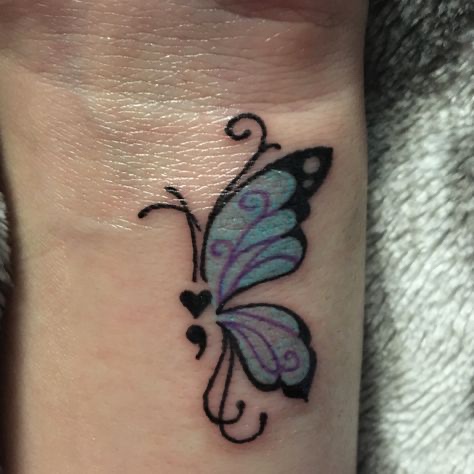
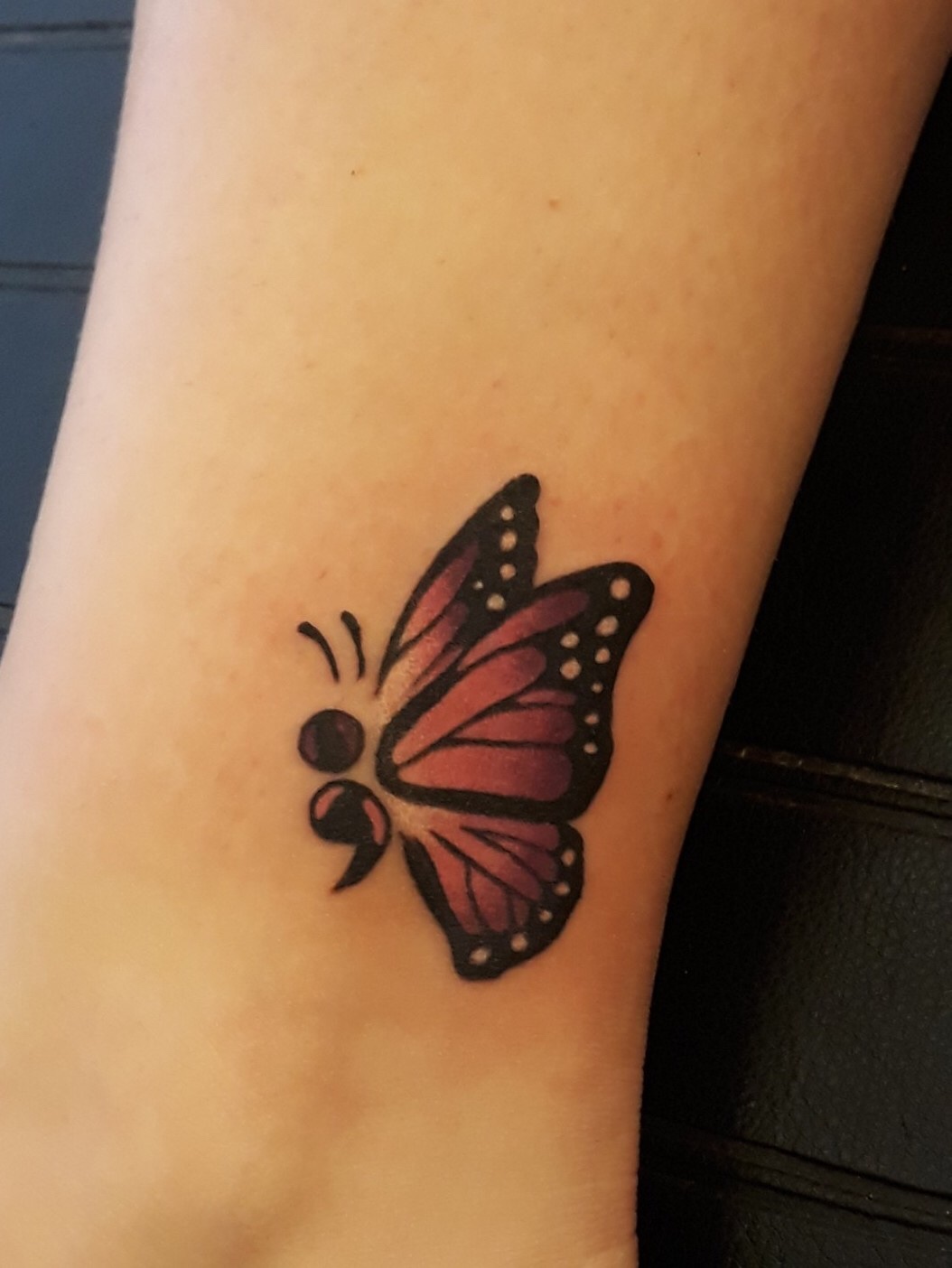
I love Project Semicolon and these Semicolon Butterfly tattoos are amazingly beautiful:

A growing movement is using the semicolon, and in particular a semicolon tattoo, as a symbol of hope for people with mental illness. The Project Semicolon describes the meaning behind the symbol:

“A semicolon represents a sentence the author could have ended, but chose not to. The sentence is your life and the author is you.”

It represents a choice to live on especially for those who may have considered ending their lives.

The project has inspired many people to tattoo or draw the symbol in creative ways to symbolize their own struggles or to honor or support loved ones who have struggled. The project encourages people to use social media to promote the message and continue the conversation, sharing pictures and stories of hope and strength to help end the stigma of mental illness and encourage those who are struggling feel safe and comfortable enough to reach out for help.

Mammalian Diving Reflex

How to Activate the Mammalian Diving Reflex:

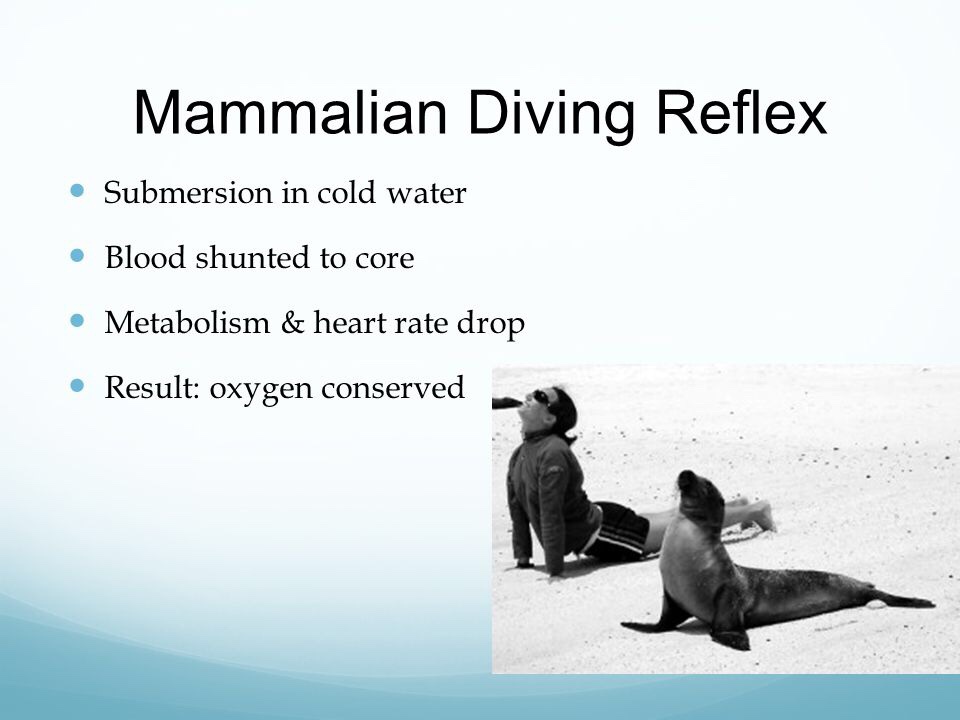
In order to get ourselves to a place of being capable of processing information, we must find a way to essentially “reset” the nervous system. Fortunately, all mammals have something called the “mammalian diving reflex” that forces the parasympathetic nervous system (PNS) to kick in, which functions to relax us and calm us down.

Dr. Linehan explained that this reflex is activated by icy cold water (i.e., not freezing) on the face. In particular, the icy cold water must hit the parts of the face just below the eyes and above the cheekbones for the dive reflex to be activated. She suggests that when in an extremely heightened state of emotional arousal:

• Fill a bowl with icy cold water

• Bend/lean over

• Hold your breath

• Put face in icy cold water for 30 seconds

• Make sure that area underneath eyes/above cheekbones (most sensitive part of the face) feels the icy water

Dr. Linehan reports that this surprisingly simple technique will “calm you down immediately” and is “incredibly effective.” Other ways to activate the diving reflex and get the parasympathetic nervous system to kick in and calm you down include an icy cold gel mask over/around the eye area. It is worth noting that this technique also works best (to activate the dive reflex) if you hold your breath and bend over for 30 seconds.

Warnings:

Caveats to using this technique:

• Activating the dive reflex slows the heart rate, so anyone with heart problems or a slow heartbeat should avoid this strategy

• Those with eating disorders (particularly anorexia nervosa) should avoid activating the dive reflex, as this is dangerous for the heart

Not convinced that something so simple could be so powerfully effective? Evolutionary processes have existed for thousands of years to provide means of regulating our emotions, since effective regulation of emotion is so vital to our survival. Consider how likely a person is to survive over the long-term if they are utterly incapable of calming themselves down when in an intense state of emotional arousal.

An incredible part of this simple technique is that it provides immediate relief and is intended to get you into a functional state of mind where you are capable of using problem-solving skills to solve the intense problem at hand. The next time that you experience an event so intense that you are completely overwhelmed to the point of not being able to think clearly or process information, activate the diving reflex. Thirty seconds later, you will be able to process incoming information and use problem-solving skills.