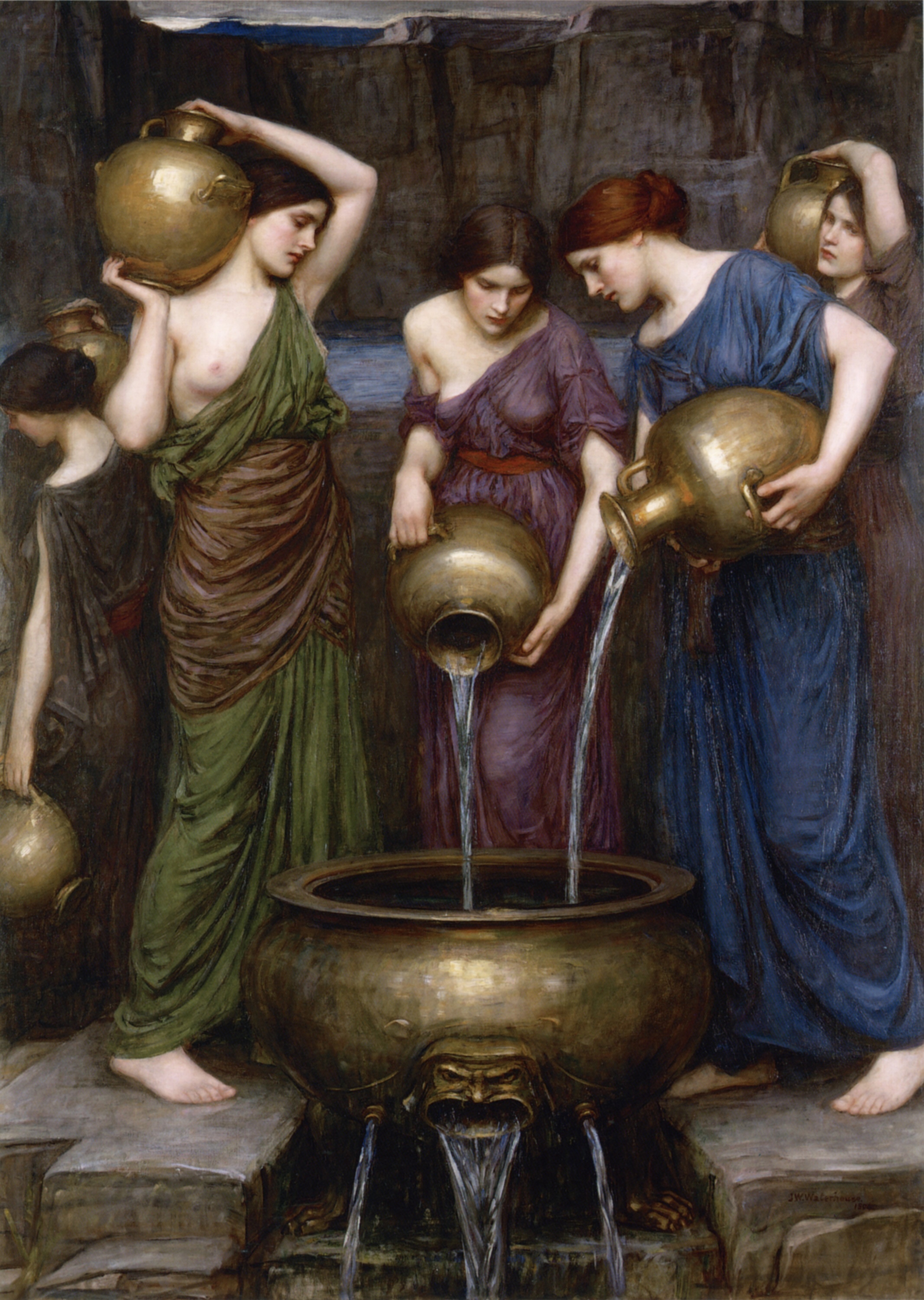
Fand

Fand – In Celtic myth Fand is a faery queen, who was once married to the sea god Manannan. After he left her she was preyed upon by three Fomorian warriors in a battle for control of the Irish Sea. Her only hope in winning the battle was to send for the hero Cuchulainn who would only agree to come, if she would marry him. She reluctantly acquiesced to his wishes, though when she met him, she fell as deeply in love with him as he was with her. Manannan knew that the relationship between the human world and the world of the faery could not continue without in eventually destroying the faeries. He erased the memory of one from the other by drawing his magical mantle between the two lovers.

Fand was also a minor sea goddess who made her home both in the Otherworld and on the Islands of Man. With her sister, Liban, she was one of the twin goddesses of health and earthly pleasures. She was also known as “Pearl of Beauty”. Some scholars believe she was a native Manx deity who was absorbed in the Irish mythology.

Huldufólk

In Iceland and the Faroe Islands, elves are often called the Huldufólk (the hidden folk). They are mysterious and mischievous, at times acting helpful and at other times playing tricks. Tradition says they make their homes in the rocks that cover the island. For centuries, the wee folk lived in the dancing shadows of hearth fires as farmers entertained wide-eyed children with tales of shenanigans while warning them not to stray too far from home, lest they disappear into elfland, never to return.

In Iceland, elves, (‘alfar’ in Icelandic), are beings thought to be smaller than most humans. Elves are thought to live outdoors, and to rarely speak. While some Icelanders believe elves to be a very distinct group, many have come to see them as synonymous with another group of mythical beings known as the huldufólk, or Hidden People.

Like elves, huldufólk also live outdoors, making their homes in Iceland’s rocks and cliffs. According to a study done in 2006, 32% of Icelanders believe the existence of these beings to be possible, while 24% believe their existence is either likely or an outright certainty.

Celebrating elves and huldufólk is common in Iceland. For instance, it is customary for Icelanders to clean and leave food for elves as it’s believed they hold parties late at night. On New Year’s Eve, it is thought that huldufólk move to new locations. As a result, it’s traditional to leave candles out to help them find their way. Finally, Þrettándinn, or Thirteenth Night, is celebrated on January 6th and marks the last day of Christmas in Iceland. On this day, bonfires called álfabrennur, of Elf Fires, are commonly lit.

#Huldufólk #Elves #Iceland #FaroeIslands

The Dullahan

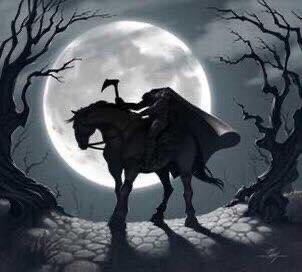
The Dullahan (pronounced DOOL-a-HAN) – also referred to as the Headless Horseman – is a type of Fae originating from Irish folklore. This sinister being appears as a man or a woman riding upon a black horse, but the rider has no head upon their shoulders. Typically, the Dullahan carries its head under its arm; the head appears dead and rotten (sometimes compared to having flesh resembling old cheese) with a demonic grin spread across its face from ear to ear.

The Dullahan carries a whip made from a human’s spine. Sometimes pulls wagon which is adorned with funeral objects (e.g., candles in skulls to light the way, the spokes of the wheels are made from thigh bones, the wagon’s covering made from a worm-chewed pall or dried human skin). When the Dullahan stops riding, that is where a person is due to die and when a Dullahan calls out the person’s name, the person immediately perishes.

There is no way to bar the road against a Dullahan—all locks and gates open to them when they approach. They do not appreciate being watched while on their errands, throwing a basin of blood on those who dare to do so (often a mark that they are among the next to die), or even lashing out the watchers’ eyes with their whips. They are however frightened of gold, and even a single gold pin can drive a Dullahan away.

Brownies

Brownies are somewhat unusual among the wider groupings of fairies because they prefer to live with or near humans, either in human homes or in mills, although some have also been connected to bodies of water like ponds.  Brownies in mills come out at night and work in the mill, not always in a way that helps the human owners, while Brownies in homes come out while the human inhabitants are sleeping and clean. Overall Brownies have a good reputation as helpful spirits, however, in older folklore they were seen as ambiguous beings and potentially dangerous particularly to those outside their chosen family, although even that family could be on the receiving end of the Brownie’s destructive temper if it was angered.

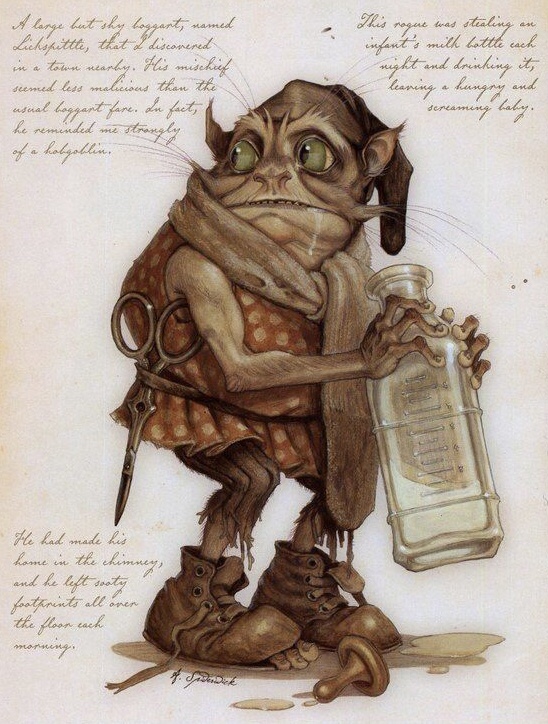
In descriptions Brownies are usually, as the name implies, a nut-brown color and are said to dress in rags. This style of dress may be a preference as stories tell of the unfortunate results of well-meaning humans offering their resident Brownie a new set of clothes. In best case scenarios the Brownie snatches up the clothing and leaves forever, sometimes singing happily that the new clothes mean that they will not work anymore; worst case scenarios the helpful Brownie is so offended it transforms into a malicious Boggart. This may be because the Brownie is bound to service and can only be released with purposeful payment, or because they are mortally offended by any implication that they are serving humans.

When Brownies appear in folklore the focus is usually on their role around human homes or farms, and secondarily their place at mills. Around a home they are known to do chores while on a farm they will help bring in crops and tend to the livestock. In one story centered on a mill, a human girl goes to grind wheat after dusk only to find the mill occupied by a Brownie who she douses with boiling water when he gets too amorous with her; he flees to his mother but later dies of his burns.

Brownies must be paid surreptitiously for their work, with food being left out for them but never directly given to them. A household with a Brownie would be expected to leave a bowl of milk and small loaf of bread or cake out once a week to show their gratitude for the Brownie’s efforts.  This food and drink should be left without verbal thanks and not directly as a gift, but placed carefully where the faerie would find it to avoid any chance of offending them. In this we see a juxtaposition of careful preparation and seemingly casual placement, with the housewife ensuring the Brownie’s continued effort for the household this way

Besides leaving if given clothes there are a few other things that will force a Brownie to leave a location. Several accounts of Brownies attached to homes describe the faeries being driven off by well-intentioned efforts to baptize them or reading from the Christian Bible in their presence, two things these faeries apparently cannot tolerate. Farm-oriented Brownies will become destructive and leave if the quality of their work is insulted or more generally if a person speaks ill of them.

Goblins

The name ‘goblin’ may derive from the Greek ‘kobalos’, which means ‘villain’ (or ‘rogue’). Its Latin name is ‘cobalus’ while its French name is ‘gobelin’ and in German tales, this being is ‘cobalt’. Today, the creature is widely known under its English name: ‘goblin’ and this name characterizse evil and malicious spirits.

They are small (dwarfish) and grotesque, about the size of a fairy tale dwarf, however, giant goblins, whose height can reach two meters are mentioned in the mythology of the Germanic peoples. Goblins have unusually big ears and noses, dark skin and yellow very filthy teeth.

Goblins prefer to dwell in caves, rock crevices and roots of ancient trees located in isolated places and hardly accessible mountain regions. They can even enter houses or disturb people by knocking on doors and walls and then immediately disappear. They smash pots, pull sleeping people out of bed, pulling pajamas off of them and make noises while moving furniture at night. Unfamiliar with the peoples’ concept of ethics and morality, the goblins do bad things just for fun.

Small, malicious creatures resembling demons, goblins are known for their greed and tempers. They first appeared by the name of “goblin” around the Middle Ages in Europe, but can be found with varying details to their personalities in the tales of many countries. For example, the redcap of Anglo-Scottish folklore gets his red chapeau from dipping it in the blood of those he has killed.

There is also a rare occurrence of a friendly goblin in the thirteenth-century Latin book Gesta Romanorum, which has a tale titled “How, in a certain part of England, thirsty hunters were given refreshment by a benevolent goblin,” the plot of which is rather self-explanatory. Goblins vary in size and shape and are said to be easily distracted by the promise or sight of gold. They can also be terrible tempters, as in Christina Rossetti’s haunting and erotically charged poem “Goblin Market,” where they lure victims to their doom with luscious, irresistible fruit.

Sidhe

Sidhe are the more modern versions of the Tuatha Dé Danann, the fairy race of Old Ireland who were great masters of magic and appeared in early Celtic mythic tales such as Tochmarc Étaíne. After being conquered by the Sons of Mil (ancestors of the Irish people), the Tuatha Dé Danann retreated underground and dwindled into the still unearthly beautiful (but diminished) sidhe. The word “sidhe” originally referred to the fairy mounds where these beings lived. Tad Williams’s Sithi race from his epic fantasy trilogy Memory, Sorrow, and Thorn, is akin to the sidhe.

In folk belief and practice, the sidhe are often appeased with offerings, and care is taken to avoid angering or insulting them. Often they are not named directly, but rather spoken of as “The Good Neighbors”, “The Fair Folk”, or simply “The Folk”. The most common names for them, aos sí, aes sídhe, daoine sídhe (singular duine sídhe) and daoine sìth mean, literally, “people of the mounds” (referring to the sídhe). The sidhe are generally described as stunningly beautiful, though they can also be terrible and hideous.

Sidhe are seen as fierce guardians of their abodes—whether a fairy hill, a fairy ring, a special tree (often a hawthorn) or a particular loch or wood. It is believed that infringing on these spaces will cause the sidhe to retaliate in an effort to remove the people or objects that invaded their homes. Many of these tales contribute to the changeling myth in west European folklore, with the sidhe kidnapping trespassers or replacing their children with changelings as a punishment for transgressing.

The sidhe are often connected to certain times of year and hours; as the Gaelic Otherworld is believed to come closer to the mortal world at the times of dusk and dawn, the sidhe correspondingly become easier to encounter. Some festivals such as Samhain, Beltane and Midsummer are also associated with the sidhe.

Pixies

Pixies are the whimsical and tiny fairy creatures often depicted in Victorian fairy paintings and the popular work of artist Cicely Mary Barker.

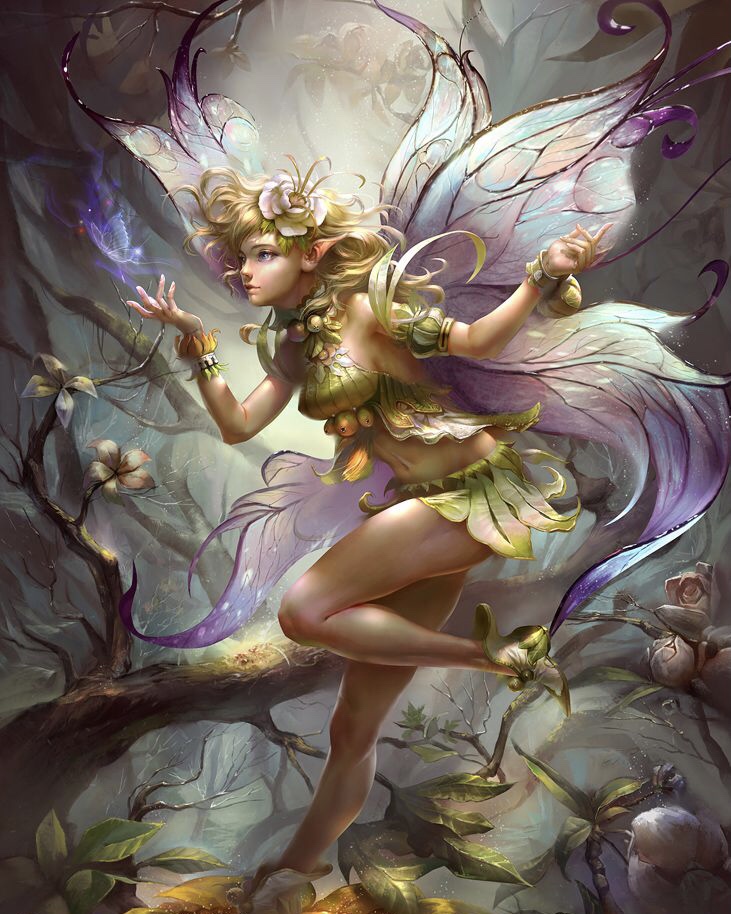
Pixies do often have wings, and love dancing and playing games. They’re also fond of flowers and gardens. Pixies are often drawn to laughter, children, and merrymaking. Tinker Bell from J. M. Barrie’s Peter Pan is a pixie.