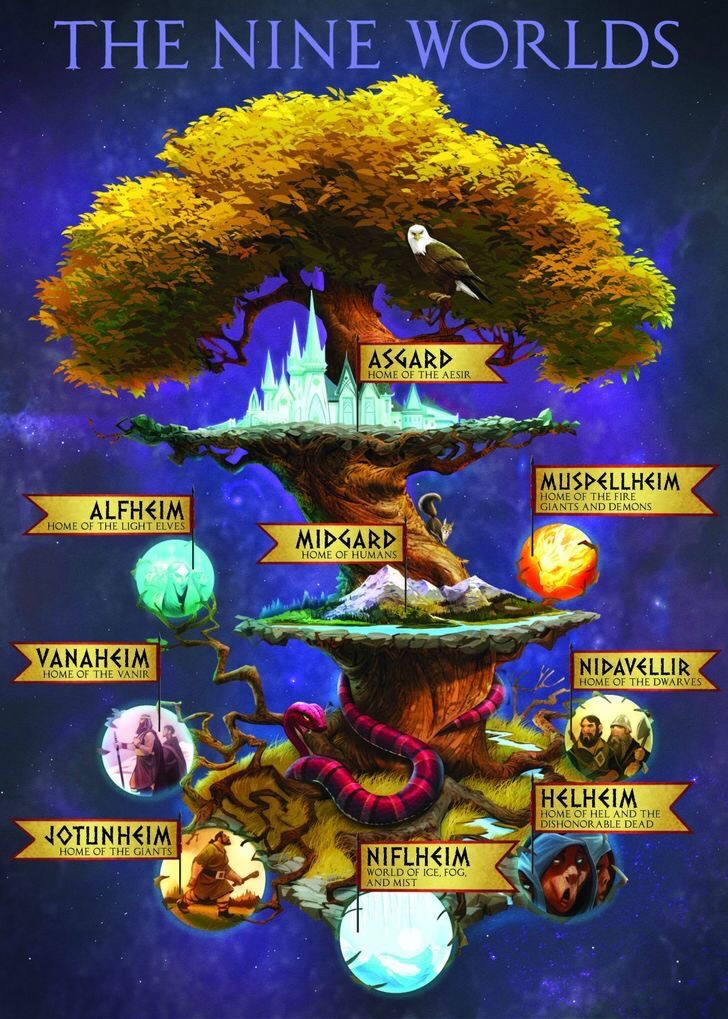
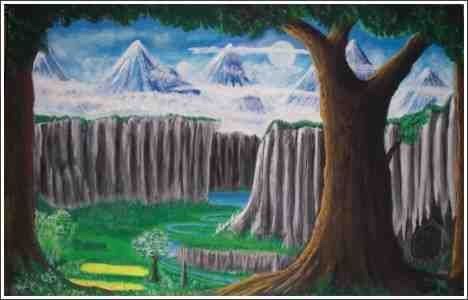
Vanaheim

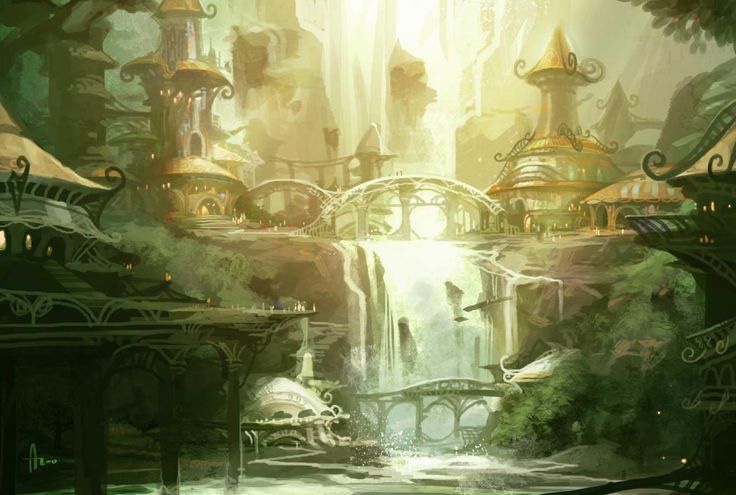
Vanaheim (Old Norse Vanaheimr, “Homeland of the Vanir“) is one of the Nine Worlds that are situated around the world-tree Yggdrasil. As the name implies, it’s the home of the Vanir tribe of deities, who tend to be somewhat more associated with fertility and what we today would call “nature” than the other tribe of Norse deities, the Aesir, who have their home in Asgard.

The surviving sources for our information on Norse mythology and religion, as fragmentary as they are, don’t contain any explicit mention of where exactly Vanaheim is located.  The sole clue we have comes from the Lokasenna (“The Taunting of Loki“), one of the poems in the Poetic Edda, which states that the Vanir god Njord went eastward when he went to Asgard as a hostage at the conclusion of the Aesir-Vanir War.  Presumably, then, Vanaheim lies somewhere to the west of Asgard.

Some scholars have gone so far as to claim that Vanaheim was invented by the thirteenth-century Icelandic Christian historian and poet Snorri Sturluson. However, there is one authentic and reliable Old Norse poem that mentions Vanaheim by name, so we can be reasonably certain that it was a genuine element of pre-Christian Norse religion.

It should come as no surprise, then, that the sources are completely silent as to what kind of world Vanaheim is. However, its name may contain an indication of the place’s character. One of the primary ways the pre-Christian Norse and other Germanic peoples classified geographical spaces (as well as psychological states) was with reference to their concept of the distinction between the innangard and utangard. That which is innangard (“inside the fence”) is orderly, law-abiding, and civilized, while that which is utangard (“beyond the fence”) is chaotic, anarchic, and wild. This psychogeography found its natural expression in agrarian land-use patterns, where the fence separated pastures and fields of crops from the wilderness beyond them. Of the Nine Worlds, two are innangard spaces: Asgard and Midgard, the world of human civilization. Both of these contain -gard in their names and are depicted as having a fence or fortification surrounding them. The rest of the Nine Worlds’ names end in -heim, and there’s no reference to their being enclosed in any way, which seems to indicate that they’re essentially utangard places. Such a designation is certainly in keeping with the way these places are described in Old Norse literature. Thus, we can infer that Vanaheim, like the Vanir themselves, is somewhat more wild or “natural,” and less “cultural,” than the world of the Vanir’s Aesir counterparts, or even that of humanity.

Sources: Sons of Vikings, norse-mythology.org
The Aesir-Vanir War

In Norse mythology, gods and goddesses usually belong to one of two tribes: the Aesir and the Vanir. Throughout most of the Norse tales, deities from the two tribes get along fairly easily, and it’s hard to pin down firm distinctions between the two groups. But there was a time when that wasn’t the case.

The Vanir goddess Freya was always the foremost practitioner of the art of seidr, the most terribly powerful kind of magic. Like historical seidr practitioners, she wandered from town to town plying her craft for hire.

Under the name Heiðr (“Bright”), she eventually came to Asgard, the home of the Aesir. The Aesir were quite taken by her powers and zealously sought her services. But soon they realized that their values of honor, kin loyalty, and obedience to the law were being pushed aside by the selfish desires they sought to fulfill with the witch’s magic. Blaming Freya for their own shortcomings, the Aesir called her “Gullveig” (“Gold-greed”) and attempted to murder her. Three times they tried to burn her, and three times she was reborn from the ashes.

Because of this, the Aesir and Vanir came to hate and fear one another, and these hostilities erupted into war. The Aesir fought by the rules of plain combat, with weapons and brute force, while the Vanir used the subtler means of magic. The war went on for some time, with both sides gaining the upper hand by turns. 

Eventually the two tribes of divinities became weary of fighting and decided to call a truce. As was customary among the ancient Norse and other Germanic peoples, the two sides agreed to pay tribute to each other by sending hostages to live among the other tribe. Freya, Freyr, and Njord of the Vanir went to the Aesir, and Hoenir (pronounced roughly “HIGH-neer”) and Mimir went to the Vanir.

Njord and his children seem to have lived more or less in peace in Asgard. Unfortunately, the same can’t be said of Hoenir and Mimir in Vanaheim. The Vanir immediately saw that Hoenir was seemingly able to deliver incomparably wise advice on any problem, but they failed to notice that this was only when he had Mimir in his company. Hoenir was actually a rather slow-witted simpleton who was at a loss for words when Mimir wasn’t available to counsel him. After Hoenir responded to the Vanir’s entreaties with the unhelpful “Let others decide” one too many times, the Vanir thought they had been cheated in the hostage exchange. They beheaded Mimir and sent the severed head back to Asgard, where the distraught Odin chanted magic poems over the head and embalmed it in herbs. Thus preserved, Mimir’s head continued to give indispensable advice to Odin in times of need.

The two tribes were still weary of fighting a war that was so evenly-matched, however. Rather than renewing their hostilities over this tragic misunderstanding, each of the Aesir and Vanir came together and spat into a cauldron. From their saliva they created Kvasir, the wisest of all beings, as a way of pledging sustained harmony.

Sources: norse-mythology.org, Sons of Vikings, Children of Ash and Elm

Bitfrost Bridge (Rainbow Bridge)

Norse mythology describes the universe as a fascinating cosmos with many intriguing worlds. But one of the most interesting elements of the Norse cosmos is not a world at all, but the Rainbow Bifrost Bridge.

An enchanted bridge created by the gods, it connects the worlds of the Aesir gods and men, allowing the gods access to care for and protect their mortal creations. But it is also a vulnerability in the defenses of Asgard, and so must be guarded at all times. The Norse gods chose Heimdallr to fulfill this important task.

The Bifrost Bridge always plays an important role in modern re-imaginings of Asgard and the Norse gods. But let’s take a look at the original Rainbow Bifrost Bridge, as it is described in the Prose Edda and other sources.

According to Norse mythology, the Norse cosmos comprises nine worlds, all of which are descreet. They sit among the roots and branches of Yggdrasil, the mighty world tree that is the glue of the universe.

Movement between these different worlds is not easy, and not all beings are capable of doing it. For example, Odin’s eight-legged steed Sleipnir is one of the few beings with the power to move easily between the worlds.

The Aesir gods live in Asgard (the fortress of the Aesir), but Odin, in his role as a creator god, also created Midgard, the middle fortress, and populated it with mankind. But mankind are mortal beings with inferior power and strength to the gods and the giants (jotun), and so Odin realized that the Aesir must take responsibility for protecting these beings from the chaotic forces of the jotun.

Therefore, Odin created the Bifrost Bridge from the elements of Fire, Water, and Air in order to give the gods an easy way to move freely between Asgard and Midgard.

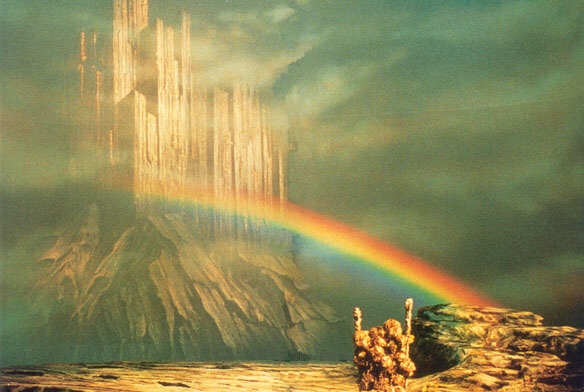
The Bifrost Bridge is called the rainbow bridge, as the name “Bifrost” can be interpreted as meaning “fleetingly glimpsed rainbow” or “shaking and trembling rainbow”.

The Prose Edda, a thirteenth-century text that draws on earlier sources, describes the bridge as an unstable rainbow that touches the Earth from the Heavens, which suggests that the Vikings also imagined the bridge as a rainbow.

Perhaps, whenever a rainbow appeared in the sky, the Vikings believed that the gods were passing over the bridge.

It has also been suggested that the rainbow shape of the bridge is meant to represent the Milky Way, which would have glimmered in the dark night sky during Viking times.

But the gods were not the only beings to pass over the bridge. It was also the Bifrost bridge that allowed the souls of warriors who died bravely on the battlefield to pass from Midgard to Asgard, where they lived in Valhalla, the hall of Odin. There the dead are destined to feast until they are called on to fight again in the final battle of Ragnarok.

But, while the Bifrost Bridge provided safe passage between Asgard and Midgard, it also represents a weak point in the defenses of Asgard. The gods did fortify their realm in order to protect it against the jotun.

So, the Aesir gods need to be vigilant about watching the bridge, and therefore assigned the god Heimdallr as its guardian.

Heimdallr’s name probably means “he who illuminates the world”, which is probably a reference to him shining in some way as he is often described as the “brightest” of the gods.

He may have been one of the many sons of Odin, and is said to have had nine mothers, the daughters of the sea giant Aegir, also known as the nine waves. They nourished him on the power of the Earth, the water of the Sea, and the heat of the Sun, making him one of the strongest beings in existence (probably only behind Thor and Odin).

His extraordinary parentage left him with many incredible attributes.

Heimdallr is said to require less sleep than a bird, and he can see for over 100 leagues in light or darkness. His hearing is so good that he can hear the grass growing in the meadows and the wool growing on sheep.

He is also described as having the power of foresight, which caused one author to say that he is one of the Vanir gods, among whom this trait is more common. But this would throw the other assertions about his parentage into question.

As the protector of the bridge, Heimdallr lives in a stronghold called Himinbjork, which means sky cliffs. It sits exactly where the Bifrost Bridge intersects with Asgard.

As well as fighting off enemy threats himself with his flashing sword and his steed Gulltoppr, when threats descend on Asgard, he sounds his horn Gjallarhorn, which can be heard throughout the Norse cosmos.

Nothingness in Existential Philosophy & Norse Mythology Concept of Ginnungagap

Nothingness in Existential Philosophy & Norse Mythology Concept of Ginnungagap

Several modern philosophers associated with existentialism, a movement that takes our experience of existence as the starting point of its philosophizing, have spoken of a similar schema using the more prosaic and impersonal language of philosophy and psychology. While the writings of luminaries such as Søren Kierkegaard, Martin Heidegger, and Jean-Paul Sartre differ considerably on these points, a fascination with negation and anxiety is a central focus of their work. In existentialist parlance, “nothingness” is that which negates oneself, one’s values, and/or one’s worldview – one’s “personal cosmos.” 

The ultimate nothingness is death, because it negates one absolutely (at least in the modern worldview – see Death and the Afterlife for Norse perspective on death), but any condition over which one cannot triumph is a hostile absence into which one’s yearnings, strivings, and beliefs vanish. This negation is the root of anxiety (or “angst” or “Being-toward-death”), the fear of what we might not be able to overcome, that which stands every chance of “getting us” in the end. This is one of the fundamental facts of life with which everyone who strives to live deliberately and authentically must grapple. In Heidegger’s words, “To be a particular being means to be immersed in nothingness.”[5] While these philosophers don’t necessarily identify nothingness with a physical void as the Norse did, the principle remains the same.

This primordial, annihilating chaos is ever-present; wherever there is darkness, wherever there is silence, wherever any wish or belief is negated, there is Ginnungagap.

Sources: Poetic Edda, Norsemythology.org
Frigga’s Handmaidens

Frigga’s Handmaidens:

Eir

She is known as a healer. That said, Eir’s name translates roughly to the word “mercy,” and in addition to being one of Frigga’s handmaidens, she is listed among Odin’s Valkyries. This has led some modern heathens to speculate that, in addition to her healing skills, she was the source of “mercy on the battlefield,” which, depending on the circumstances, could mean a clean death for those already dying from their wounds.

Fulla

Not much is known about Fulla. She is called a virgin and goes about with her hair unbound and flowing. She wears a gold band around her head. She carries Frigga’s casket, a small chest, and also cares for Frigga’s shoes. She is considered someone with whom Frigga shares her secrets. Fulla may be the Volla listed in the Second Meresburg Charm, Frigga’s sister, or, potentially, Frigga herself.

Gefjon

Gefjon has four sons, whom she changed into oxen in order to carve land for herself out of Denmark; folklore has it that Zealand is Gefjon’s property. Her name means “giver,” and this has caused her to be confused with Freyja, whose byname, Gefn, means the same thing. However, as Frigga’s handmaiden, she protects maidens and unmarried women. This, taken along with the myth about Zealand, is enough evidence to suggest that she is a goddess in her own right.

Lofn

Lofn is the handmaiden who clears the way for permission to be granted for marriages, particularly those marriages which would otherwise be seen as forbidden.

Sága

Sága is an interesting character. Her hall, Sökkvabekk, refers to sunken benches, the implication being a bog or fen. Frigga’s hall is Fensalir, which also involves a fen. Frigga is married to Odin; Sága is known to sit with Odin in her hall and drink mead with him. In fact, there are so many similarities between Sága and Frigga that many scholars contend that they are one and the same, and that Sága is one of Frigga’s bynames. The Prose Edda mentions her as one of Frigga’s handmaidens.

Sjofn

Sjofn helps turn the minds of men and women to love.

Snotra

Snotra is known to be wise and courteous.

Syn

Syn is known as the handmaiden who bars the doors to the hall and guards against those who are forbidden to enter. It is also said that she can stand in assembly as a party for the defense, in cases that involve her.

Var

Var is most concerned with hearing the oaths people make, particularly the marriage oath.

Vor

Vor is also known to be wise, but she asks questions, and nothing can be concealed from her. Vor is the last of Frigga’s handmaidens that we have record of.

How Iceland Saved Viking Lore and Traditions

A majority of the written sources we do have are from Iceland. Vikings discovered Iceland in the middle of the 9th century. This discovery led to a land rush as many families were eager to carve out a new life in this austere place of stark beauty. Many of these settlers were escaping Harald Fairhair and other despotic kings who were nation-building in Scandinavia. These pioneer families were fiercely independent and wanted to preserve their way of life and culture without becoming the serfs of greedy lords.

Consequently, many of the Vikings who settled Iceland were from western Norway. Other Vikings came to Iceland indirectly, by way of the Hebrides, Orkney, Ireland, or the Faroe Islands, with Celts from those lands making up portions of their households.

The Vikings set up a democracy in Iceland, with a firm sense of law based on honor and restitution. In the year 1000, the Icelanders voted to accept Christianity as the public religion, while allowing people to practice whatever religion they chose in private. This decision was made for the sake of peace and to keep up with the changing times. But this peculiar conversion would have another effect as well: while Viking descendants in Christianized Scandinavia, Normandy, England, and elsewhere actively distanced themselves from their pagan past, the Icelanders were much more comfortable with that part of their heritage. This, combined with natural isolation and a conservative disposition, led to Iceland remaining a bastion of Old Norse culture. 

Even today, a thousand years later, the modern Icelandic language is very similar to Old Norse. Though some word meanings and pronunciation have naturally shifted, Icelandic college students can read the Medieval manuscripts without much difficulty. This retention of language is a tremendous testament to the cultural preservation that occurred in that island nation.

In the middle of the 13th century – more than 150 years after the last Vikings sailed the seas or stood in battle – Iceland was undergoing a violent political crisis. This crisis of politics became a crisis of identity, and perhaps because of this, there was a strong intellectual impulse to record the remnants of their ancient heritage. For the first time, Viking lore was set down in writing for future generations to read. 

This creative impulse expressed itself in two forms: The first was the Eddas – the collected poetry and myths of the Old Norse gods, goddesses, and heroes. But the second impulse may have been the more remarkable: the Icelanders set down the stories of their ancestors – ordinary men and women. These sagas were a unique accomplishment in medieval literature. Even today, the sagas are recognized as one of the world’s great literary achievements and a forerunner of the modern novel. 

Even in the Viking Age, poets from Iceland were considered among the best. But after their time, their descendants expanded the Norse oral tradition into a vibrant literary culture. To this day, Icelanders read more books and even write more books per capita than any other nation in the world.

Source: Son of Vikings

The War between the Giants and the Norse Gods

At the dawn of time, Odin and his two brothers killed the giant Ymir and created the world from his body. As usual, a god’s motivations are difficult to determine. Did Odin simply need Ymir dead for the sake of creation? Or did the Alfather reason that if Ymir continued to spawn giants that any order in the universe would become impossible? In any case, as the three gods tore the massive giant to pieces, a vast deluge of blood burst forth. This blood became all the world’s oceans, and the torrent swept away every giant – except for one family who escaped in a wooden ark. This giant was named Bergelmir, and all the later giants were descended from him.

Odin and his brothers made the land from Ymir’s corpse, with his teeth and broken bones forming the stones and the mountains, the great dome of his skull forming the sky, and even his thoughts forming the clouds – thin and wispy or dark and brooding. They called this world Midgard, and they encircled it with a mighty barrier made from Ymir’s eyelashes. They also made their own realm, Asgard. Asgard and Midgard (along with several other of the Nine Worlds) became “innangard,” a place of protection where the gods ruled. Beyond, were places the giants ruled – Jotunheim, Hel, and the other realms that formed “utangard” or, as both Utgard and utangard would be translated, “beyond the enclosure.”

Cast out into the darkness of Utgard, the Jötnar remembered a time when they ruled. Either out of a need for revenge or because – as the Eddic Poem says – they really were “born of venom and thus fierce and cruel,” the giants dream of a time when they will overcome Asgard and Midgard.

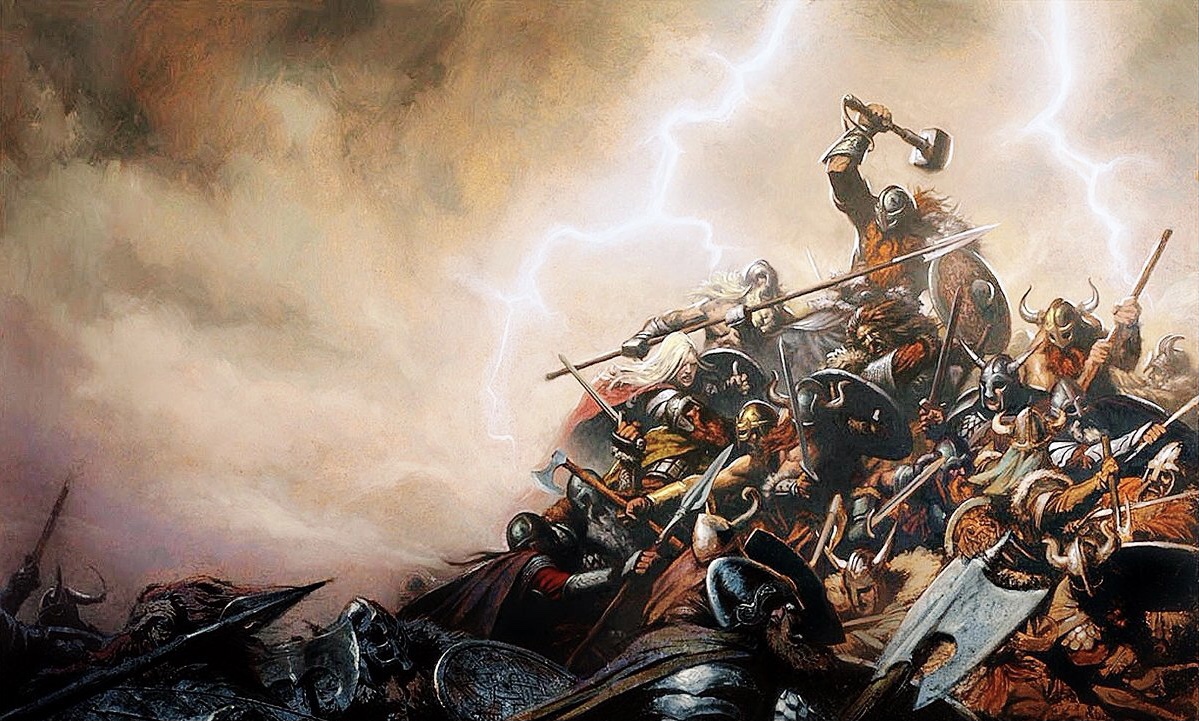
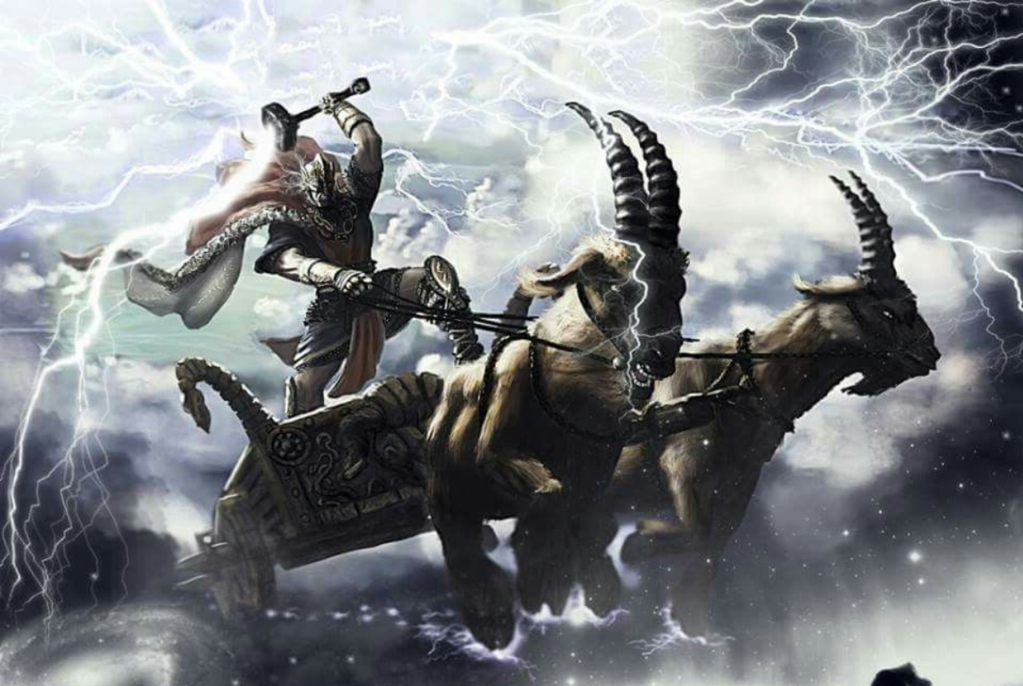
The time for them to unite and march against the gods will come in Ragnarok. In the meantime, many giants try their luck raiding the territory of the gods. The bravest of them sometimes appear in Asgard, with a challenge or a trick for the Aesir gods, or they come to terrify us mortals in Midgard. When the Vikings and other Nordic/Germanic peoples took shelter from howling storms, they knew it was Odin leading the gods in “the Wild Hunt” against the giants. When they saw thunder’s flash and the pound of lightning, they knew Thor was smiting giants with his mighty hammer, Mjolnir.

Sometimes, the gods and giants live in an uneasy peace. Not only did gods and giants often form marriages, liaisons, and alliances, but there were times when giants were even able to show some sympathy with the gods. For example, when the most beloved god, Baldr, died because of Loki’s treachery, even the giants wept. Peace never lasted long, though. Whether because giants would make incursions into Asgard, or because Odin or Thor would venture into Jotunheim on their adventures, the hostility between giants and gods was always kept alive.

This enmity and ages-long struggle will come to fruition at Ragnarok. There the gods and giants will destroy each other. Like the opposing forces of creation and chaos they seem to be, they will cancel each other out, and oblivion will resume before the universe is – perhaps – born anew.

Source: Sons of Vikings

Frost Giants of Norse Mythology

Frost Giants of Norse Mythology

It is common to hear the Norse giants referred to as frost giants or ice giants.  The Prose Edda seems to refer to Jötnar as frost giants (hrimþursar) much of the time.  This is only part of the story, though. 

The association between giants and ice is understandable considering that the giants first arose from the meeting of fire and ice in the yawning void at the dawn of time and because the giants live beyond the realm of gods and mortals.  People living as close to nature as Vikings did usually associated intense cold with death and hardship.  The inhabited parts of the Viking world were hemmed by glaciers and frozen mountains.  Meanwhile, the Giants were said to live in Jotunheim or Utgard (which means a place outside or beyond the boundaries of the worlds of humans and gods).  One Eddic poem describes a hall in Utgard this way:

I saw a hall that stands far from the sun
On the beaches of corpses the doors face north
Drops of poison fall from the roof
The walls are encircled by serpents

(Voluspa, verse 37, Crawford’s 2015 translation)

Despite these associations with cold and ice, not all giants are “frost giants” as such.  One of the most feared giants of all is Surt, a massive being of fire that will bring great destruction to the world at Ragnarok.  The Poetic Edda mentions Thor killing “lava giants” as well as frost giants, and sometimes presents them in juxtaposition, as in the poem For Skirnis: “hear me, giants, hear me, frost-trolls, hear me, fire-trolls!”  In this same poem, some giants are presented as radiantly beautiful, while others are ghastly and horrifying.  Indeed, the Jötnar may be the most diverse of all the beings that haunt the Viking imagination.

Source: Sons of Vikings

Giants of Norse Mythology 101

In Norse mythology, giants are the original “founding” beings at the top of the Norse family tree. The more commonly known gods (such as Odin, Thor) are all direct or indirect descendants of these giants. Giants were called Jötunn (singular) or Jötnar (plural). The word Jötunn originally came from the Proto-Germanic word that meant “devourer.”

Another name for them was þursar or þurs (pronounced thurss), which means something like “powerful and injurious one” or simply something like “piercer” or “thorn.”  In the rune poems, the Thurisaz rune is associated with the Jötnar (giants), as well as sickness, tragedy, and pain.

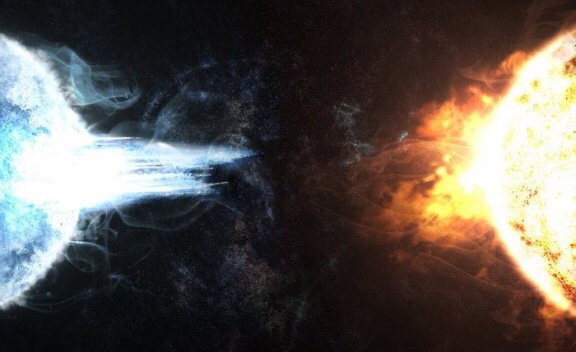
The very first giant, Ymir (pronounced EE-mir), arose from primordial chaos when the worlds of fire and of ice came together in a tremendous, hissing scream.  His offspring, the Jötnar, were spirits of this chaos, representing the destructive cycle of the natural universal order.

The Aesir and the Vanir tribes of gods also arose partially from this same race of giants (though they also had another ancestor, Buri – a being of unknown origin that had been bounded in ice until he was eventually set free from Ymir’s cow named Auðumbla who licked at the ice for three days). By the gods’ own nature and choice, the giants became the positive or creative aspect of universal order.  In Viking lore, it is not so much that the gods are good and the giants evil, but rather that the gods and giants are in opposition and balance.  This is not to say that Norse belief observed a strict dualism (as some ancient religions did), but they understood their world through their stories of struggle between the gods and the Jötnar, between creation and destruction,   

Sometimes, the difference between giants and gods is itself obscure.  For example, Loki is often thought of as the Viking god of trouble.  He was an adopted member of the Aesir tribe of gods and blood-brother to Odin, but Loki was the son of giants and is only ambiguously called a god in the primary sources.  None of his offspring are gods but are giants or supernatural beasts.  Similarly, Jörð (a “Mother Earth” figure) and Skadi (the ski-borne goddess of the wild) appear in the Eddas as Jötunn in origin. They are later called goddesses, but then often excluded from lists or gatherings of goddesses in Asgard. 

Some experts see in this interplay between gods and giants a parallel of how the Vikings themselves interacted with the cultures around them. Whether this is accurate or not, the lore is clear that the gods and giants are not distinct races of beings but rather opposing and competing forces. These competing forces’ cosmic nature can easily be inferred from the names, attributes, and actions of the individual members within these “warring tribes.”

Source: Sons of Vikings

Ghosts and the Undead of Norse Mythology

Ghosts and the Undead

Most people have heard that for the Vikings, brave warriors went to Valhalla while everyone else went to Hel (the underworld), but actual Norse beliefs were more complicated and less standardized than that. To the Viking mind, there were different layers of self and different time frames. These elements could move on – as well as various places they could go. This left plenty of room for ghosts and the undead in the Norse imagination.

Stories of ghosts occur in many of the sagas and Eddic poems. They sometimes visit the living in dreams or can be found haunting their burial mounds. One reference in Njal’s Saga speaks of a ghost who sits atop his burial mound singing by night, seemingly content. This offers a glimpse of how the Vikings felt their ancestors were always with them.

The Eddic poem, Helgaknitha Hundingsbana II (The Second Poem of Helgi Killer of Hunding), paints a darker picture of such a haunting. Helgi, the slain hero, returns to his burial mound from Valhalla on one magical night. Helgi’s ghost has physical substance and still bleeds from his battle wounds. His grieving widow, Sigrun, spends the night in his arms within the cold tomb. Sigrun returns to the burial mound night after night, though it is unknown if Helgi ever returns. She eventually dies from her sorrow. The poem ends with the lines, “all the dead are more powerful by night than they are by bright day.

Some ghosts are not lost loved ones visiting from beyond the grave, though. The Vikings believed in beings called Draugr (also called an Aptrganga or “after-walker”), a malicious ghost with physical form. This undead being usually had been a bad man who died in a bad way. They were recognizable as the dead man but had grotesque features, bluing skin, and eyes that could render humans immobile with fear. They had otherworldly strength. They could sometimes appear much larger than they had been when alive and were usually described as inexplicably heavy.

Sometimes the Draugr was content to guard his treasure in his burial mound, but others terrorized farms or haunted a specific area. An embodiment of the bad luck that could plague the farms of the Viking world, the Draugr would kill livestock, horses, or pets. They could cause roofs to collapse or other disasters. Sometimes, the Draugr would kill people directly, especially if he was challenged. Shepherds, servants, or cattle-drivers would be found dead, and when their bodies were inspected, it was found that every bone – big and small – was broken.

One of the most detailed accounts of these “Viking zombies” is in Grettir’s Saga. Grettir is an outlaw and an antihero, but he is a fearless Viking of great physical strength. Early in his life, he faces a Draugr in a burial mound and kills it, winning the short sword (seax) that was buried with it. Years later, though, Grettir faces Glam, a very dangerous, malevolent Draugr. Grettir decapitates Glam, but not before Glam places a heavy curse on him. This curse causes Grettir trouble and tragedy for the rest of his life, and ever-after the mighty Viking is afraid of the dark.

According to Grettir’s Saga and some other sources, the Viking method for killing the undead was not a stake through the heart or fire, but rather by cutting off the fiend’s head and place it next to its ass. Interestingly, archaeologists have found several Viking Age graves in which the skull was found between the skeleton’s legs, just below the pelvis. Other remains have been found weighed down by heavy stones to keep the dead where they were.

Source: Sons of Vikings