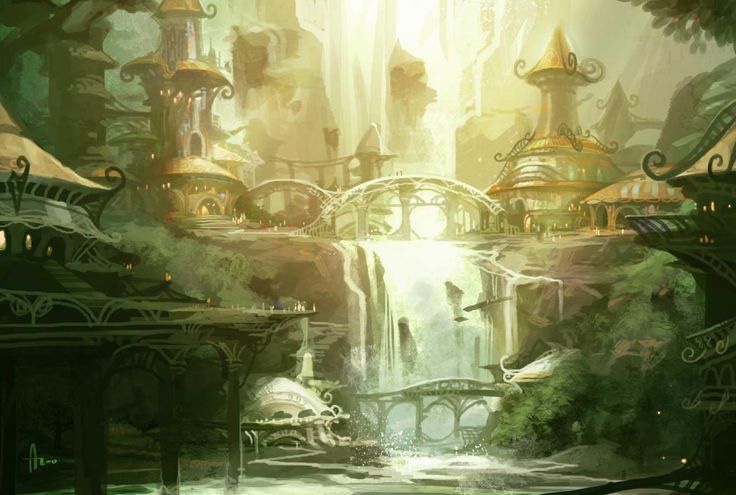
When Icelandic member of parliament Árni Johnsen escaped unharmed from a car crash in 2010, he knew whom to credit for his survival: elves. After rolling five times, the politician’s SUV came to rest beside a 30-ton boulder. Johnsen, believing that multiple generations of elves called that boulder home, concluded that they used their magic to save him. When roadwork later required the removal of the boulder, he claimed it for himself, transporting it to his home to ensure the elves would continue to watch over him.
Johnsen’s beliefs are not unusual. According to Icelandic folklore, thousands of elves, fairies, dwarves, and gnomes—collectively known as “hidden people”—live in rocks and trees throughout the country. It is no wonder, then, that the world’s only elf school is located in Reykjavík.
Historian Magnús Skarphéðinsson, who has spent decades documenting people’s encounters with elves, established the school in 1991. Classes focus on the distinguishing characteristics of Iceland’s 13 varieties of hidden people. The school also offers five-hour classes for travelers, which include a tour of Reykjavík’s elf habitats. Students receive a diploma in “hidden people research.”
Skarphéðinsson has never seen an elf. His knowledge of their appearance and behavior comes from the hundreds of testimonies he has collected from people who claim to have made contact with hidden people.
Though Skarphéðinsson has devoted 30 years to the subject and considers himself the foremost authority on elves, he maintains a sense of humor about it all. At the end of class, he serves homemade coffee and pancakes and tells stories about the people who come up to him to say, “I swear I’m not on drugs, but I saw the strangest thing . . .”
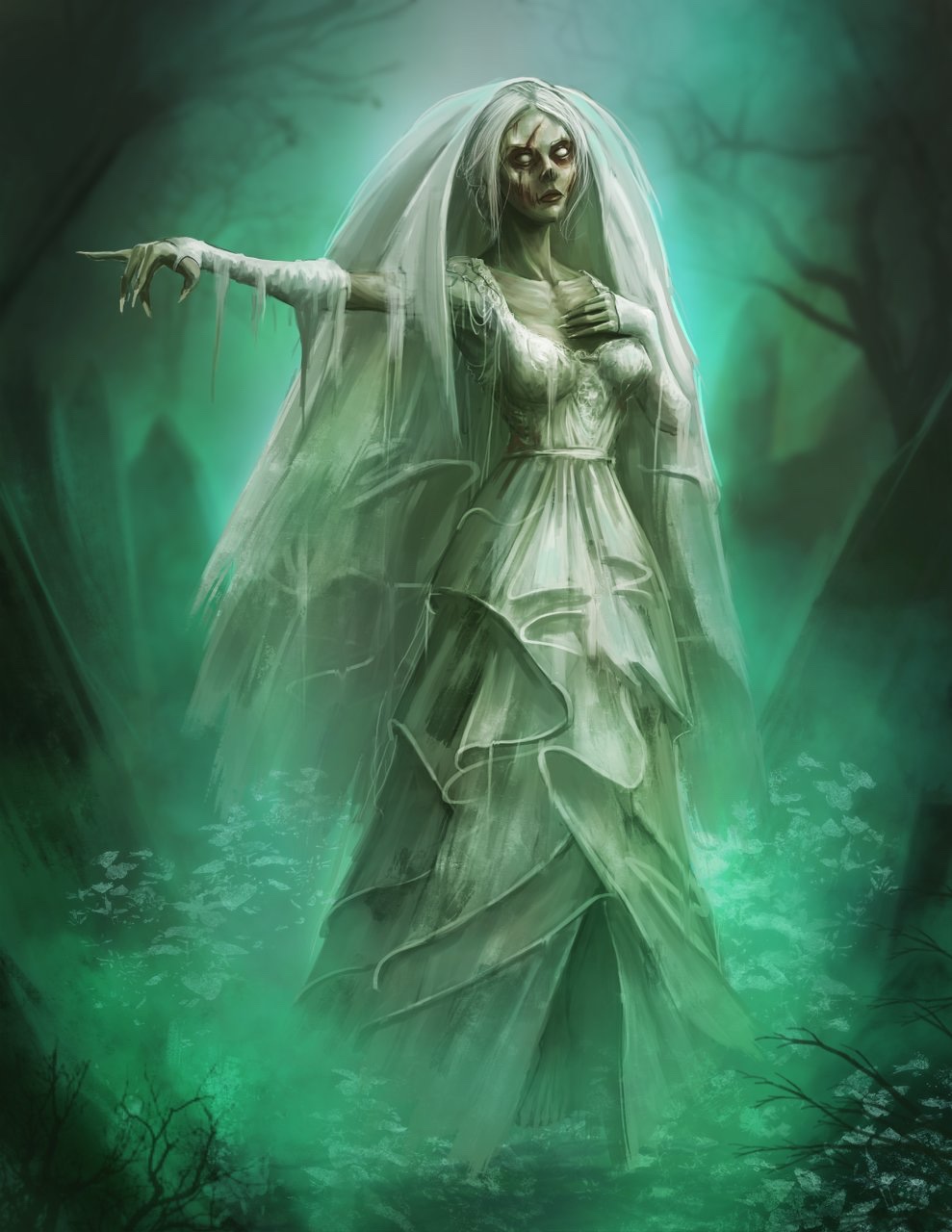
Banshee – actually should be spelled Bean Sidhe. She’s an Irish death spirit. Their keening fortells a death. They have very long, flowing hair and wear green dresses with grey cloaks. Their eyes are bright red because of their continuous weeping; or Benshee – an Irish faery attached to a house. Common name for the Irish Bean Sidhe. In Scotland the banshee is known as caoineag (wailing woman) also Bean-Nighe and, although seldom seen, she often heard in the hills and glens, by lakes or running water.
Bean Sidhe – In Irish folklore, the Bean Sidhe (woman of the hills) is a spirit or fairy who presage a death by wailing. She is popularly known as the Banshee. She visits a household and by wailing she warns them that a member of their family is about to die. When a Banshee is caught, she is obliged to tell the name of the doomed. The antiquity of this concept is vouched for by the fact that the Morrigan, in a poem from the 8th century, is described as washing spoils and entrails. It was believed in County Clare that Richard the Clare, the Norman leader of the 12th century, had met a horrible beldame, washing armor and rich robes “until the red gore churned in her hands”, who warned him of the destruction of his host. The Bean Sidhe has long streaming hair and is dressed in a gray cloak over a green dress. Her eyes are fiery red from the constant weeping. When multiple Banshees wail together, it will herald the death of someone very great or holy. The Scottish version of the Banshee is the Bean Nighe. Aiobhill is the banshee of the Dalcassians of North Munster, and Cliodna is the banshee of the MacCarthys and other families of South Munster.
Bean-Nighe – pronounced “ben-neeyah”; type of Banshee around streams in Scotland and Ireland. She washed bloodstained clothing of people who will soon die. They are rumored to be the ghosts of women who died in childbirth and will continue to wash until the day they should have died. The Washer at the Ford.
This Russian vampire revenant is created when a heretic, sorcerer, or witch dies or as the child of a werewolf and a witch. Active between noon and midnight it looks like a normal person and preys on the children of a family and then moves on to the parents. After draining the victim of blood it will open a hole in the chest with its ironlike teeth and consume the heart.
Its grave can only be found by attaching a spool of thread to its clothing and following the thread. The grave must be soaked in Holy water and a stake driving though it in a single blow or the vampire will still rise. Another method of destruction is to decapitate the vampire and burn its corpse to ashes.
“Those who know, not only that the Everlasting lives in them, but that what they, and all things, really are IS the Everlasting, dwell in the groves of the wish-fulfilling trees, drink the brew of immortality, and listen everywhere to the unheard music of eternal concord. These are the immortals.”
~ Joseph Campbell, from “The Hero with a Thousand Faces”
Aeval was a Celtic faerie queen of northern Munster. She was part of the Tuatha Dé Danann tribe and associated with the O’ Brien Clan. She Became the Banshee of the O’Brien Family and began her lament whenever one of the family members died. Her name means beautiful. She made Craig Liath her home which mean Gray Rock. She held a midnight court to determine if Husbands were satisfying their wives sexual needs. When found to be remiss the husband would to ordered to over come there prudishness and give their wives what they need.
Aeval had a lover once who was a servant of Murchadh named Dudhlaing Ua Artigan. Murchadh was the eldest son of Brian Boru. Aeval placed a druid mist around her lover to ensure that he would not go into battle in the Battle of Clontarf and be killed. Aeval went to Brian Boru’s tent to tell him that he would be victorious in battle but that he would loose his own life and the first son to visit him in his tent would become king. Brian sent for his eldest son Murcahd, but Murchadh decided to delay to change clothing. So instead his other son Donnchadh was the first to enter the tent. Murchadh went into battle with Dudhlaing, and they struck their enemies a mighty blow on either side. Murchadh said they he heard the sound of Dudhlaing’s blows but could not see him. It seems that Dudhlaing did not want to keep the magick mist about him when Muchadh could not see him, so he withdrew from the druid cloack. They went to the plain where Aeval was because they thought she could give them news of the battle. Aeval pleaded with the two men to stop and stay away from the battle. Murchadh refused and said that fear of his mortality would not keep him from going into battle, and that if he fell, he would bring the enemy down with him. She pleaded with Dudhlaing that if he stayed with her he would know 200 years of happiness to which he replied that he will not soil his good name for gold or silver. Aeval told the two men that they would fall in battle and that by tomorrow your blood will be spilt on the plains.
Aeval had a harp whose music was sweet and beautiful, but deadly to mortals. It is said that whoever heard the music of the harp would die shortly afterwards. The harp did not have to be strummed or plucked by her. It would play whatever it was told to play by her. The victims of her harp were usually young men. It is said that she gifted her harp to the son of Meardha when he was learning at the school of the Sidhe at Connacht. He learned that his father had been killed by the King of Lochlann. The son of Meardha went to where the three sons of the King of Lochlann were, and played his harp. The three sons died shortly afterward.
The Varacolaci vampire is from Romania. This is one of the most powerful of the undead creatures. It’s said that the Varacolaci has the ability to cause lunar and solar eclipses.
The Varacolaci, a vampire revenant in Romania, is said to be created when an unbaptized baby died or if a person committed suicide. But there are also some instances that being a varacolaci becomes inherited or passed down from generation to generation.
If a varacolaci was created after his death, the person who turned into a varacolaci would look exactly the same, though would tend to look pale and with dried out skin. The varacolaci hunts its prey all year round but it is particularly active during St. Andrew’s Day and St. George’s Day. This creature is also said to be one of the most dangerous types of vampire since it was considered as the strongest type of vampire in the folklore of Romania.
A varacolaci like any vampire drains the blood of its victim, but it does not leave any bite marks. It can shape shift into any animals, but it usually takes the form of a flea, cat, spider, frog and dog. It is also said to be responsible for causing lunar eclipse and solar eclipse by putting itself into a trance.
The varacolaci also has the ability of “midnight spinning”, a sort of astral projection that allows them to travel safely at night anywhere they wish to go. While they were on astral projection, the creature seems to look like a dragon or a creature with several mouths. However if one manages to find a varacolaci in this state, the creature would be unable to return to its body causing it to sleep forever and leaving its soul to wander around eternally.
Traditionally, those corpses that are suspected of becoming a varacolaci, can be prevented on rising from its grave by planting a thorny plant on its grave. If in an instance that a person dies by committing suicide the only way to prevent him from being a varacolaci is to throw his body into a river immediately.
An intricate ritual needs to be performed in order to completely vanquish the vampire being, first the vampire must rise from its grave and must be captured. In the case of a male varacolaci, their heart must be ripped off and cut in half. A nail must be punctured into its forehead and whole cloves of garlic must be placed inside its mouth. The corpse is then filled with a pig fat that comes from a pig that was slaughtered on St. Ignatius Day. A burial shroud is then dipped into a holy water and wrapped on the corpse. The body was then reburied into an isolated area far from the community. In the case of a female varacolaci an iron fork must be driven into its eyes and heart and the body was buried into a very deep grave.
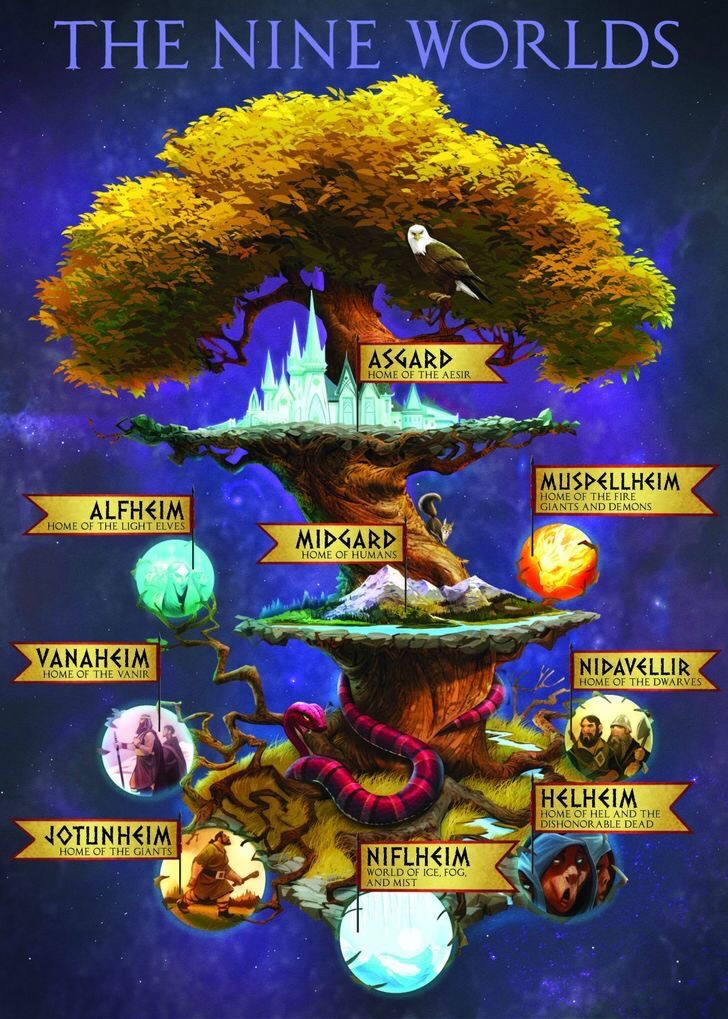
Vanaheim (Old Norse Vanaheimr, “Homeland of the Vanir“) is one of the Nine Worlds that are situated around the world-tree Yggdrasil. As the name implies, it’s the home of the Vanir tribe of deities, who tend to be somewhat more associated with fertility and what we today would call “nature” than the other tribe of Norse deities, the Aesir, who have their home in Asgard.
The surviving sources for our information on Norse mythology and religion, as fragmentary as they are, don’t contain any explicit mention of where exactly Vanaheim is located. The sole clue we have comes from the Lokasenna (“The Taunting of Loki“), one of the poems in the Poetic Edda, which states that the Vanir god Njord went eastward when he went to Asgard as a hostage at the conclusion of the Aesir-Vanir War. Presumably, then, Vanaheim lies somewhere to the west of Asgard.
Some scholars have gone so far as to claim that Vanaheim was invented by the thirteenth-century Icelandic Christian historian and poet Snorri Sturluson. However, there is one authentic and reliable Old Norse poem that mentions Vanaheim by name,so we can be reasonably certain that it was a genuine element of pre-Christian Norse religion.
It should come as no surprise, then, that the sources are completely silent as to what kind of world Vanaheim is. However, its name may contain an indication of the place’s character. One of the primary ways the pre-Christian Norse and other Germanic peoples classified geographical spaces (as well as psychological states) was with reference to their concept of the distinction between the innangard and utangard. That which is innangard (“inside the fence”) is orderly, law-abiding, and civilized, while that which is utangard (“beyond the fence”) is chaotic, anarchic, and wild. This psychogeography found its natural expression in agrarian land-use patterns, where the fence separated pastures and fields of crops from the wilderness beyond them. Of the Nine Worlds, two are innangard spaces: Asgard and Midgard, the world of human civilization. Both of these contain -gard in their names and are depicted as having a fence or fortification surrounding them. The rest of the Nine Worlds’ names end in -heim, and there’s no reference to their being enclosed in any way, which seems to indicate that they’re essentially utangard places. Such a designation is certainly in keeping with the way these places are described in Old Norse literature. Thus, we can infer that Vanaheim, like the Vanir themselves, is somewhat more wild or “natural,” and less “cultural,” than the world of the Vanir’s Aesir counterparts, or even that of humanity.
In Norse mythology, gods and goddesses usually belong to one of two tribes: the Aesir and the Vanir. Throughout most of the Norse tales, deities from the two tribes get along fairly easily, and it’s hard to pin down firm distinctions between the two groups. But there was a time when that wasn’t the case.
The Vanir goddess Freya was always the foremost practitioner of the art of seidr, the most terribly powerful kind of magic. Like historical seidr practitioners, she wandered from town to town plying her craft for hire.
Under the name Heiðr (“Bright”), she eventually came to Asgard, the home of the Aesir. The Aesir were quite taken by her powers and zealously sought her services. But soon they realized that their values of honor, kin loyalty, and obedience to the law were being pushed aside by the selfish desires they sought to fulfill with the witch’s magic. Blaming Freya for their own shortcomings, the Aesir called her “Gullveig” (“Gold-greed”) and attempted to murder her. Three times they tried to burn her, and three times she was reborn from the ashes.
Because of this, the Aesir and Vanir came to hate and fear one another, and these hostilities erupted into war. The Aesir fought by the rules of plain combat, with weapons and brute force, while the Vanir used the subtler means of magic. The war went on for some time, with both sides gaining the upper hand by turns.
Eventually the two tribes of divinities became weary of fighting and decided to call a truce. As was customary among the ancient Norse and other Germanic peoples, the two sides agreed to pay tribute to each other by sending hostages to live among the other tribe. Freya, Freyr, and Njord of the Vanir went to the Aesir, and Hoenir (pronounced roughly “HIGH-neer”) and Mimir went to the Vanir.
Njord and his children seem to have lived more or less in peace in Asgard. Unfortunately, the same can’t be said of Hoenir and Mimir in Vanaheim. The Vanir immediately saw that Hoenir was seemingly able to deliver incomparably wise advice on any problem, but they failed to notice that this was only when he had Mimir in his company. Hoenir was actually a rather slow-witted simpleton who was at a loss for words when Mimir wasn’t available to counsel him. After Hoenir responded to the Vanir’s entreaties with the unhelpful “Let others decide” one too many times, the Vanir thought they had been cheated in the hostage exchange. They beheaded Mimir and sent the severed head back to Asgard, where the distraught Odin chanted magic poems over the head and embalmed it in herbs. Thus preserved, Mimir’s head continued to give indispensable advice to Odin in times of need.
The two tribes were still weary of fighting a war that was so evenly-matched, however. Rather than renewing their hostilities over this tragic misunderstanding, each of the Aesir and Vanir came together and spat into a cauldron. From their saliva they created Kvasir, the wisest of all beings, as a way of pledging sustained harmony.
Sources: norse-mythology.org, Sons of Vikings, Children of Ash and Elm
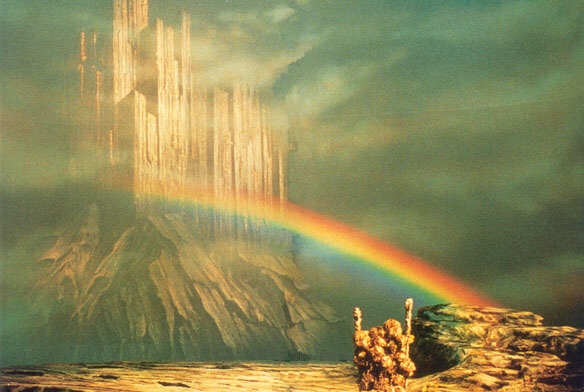
Norse mythology describes the universe as a fascinating cosmos with many intriguing worlds. But one of the most interesting elements of the Norse cosmos is not a world at all, but the Rainbow Bifrost Bridge.
An enchanted bridge created by the gods, it connects the worlds of the Aesir gods and men, allowing the gods access to care for and protect their mortal creations. But it is also a vulnerability in the defenses of Asgard, and so must be guarded at all times. The Norse gods chose Heimdallr to fulfill this important task.
The Bifrost Bridge always plays an important role in modern re-imaginings of Asgard and the Norse gods. But let’s take a look at the original Rainbow Bifrost Bridge, as it is described in the Prose Edda and other sources.
According to Norse mythology, the Norse cosmos comprises nine worlds, all of which are descreet. They sit among the roots and branches of Yggdrasil, the mighty world tree that is the glue of the universe.
Movement between these different worlds is not easy, and not all beings are capable of doing it. For example, Odin’s eight-legged steed Sleipnir is one of the few beings with the power to move easily between the worlds.
The Aesir gods live in Asgard (the fortress of the Aesir), but Odin, in his role as a creator god, also created Midgard, the middle fortress, and populated it with mankind. But mankind are mortal beings with inferior power and strength to the gods and the giants (jotun), and so Odin realized that the Aesir must take responsibility for protecting these beings from the chaotic forces of the jotun.
Therefore, Odin created the Bifrost Bridge from the elements of Fire, Water, and Air in order to give the gods an easy way to move freely between Asgard and Midgard.
The Bifrost Bridge is called the rainbow bridge, as the name “Bifrost” can be interpreted as meaning “fleetingly glimpsed rainbow” or “shaking and trembling rainbow”.
The Prose Edda, a thirteenth-century text that draws on earlier sources, describes the bridge as an unstable rainbow that touches the Earth from the Heavens, which suggests that the Vikings also imagined the bridge as a rainbow.
Perhaps, whenever a rainbow appeared in the sky, the Vikings believed that the gods were passing over the bridge.
It has also been suggested that the rainbow shape of the bridge is meant to represent the Milky Way, which would have glimmered in the dark night sky during Viking times.
But the gods were not the only beings to pass over the bridge. It was also the Bifrost bridge that allowed the souls of warriors who died bravely on the battlefield to pass from Midgard to Asgard, where they lived in Valhalla, the hall of Odin. There the dead are destined to feast until they are called on to fight again in the final battle of Ragnarok.
But, while the Bifrost Bridge provided safe passage between Asgard and Midgard, it also represents a weak point in the defenses of Asgard. The gods did fortify their realm in order to protect it against the jotun.
So, the Aesir gods need to be vigilant about watching the bridge, and therefore assigned the god Heimdallr as its guardian.
Heimdallr’s name probably means “he who illuminates the world”, which is probably a reference to him shining in some way as he is often described as the “brightest” of the gods.
He may have been one of the many sons of Odin, and is said to have had nine mothers, the daughters of the sea giant Aegir, also known as the nine waves. They nourished him on the power of the Earth, the water of the Sea, and the heat of the Sun, making him one of the strongest beings in existence (probably only behind Thor and Odin).
His extraordinary parentage left him with many incredible attributes.
Heimdallr is said to require less sleep than a bird, and he can see for over 100 leagues in light or darkness. His hearing is so good that he can hear the grass growing in the meadows and the wool growing on sheep.
He is also described as having the power of foresight, which caused one author to say that he is one of the Vanir gods, among whom this trait is more common. But this would throw the other assertions about his parentage into question.
As the protector of the bridge, Heimdallr lives in a stronghold called Himinbjork, which means sky cliffs. It sits exactly where the Bifrost Bridge intersects with Asgard.
As well as fighting off enemy threats himself with his flashing sword and his steed Gulltoppr, when threats descend on Asgard, he sounds his horn Gjallarhorn, which can be heard throughout the Norse cosmos.
Fand – In Celtic myth Fand is a faery queen, who was once married to the sea god Manannan. After he left her she was preyed upon by three Fomorian warriors in a battle for control of the Irish Sea. Her only hope in winning the battle was to send for the hero Cuchulainn who would only agree to come, if she would marry him. She reluctantly acquiesced to his wishes, though when she met him, she fell as deeply in love with him as he was with her. Manannan knew that the relationship between the human world and the world of the faery could not continue without in eventually destroying the faeries. He erased the memory of one from the other by drawing his magical mantle between the two lovers.
Fand was also a minor sea goddess who made her home both in the Otherworld and on the Islands of Man. With her sister, Liban, she was one of the twin goddesses of health and earthly pleasures. She was also known as “Pearl of Beauty”. Some scholars believe she was a native Manx deity who was absorbed in the Irish mythology.








 Mark Bere Peterson’s Counterculture, Urban Legends, Paganism & Witchcraft