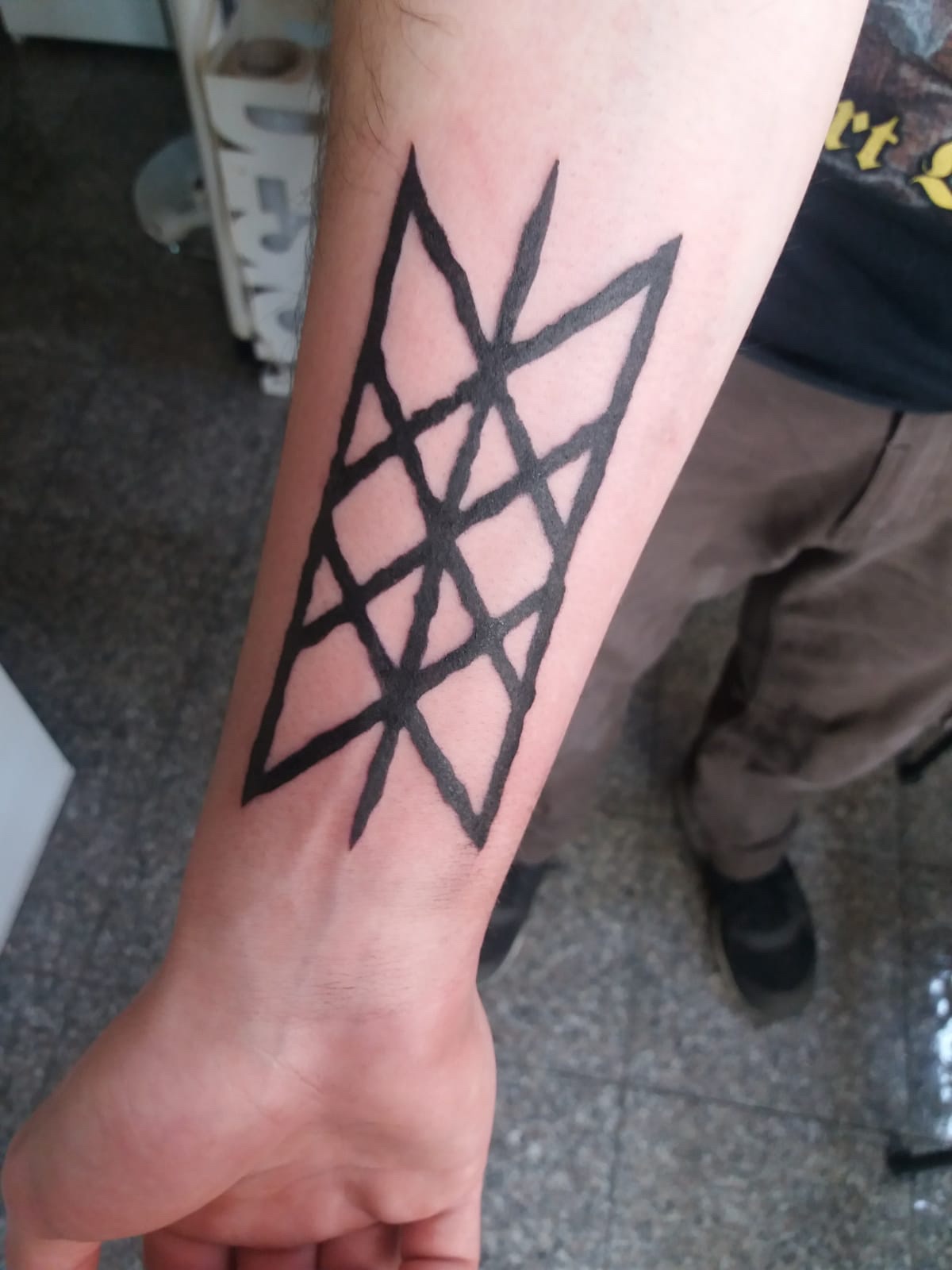
In Norse mythology the concept of fate is reflected by the Web of Wyrd that is created by the Norns who were known as ‘Shapers of Destiny. The Norns were goddesses who ruled the fates of people, determined the destinies and lifespans of individuals.
With its nine stave, the Web of Wyrd is a matrix of fate that represents past, present and future events in a person’s life. Norse people believed that everything we do in life affects future events and thus, all timelines, the past, present and future are connected with each other.
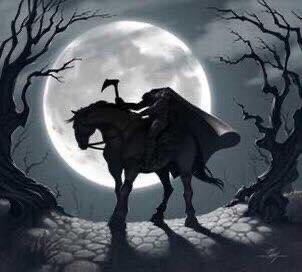
The Dullahan (pronounced DOOL-a-HAN) – also referred to as the Headless Horseman – is a type of Fae originating from Irish folklore. This sinister being appears as a man or a woman riding upon a black horse, but the rider has no head upon their shoulders. Typically, the Dullahan carries its head under its arm; the head appears dead and rotten (sometimes compared to having flesh resembling old cheese) with a demonic grin spread across its face from ear to ear.
The Dullahan carries a whip made from a human’s spine. Sometimes pulls wagon which is adorned with funeral objects (e.g., candles in skulls to light the way, the spokes of the wheels are made from thigh bones, the wagon’s covering made from a worm-chewed pall or dried human skin). When the Dullahan stops riding, that is where a person is due to die and when a Dullahan calls out the person’s name, the person immediately perishes.
There is no way to bar the road against a Dullahan—all locks and gates open to them when they approach. They do not appreciate being watched while on their errands, throwing a basin of blood on those who dare to do so (often a mark that they are among the next to die), or even lashing out the watchers’ eyes with their whips. They are however frightened of gold, and even a single gold pin can drive a Dullahan away.
Among the Aesir gods in Norse mythology, the supreme god Odin, is frequently depicted sitting on his high seat, Hlidskjalf, in Asgard, the home of the gods.
Hugin is believed to represent ‘memory’, while Munin personifies ‘thought’. Every day, Odin sends them out and they fly across the worlds to seek for important news and events. Odin surveys the worlds from Hlidskjalf and must know reports of what is going on in all Nine Worlds. In the evening, Hugin and Munin return to Odin’s shoulders and during dinner in Valhalla, they whisper all they have heard in his ears.
The Helm of Awe is one of the most powerful protective Viking symbols used not only for the purpose of protection from disease, but even to encourage all people who might suffer from depression or anxiety.
In Norse myths it is said that the Helm of Awe symbol was worn between the eyes to cause fear in your enemies, and to protect against the abuse of power. The Norse word for this very important symbol (Ægishjálmr or Aegishjalmur) is translated in English “helm of awe” or “helm of terror.” The meaning of the name awe is to strike with fear and reverence; to influence by fear, terror or respect; as, his majesty awed them into silence.
The Valknut, also known as Hrungnir’s heart, heart of the slain, Heart of Vala, and borromean triangles is a mysterious Norse symbol. its true meaning is still debated, but it is often associated with a warrior’s death in a battle.
The symbol has been found on old Norse stone carvings and funerary steles. It is sometimes called “Hrungnir’s heart,” after the legendary giant of the Eddas. It’s also possible to find a depiction of the Valknut on stone carvings as a funerary motif, where it probably signified the afterlife. In art, the Valknut is a representation of God Odin, and it demonstrates gods’ power over death. A Valknut is also believed to offer protection against spirits which is the reason why it is often carried as a talisman.
A Valknut is made of three parts, and the number three is a very common magic symbol in many cultures. In this case, the symbolism in Norse mythology showing three multiplied by three might designate the nine worlds, which are united by the Yggdrasil tree. In modern times Valknut, like Triquetra and Horn Triskelion, is often interpreted as a symbol pointing to heathen convictions.
In Norse mythology, the Yggdrasil is a giant mythological tree that holds together the Nine Worlds or realms of existence.
At the very top of Yggdrasil, an eagle lived and at the bottom of the tree lived a dragon named Nidhug. Both hated each other and were bitter enemies. The Nine Worlds are guarded by the serpent Jormungandr. Yggdrasil is one of many variations of the Cosmic Axis or Universal World Tree known to all human cultures and home to many fascinating creatures.
The image of Yggdrasil appears on the famous Överhogdal Tapestry, which dates to the year 1066 and depicts the events of Ragnarok, the doom of the Gods and apocalyptic record of the coming comet.
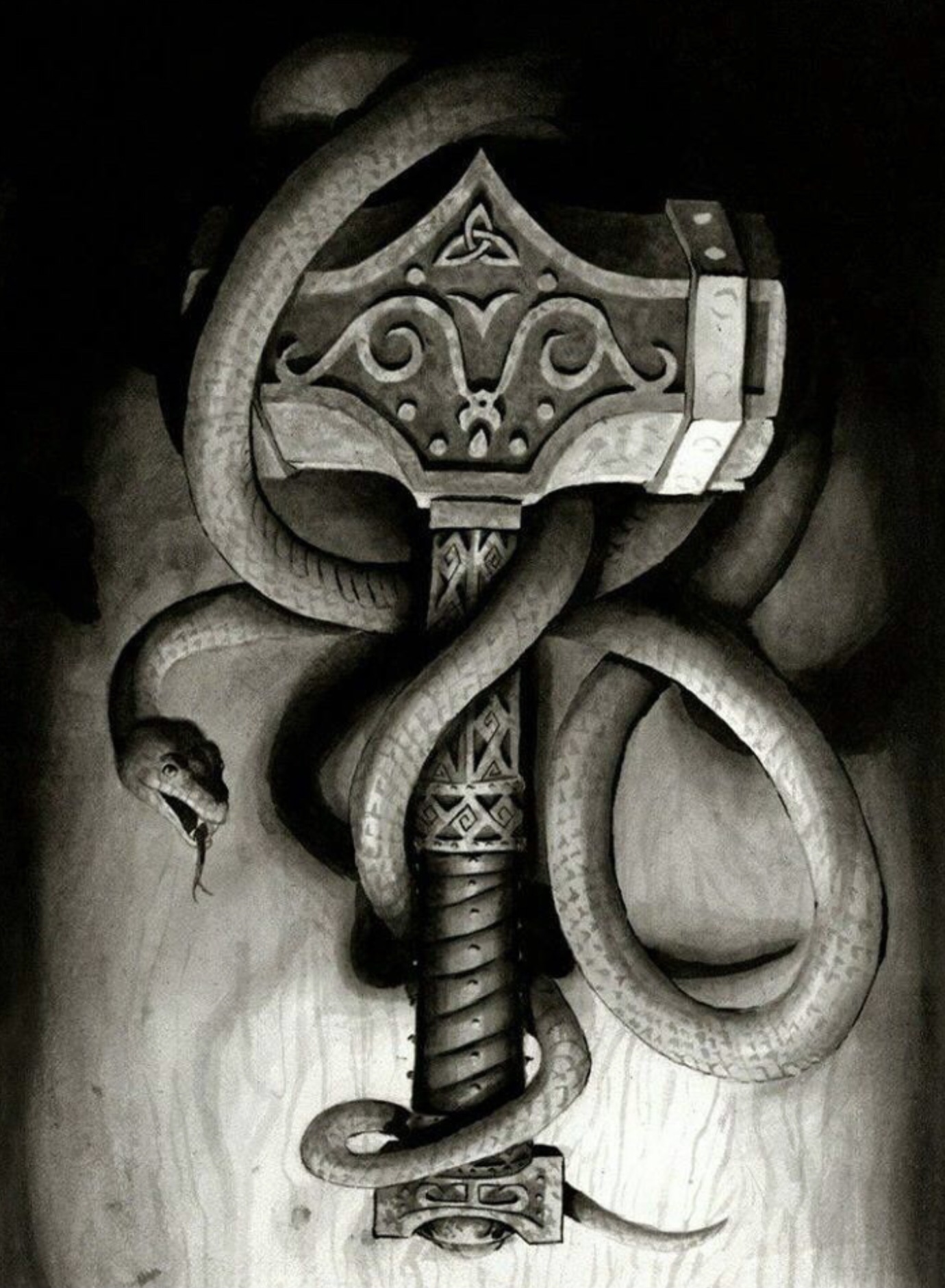
Mjölnir means lightning, and Thor’s hammer indicates the god’s power over thunder and lightning. Thor, ancient god of war is one of the most prominent figures in Norse mythology. Thor who was the storm-weather god of sky and thunder and also a fertility god, was the son of Odin and Fyorgyn, the earth goddess.
Thor’s hammer, Mjölnir is depicted in Norse mythology as one of the most fearsome weapons, capable of leveling mountains. Mjölnir, was a magical weapon that always came back to Thor when he threw it. Wearing Thor’s hammer as an amulet of protection was quite common as this was probably the most popular of all the pagan Viking symbols. Even during Christian times, from A.D. 1000 on, Vikings wore Thor’s Mjölnir as well as a cross on a chain or thong around their necks.
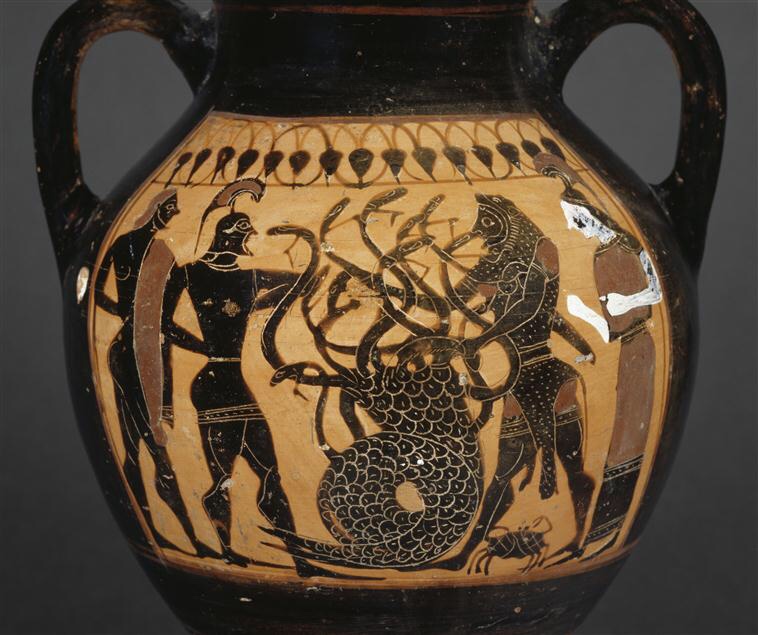
The Hydra was an enormous serpent with nine heads—or as many as fifty or one hundred—one of which was immortal. Its parents were the giant Typhon and Echidna, half maiden and half serpent, the so-called “mother of all monsters.” The Hydra’s haunts were the marshes of Lerna, near the city of Argos.
The second of Hercules’s Labors was the slaying of the Hydra. But each time that Hercules would cut off one of its heads, two would grow in its place. Not only this, but a giant crab that kept the Hydra company appeared and joined the fray. Hercules’s clever nephew and companion Iolaus proposed a remedy: the moment Hercules severed a head, Iolaus would cauterize the stump with a firebrand. This the two did until only the Hydra’s immortal head remained. Hercules then cut off this head, and after burying it beneath a boulder, dipped his arrows in the Hydra’s lethal venom. Both the Hydra and the crab, which Hercules had also slain, were placed in the heavens by the goddess Hera as constellations.
An epic poem written by Edmund Spenser and published starting in 1590. ‘The Faerie Queene’ is the tale of Arthur and his knights and a variety of adventures and quests they go on, including their interactions with the Fairy realm and the Fairy Queen Gloriana, who is a literary invention of Spenser’s. The poem is largely allegorical and possibly intended to reflect the real world politics of the time, with Gloriana acting as a stand in for Queen Elizabeth and Fairy for Elizabethan England.
In Norse mythology, the Valkyries were a group of warrior maidens who had served the God Odin and were sent to the battlefields to choose pass judgments upon the slain.
They were not only associated with bloodshed and battle but also with fairness. They were a force to be reckoned with. The Old Norse Poems provide a list of Valkyrie names who were known as the fiercest warriors in battles:
1. Brynhildr(pronounced as “Brin-hil-duur”), meaning”battle armor” or “bright battle,” was known as the leader of the Valkyries.
2. Eir(pronounced as “Ee-rh”), meaning”peace” or “mercy.” In Old Norse mythology, she is a Valkyrie associated with medical proficiency.
3. Geirahöð (pronounced as “Gee-ey-ra-hut”), meaning”battle spear,” is mentioned in some of the manuscripts of Grímnismál.
4. Geiravör (pronounced as “Gee-ey-ra-vurr”), meaning “spear-vör,” is a Valkyrie mentioned in the long list amongst the two Nafnaþulur lists found in the Prose Edda.
5. Geirdrifu(pronounced as “Gee-ey-dra-fu”), meaning”spear-flinger.”
6. Geirönu(pronounced as “Gee-ey-ro-nu”), meaning”the one charging forth with the spear.”
7. Geirskögu(pronounced as “Gee-aer-sko-gu”), meaning”spear-bearer,” a fierce Valkyrie name.
8. Göl(pronounced as “Gawl”), meaning”tumult” or “noise, battle,” is a Valkyrie who served Odin in battle.
9. Göndu(pronounced as “Gawn-du”), meaning”wand-wielder” is one of the most fierce Old Norse Valkyries and the chooser of the slain.
10. Gunnr(pronounced as “Gunner”), meaning”war” or “battle” is a great Valkyrie name with a dual meaning.
11. Herfjötur(pronounced as “Her-fyo-tur”), meaning “fetter of the army” or “host fetter” is well-known in Norse mythology as a powerful Valkyrie with her ability to place fetters.
12. Herja(pronounced as “Herja”), meaning”one who devastates” who was both a Valkyrie and a Germanic goddess and chooser of the slain.
13. Hlaðguðr svanhvít(pronounced as “Hluh-goor-svan-vit”), meaning”swan-white” is King Hlödvér’s daughter, and the sister of Hervör alvit.
14. Hildr (pronounced as “Hill-dur”), meaning”battle” is the daughter of Högni and Hedin’s wife.
15. Hjalmþrimul(pronounced as “Jam-pree-mul”), meaning”helmet clatterer” is amongst the Valkyries in Norse Legend who chooses who will die in battle.
16. Hervör alvitr (pronounced as “Her-vor-aal-vee-tur”), meaning”all-wise strange creature” is a Valkyrie who is the sister of the sister of Hlaðguðr in Nordic mythology.
17. Hjörþrimul(pronounced as “Jor-pree-mul”), meaning”the female sword warrior,” is a legendary Valkyrie.
18. Hlökk(pronounced as “Lowk”), meaning”noise, battle”. She is mentioned in the Poetic Edda poemGrímnismál.
19. Hrist(pronounced as “Rist”), meaning”the quaking one” is a legendary Norse Valkyrie who also appears intheValkyrie Profile series.
20. Hrund(pronounced as “Rund”), meaning“pricker”.
21. Kára(pronounced as “Kaara”), meaning”the curly one” is a Valkyrie mentioned in the Poetic Edda poem Helgakviða Hundingsbana II.
22. Mist(pronounced as “Mist”), meaning”cloud” or “mist”. She appears in the list in the Poetic Edda poem Grímnismál.
23. Ölrún(pronounced as “Awl-run”), meaning”ale-rune” is a powerful Valkyrie.
24. Randgrid(pronounced as “Rand-grid”), meaning”shield-destroyer” is a powerful Valkyrie.
25. Ráðgríðr(pronounced as “Rad-gri-dur”), meaning”council-truce” is a well-known Valkyrie in Norse legend who judges who will die in battle.
26. Reginleif(pronounced as “Rain-leaf”), meaning”daughter of the gods” is a Valkyrie who became Volund for Adam when Ragnarök took place.
27. Róta(pronounced as “Row-tah”), meaning”sleet and storm” is a Valkyrie who is attested in the 36th chapter of the Prose Edda book Gylfaginning, mentioned alongside the other valkyries.
28. Sanngriðr(pronounced as “San-grid-ur”), meaning”very violent and very cruel” is a Valkyrie who is mentioned in the skaldic poem Darraðarljóðand a powerful female figure.
29. Sigrdrífa(pronounced as “Sig-ur-dri-fa”), meaning”inciter to victory” is a well-known Valkyrie in Norse literature who is known as the chooser of the slain.
30. Sigrún(pronounced as “Sig-run”), meaning”victory rune” is a famous Nordic Valkyrie in Norse mythology.
31. Skalmöld(pronounced as “Skal-mold”), meaning”sword-time” is amongst the Valkyries is one of the female figures who decide who will die in battle.
32. Skeggöld(pronounced as “Ske-gold”), meaning”axe-age” who appears in at two poems as a Valkyrie and was one of the powerful female figures.
33. Skögul(pronounced as “Sko-guul”), meaning”shaker” or “high-towering” is one of the Valkyries who appear in Heimskringla.
34. Skuld(pronounced as “Skuld”), meaning“debt” or “future” is a Valkyrie who held the Norn position as the goddess of fate.
35. Sveið(pronounced as “Sveyud”), meaning”vibration” or “noise” is a powerful Valkyrie.
36. Svipu(pronounced as “Svi-poo”), meaning”changeable” is one of the Valkyries about whom much information isn’t provided.
37. Þögn(pronounced as “Pawn”), meaning”silence” is a Valkyrie, found in the Nafnaþulur section attached to the Prose Edda.
38. Þrima(pronounced as “Prima”), meaning “fight” is a Valkyrie, found in the Nafnaþulursection of Skáldskaparmál.
39. Þrúðr (pronounced as “Pruder”), meaning”strength” or “power” is an old Norse Valkyrie who serves ale to the Einherjar in Valhalla.







 Mark Bere Peterson’s Counterculture, Urban Legends, Paganism & Witchcraft