Chaucer’s Canterbury Tales, ‘the Wife of Bath’s Tale’ 14th century:
“In the days of King Arthur, Britain was full of fairies. The elf queen danced in meadows with her companions. This is what I read, anyway. Now, no one sees elves any more, because of the prayers of friars. These friars search all over the land, blessing every building and house, with the result that there are no more fairies. Where elves used to walk, the friar himself now goes at all times of the day, saying his prayers. Women can walk anywhere they want without fearing anyone but the friar, who will only dishonour them, rather than beget demon children upon them.”
Excerpt from ‘Farewell, Rewards, and Fairies’ by Bishop Richard Corbet, 16th century:
Ásatrú is a modern religion that revives, reconstructs, and reimagines the ancient polytheism of Northern Europe. The new religious movement began in 1972, when Sveinbjörn Beinteinsson and eleven other Icelanders decided to bring back public worship of the Norse gods, goddesses, and land spirits. New iterations of the Old Way quickly spread around the world, and by 2013 there were nearly 40,000 followers of related practices in ninety-eight countries.
The word Ásatrú is modern Icelandic for “Æsir Faith” and refers to belief in the major tribe of Norse deities. Practitioners often self-identify as Heathens, and the term Heathenry is generally used to refer to the wider range of contemporary religions related to various Northern European polytheistic traditions dating back to approximately 2000 BCE. Although there are clergy known as goðar (singular goði), there is no central Ásatrú authority and no set dogma. Throughout the Heathen world, there is a great variety of beliefs and practices.
The history of Northern European polytheism stretches from the Bronze Age through the Viking Age, a long period in which local variants developed among the Germanic peoples of continental Europe, the Nordic countries, and the British Isles. Although large-scale practice ended with the coming of Christianity, private worship is documented for several subsequent centuries. Some beliefs and rituals survived into the twentieth century as elements of folk religion throughout the Northern European diaspora.
Since the founding of Iceland’s Ásatrúarfélagið (“Æsir Faith Fellowship”) in 1972, modern practice has spread worldwide through a mixture of national organizations, regional gatherings, local worship groups, and lone practitioners. The Ásatrúarfélagið has been recognized by the Icelandic government since 1973, and Ásatrú is now Iceland’s largest non-Christian religion. In the United States, the Department of Defense officially recognized Ásatrú and Heathenry in 2017, thereby granting full religious rights to practitioners in all service branches.
Today’s beliefs and practices span a range from humanism to reconstructionism, from viewing the gods as metaphorical constructs to approaching them as distinct beings. Deities venerated in Ásatrú include Odin, Thor, and Freya, but respect is paid to a large number of figures. Ásatrú is a world-accepting religion; emphasis is placed on right action in this life rather than on expectation of an otherworldly afterlife. Practitioners assert that “we are our deeds,” meaning that the sum of one’s actions is of primary importance.
Blót is the central ritual of Ásatrú. The Old Norse word for “sacrifice” is used for a rite in which offerings are made to gods, goddesses, land spirits, and departed people of importance. Blót is often performed outside, and the most common offering is some form of alcohol (usually ale, beer, or mead). The ritual can be performed as often as desired by the community, and it forms the core of major holiday celebrations such as Midsummer and Yule.
For grounding and inspiration, followers of Ásatrú turn to a diverse set of texts that includes Greek, Roman, and Arabic descriptions of Germanic peoples; myths preserved by the medieval Icelander Snorri Sturluson and his Danish contemporary Saxo Grammaticus; Old Norse, Anglo-Saxon, and Middle High German mythic and heroic poetry; legendary and historical sagas of Iceland; and later folklore collections. Many practitioners also study and write modern scholarly work in disciplines such as archaeology, history, medieval studies, and religious studies.
Brownies are somewhat unusual among the wider groupings of fairies because they prefer to live with or near humans, either in human homes or in mills, although some have also been connected to bodies of water like ponds. Brownies in mills come out at night and work in the mill, not always in a way that helps the human owners, while Brownies in homes come out while the human inhabitants are sleeping and clean. Overall Brownies have a good reputation as helpful spirits, however, in older folklore they were seen as ambiguous beings and potentially dangerous particularly to those outside their chosen family, although even that family could be on the receiving end of the Brownie’s destructive temper if it was angered.
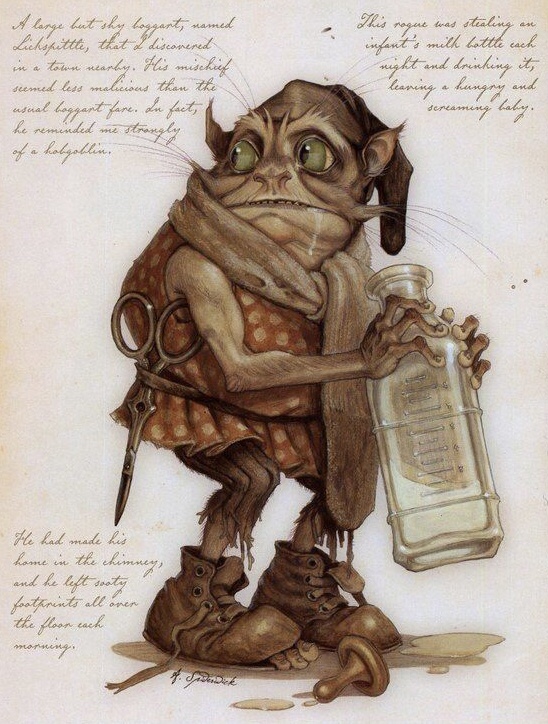
In descriptions Brownies are usually, as the name implies, a nut-brown color and are said to dress in rags. This style of dress may be a preference as stories tell of the unfortunate results of well-meaning humans offering their resident Brownie a new set of clothes. In best case scenarios the Brownie snatches up the clothing and leaves forever, sometimes singing happily that the new clothes mean that they will not work anymore; worst case scenarios the helpful Brownie is so offended it transforms into a malicious Boggart. This may be because the Brownie is bound to service and can only be released with purposeful payment, or because they are mortally offended by any implication that they are serving humans.
When Brownies appear in folklore the focus is usually on their role around human homes or farms, and secondarily their place at mills. Around a home they are known to do chores while on a farm they will help bring in crops and tend to the livestock. In one story centered on a mill, a human girl goes to grind wheat after dusk only to find the mill occupied by a Brownie who she douses with boiling water when he gets too amorous with her; he flees to his mother but later dies of his burns.
Brownies must be paid surreptitiously for their work, with food being left out for them but never directly given to them. A household with a Brownie would be expected to leave a bowl of milk and small loaf of bread or cake out once a week to show their gratitude for the Brownie’s efforts. This food and drink should be left without verbal thanks and not directly as a gift, but placed carefully where the faerie would find it to avoid any chance of offending them. In this we see a juxtaposition of careful preparation and seemingly casual placement, with the housewife ensuring the Brownie’s continued effort for the household this way
Besides leaving if given clothes there are a few other things that will force a Brownie to leave a location. Several accounts of Brownies attached to homes describe the faeries being driven off by well-intentioned efforts to baptize them or reading from the Christian Bible in their presence, two things these faeries apparently cannot tolerate. Farm-oriented Brownies will become destructive and leave if the quality of their work is insulted or more generally if a person speaks ill of them.
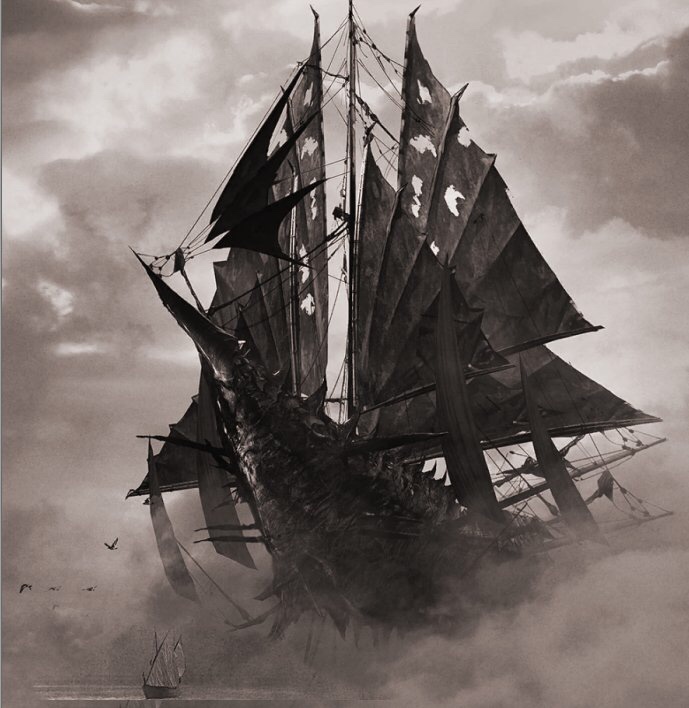
Naglfar (“Nail-ship”): This is the ship of the dead. It is made from the fingernails and toenails of the dead. This is why it is always necessary to trim the nails of the deceased before burying them, for if this is not done the nails will provide building material for the construction of Naglfar. The completion of the ship-building will be the sign that the end of the world has begun. The sons of Muspell will then travel on Naglfar to join the assault on Ásgarðr.
The ship sails from the east and is packed with forces of evil and chaos, according to the Poetic Edda.
Naglfar is on its way into the battle against the Aesir gods and will arrive on the shores of Midgard, just in time when the Midgard serpent emerges from the sea.
The captain of the ship is the giant Hrym, who brings with him all the legions of the giants, while Loki takes the helm of the fatal ship full of giants. He steers Naglfar over the stormy and cold northern waters, to Vigrid (Norse: Vígríðr), the plain where the decisive battle will take place.
Superstitions have often accompanied ancient people in their daily life. According to ancient Norse beliefs, it was important that no one in the Viking world should die with untrimmed nails. There is one way to delay the ship’s arrival. The ship’s size would depend on how many deceased had been buried with unpaired fingernails.
If someone dies with long fingernails, the surviving relatives of the dead must immediately cut them short before the deceased is laid to rest. Otherwise, their nails will be used to build the Naglfar larger and stronger.
The ancient Vikings believed that this action could significantly delay the construction of the ghost ship and the day of the end of the world.
The Sphinx is said to be associated with Khafre during 2558-2532 BC, and it lines up with the Pyramid of Khafre at the foot of its causeway.
The Sphinx has the body of lion and the head of a king or god. In 1905 the sand was cleared away from the sculpture base to reveal how massive the Sphinx really is. The paws alone are 50 feet long and the entire body equals out to 150 feet long. The head is proportionally a lot smaller at only 30 feet long and 14 feet wide. The Sphinx is believed to have been quite colorfully painted at one time. Unfortunately, the bedrock it is carved into is sandstone so it does not hold up well to the elements and a lot of erosion has occurred.
The Sphinx lost its nose because Muhammad Sa’Im Al-Dahr was angered by peasants making offerings to it, so he destroyed the nose then was promptly hanged for vandalism. Other stories such as the claim that Turks shot off its nose during target practice or even Napoleon. More mystery surrounding the Sphinx is who it resembles. Some believe that the face resembles that of Khafre’s older brother, Pharaoh Djedefre. A German Egyptologist has also suggested that the Sphinx was built by King Khufu, Khafre’s father. So many rumors circulate around the Sphinx, but I do not think we will ever truly know what it’s true purpose was.
The Dream Stele is between the paws of the Sphinx. The stele tells the story of when Thutmosis IV fell asleep under the Sphinx, which at the time was covered in sand up to its neck. He had a dream that the Sphinx talked to him and told him that if he freed the Sphinx from the sand then he would become king. Some people do believe that the Sphinx has magical powers or that it has hidden passageways under it. But none of these have been confirmed.
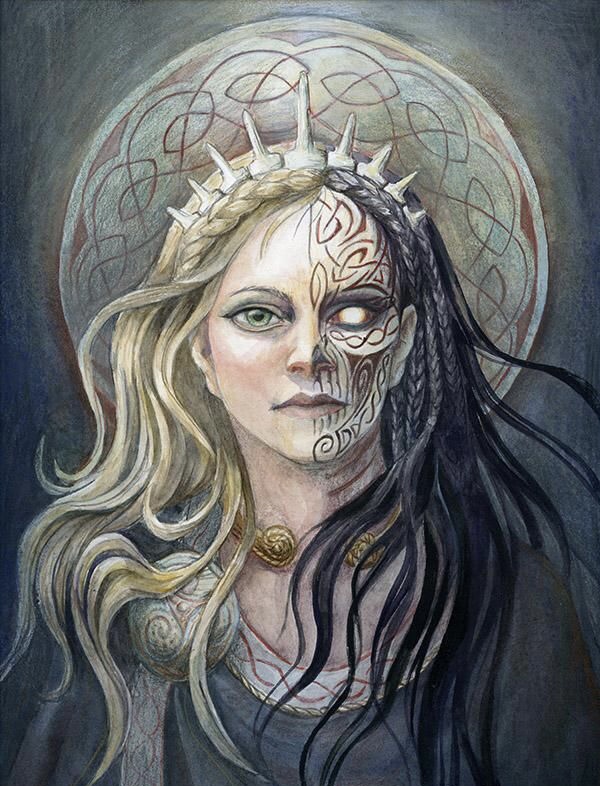
Hel (“Hidden” or “Concealer”) is a goddess who rules over the identically-named Hel, the underworld where many of the dead dwell. Her name’s meaning of “Hidden” surely has to do with the underworld and the dead being “hidden” or buried beneath the ground.
Hel is the daughter of Loki and the giantess Angrboda (“Anguish-boding”), and therefore the sister of the wolf Fenrir and the world serpent, Jormungand. This makes her part of a highly dangerous and disreputable family.
Hel is generally presented as being rather greedy, harsh, and cruel, or at least indifferent to the concerns of both the living and the dead. However, her personality is little-developed in what survives of Old Norse literature. She’s mostly mentioned only in passing. She’s described as having the appearance as being half-black (or sometimes blue), half-white, and with a perpetually grim and fierce expression on her face.
The only surviving myth in which she features prominently is that of The Death of Baldur. The beloved god Baldur was slain by none other than Hel’s father, Loki, and the gods sent an emissary named Hermod to Hel in hopes of retrieving Baldur. Hermod pleaded with Hel, telling her how every living thing was in sorrow over the loss of Baldur. But Hel wouldn’t give up her prize so easily. She told Hermod that she would only consent to release Baldur if every last thing in the universe wept for him. Hermod and the other gods went around and got almost everything in the cosmos to weep for Baldur. Only one giantess, who was probably Loki in disguise, refused. But because of that one refusal, the terms of Hel’s offer weren’t met, and Hel kept Baldur in her cold clutches.
The realm of the dead has several names: Niðavellir (“Obscure Plains” or “Fields of Darkness”), Náströnd (“Corpse-shore”), or Násheimr (“Corpse-world”). It seems to consist of nine dwellings, the most terrible of which is Náströnd, in the southern reaches of Hel, where those who broke the moral laws, especially oath breakers, are cast. The dragon Níðhöggr gnaws on their corpses.
Because of how sparsely-defined her character is, many scholars view Hel as more of a late literary personification of the grave than a goddess who was actually worshiped or appeased in her own right. Due to the lack of conclusive evidence either way, this must remain an open question.
The name ‘goblin’ may derive from the Greek ‘kobalos’, which means ‘villain’ (or ‘rogue’). Its Latin name is ‘cobalus’ while its French name is ‘gobelin’ and in German tales, this being is ‘cobalt’. Today, the creature is widely known under its English name: ‘goblin’ and this name characterizse evil and malicious spirits.
They are small (dwarfish) and grotesque, about the size of a fairy tale dwarf, however, giant goblins, whose height can reach two meters are mentioned in the mythology of the Germanic peoples. Goblins have unusually big ears and noses, dark skin and yellow very filthy teeth.
Goblins prefer to dwell in caves, rock crevices and roots of ancient trees located in isolated places and hardly accessible mountain regions. They can even enter houses or disturb people by knocking on doors and walls and then immediately disappear. They smash pots, pull sleeping people out of bed, pulling pajamas off of them and make noises while moving furniture at night. Unfamiliar with the peoples’ concept of ethics and morality, the goblins do bad things just for fun.
Small, malicious creatures resembling demons, goblins are known for their greed and tempers. They first appeared by the name of “goblin” around the Middle Ages in Europe, but can be found with varying details to their personalities in the tales of many countries. For example, the redcap of Anglo-Scottish folklore gets his red chapeau from dipping it in the blood of those he has killed.
There is also a rare occurrence of a friendly goblin in the thirteenth-century Latin book Gesta Romanorum, which has a tale titled “How, in a certain part of England, thirsty hunters were given refreshment by a benevolent goblin,” the plot of which is rather self-explanatory. Goblins vary in size and shape and are said to be easily distracted by the promise or sight of gold. They can also be terrible tempters, as in Christina Rossetti’s haunting and erotically charged poem “Goblin Market,” where they lure victims to their doom with luscious, irresistible fruit.
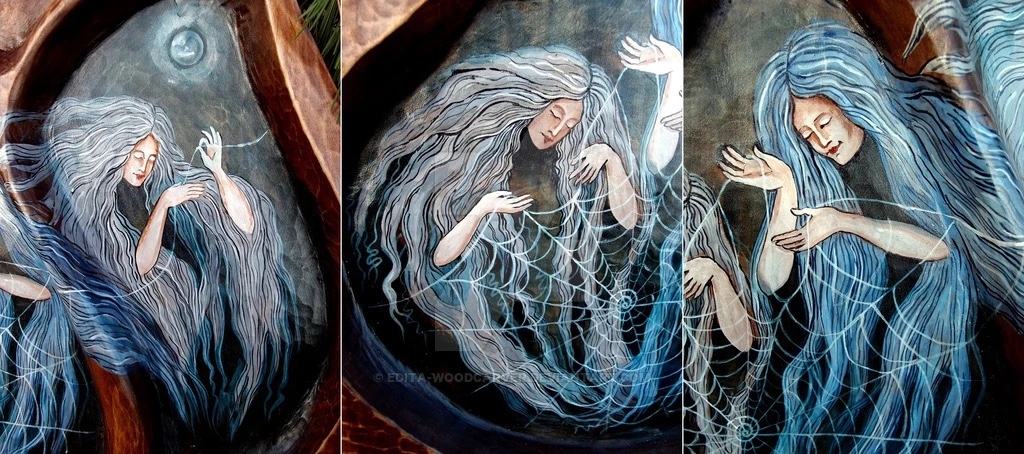
The goddesses of fate who almost always appear as a group of three figures. Snorri Sturluson writes: “A beautiful hall stands under the ash by the well [i.e., beneath Yggdrasill], and out of this hall come three maidens whose names are Urðr [“Past”], Verðandi [“Present”], and Skuld [“Future”]. They shape the lives of men. We call them Norns.”
These maidens are giantesses who sprinkle clear water and white clay on the tree every day. They are depicted as wicked and ugly; their verdict is irrevocable. It is said they come from the sea. Sturluson goes on to remark: “There are also other Norns who visit everyone when they are born to shape their lives, and these are of divine origin, though others are of the race of elves, and a third group are of the race of dwarves.”
The Norns correspond to the Fates—the Greek Moirai and the Roman Parcae—as well as to the fairies of Celtic and Roman legends. In fact, several texts in Old French depict three fairies around a cradle who endow a child with beneficial or harmful aspects, a theme also found in the fairy tale Sleeping Beauty. Only the Norn Urðr appears to be ancient and authentic; Skuld and Verðandi appear to be later additions to form a triad modeled on the Parcae. Furthermore, the spring at the foot of Yggdrasill is named the “Well of Urðr.”
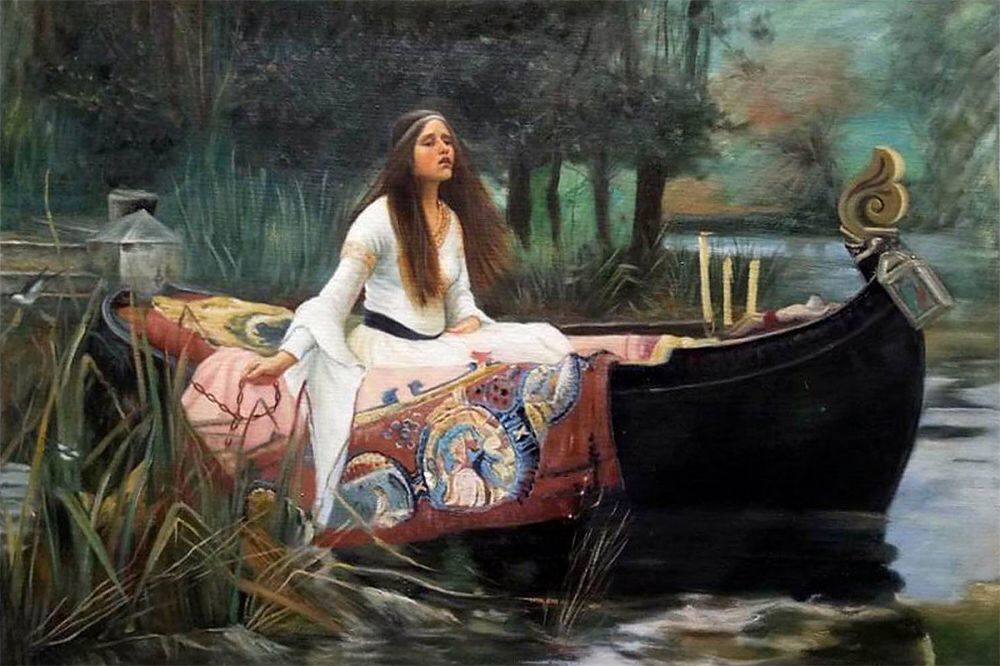
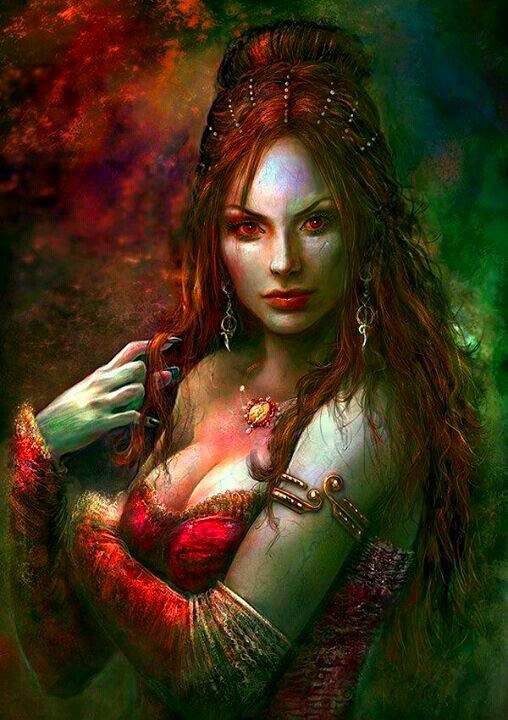
Sidhe are the more modern versions of the Tuatha Dé Danann, the fairy race of Old Ireland who were great masters of magic and appeared in early Celtic mythic tales such as Tochmarc Étaíne. After being conquered by the Sons of Mil (ancestors of the Irish people), the Tuatha Dé Danann retreated underground and dwindled into the still unearthly beautiful (but diminished) sidhe. The word “sidhe” originally referred to the fairy mounds where these beings lived. Tad Williams’s Sithi race from his epic fantasy trilogy Memory, Sorrow, and Thorn, is akin to the sidhe.
In folk belief and practice, the sidhe are often appeased with offerings, and care is taken to avoid angering or insulting them. Often they are not named directly, but rather spoken of as “The Good Neighbors”, “The Fair Folk”, or simply “The Folk”. The most common names for them, aos sí, aes sídhe, daoine sídhe (singular duine sídhe) and daoine sìth mean, literally, “people of the mounds” (referring to the sídhe). The sidhe are generally described as stunningly beautiful, though they can also be terrible and hideous.
Sidhe are seen as fierce guardians of their abodes—whether a fairy hill, a fairy ring, a special tree (often a hawthorn) or a particular loch or wood. It is believed that infringing on these spaces will cause the sidhe to retaliate in an effort to remove the people or objects that invaded their homes. Many of these tales contribute to the changeling myth in west European folklore, with the sidhe kidnapping trespassers or replacing their children with changelings as a punishment for transgressing.
The sidhe are often connected to certain times of year and hours; as the Gaelic Otherworld is believed to come closer to the mortal world at the times of dusk and dawn, the sidhe correspondingly become easier to encounter. Some festivals such as Samhain, Beltane and Midsummer are also associated with the sidhe.










 Mark Bere Peterson’s Counterculture, Urban Legends, Paganism & Witchcraft