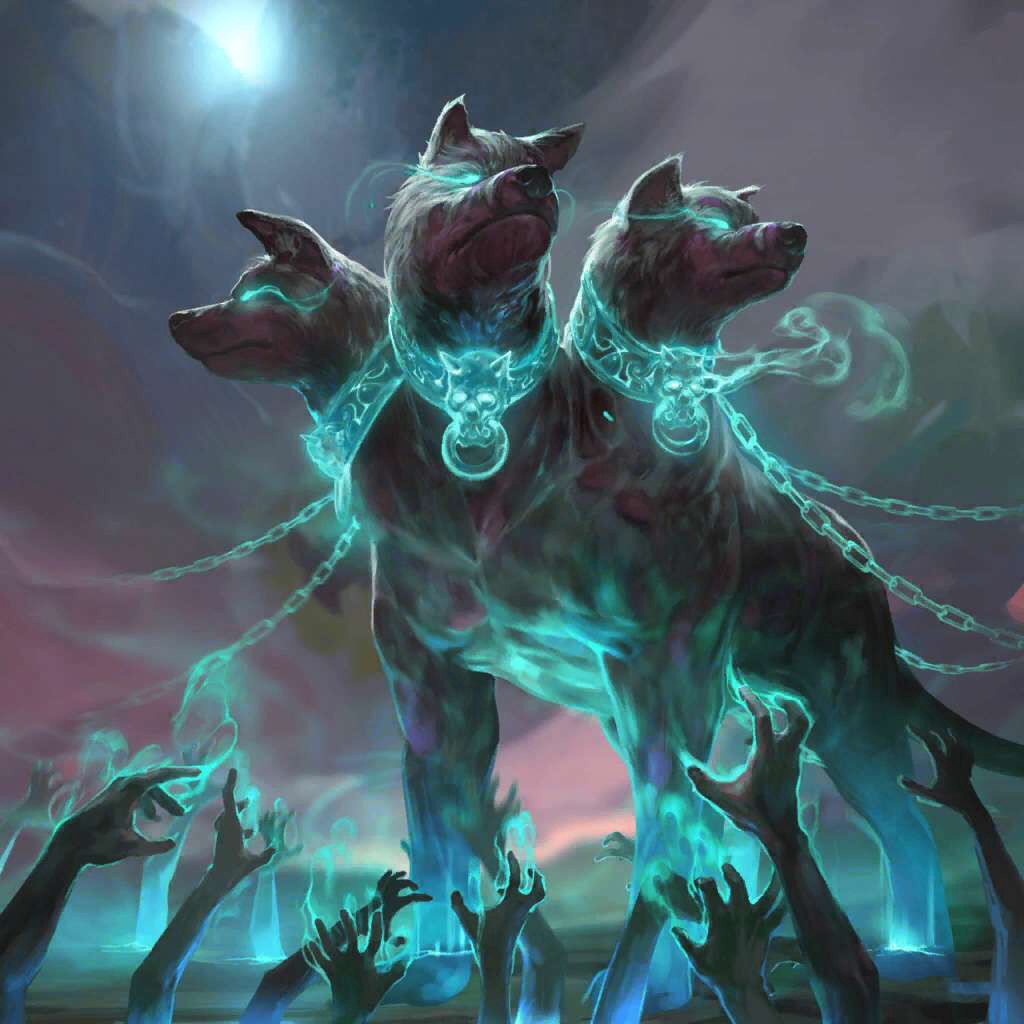
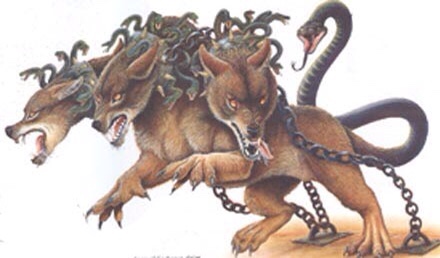
Cerberus, whom Homer calls “the hound of Hades,” was one of the brood of monsters, which include the Hydra of Lerna and the Chimaera, spawned by Typhon and the half maiden, half serpent Echidna. He was variously described as having as many as fifty or one hundred heads and as few as three. The mythographer Apollodorus writes that Cerberus, the three-headed dog, had the tail of a dragon and snakes’ heads growing from his back. For the poet Hesiod, Cerberus was an eater of raw flesh and had a bark like clashing bronze.
Cerberus’s duty was to allow the deceased to enter the House of Hades but to block the living from entering and the dead from leaving. On the instruction of the Sibyl of Cumae, the living hero Aeneas secured passage into Hades by throwing Cerberus a drugged honey cake. The best-known myth involving Cerberus is the tale of Hercules’s twelfth and final Labor (or by some accounts, the tenth): Hercules was ordered to bring Cerberus up from the Underworld, a task that he accomplished by overpowering the beast without the use of weapons. As the poet Ovid writes, upon reaching the realm of the living, the distressed hound raged, foam from its mouth falling upon the earth to produce the poisonous plant aconite, which the sorceress Medea used in attempting to kill the hero Theseus.
To the Ancient Egyptians, the soul was the most important part of a person and it was separated into different parts making up it’s vehicle (the human, in this case). There was one physical form and eight semi-divine parts which made up one’s soul. These parts are as follows:
~ Kha: The physical body of the human which decayed after death, according to the Egyptians, only if it was not mummified and persevered properly.
~ Ka: The double that lingered on in the tomb inhabiting the body or even statues of the dead, but was also independent of the deceased body and could move, eat and drink at will.
~ Akhu: This was the immortal part, the radiant and shining being that lived on in the Sahu, the intellect, will and intentions of the deceased that transfigured death and ascended to the heavens to live with the gods.
~ Sahu: The incorruptible spiritual body of man that could exist in the heavens, appearing from the physical body after the judgement of the dead was passed (if successful) with all of the mental and spiritual abilities of a living body.
~ Sekhem : This was the incorporeal personification of the life force of man, which lived in heaven with the Akhu, after death.
~ Khaibit: The shadow of a man, it could partake of funerary offerings and was able to detach itself from the body and travel at will, though it always was thought to stay near the Ba.
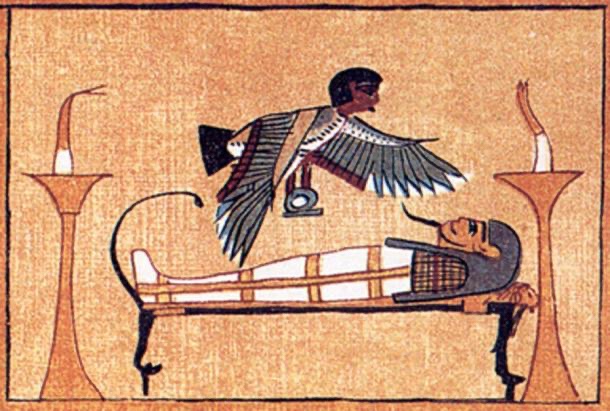
~ Ba: The human headed bird flitted around in the tomb during the day bringing air and and food to the deceased, but traveled with Ra on the Solar Barque during the evenings.
~ Ab: The heart, this was the source of good and evil within a person, the moral awareness and center of thought that could leave the body at will, and live with the gods after death, or be eaten by Ammut as the final death if it failed to weigh equally against Ma’at.
~ Ren: The true name, a vital part to man on his journey through life and the afterlife, a magical part that could destroy a man if his name was obliterated or could give power of the man if someone knew his Ren.
In ancient Egyptian mythology, the Duat is the underworld or the realm of the dead. It is the home of the god Osiris, Anubis, Thoth, Horus, Hathor, and Ma’at, and many grotesque spirits controlled by them. Ra, the sun god, also travels through the Duat every night and battles the serpent monster Apep.
The most important function of the Duat however is that it is where people’s souls go for judgment after death. Their tombs were viewed to be entrances into the Duat, and they could travel back and forth from the underworld through these burial chambers.
Within the Duat are many impressive geographical features. There are normal features like islands, fields, caverns, rivers, and mounds – but also unrealistic structures like lakes of fire, trees of turquoise, and walls of iron. Once someone had passed away, it was up to them to navigate this tricky landscape to become an akh, or blessed spirit. They had to pass through a series of gates protected by grotesque spirits with human bodies and heads of animals, knives, torches, or insects. Along the way were also mounds and caverns filled with animals or gods who would threaten the dead as they passed.
Once the dead passed all of these unpleasant spirits, if they did, they would reach the Weighing of the Heart. This ritual involved weighing the heart of the deceased against a feather, representing Ma’at – the goddess of truth and justice. This ritual was performed by Anubis. If the heart was out of balance, due to failure to follow Ma’at, then the heart would be devoured by Ammit, the Devourer of Souls. Those who did pass would travel to the paradise of Aaru.
** All we know about the Duat and the afterlife comes from funerary texts like the Book of the Dead, Pyramid Texts, Coffin Texts. **
In Japan, the crane is a national treasure. It is the symbol of longevity and good luck because it was thought to have a life span of a thousand years. Tsuru are also monogamous, therefore, often used for wedding decor. An example of this is seen on formal wedding kimonos, and the uchikake, a decorative kimono that goes over the actual kimono, where beautiful images of tsuru are often embroidered.
The crane is often produced in Japanese origami and artwork. Large colourful necklaces of cranes are also commonly seen outside of Japanese temples.
Another example of the crane used in Japanese culture is the 1,000 origami cranes called senba zuru. As the story goes, during WWII, Sadako Sasaki, a young victim of the atomic bomb in Hiroshima, was diagnosed with leukemia from exposure to radiation. There are many versions of her story; one says she decided to fold 1,000 paper cranes as a symbol of peace and hope but was only able to fold 644 before she died of her injuries. Another says her friend folded the cranes for her in hopes of her recovery. Regardless of who folded the cranes, today people of Japanese ancestry as well as many others, carry on the tradition of folding 1,000 cranes in hopes of health, happiness, and peace. There is a memorial statue of Sadako at theHiroshima Peace Memorial Park with her holding a single crane.
The craneis a majestic bird that is a favorite subject in many Asian paintings. Although there are many species of cranes, in Asia it’s usually the red crown crane that is depicted. The long white neck and torso, contrasting black legs and head is topped with a red crown. Their physical beauty is undeniable.
There is a Japanese idiom that says, “tsuru no hito koe“, 鶴の一声 or つるのひとこえ, which literally translates as, “one word from the crane’, meaning the “voice of authority”, the one who has the final word that isn’t challenged.
Koi means Carp in Japanese, and this fish is a symbol of perseverance due to the fish’s tendency to swim upstream and resist the flow of water. Koi Carp also symbolise faithfulness and marriage in Japan. A design of carp swimming against rapids symbolises the Children’s Day Festival on May 5th. This is to inspire children to work hard in order to succeed.
Koi are a colorful, ornamental versions of the common carp. Though carp domestication is believed to have begun in China as far back as the 4th century, modern Japanese koi are believed to date back to early 19th-century Japan where wild, colorful carp were caught, kept and bred by rice farmers. There are now dozens of different color varieties of koi.
Koi varieties are distinguished by coloration, patterning, and scalation. Some of the major colors are white, black, red, yellow, blue, and cream. Although the possible colors are virtually limitless, breeders have identified and named a number of specific categories. The most notable category is Gosanke, which is made up of the Kohaku, Taisho Sanshoku, and Showa Sanshoku varieties.
Kōhaku (紅白) is a white-skinned koi, with large red markings on the top. The name means “red and white”; kohaku was the first ornamental variety to be established in Japan (late 19th century).
Taishō Sanshoku (or Taishō Sanke) (大正三色) is very similar to the kohaku, except for the addition of small black markings called sumi (墨). This variety was first exhibited in 1914 by the koi breeder Gonzo Hiroi, during the reign of the Taishō Emperor. In the United States, the name is often abbreviated to just “Sanke”. The kanji, 三色, may be read as either sanshoku or as sanke (from its earlier name 三毛).
Shōwa Sanshoku (or Showa Sanke) (昭和三色) is a black koi with red (hi 緋) and white (shiroji 白地) markings. The first Showa Sanke was exhibited in 1927, during the reign of the Shōwa Emperor. In America, the name is often abbreviated to just “Showa”. The amount of shiroji on Showa Sanke has increased in modern times (Kindai Showa 近代昭和), to the point that it can be difficult to distinguish from Taisho Sanke. The kanji, 三色, may be read as either sanshoku or as sanke.
The Japanese word for turtle is kame, and the Japanese believe that the turtle is a symbol for wisdom, luck, protection, and longevity; longevity due to their long lifespan and slow movements. The turtle is magic and unites heaven and earth, with its shell representing heaven and its square underside representing earth.
Images of kame are quite popular. In Japanese mythology kame is a symbol of power and immortality. Kame supports the World Mountain, a refuge of the immortals. One such image is found in the monument to Tokugawa Ieyasu in Ryogoku, Tokyo. Kame have often been pictured by Japanese artists, including one of the most famous artists of Edo era, Hokusai Katsushika.
Among popular Japanese spiritual symbols are frogs. There are many species of frogs in Japan as a result of flooding rice fields in Japanese agriculture. These creatures are often used in poetry and art, and are sometimes carried by travellers to make sure they return home safely from their journeys. The word ‘frog’ in Japanese means ‘return’, which is why the frog is considered a Japanese lucky animal and seen as good fortune in things returning.
Japan is home to 40 species of frogs in five families. The most common is the tiny Japanese tree frog, which is usually green but can change its color to match its background, and the Japanese rain frog.
There are Japanese folk stories of giant toads, two to three meters in height, that found high up on mountain streams. According to legend they can breath out great rainbows and use the rainbows to slide prey into their mouth and are able to walk on their hind legs. They are said to be particularly numerous around in the mountains of the Suo region of Yamaguchi Prefecture.
Japan perceives the butterfly to be a ‘soul of the living and the dead’, as a result of the popular belief that spirits of the dead take the form of a butterfly when on their journey to the other world and eternal life.
The butterfly is also often used as a symbol for young girls as they spread their wings and emerge into womanhood, as well as it being believed to symbolise joy and longevity. Additionally, if a symbol contains two butterflies dancing around each other, it’s a symbol of marital happiness.
Eternity —> The meaning of eternity which represented by the butterfly is due to the belief that spirits of the dead take the form of a butterfly on their journey to the other world and eternal life. Or spirits of the dead are guided by butterflies to the afterlife.
Womanhood —> The cycle of transformations through which a butterfly passes in its life is often associated with the transformations through which a girl passes on her way of becoming a young woman. In Japanese culture, the butterfly is associated with femininity, also, because of its grace and beauty.
Love —> In Japanese symbolism, the butterfly is a sign of good luck in love and finding your soul mate. It is a symbol of a happy marriage, and is used as a decorative element for weddings. An old Chinese legend, adopted by most East Asian countries, tells the story of two lovers who turn into butterflies after committing suicide together. This story has been compared as the Romeo and Juliet of Asia, and expresses the eternal love of those two.
Butterfly Motif —> The motif of butterfly is common on Japanese clothing. The motif of a butterfly on yukatas and kimonos is very common because of its meanings, especially on those worn by girls and young women. Also there is the butterfly knot used to tie the women’s obi (long, broad sash tied about the waist over a Japanese kimono).
The Butterfly in the Arts —> Throughout history, the butterfly was a common motif in paintings, paper panels, fans and more. In the Edo period, the butterflies were a very popular subject among ukiyo-e artists, being painted by artists like Utagawa (Ando) Hiroshige, Kudo Shunman, Yanagawa Shiganobu, Totoya Hokkei, Utagawa Toyokuni, Yanagawa Shigenobu, Kitao Masayoshi, and Shirabe Fujie. One of the most famous ukiyo-e paintings belongs Katsushika Hokusai, “Peonies and Butterflies”, whose fan was even Claude Monet.
Samurai Mon (紋) —> The butterfly was often used as a symbol for the mon (emblems used to decorate and identify an individual) of the samurai clans. One of the first clans who used butterfly was Taira clan, one of the most powerful clans in the Heian period.
Origami —> The butterfly is the first form of origami that was ever made, and it was inspired by a poem by Ihara Saikaku in 1680, in which he describes a dream about paper butterflies. Ihara describes two butterflies called Ocho and Mecho. Now there is a tradition in which two paper butterflies are placed on sake bottles used at weddings.
Manga & Anime —> In the modern culture of Japan, anime and manga plays an important role, and the butterfly is present in both. In the anime series Bleach, butterflies are present as the traditional form of guides for the spirits of the dead. In Sailor Moon, the butterfly is the symbol of Princess Kakyuu. In the manga Little Butterfly, it is a symbol of freedom and hope for the two young lovers who want to escape to be together.
Translation: mountain geezer Alternatenames: yamanji, yamachichi (“mountain father”) Habitat: deep in the mountains of Shikoku Diet: omnivorous
A: Yamajijii look like eldery men about 3-4 feet tall, with only one leg and one eye. In actuality, they have two eyes, but one of them is so huge and the other so tiny that they appear to have only one eye. Their bodies are covered in fine gray hair, and they can be found wearing old clothes, tattered rags, or nothing at all. Their teeth are sharp and very powerful — a yamajijii’s bite is said to be strong enough to crush the bones of wild boars or monkeys.
Behavior: Yamajijii live in the mountains far from human settlements. They rarely appear before humans, but their tracks are easily recognizable. They leave deep, sunken footprints about 12 inches long every 6 to 7 feet (from their hopping about on one leg). Because their bite is so strong, hunters would sometimes tame yamajijii and use them to drive away wolves. They also have the uncanny ability to read peoples’ thoughts as they think of them. They are most well known, however, for their powerful voices. The cry of a yamajijii is so powerful it blows the leaves off of branches, splits trees and moves rocks, reverberates through the mountains, and shakes the heavens and the earth. They enjoy shouting contests, and will occasionally allow a human to challenge them; however, humans who are close to a yamajijii when it shouts sometimes have their eardrums burst, or even die.
Legends: A legend from Shikoku tells of a brave hunter who challenged a yamajijii to a shouting contest. On the hunter’s turn, he fired his rifle when he shouted, winning the contest. Later, the yamajijii realized he had been tricked, shape-shifted into a spider, and sneaked into the hunter’s bed to attack him in his sleep. In some versions of the tale, the clever hunter prepares for the shouting contest by praying to the gods of Ise and crafting a special holy bullet inscribed with their names. This bullet had a very special power: when fired it would never miss its target. Because of its magic, whenever the hunter carried it with him it would invariably attract the attention of yokai; however, any time a yamajijii came near enough to threaten him, the hunter would display the bullet, and the yamajijii would flee in terror.
A tale from Tokushima tells of a group of woodcutters warming themselves by a fire in a cabin when yamajijii suddenly appeared to them. The woodcutters were terrified and all thought of the same idea: kill the yokai! The yamajijii read each one of their minds one by one and learned of their thoughts, when suddenly one of the logs in the fire split with a loud snap! The yamajijii thought that there must be a mind he could not read among the hunters, and he quickly fled the cabin in terror.
A story from Kochi tells of a kind yamajijii who gave a sorghum seed to a poor farmer as a gift. The farmer sowed the seed and that year was blessed with an incredible harvest. That winter, the yamajijii returned and asked for some mochi to eat. The grateful farmer gladly gave the yamajijii as much mochi as it could eat. The next year another great harvest followed, and again the yamajijii came back in the winter to ask for mochi. Each year, the yamajijii was able to eat more and more mochi, until it was able to eat 3 huge barrels-full. The farmer became afraid of losing his fortune, and gave the yamajijii a pile of burned stones, passing them off as yaki-mochi. The yamajijii ate them, but soon began to feel sick and hot. The farmer offered a cup of hot oil, passing it off as tea, but the yamajijii realized the farmer’s trick. Surprised and hurt, it fled into the woods, but died before it could get back to its home. Afterwards, the farmer’s family fell into ruin and was never rich again.
Appearance: The yama oroshi is a metal grater which has been improperly cared for and has grown too dull to grate anything. It sprouts a body, and the dull slicers on the grater stick out like wild spines from its head.
Origin: Yama oroshi’s name contains a double pun. First, the Japanese word for grater is oroshi, which is found in this tsukumogami’s name. Second, its name sounds like yamaarashi, the Japanese word for porcupine. This yōkai resembles a porcupine with its spines.




 Mark Bere Peterson’s Counterculture, Urban Legends, Paganism & Witchcraft