Hannya (般若 / はんにゃ)

Translation: wisdom; specifically the Buddhist concept of Perfect Wisdom

Appearance: Hannya refers to demons or oni; more specifically to female demons called kijo—even more specifically to those kijo which appear in noh theater. They were once human women who were consumed by jealousy and transformed into demonesses. The name hannya also refers to a specific type of demon mask used in noh theater.

There are three grades of hannya: namanari, chūnari, and honnari. Namanari hannya are kijo that still resemble human women. They have small horns and use dark magic to perform their evil deeds, such as summoning ikiryō to attack their enemies. They are not completely evil; there remains a chance for these beginner demons to return to humanity. Chūnari hannya are mid-level demons. They have long, sharp horns, tusk-like fangs, and more powerful magic. However, they are still vulnerable to Buddhist prayers. Honnari hannya are true demons and the most powerful of the three. They have serpentine bodies and breathe fire. Honnari hannya have embraced their jealousy so deeply that there is no calming their fury.

Origin: Hannya originate from the Sanskrit term for wisdom—specifically Prajñāpāramitā, the highest form of Buddhist wisdom which leads to enlightenment. The juxtaposition of the highest form of wisdom and creatures who represent direct opposition to that wisdom comes from the use of the hannya mask in noh. In the play Aoi no Ue, a shugenja (an ascetic mystic) exorcises the spirit of the hannya Lady Rokujō from Lady Aoi. As it is driven away, the evil spirit cries out, “Oh, how horrible! The voice of wisdom is like a demon!” Since then, demon masks and wisdom have been associated with each other.

The three most famous hannya from Japanese literature are Lady Rokujō from Aoi no Ue, Kurozuka from Kurozuka, and Kiyo-hime from Dōjō-ji.

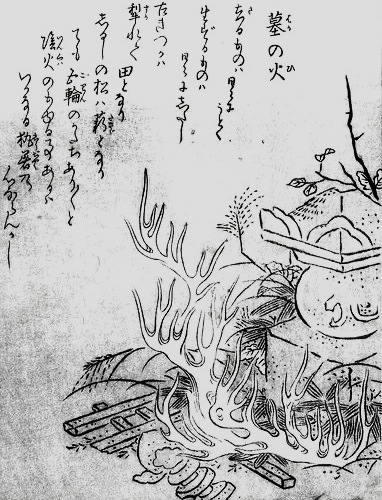
Haka No Hi (墓の火 / はかのき)

Haka No Hi (墓の火 / はかのき)

Translation: grave fire
Habitat: tombs, graveyards, and burial grounds

Appearance: Haka no hi are mysterious, supernatural fires, or kaika. They spout forth from the base of graves.

This creature is described as a strange type of fire spirit (like a human soul) which can be seen lingering around a small five storied pagoda which you can see in graveyards.

Origin: The cause of haka no hi is unknown. It is commonly believed to be a result of failure on the part of the grave’s owner to reach enlightenment and pass on to Nirvana. The flames are thought to be residual energy from worldly attachments, or else feelings of grudge or resentment, coming from the remains interred in the grave.

Haishaku (肺積 / はいしゃく)

Translation: lung shaku (a type of infection)
Alternate names: sokuhon
Habitat: the lungs

Appearance: Haishaku originates under the right armpit and gradually migrates into the lungs. It grows from a smaller larval form into a large, white, lumpy shape that envelops the lungs and causes sickness. Its nose opens directly into the lugs, so it is extremely sensitive to smells.

Interactions: People infected with haishaku develop smooth, white skin. They begin to dislike strong smells, whether good or bad, and instead prefer raw, fishy smells. They prefer spicy foods over bland ones. They also commonly become pessimistic and depressed. Because the haishaku is shaped like a cloud, their hearts too become cloudy and subdued. Tears will also flow like rain.

Haishaku infections can be treated with very gentle and shallow acupuncture. Anything stronger than that will be too painful for the victim.

Baku (獏 / ばく)

Translation: Dream Eater; based on the Chinese name for the same creature
Habitat: deep in thick forests
Diet: bad dreams

Appearance : The baku is a strange, holy beast that has the body of a bear, the head of an elephant, the eyes of a rhinoceros, the tail of an ox, and the legs of a tiger. Despite their monstrous appearance, baku are revered as powerful forces of good and as one of the holy protectors of mankind.

Behavior: Baku watch over humans and act as guardian spirits. They feed on the dreams of humans—specifically bad dreams. Evil spirits and yōkai fear baku and flee from baku-inhabited areas. Because of this, health and good luck follow baku wherever they go.

Interactions: The baku’s written name and image have been used as symbols of good luck in talismans and charms throughout Japanese history. In the old days, it was common to embroider the kanji for baku onto pillows in order to keep away bad dreams, sickness, and evil spirits. Fearsome baku images are commonly carved into the pillars above temple doors and on the columns supporting temple roofs. Baku are one of only a handful of holy creatures honored in this manner.

Origin: Legend has it that when the world was new and the gods were making the animals, the baku was put together from the leftover bits and pieces at the end of creation. That explains its bizarre appearance, and why it is considered a favorite of the gods.

Today, the Japanese word baku also refers to the tapir. The animal was named for its uncanny resemblance to this holy chimerical beast.

Kemetism: An Introduction

01957F49-DB87-448F-A770-DED8CF480561

Neo-Paganism, also known as Contemporary Paganism and Modern Paganism, is a collective term for new religious movements influenced by or claiming to be derived from the various historical pagan beliefs of pre-modern Europe, North Africa and the Near East. Adherents rely on pre-Christian, folkloric and ethnographic sources to a variety of degrees; many follow a spirituality which they accept as being entirely modern, while others attempt to reconstruct or revive indigenous, ethnic religions as found in historical and folkloric sources as accurately as possible. Nep-Paganism in the United States is largely a phenomenon of a white college educated demographic with over 90% being whites and 65% having a college degree.

The 2014 Pew Research Center’s Religious Landscapes Survey included a subset of the New Age Spiritual Movement called “Pagan or Wiccan,” reflecting that ¾ of individuals identifying as New Age also identified as Pagan or Wiccan and placing Wiccans and Pagans at 0.3% of the total U.S. population or approximately 956,000 people of just over 1,275,000 individuals in the New Age movement. This is a dramatic increase from the 1990’s when only 200,000 individuals identified themselves as part of a New Age religion. Roughly 10 million Wiccan-related books were sold in 2000, up from 4.5 million in 1990. A division within modern Paganism rests on differing attitudes to the source material surrounding pre-Christian belief systems. “We might say that Reconstructionist Pagans romanticize the past, while Eclectic Pagans idealize the future. In the first case, there is a deeply felt need to connect with the past as a source of spiritual strength and wisdom; in the second case, there is the idealistic hope that a spirituality of nature can be gleaned from ancient sources and shared with all humanity,” according to Religious studies scholar Michael Strmiska.

7636908D-4FF4-4DE1-BD97-06F77FF3493A

Some of the more common Neo-Pagan religions are Wicca, the Goddess movement, Heathenism, Neo-Druidism, Eco-Paganism, and Syncretism. Today I am going to focus on the small, but growing religion of Kemetism. Kemetism also sometimes referred to as Neterism or Egyptian Neopaganism, is the contemporary revival of Ancient Egyptian religion and related expressions of religion in classical and late antiquity, emerging during the 1970s. A Kemetic is one who follows Kemetism. There are several main groups, each of which take a different approach to their beliefs, ranging from eclectic to reconstructionistic. Kemetic Orthodoxy is a modern religious sect based on Kemeticism, which is a reconstruction of Egyptian polytheism. It claims to derive a spiritual lineage from the Ancient Egyptian religion. It was founded in 1988 by Tamara Siuda, who remains its current Nisut or Pharaoh. Siuda’s leadership proved to be extremely successful, and in 1994, Kemetic Orthodoxy had attracted a sufficient number of new adherents to be officially recognized as a religious group by the federal government.

At the heart of the religion is a belief in ma’at: the guiding force of the universe and the principle of divine balance. Kemetics also believe in a supreme being, known as Netjer, and his many incarnations. Ancestor veneration, or Akhu veneration, is a very important aspect of Kemetic Orthodoxy. Adherents believe that their Akhu are their ancestors. As Akhu are believed to have already experienced human life, it is thought that they can give valuable advice and support regarding things related to daily human life. Kemetic Orthodoxy grew out of the personal teachings of Siuda. The temple began in 1988, when she claimed to have experienced a series of visions during her initiation as a Wiccan priestess. She started a small study and worship group at that time, which gradually grew in membership. In 1993, the group was federally recognized as a religious entity and changed its name from the House of Bast to the House of Netjer. The temple was granted tax-exempt status in 1999.

Kemetic Orthodoxy has a strong internet presence with rituals performed online via a chat room. They make the important distinction that they are a religion on the internet and not a internet religion. Members of Kemetic Orthodoxy gather at Tawy House (in Joliet, Illinois) in August for the Kemetic New Year, Wep Ronpet. As the largest gathering, it is the best example of an event held by the Kemetic Orthodox off-line. It includes rituals, fellowship, lectures and workshops. Personal worship is also observed in the form of personal deity-centered shrines in their homes as well as Senut ritual. The Senut ritual is composed of various rites, and is a fully functional ritual for individual use yet containing all of the necessary elements of all Kemetic ritual, whether practiced by one or a thousand.

If you’re interested you can find out more here: http://www.kemet.org/about

Arachne

There are several versions of the Greek myth of Arachne. I’m sharing the version conceived by Ovid the Roman poet.

Arachne, a young woman of common birth, but of uncommon skill as a weaver. She lived in the village of Hypaepa in Lydia. Her father was a humble wool dyer, and her mother was deceased. Despite her lowly rank, Arachne became famous throughout the towns of Lydia for her expert ability to spin and weave wool. Even the local nymphs came to marvel at her. Though spinning and weaving were specifically Athena’s arts, Arachne would not admit that the goddess had been her teacher. Instead, she made it known that she would gladly challenge the goddess to a weaving contest. Athena could not bear this insult and, appearing to her in the guise of an old woman, cautioned Arachne not to dishonor the gods with such arrogance. Arachne still would not relent, so Athena revealed herself to the girl in her full divinity.

The contest thus commenced. Athena wove into her design the contest in which she had prevailed over Poseidon to win the stewardship of the city of Athens by producing an olive tree. As a clear warning to Arachne, she also depicted a host of mortals who had challenged the gods and been punished terribly. Arachne, for her part, wove vignettes depicting misdeeds of the gods, a twofold affront to the goddess. There appeared Zeus taking on the shape of a bull to seduce Europa, of a swan to make advances on Leda, of her own husband to lie with Alcmena, of a shower of gold to penetrate the cell of Danae, and of a flame to approach Aegina. Poseidon, too, was shown. He assumed the shape of a dolphin in pursuit of Melantho, of a bird to approach Medusa, and of a ram, river, and stallion to make advances on other maidens still. Apollo, Dionysus, and Cronus, all behaving ignobly, also found a place in Arachne’s design.

Arachne’s work was perfection, flawless even in Athena’s eyes. So great was the goddess’s anger that she tore apart Arachne’s weaving and struck Arachne on the head until, unable to bear this assault, she hanged herself. Arachne did, however, live on, now as a spider, misshapen but spinning for all time.

The Nine Realms of Norse Mythology

7EA378CB-6E38-4D04-AA53-C04861C94F47

Asgard: Home of the Gods

In the middle of the world, high up in the sky is Asgard (Old Norse: “Ásgarðr”). It’s the home of the Gods and Goddesses. The male Gods in Asgard, are called Aesir, and the female Gods are called Asynjur. Odin is the ruler of Asgard and the chief of the Aesir. Odin is married to Frigg; and she is the Queen of the Aesir. Inside the gates of Asgard is Valhalla; it’s the place where half of the Vikings “Einherjer” that died in battle will go for the afterlife, the other half goes to Fólkvangr.

1FBBB3B6-758F-4FC1-97FB-E243EFB34C73

Alfheim: Home of the Light Elves

Alfheim (Old Norse: “Álfheimr or Ljósálfheimr”) is right next to Asgard in the heaven. The light elves are beautiful creatures. They are considered the “guardian angels” The God Freyr, is the ruler of Alfheim. The Light elves are minor Gods of nature and fertility; they can help or hinder humans with their knowledge of magical powers. They also often delivered an inspiration to art or music.

Midgard: Home of the Humans

Midgard (Old Norse: “Miðgarðr”) “middle earth” is located in the middle of the world, below Asgard. Midgard and Asgard are connected by Bifrost the Rainbow Bridge. Midgard is surrounded by a huge ocean that is impassable.

The Ocean is occupied by a huge sea serpent, the Midgard Serpent. The Midgard serpent is so huge that it encircles the world entirely, and biting its own tail. Odin and his two brothers Vili and Ve created the humans from an Ash log, the man and from an elm log, the woman.

Muspelheim: The Land of Fire

Muspelheim (Old Norse: “Múspellsheimr”) was created far to the south of the world in Norse mythology. Muspelheim is a burning hot place, filled with lava, flames, sparks, and soot. Muspelheim is the home the of fire giants, fire demons and ruled by the giant Surtr. He is a sworn enemy of the Aesir. Surtr will ride out with his flaming sword in his hand at Ragnarok “Ragnarök” “the end of the world” Surtr will then attack Asgard, “the home of the Gods” and turn it into a flaming inferno.

Vanaheim: Home of the Vanir

Vanaheim (Old Norse: “Vanaheimr”) is the home of the Vanir Gods. The Vanir Gods is an old branch of Gods. The Vanir are masters of sorcery and magic. They are also widely acknowledged for their talent to predict the future. Nobody knows where exactly the land, Vanaheim is located, or even how it looks like. When the war between the Aesir and the Vanir ended, three of the Vanir came to live in Asgard, Njord and his children Freya and Freyr.

Niðavellir/ Svartalfheim: Home of the Dwarves

Svartalfheim (Old Norse: “Niðavellir or Svartálfaheimr”) is the home of the dwarves, they live under the rocks, in caves and underground who are also synonymous with the Dark Elves (“Dökkálfar”) and Black Elves (“Svartálfar”).  Hreidmar was the king of Svartalfheim, Svartalfheim means Dark fields. The dwarves are masters of craftsmanship. The Gods of Asgard have received many powerful gifts. Like , the magical ring Draupnir and also Gungnir, Odin’s spear.

Jotunheim: Home of the Giants

Jotunheim (Old Norse: “Jötunheimr or Útgarðr”) is the home of the giants (also called Jotuns). They are the sworn enemies of the Aesir. Jotunheim consists mostly of rocks, wilderness, and dense forests, and it lies in the snowy regions on the outermost shores of the ocean. Because of this, the giants live mostly from the fish from the rivers, and the animals from the forest, because there is no fertile land in Jotunheim.

The giants and the Aesir are constantly fighting, but it also happens from time to time, that love affairs will occur. Odin, Thor and a few others, had lovers who were giants. Loki also came from Jotunheim, but he was accepted by the Aesir and lived in Asgard. Jotunheim is separated from Asgard by the river Iving, which never freezes over. Mimir’s well of wisdom is in Jotunheim, beneath the Midgard root of the ash tree Yggdrasil. The stronghold of Utgard is so big that it is hard to see the top of it. And there the feared Jotun king Utgard-Loki lives. Utgard is carved from blocks of snow and glistening icicles.

Niflheim: The World of Fog and Mist

Niflheim (Old Norse: “Niðavellir”) and it means (“Mist home” or “Mist World”) is the darkest and coldest region in the world according to Norse mythology. Niflheim is the first of the nine worlds and Niflheim is placed in the northern region of Ginnungagap. The eldest of the three wells are located in Niflheim which is called Hvergelmir “bubbling boiling spring” and it is protected by the huge dragon called Nidhug (Níðhöggr).

It is said that all cold rivers come from the well called Hvergelmir, and it is said to be the source of the eleven rivers in Norse mythology. The well Hvergelmir is the origin of all living and the place where every living being will go back. Elivagar “ice waves” are the rivers which existed in Niflheim at the beginning of the world. They were the streams floating out of Hvergelmir. The water from Elivagar flowed down the mountains to the plains of Ginnungagap, where it solidified to frost and ice, which gradually formed a very dense layer. This is the reason that it is very cold in the northern plains. As the world tree Yggdrasil started to grow, it stretched one of its three large roots far into Niflheim and drew water from the spring Hvergelmir.

Helheim: Home of the dishonorable dead

This is where all the dishonorable dead, thieves, murderers and those the Gods and Goddesses feel is not brave enough to go to Valhalla or Folkvangr. Helheim is ruled by Hel, Helheim is a very grim and cold place, and any person who arrives here will never feel joy and happiness again. Hel will use all the dead in her realm at Ragnarök to attack the Gods and Goddesses, which will be the end of the world.