Brynhildr

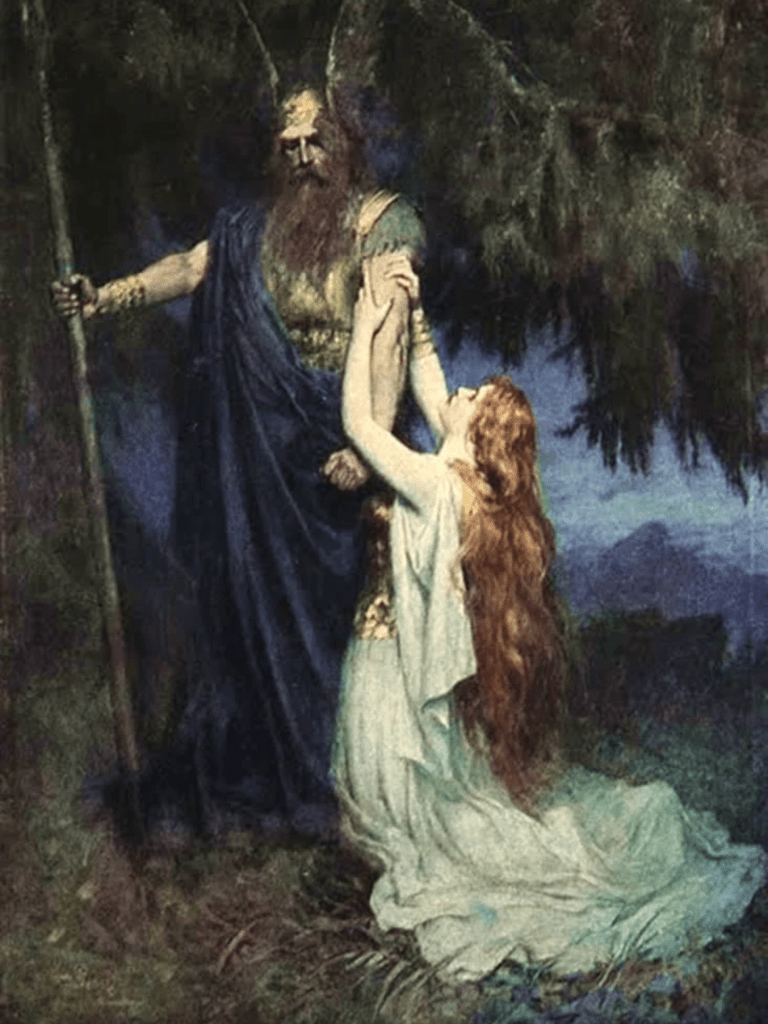
Brynhildr was a princess, a shield-maiden, and was said to be a Valkyrie who disobeyed Odin. Stripped of her Valkyrie powers, she was put into a deep slumber, on a castle on top of a mountain surrounded by a magic fire, and can only awakened by a brave man with a kiss, which she was by Sigurd the Dragonslayer. With Sigurd, she had a daughter; Aslaug.

Although the pair fell in love, Sigurd was deceived by Gjuki, King of Burgundy, whose wife, the sorceress Grimhild, prepared a magic potion that made Sigurd forget about Brynhildr so he could marry their daughter Gudrun. When she found out about Brynhildr, they let their son Gunnar go to her castle. Gunnar was only able to cross the ring of fire when he switched places with the enchanted Sigurd and convinced Brynhildr to marry Gunnar instead of Sigurd.

Sigurd later regained his memories. Heartbroken upon finding out the truth from Gudrun, Brynhildr urged Gunnar to murder Sigurd. Gunnar and his brother Hogni had both sworn oaths of blood brotherhood with Sigurd and could not kill him in fear of angering the gods, so they instead incited their young brother Gutthorm to do the deed. Sigurd killed the young Gutthorm, and was also killed, while Brynhildr killed Sigurd’s and Gudrun’s son.

Distraught over her actions, Brynhildr committed suicide by throwing herself on Sigurd’s funeral pyre. They reunited in Hel, but left Aslaug alone in the world.
Real Vampires

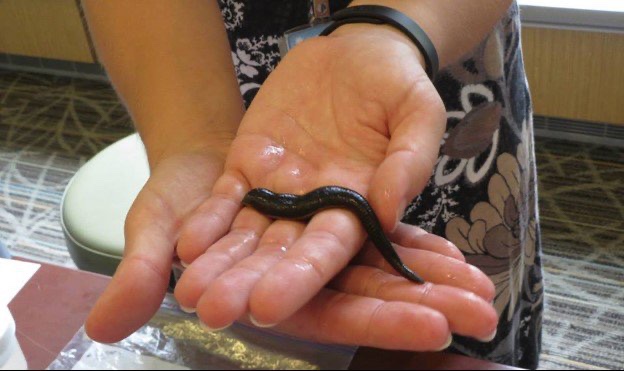
There are, of course, a few truly vampiric animals, including leeches, lampreys and vampire bats. And in all these cases the vampire’s intent is to draw enough blood for sustenance, but not enough to kill the host.

But what about human vampires? There are certainly many self-identified vampires who participate in gothic-inspired subcultures. Some host vampire-themed book clubs or secret bloodletting rituals; others wear capes or get vampire-fang dental implants. It’s all frightening and fun, but blood drinking is another matter entirely. The problem is that blood is toxic; because it is so rich in iron — and because the human body has difficulty excreting excess iron — anyone who consumes blood regularly runs a real risk of haemochromatosis (iron overdose), which can cause a wide variety of diseases and problems, including liver and nervous system damage.

In one form or another, vampires have been part of human culture and folklore in different forms for millennia, and the bloodsuckers show no signs of going away any time soon.

Jiangshi (Hopping Corpse)

The myth of the hopping corpse of China comes from a story titled The Corpse Who Traveled a Thousand Miles. It is a tale about a wizard who enchants corpses to hop home so that they may receive proper burial and their P’O (soul) can be laid to rest. It has been speculated that if smugglers did not invent the tale, they most certainly capitalized upon it by dressing up as these corpses and hopping to scare away superstitious local law enforcement.

According to the myth, a corpse that has had its yin shocked and its P’O disrupted will become a vampiric revenant. Events that can cause this to happen are if a cat jumps over a corpse, moonlight falls on it, or the body was not sent back to its home for proper burial. If the P’O will not leave the body, the soul cannot be laid to rest.

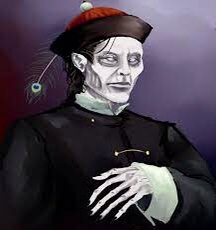
A hopping corpse is described as wearing burial clothes from the Qing Dynasty and is accom- panied by monks, mourners, and Taoist priests. Its eyes are bulging out of its sockets and its tongue is lolling from its mouth. Its arms are out stretched and it smells horrible enough to make a man fall unconscious.

A hopping corpse hunts by its sense of smell, and when it finds someone, it goes right for the throat, either biting right in the jugular or strangling the person to death. It has the power to kill a person instantly with a single touch, never grows tired, and can fly if need be.

Yellow and red Chinese death blessings placed on its forehead will slow it down, as will throwing long grain rice at it, since it will be compelled to count them. It can be warded off for a while, as it is afraid of chicken blood, straw brooms, and Taoist eight-sided mirrors. However, to destroy a hopping corpse, only long-term exposure to dawn’s light or by burning it and its coffin to ash will work.

Priests and Priestesses of Ancient Egypt

The ancient Egyptians understood that their gods had prevailed over the forces of chaos through the creation of the world and relied upon humanity’s help to maintain it. The people of Mesopotamia held this same belief but felt they were co-workers with the gods, laboring daily to hold back chaos through even the simplest acts, but the Egyptians believed all they had to do was recognize how the world worked, who was responsible for its operation, and behave accordingly.

This behavior was directed by the central cultural value, ma’at (harmony and balance) which was sustained by an underlying force known as heka (magic). Heka (personified as the god Heka) had been present at the creation of the world, pre-existing the gods, and allowed those gods to perform their duties. All the people, by observing ma’at, helped to maintain the order established by the gods through heka, but a special class was responsible for honoring and caring for the gods daily, and this was the priesthood.

The clergy of ancient Egypt did not preach, interpret scripture, proselytize, or conduct weekly services; their sole responsibility was to care for the god in the temple. Men and women could be clergy, performed the same functions, and received the same pay. Women were more often priestesses of female deities while men served males, but this was not always the case as evidenced by the priests of the goddess Serket (Selket), who were doctors and both female and male, and those of the god Amun. The position of God’s Wife of Amun, held by a woman, would eventually become as powerful as that of the king.

High priests were chosen by the king, who was considered the high priest of Egypt, the mediator between the people and their gods, and so this position had political as well as religious authority. The priesthood was already established in the Early Dynastic Period in Egypt (c. 3150-2613 BCE) but developed in the Old Kingdom (c. 2613-2181 BCE) at the same time as the great mortuary complexes like Giza and Saqqara were being constructed. Throughout Egypt’s history, the priesthood would serve a vital role in maintaining religious belief and tradition while, at the same time, consistently challenge the authority of the king by amassing wealth and power which at times rivaled that of the crown.

Sources: World History Encyclopedia

Athena

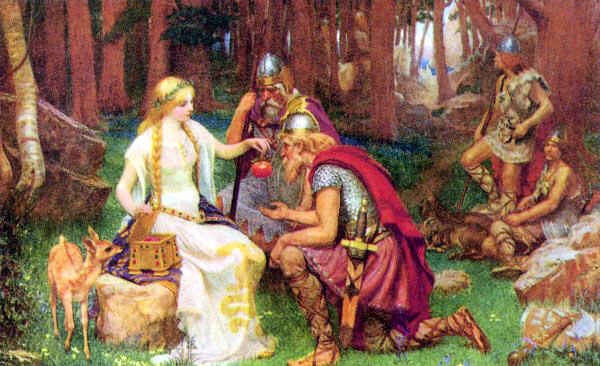
Athena, the Greek goddess of wisdom, war, the arts, industry, justice and skill. She was the favorite child of Zeus. She had sprung fully grown out of her father’s head. Her mother was Metis, goddess of wisdom and Zeus’ first wife. In fear that Metis would bear a son mightier than himself. Zeus swallowed her and she began to make a robe and helmet for her daughter. The hammering of the helmet caused Zeus great pain in the form of headaches and he cried out in agony. Skilled Hephaestus ran to his father and split his skull open and from it emerged Athena, fully grown and wearing her mother’s robe and helmet.

She is the virgin mother of Erichthnonius. Athena and her uncle Poseidon were both very fond of a certain city in Greece. Both of them claimed the city and it was decided that the one that could give the finest gift should have it. Leading a procession of citizens, the two gods mounted the Acropolis. Poseidon struck the side of the cliff with his trident and a spring welled up. The people marveled, but the water was as salty as Poseidon’s sea and it was not very useful. Athena’s gift was an olive tree, which was better because it gave the people food, oil and wood. Athena named her city Athens. Athena’s companion was the goddess of victory, Nike, and her usual attribute is the owl. Athena possessed the Aegis.

Freyr

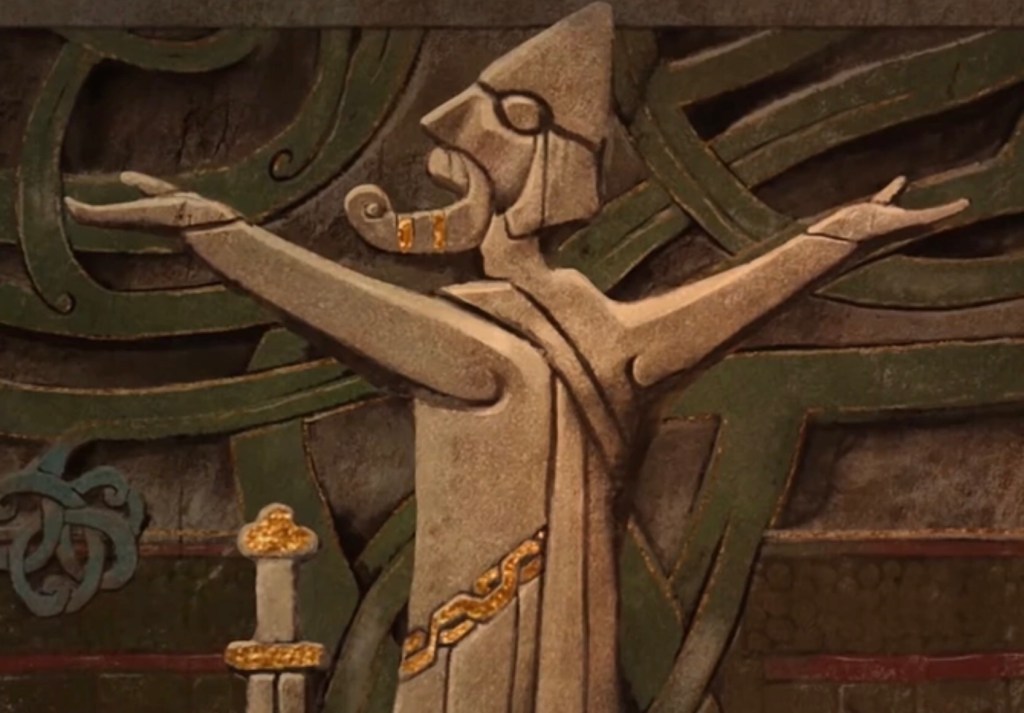
Freyr is the god of sun and rain, and the patron of bountiful harvests. He is both a god of peace and a brave warrior. He is also the ruler of the elves. Freyr is the most prominent and most beautiful of the male members of the Vanir, and is called ‘God of the World’. After the merging of the Aesir and the Vanir, Freyr was called ‘Lord of the Aesir’. Freyr was also called upon to grant a fertile marriage. He is married to the beautiful giantess Gerd, and is the son of Njord. His sister is Freya.

He rides a chariot pulled by the golden boar Gullinbursti which was made for him by the dwarves Brokk and Eitri. He owns the ship Skidbladnir (“wooden-bladed”), which always sails directly towards its target, and which can become so small that it can fit in Freyr’s pocket. He also possesses a sword that would by itself emerge from its sheath and spread a field with carnage whenever the owner desired it. Freyr’s shield bearer and servant is Skirnir, to whom he gave his sword, which Skirnir demanded as a reward for making Gerd his wife. On the day of Ragnarok he will battle without weapons (for he gave his sword away to Skirnir), and will be the first to be killed by the fire giant Surt.

The center of his cult was the city Uppsala in Sweden. In southern Sweden he was called Fricco.

Elves

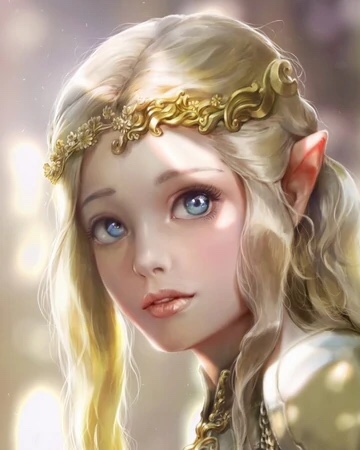
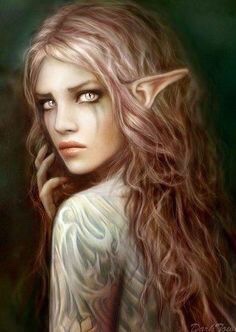
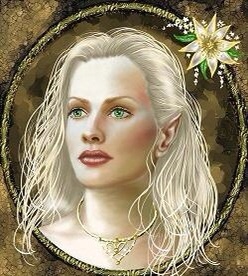
Elves are nature spirits who appear in various folklore and mythology around the world. The term Elf encompasses various beings that vary across cultures, but it is most commonly associated with early Germanic tribes, Britain, and Iceland, as well as in Teutonic and Norse mythology.

Initially, the term Elf included all varieties of Fae in Anglo-Saxon, but it eventually came to represent a specific type of Fae. Over time, many cultures accepted this shift in meaning as well. Elves are human-like Fae who can change their appearance freely.

Depending on the culture, folklore, or location, Elves can go by different names, including –

  • Schrat (German)
  • Grove folk or Elvor (Sweden)
  • Ellen or Elle Folk (Danish)
  • Spae-wives (Iceland)

Tuatha dè Danann

Prevalent in ancient Celtic mythology is theTuatha dè Danann (pronounced Too-a Day Dah-nuhn), which means People of the Goddess Danu, and they are believed to be her children.

They are believed to have magically materialized from a cloud of mist from across the northern sea.

They brought with them from across the sea four deeply magical objects:

Lia Fail, the Stone of Destiny (also the Stone of Scone, upon which ancient Irish-and later, Scottish – kings were crowned);

the Invicible Spear of Lugh (which always hit its target mere moments after being thrown, and made Lugh unstoppable in battle);

the “Shining Sword” of Nuada (also called the Sword of Light), which could allegedly dispel truth from lies, enforce the law, dispense justice, and punish the enemies of Ireland;

and the Cauldron of Dagda, which not only continuously dispensed unlimited food and drink to the worthy, but was also capable of healing wounds and resurrecting dead warriors.”

D.R. McElroy – Superstitions A Handbook of Folklore, Myths, and Legends from Around the World

The Tuatha dè Danann were immortal and known for their magical abilities, as well as their power, charm, elegance, and cleverness. They were believed to have ruled Ireland four thousand years ago.

They’re described as beautiful and graceful, often have pale or golden skin, and some believe they have Greek origins.

They withdrew to the Otherworld underground beneath the Sidhe mounds when they were invaded and overpowered by the Milesians. Scholars believe the Milesians were most likely the first Gaels in Ireland and ancestors of the modern Irish.

It is thought they continue to practice their magic in the Otherworld. Their courts, towns, culture, and festivities have all been preserved. Humans might venture too far into this Otherworld if they found the secret entrance.

Atlas

Atlas was a second-generation Titan god, from a patrilineal perspective. He was the child of the first-generation Titan Iapetus and Clymene, a daughter of Iapetus’s brother Oceanus (an Oceanid). With his Oceanid aunt Pleione he sired the Pleiades, the Hyades (whose mother is also named as Aethra, another Oceanid), and Calypso. With Hesperis, daughter of the Evening Star Hesper, he produced the Hesperides. Atlas’s brothers were Prometheus, Epimetheus, and Menoetius.

The mythographer Hyginus reports that as a consequence of his leadership role in the power struggle between the Olympian gods and the Titans, Zeus punished him by placing the heavens on his shoulders. Atlas was said to live by the garden of the Hesperides, on the westernmost shores of the river Oceanus, in Libya, or in the distant North (or East), where the Hyperboreans resided.

Hercules enlisted Atlas’s assistance when he went to fetch the apples of the Hesperides: Hercules asked Atlas to retrieve the apples in exchange for giving Atlas a break from holding up the heavens by shouldering the burden himself. But Atlas, apples in hand, attempted to protract the reprieve from his onerous task by offering then to deliver the apples to Eurystheus, at whose behest Hercules was performing the task. Hercules tricked him into taking the heavens back by asking him to hold up the burden momentarily while he looked for a pillow to cushion his shoulders. Needless to say, Hercules did not resume the burden. Atlas also played a role in the saga of the hero Perseus. As retribution for not having offered him hospitality, Perseus, holding up Medusa’s severed head, transformed Atlas into the mountains that still bear his name.

Sources: Classical Mythology A to Z

Will o’ the Wisps

Will o’ the Wisp, sometimes known as Jack-o’-lantern, is a type of Fae pixie believed to inhabit the marshes and bogs of England. Will O’ Wisps are nature spirits that inhabit the elements of the earth.

The name Will o’ the Wisp is derived from the Saxon word wile and means trickery or deceitfulness combined with the Swedish word Wisp, meaning a bundle of tinder.

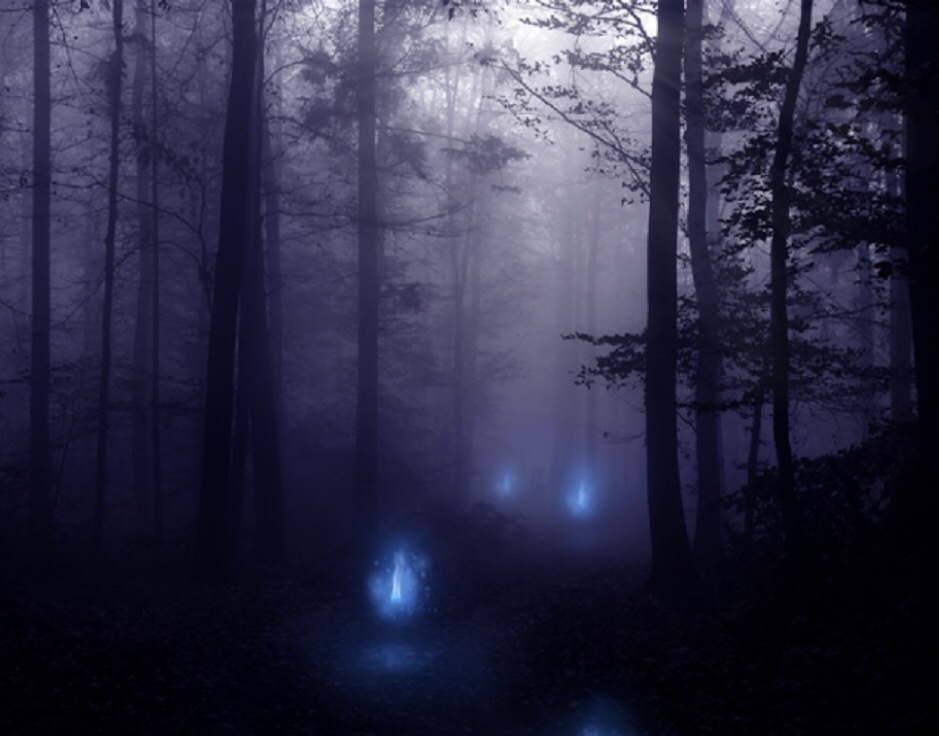
Travelers at night describe theWill o’ the Wisp as ghost-like blue flames, with an unwavering glow, that floats a few feet above the ground.

Will o’ the Wisps have a variety of folklore associated with them and some say they’re flames created by Fae, lights carried by Elves, unbaptized children, or souls who evaded purgatory.

They’re sometimes claimed to give you the power of divination and prophecy, but mostly they’re believed to be mischievous creatures.

It’s often said Will o’ the Wisps love to flit from one place to another, leading travelers astray with their ghost lights and into ditches or bogs.

Will o’ the Wisps have been observed in a variety of locations throughout the world with different names including Germany (Irrlicht), Finland (Liekko), France, (Feu Follets), Sweden (Irrbloss), the Netherlands (dwaallicht), and in Norway where it’s called Hoberdy’s Lantern.

The scientifc community has provided their explanation for these mysterious blue lights found above swamps and marshes throughout the world. It’s called ignis fatuus meaning foolish or false fire.

The [Jack-o’-lantern] phenomenon is generally believed to be due to the spontaneous ignition of marsh gas, which consists mostly of methane and which is produced by the decomposition of dead plant matter.

Britannica – Jack-o’-lantern phenomenon