Ars Goetia: Marbas

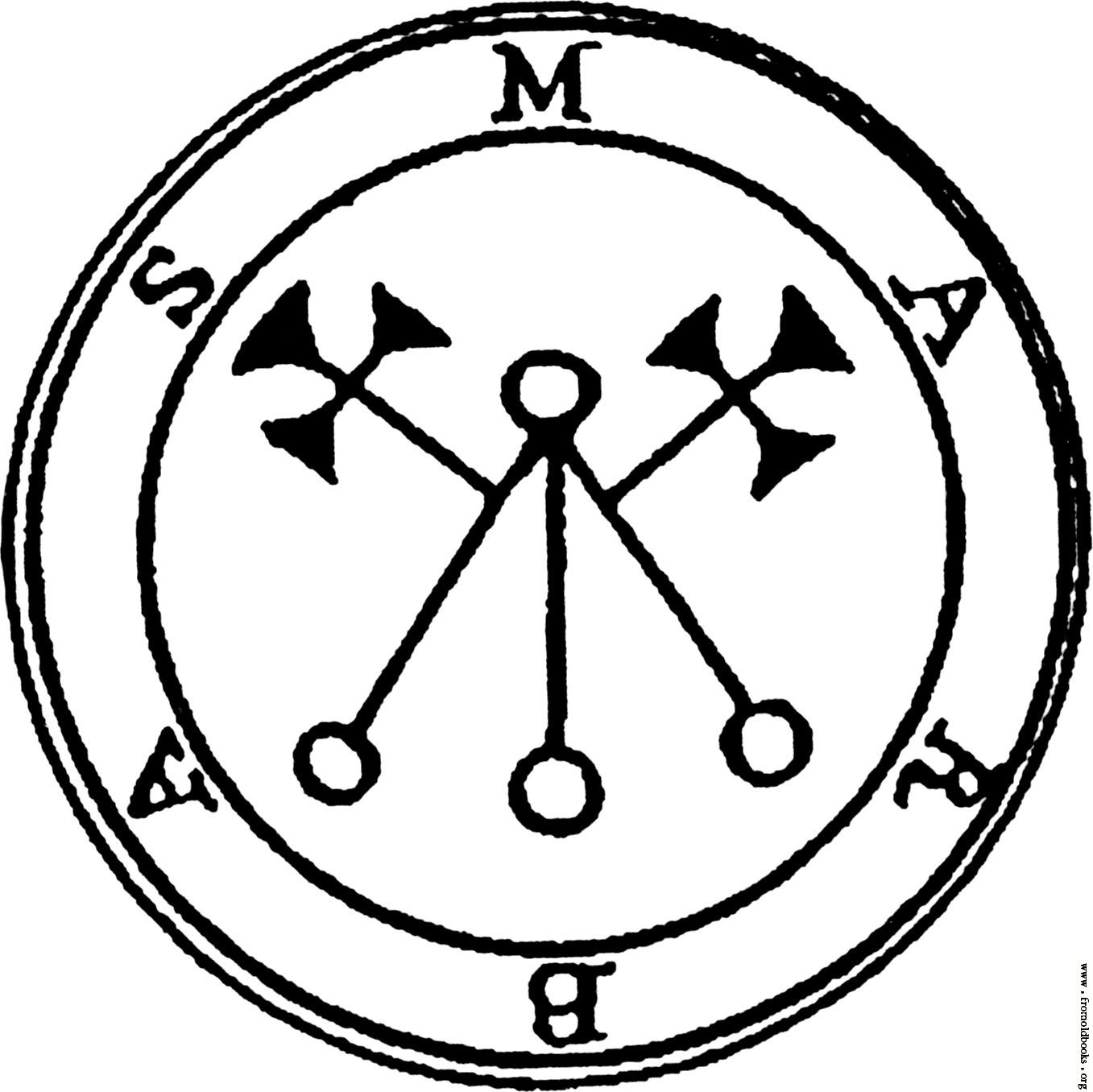
Marbas —> The fifth Spirit is Marbas. He is a Great President, and appeareth at first in the form of a Great Lion, but afterwards, at the request of the Master, he putteth on Human Shape.

He answereth truly of things Hidden or Secret. He causeth Diseases and cureth them. Again, he giveth great Wisdom and Knowledge in Mechanical Arts; and can change men into other shapes. He governeth 36 Legions of Spirits. And his Seal is this, which is to be worn as aforesaid.

Ars Goetia: Samigina or Gamigm

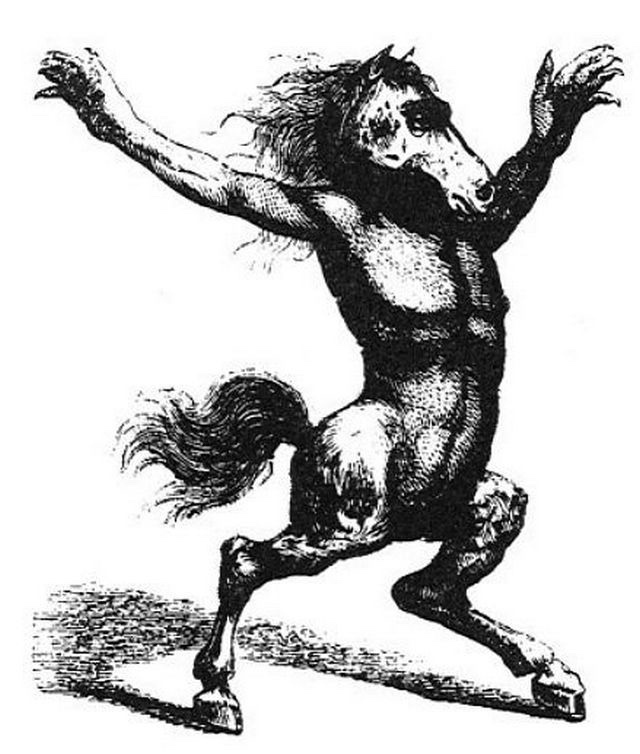
Samigina, or Gamigm —> The Fourth Spirit is Samigina, a Great Marquis. He appeareth in the form of a little Horse or Ass, and then into Human shape doth he change himself at the request of the Master. He speaketh with a hoarse voice. He ruleth over 30 Legions of Inferiors. He teaches all Liberal Sciences, and giveth account of Dead Souls that died in sin. And his Seal is this, which is to be worn before the Magician when he is Invocator, etc.

Ars Goetia: Agares

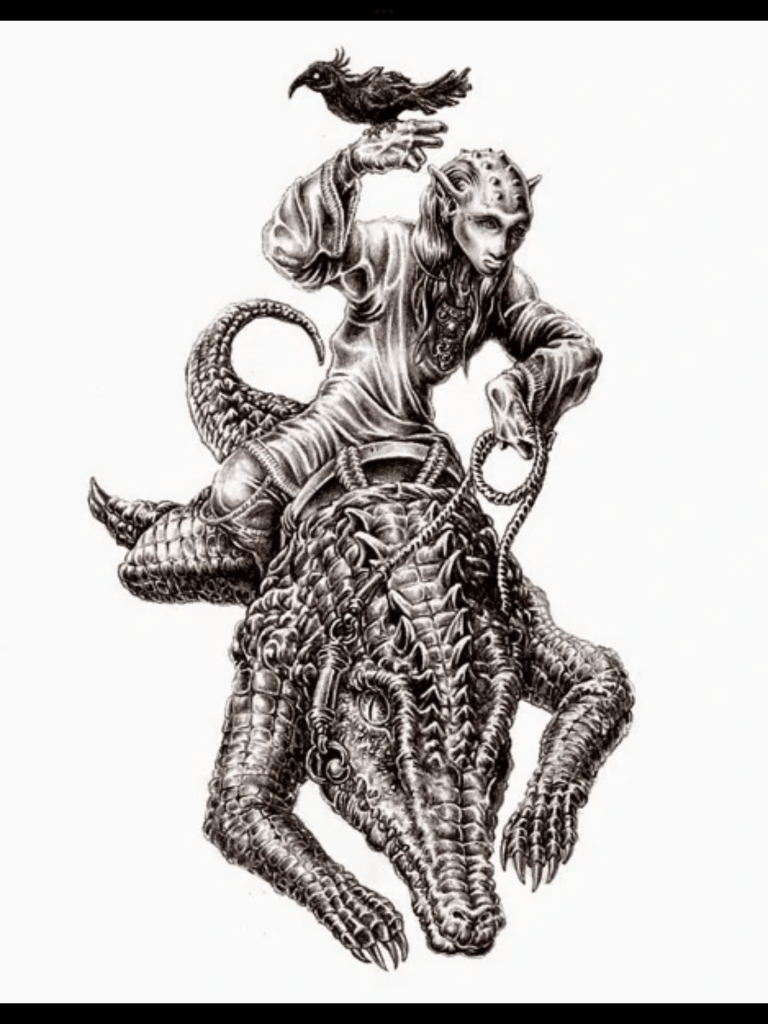
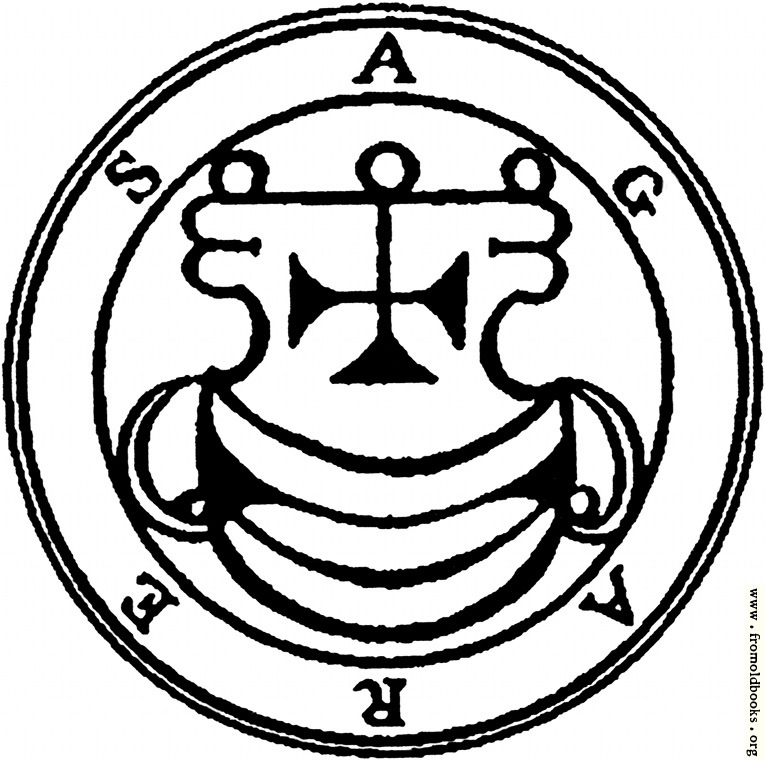
Agares —> The Second Spirit is a Duke called Agreas, or Agares. He is under the Power of the East, and cometh up in the form of an old fair Man, riding upon a Crocodile, carrying a Goshawk upon his fist, and yet mild in appearance.

He maketh them to run that stand still, and bringeth back runaways. He teaches all Languages or Tongues presently. He hath power also to destroy Dignities both Spiritual and Temporal, and causeth Earthquakes. He was of the Order of Virtues. He hath under his government 31 Legions of Spirits. And this is his Seal or Character which thou shalt wear as a Lamen before thee.

Ars Goetia: Bael

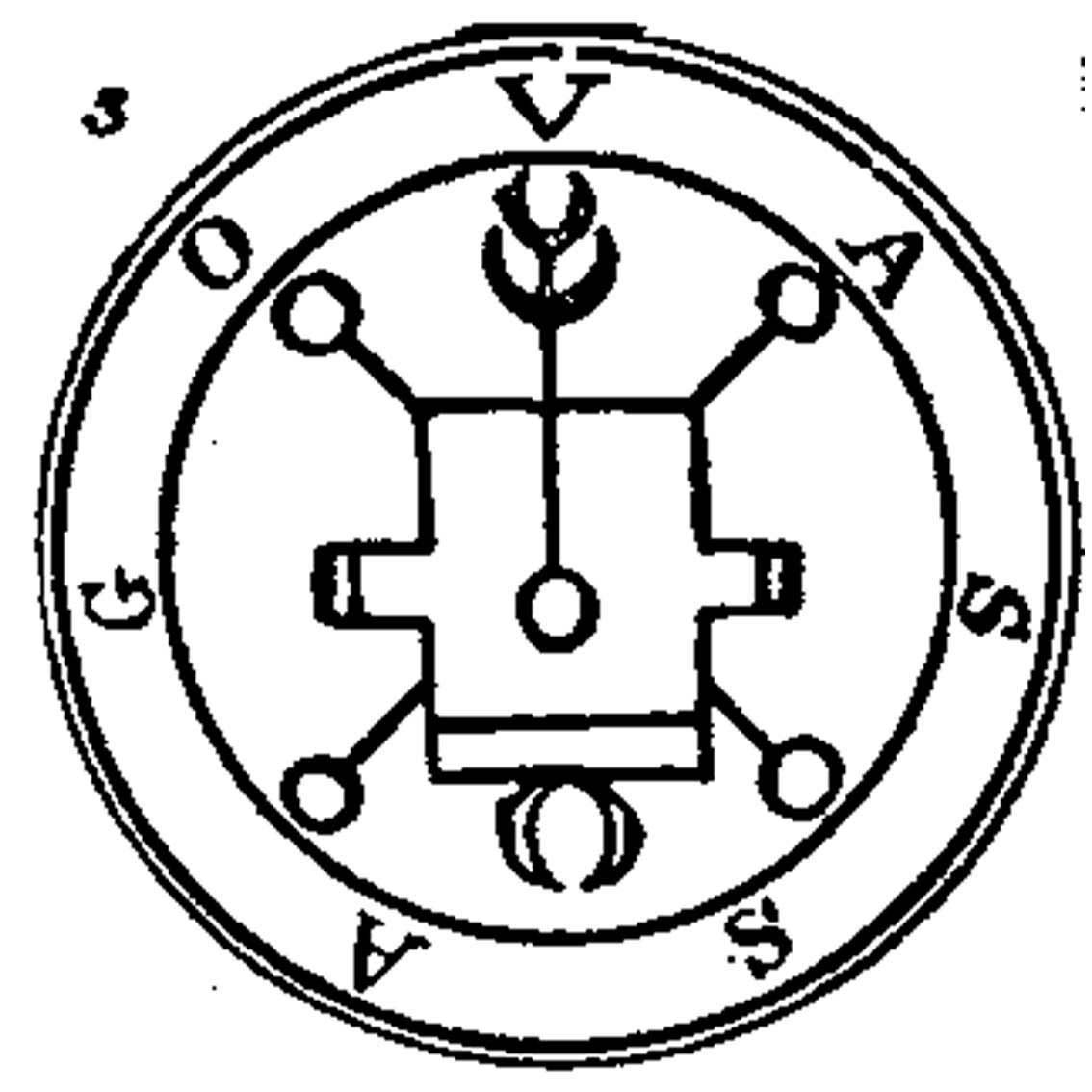
Bael —> The First Principal Spirit is a King ruling in the East, called Bael. He maketh thee to go Invisible. He ruleth over 66 Legions of Infernal Spirits. He appeareth in divers shapes, sometimes like a Cat, sometimes like a Toad, and sometimes like a Man, and sometimes all these forms at once. He speaketh hoarsely. This is his character which is used to be worn as a Lamen before him who calleth him forth, or else he will not do thee homage.

Urban Legends: The Witch of Yazoo (Yazoo City, Mississippi)

The story surrounding this grave is pure legend, yet it continues to lure visitors to Glenwood Cemetery in Yazoo City, Miss. A woman thought to be a witch is reportedly interred in a plot surrounded by chain links, which led to a legend printed in 1971 in the book “Good Old Boy,” written by local Willie Morris, who died in 1999 and is buried 13 steps south of the witch’s grave.

According to the legend, the old woman lived on the Yazoo River, and was caught torturing fishermen who she lured in off the river. The sheriff is said to have chased her through the swamps where she was half drowned in quicksand by the time the sheriff caught up with her. As she was sinking, she swore her revenge on Yazoo City and on the town’s people. ‘In 20 years, I will return and burn this town to the ground!” No one thought much of it at the time. Then came May 25, 1904… The Fire of 1904 destroyed over 200 residences and nearly every business in Yazoo City – 324 buildings in total.

Sources: Visit Yazoo dot Org

NXIVM And The Accusations Of It Being A Sex Cult

On September 30 2020, Clare Bronfman was sentenced to six years and nine months in prison. Nine former members of NXIVM testified against her, detailing her role in the organization’s unabated, years-long legal pursuit of them. On October 27 2020, “Vanguard” Keith Raniere was sentenced to 120 years, after many hours of victim statements from fifteen former NXIVM members and victims of his abuse. On June 30 2021, Allison Mack received a sentence of three years in prison, three years of supervised release after serving her prison term, plus a fine of $20,000 dollars. On September 8 2021, NXIVM’s co-founder Nancy Salzman was sentenced to three and a half years in prison.

Detractors say he runs a cult-like program aimed at breaking down his subjects psychologically, separating them from their families and inducting them into a bizarre world of messianic pretensions, idiosyncratic language and ritualistic practices.

Sources: Esquire Magazine

Priests and Priestesses of Ancient Egypt

The ancient Egyptians understood that their gods had prevailed over the forces of chaos through the creation of the world and relied upon humanity’s help to maintain it. The people of Mesopotamia held this same belief but felt they were co-workers with the gods, laboring daily to hold back chaos through even the simplest acts, but the Egyptians believed all they had to do was recognize how the world worked, who was responsible for its operation, and behave accordingly.

This behavior was directed by the central cultural value, ma’at (harmony and balance) which was sustained by an underlying force known as heka (magic). Heka (personified as the god Heka) had been present at the creation of the world, pre-existing the gods, and allowed those gods to perform their duties. All the people, by observing ma’at, helped to maintain the order established by the gods through heka, but a special class was responsible for honoring and caring for the gods daily, and this was the priesthood.

The clergy of ancient Egypt did not preach, interpret scripture, proselytize, or conduct weekly services; their sole responsibility was to care for the god in the temple. Men and women could be clergy, performed the same functions, and received the same pay. Women were more often priestesses of female deities while men served males, but this was not always the case as evidenced by the priests of the goddess Serket (Selket), who were doctors and both female and male, and those of the god Amun. The position of God’s Wife of Amun, held by a woman, would eventually become as powerful as that of the king.

High priests were chosen by the king, who was considered the high priest of Egypt, the mediator between the people and their gods, and so this position had political as well as religious authority. The priesthood was already established in the Early Dynastic Period in Egypt (c. 3150-2613 BCE) but developed in the Old Kingdom (c. 2613-2181 BCE) at the same time as the great mortuary complexes like Giza and Saqqara were being constructed. Throughout Egypt’s history, the priesthood would serve a vital role in maintaining religious belief and tradition while, at the same time, consistently challenge the authority of the king by amassing wealth and power which at times rivaled that of the crown.

Sources: World History Encyclopedia

Athena

Athena, the Greek goddess of wisdom, war, the arts, industry, justice and skill. She was the favorite child of Zeus. She had sprung fully grown out of her father’s head. Her mother was Metis, goddess of wisdom and Zeus’ first wife. In fear that Metis would bear a son mightier than himself. Zeus swallowed her and she began to make a robe and helmet for her daughter. The hammering of the helmet caused Zeus great pain in the form of headaches and he cried out in agony. Skilled Hephaestus ran to his father and split his skull open and from it emerged Athena, fully grown and wearing her mother’s robe and helmet.

She is the virgin mother of Erichthnonius. Athena and her uncle Poseidon were both very fond of a certain city in Greece. Both of them claimed the city and it was decided that the one that could give the finest gift should have it. Leading a procession of citizens, the two gods mounted the Acropolis. Poseidon struck the side of the cliff with his trident and a spring welled up. The people marveled, but the water was as salty as Poseidon’s sea and it was not very useful. Athena’s gift was an olive tree, which was better because it gave the people food, oil and wood. Athena named her city Athens. Athena’s companion was the goddess of victory, Nike, and her usual attribute is the owl. Athena possessed the Aegis.

Bluebell (hyacinthoides non-scripta)

Bluebell (hyacinthoides non-scripta)

A native woodland plant that is potentially as dangerous as the foxglove since it contains glycosides called scillarens, which are similar to the glycosides in foxgloves. Like the snowdrop, the bulb can be mistaken for onions and eaten. Theoretically, it lowers the pulse rate and causes nausea, diarrhoea and vomiting and larger doses could cause cardiac arrhythmias, hypotension and electrolyte imbalance similar to the effects of digoxin in overdose. Folklore tells us that by wearing a wreath made of bluebell flowers, the wearer would be compelled to speak only the truth; the chemical that makes the plant poisonous was used in alchemy.

Magical propensities for speaking the truth; preventing nightmares; love spells; easing mourning.

Sources: By Wolfsbane & Mandrake Root