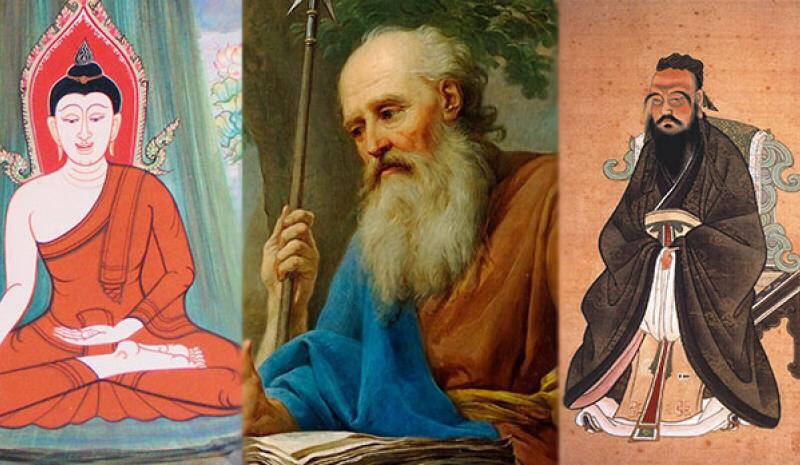
Plato from the “Apology”

“I am wiser than this man, for neither of us appears to know anything great and good; but he fancies he knows something, although he knows nothing; whereas I, as I do not know anything, so I do not fancy I do. In this trifling particular, then, I appear to be wiser than he, because I do not fancy I know what I do not know.”

~ Plato, from the “Apology”

#FavoriteQuotes #Plato #Wisdom

Three Great Minds

It’s interesting that approximately 2500 years ago three men were born who would change the world, in three distinct parts of the world that would have no interaction with each other. Confucius, The Buddha, and Socrates were born within 100 years of each other whose lives would overlap:

Confucius 551-479 B.C.
The sagacious Confucius, Kongzi, or Master Kung (551-479 B.C.) was a social philosopher whose values became dominant in China only after he died. Advocating living virtuously, he put emphasis on socially appropriate behavior.

Buddha c. 563-483 B.C.
Siddhartha Gautama was a spiritual teacher of enlightenment who acquired hundreds of followers in India and founded Buddhism. His teachings were preserved orally for centuries before they were transcribed on palm-leaf scrolls. Siddhartha may have been born c. 563 B.C. to Queen Maya and King Suddhodana of the Shakya in ancient Nepal. By the third century B.C. Buddhism appears to have spread to China.

Socrates c. 470-399 B.C.
Socrates, an Athenian contemporary of Pericles (c. 470 – 399 B.C.), is a central figure in Greek philosophy. Socrates is known for the Socratic method (elenchus), Socratic irony, and the pursuit of knowledge. Socrates is famous for saying that he knows nothing and that the unexamined life is not worth living. He is also well known for stirring up sufficient controversy to be sentenced to a death that he had to carry out by drinking a cup of hemlock. Socrates had important students, including the philosopher Plato.

#Confucius #Buddha #Socrates

Baruch Spinoza: The God Of Spinoza

Baruch Spinoza (1632-1677) born Benedito de Espinosa was a Jewish-Dutch philosopher of Portuguese Sephardi origin. By laying the groundwork for the Enlightenmentand modern biblical criticism,including modern conceptions of the self and the universe, he came to be considered one of the great rationalists of 17th-century philosophy. Along with René Descartes, Spinoza was a leading philosophical figure of the Dutch Golden Age. Spinoza’s given name, which means “Blessed”, varies among different languages. In Hebrew, it is written ברוך שפינוזה. His Portuguese name is Benedito “Bento” de Espinosa or d’Espinosa. In his Latin works, he used Latin: Benedictus de Spinoza.

“As to the view of certain people that I identify god with nature (taken as a kind of mass or corporeal matter), they are quite mistaken”

~ Baruch Spinoza

When Spinoza wrote “Deus sive Natura” (“God or Nature”) Spinoza meant God was Natura naturans not Natura naturata, that is, “a dynamic nature in action, growing and changing, not a passive or static thing.”  One might best understand Spinoza by examining Bertrand Russell’s commentary of his beliefs from 1910:

“Spinoza, more than any other modern philosopher, writes always with a strong sense of the importance of philosophy in the conduct of life, and with a firm belief in the power of reason to improve men’s conduct and purify their desires. Like many men of great independence of mind, he feels the need of something great enough to justify him in submitting to its authority. Like all who contemplate human life without sharing its baser passions, he is oppressed by the endless strife produced by conflicting aims and unrestrained ambitions. Believing, as he does, that self-preservation is the very essence of everything that exists, he sees no end to strife except by persuading men to choose as their ends things which all may enjoy in common. Contempt and moral condemnation stand in the way of toleration; he therefore sets out to prove that what men do they do from a necessity of their nature. As well might one condemn a triangle for not having made the effort to increase its angles beyond two right angles as condemn men for being what their nature makes them. His theory of the emotions, in which, by his geometrical method, he demonstrates that men must act in ways which it is common to condemn, contains much admirable psychology; but it was not this that made him value his theory: what he valued was the conclusion that moral condemnation is foolish. It is for this reason partly that Spinoza inveighs against free-will and finds pleasure in showing the necessity of everything. But there is also another reason: what is transitory, though it may be tolerated, cannot be worshipped; but the proof of its necessity connects it with the Divine nature, and thereby removes its pitifulness. To a certain type of mind there is something sublime about necessity: it seems that in the knowledge of what is necessary we place ourselves in harmony with what is greatest in the universe. This constitutes, to those who feel it, a great part of the value of mathematical demonstration; even Spinoza’s geometrical method, which has been almost universally condemned, will be held appropriate by those who know the “intellectual love of God.”

“He who loves God,” Spinoza says, “cannot strive that God should love him in return.” Goethe, in a passage of characteristic sentimentality, misquotes this proposition in singling it out for special praise; he quotes it as, “Who loves God truly must not expect God to love him in return,” and regards it as an example of “Entsagen sollst du, sollst entsagen.” If Goethe had understood Spinoza’s religion, he would not have made this mistake. Spinoza, here and elsewhere, is not inculcating resignation; he himself loved what he judged to be best, and lived, so far as one can discover, without effort in the way which he held to be conformable to reason. There seems to have been in him, what his philosophy was intended to produce in others, an absence of bad desires; hence, his nature is harmonious and gentle, free from the cruelty of asceticism, or the monkishness of the cloister, or the moralistic priggery of Goethe’s praises. “He who clearly and distinctly understands himself and his emotions,” Spinoza says, “loves God, and loves Him better the better he understands himself and his emotions.” It is through the love of God that we are freed from bondage to the passions, and that our minds become in some degree eternal. “God loves Himself with an infinite, intellectual love,” and “the intellectual love of the mind towards God is the very love with which He loves Himself.” Hence, though immortality in the ordinary sense is an error, the mind is nevertheless eternal in so far as it consists in the intellectual love of God. To represent such a philosophy as one of renunciation is surely to miss the whole of the mystic joy which it is intended to produce, and to misunderstand the reconciliation of the individual with the whole, which is the purpose of so much elaborate argument.

Spinoza’s ethical views are inextricably intertwined with his metaphysics, and it may be doubted whether his metaphysics is as good as is supposed by followers of Hegel. But the general attitude towards life and the world which he inculcates does not depend for its validity upon a system of metaphysics. He believes that all human ills are to be cured by knowledge and understanding; that only ignorance of what is best makes men think their interests conflicting, since the highest good is knowledge, which can be shared by all. But knowledge, as he conceives it, is not mere knowledge as it comes to most people; it is “intellectual love,” something coloured by emotion through and through. This conception is the key to all his valuations.”

~ Bertrand Russell

The concept of a personal relationship with God comes from the position that one is a part of an infinite interdependent “organism.” Spinoza argued that everything is a derivative of God, interconnected with all of existence. Although humans experience only thought and extension, what happens to one aspect of existence will affect others. Thus, Spinozism teaches a form of determinism and ecology, and uses these as a basis for morality.

A core doctrine of Spinozism is that the universe is essentially deterministic. All that happens or will happen could not have unfolded in any other way. Spinoza claimed that the third kind of knowledge, intuition, is the highest kind. More specifically, he defined intuition as the ability of the human intellect to intuit knowledge based upon its accumulated understanding of the world.  Spinoza’s metaphysics consists of one thing, Substance, and its modifications (modes). Early in The Ethics Spinoza argues that there is only one Substance, which is absolutely infinite, self-caused, and eternal. Substance causes an infinite number of attributes and modes.  He calls this Substance “God”, or “Nature”. In fact, he takes these two terms to be synonymous (in the Latin the phrase he uses is “Deus sive Natura”), but readers often disregard his neutral monism. During his time, this statement was seen as literally equating the existing world with God – for which he was accused of atheism. Spinoza asserted that the whole of the natural universe is made of one Substance – God or Nature – and its modifications.

Spinoza’s doctrine was considered radical at the time he published, and he was widely seen as the most infamous atheist-heretic of Europe. His philosophy was part of the philosophic debate in Europe during the Enlightenment, along with Cartesianism. Specifically, Spinoza disagreed with Descartes on substance duality, Descartes’ views on the will and the intellect, and the subject of free will.

“It cannot be overemphasized how the rest of Spinoza’s philosophy, his philosophy of mind, epistemology, psychology, moral philosophy, political philosophy, and philosophy of religion – flows more or less directly from the metaphysical underpinnings in Part I of the Ethics.”

~  Michael Della Rocca

Sources: Wikipedia.org. Della Rocca, Michael. (2008). “Spinoza”Russell, Bertrand. “Spinoza,” The Nation (London), 8 (Nov 12 1910).  “Essential Judaism” Robinson, George. 2016. Myjewishlearning.com. Chabad.org. jewfaq.org.

Book Review: The Eight Gates Of Zen

This volume has had a profound influence upon my life as I keep returning to it over and over again.  After my illness (liver transplant) I had lost a lot of my faith in Zen and was only practicing once in a while.  A received this gift from a friend who had lived at Zen Mountain Monastery for a time.  I placed in my queue of books to read and there it sat for a few month, but I kept having this nagging feeling that reading this volume would have an immediate impact on my life.

I finally read it through in a couple of days and I have never regretted that decision, as a matter of fact it was one of the best decisions I have made.  The book presents an, “accessible introduction to the philosophy and practice of Zen Buddhism includes a program of study that encompasses practically every aspect of life.”  Soon after I finished reading it I found myself seeking a teacher.  Living in Jacksonville, Florida that task proved difficult as I could not find someone that met my requirements.  I ended up turning to the internet and listening to the dharma talks of Thich Nhat Hanh, John Daido Loori, and others.  This in no way is  a substitute for having a teacher, but it was the best solution available for me.

This small volume has taught me much and when I find my faith wandering I pick it up and read either excerpts or the whole book again.  I recently was going through one of these spells and decided to read the book.  Since completing it I have found myself a sangha, started this website and am rededicated to walking the path.  I have never felt stronger about my beliefs and I owe a debt of gratitude to John Daido Loori and his book.

The program of study developed by John Daido Loori at Zen Mountain Monastery, from their website:

Zazen

Zazen is the cornerstone of Zen training. Za means “sitting.” Zen—which derives from the Sanskritdhyana—means meditation. In its beginning stages, zazen is a practice of concentration, with a focus on following or counting the breath. More than just meditation, however, zazen is a powerful tool of self-inquiry, boundless in its ability to reveal the true basis of reality. Through zazen, we realize the unity of the self with the ten thousand things, which has the potential to transform our lives and those of others.

Study with a Teacher

Zen is an ancestral lineage that traces itself back to Shakyamuni Buddha. Because it relies on the mind-to-mind transmission of its teachings, personal study with an authentic teacher is pivotal to training. Although fundamentally, teachers have nothing to give, they are indispensable in helping students navigate the difficulties we encounter along the way, directly pointing to our original perfection. In dokusan, private interview, students deal with the questions and insights that emerge out of zazen.

Buddhist Study

The founder of Zen, Bodhidharma, said that Zen does not rely on words and letters. However, most western Buddhist practitioners are not familiar with the historical, philosophical and psychological underpinnings of the tradition, so Buddhist Study is critical to establishing a sound religious practice. Though words are not the same as the reality they describe, when used skillfully, they can act as a medium for direct realization.

Liturgy

Liturgy makes visible the invisible, bringing into awareness the shared experience of a group. In theistic religions, liturgy reaffirms our relationship with God. Zen, by contrast, is nontheistic, so its emphasis is on realizing our Buddha nature, or the nature of the self. All of Zen’s rituals point to the intimacy between the self and the ten thousand things. For an introduction to Zen liturgy, see Celebrating Everyday Life by Daido Roshi.

Right Action

Right Action is the study and practice of the Buddhist Precepts, the moral and ethical teachings of the Buddha. Though the Precepts are based on the experience of no-self, they are designed to function in the world of differences. Thus they define how a Buddha lives in the world. See Daido Roshi’s book on the moral and ethical teachings of Zen Buddhism, The Heart of Being.

Art Practice

From its inception, training at Zen Mountain Monastery has taken up both the traditional Zen arts as well as contemporary arts to deeply study the self. Art practice encompasses the entire creative process: artist and tools, the relationships between artist and subject, artist and object, and object and audience. Together, these interactions show us that creativity is an inherent human process. See Daido Roshi’s book The Zen of Creativity.

Body Practice

Our physical body is our vehicle of self-realization, an experience that encompasses our whole being. The search for self-knowledge is often reduced to a purely mental pursuit. Body practice helps us to unify body, breath and mind through activities ranging from refined practices like Tai Chi to mundane activities like washing our face or eating breakfast.

Work Practice

Work Practice is a reminder that our spiritual practice must move off the cushion and translate into the sacred activity of living and working in the world. A daily caretaking period and formal work practice give us the opportunity to explore labor that is nourishing to ourselves and others. Starting with simple, repetitive tasks, and gradually increasing their complexity, we learn to see how our minds respond to the task at hand.

Plato’s The Allegory of the Cave

E6B23110-FD67-49CF-BA74-A55501E69029.jpeg

Plato’s The Allegory of the Cave

The Allegory of the Cave, or Plato’s Cave, was presented by the Greek philosopher Plato in his work Republic (514a–520a) to compare “the effect of educationand the lack of it on our nature”. It is written as a dialogue between Plato’s brother Glaucon and his mentor Socrates, narrated by the latter.

~ Plato realizes that the general run of humankind can think, and speak, etc., without (so far as they acknowledge) any awareness of his realm of Forms.

~ The allegory of the cave is supposed to explain this.

~ In the allegory, Plato likens people untutored in the Theory of Forms to prisoners chained in a cave, unable to turn their heads. All they can see is the wall of the cave. Behind them burns a fire.  Between the fire and the prisoners there is a parapet, along which puppeteers can walk. The puppeteers, who are behind the prisoners, hold up puppets that cast shadows on the wall of the cave. The prisoners are unable to see these puppets, the real objects, that pass behind them. What the prisoners see and hear are shadows and echoes cast by objects that they do not see. Here is an illustration of Plato’s Cave:

B9559BBB-E879-40B5-B5B4-11FBE8F8D82F

~ Such prisoners would mistake appearance for reality. They would think the things they see on the wall (the shadows) were real; they would know nothing of the real causes of the shadows.

~ So when the prisoners talk, what are they talking about? If an object (a book, let us say) is carried past behind them, and it casts a shadow on the wall, and a prisoner says “I see a book,” what is he talking about?

He thinks he is talking about a book, but he is really talking about a shadow. But he uses the word “book.” What does that refer to?

~ Plato gives his answer at line (515b2). The text here has puzzled many editors, and it has been frequently emended. The translation in Grube/Reeve gets the point correctly:

And if they could talk to one another, don’t you think they’d suppose that the names they used applied to the things they see passing before them?”

~ Plato’s point is that the prisoners would be mistaken. For they would be taking the terms in their language to refer to the shadows that pass before their eyes, rather than (as is correct, in Plato’s view) to the real things that cast the shadows.

~ If a prisoner says “That’s a book” he thinks that the word “book” refers to the very thing he is looking at. But he would be wrong. He’s only looking at a shadow. The real referent of the word “book” he cannot see. To see it, he would have to turn his head around.

~ Plato’s point: the general terms of our language are not “names” of the physical objects that we can see. They are actually names of things that we cannot see, things that we can only grasp with the mind.

D9AC059C-EF45-420D-85BD-0D9746E79EB2.jpeg

~ When the prisoners are released, they can turn their heads and see the real objects. Then they realize their error. What can we do that is analogous to turning our heads and seeing the causes of the shadows? We can come to grasp the Forms with our minds.

~ Plato’s aim in the Republic is to describe what is necessary for us to achieve this reflective understanding. But even without it, it remains true that our very ability to think and to speak depends on the Forms. For the terms of the language we use get their meaning by “naming” the Forms that the objects we perceive participate in.

~ The prisoners may learn what a book is by their experience with shadows of books. But they would be mistaken if they thought that the word “book” refers to something that any of them has ever seen.

Likewise, we may acquire concepts by our perceptual experience of physical objects. But we would be mistaken if we thought that the concepts that we grasp were on the same level as the things we perceive.

Sources: Philosophy 320: History of Philosophy (University of Washington)

The Republic by Plato