
The Cone Nebula, a dark, diffuse nebula in Monoceros
The Cone Nebula is a geomatic, dark, diffuse nebula and H II region of approximately seven light-years long, located about 2,700 light-years away in the Orion Arm of our Milky Way Galaxy, in the constellation Monoceros.
The faint nebula, which is part of a much larger turbulent star-forming region, lies in the southern part of NGC 2264, the Christmas Tree Cluster, with which it shares the NGC designation. This pillar of gas and dust got its name because, in ground-based images, it has a conical shape.
The shape comes from a dark absorption nebula consisting of cold molecular hydrogen and dust in front of a faint emission nebula containing hydrogen ionized by S Monocerotis, the brightest star of NGC 2264.
The dark Cone Nebula region clearly contains much dust which blocks light from the emission nebula and open cluster behind it. One hypothesis holds that the Cone Nebula is formed by wind particles from an energetic source blowing past the Bok Globule (a small dark cloud of gas and dust that are typically condensing to form new stars) at the head of the Cone.
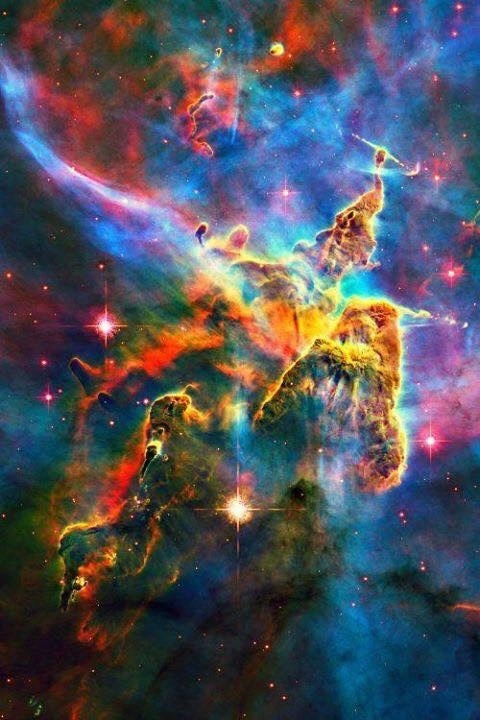
Radiation from hot, young stars off the top of the Cone slowly erodes this giant, gaseous pillar over millions of years. Additional ultraviolet radiation causes the gas to glow, giving the pillar its red halo of light. Over time, only the densest regions of the Cone will be left. Inside these regions, stars and planets may form.
Pillars of cold gas, like the Cone Nebula (and for instance the Eagle Nebula) are common in large regions of star birth. Astronomers believe that these pillars are incubators for developing stars.
Image Credit: Adam Block



 Mark Bere Peterson’s Counterculture, Urban Legends, Paganism & Witchcraft