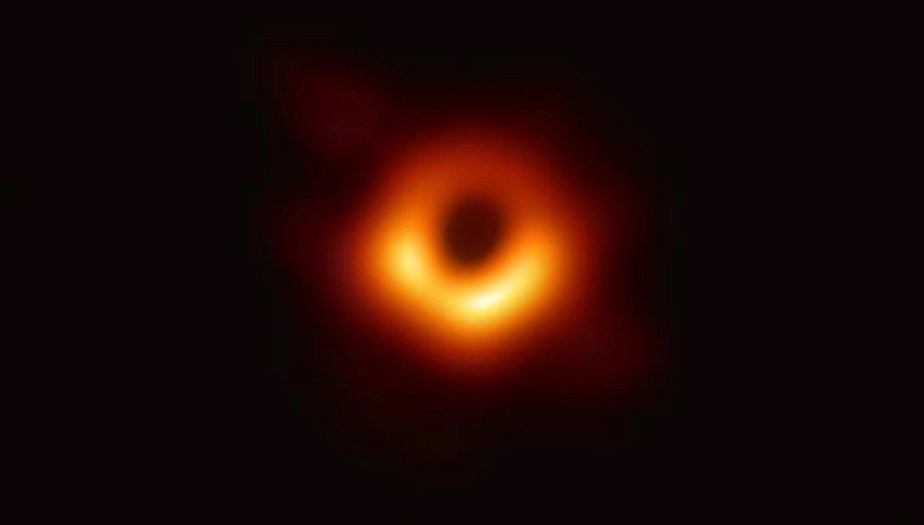
“We have seen what we thought was unseeable. We have seen and taken a picture of a black hole.”
~ Sheperd Doeleman, director of the Event Horizon Telescope Collaboration.
What are black holes?
Black holes are made up of huge amounts of matter squeezed into a small area, according to NASA, creating a massive gravitational field which draws in everything around it, including light. They also have a way of super-heating the material around them and warping spacetime. Material accumulates around black holes, is heated to billions of degrees and reaches nearly the speed of light. Light bends around the gravity of the black hole, which creates the photon ring seen in the image.
In April 2017, scientists used a global network of telescopes to see and capture the first-ever picture of a black hole, according to an announcement by researchers at the National Science Foundation Wednesday morning. They captured an image of the supermassive black hole and its shadow at the center of a galaxy known as M87.
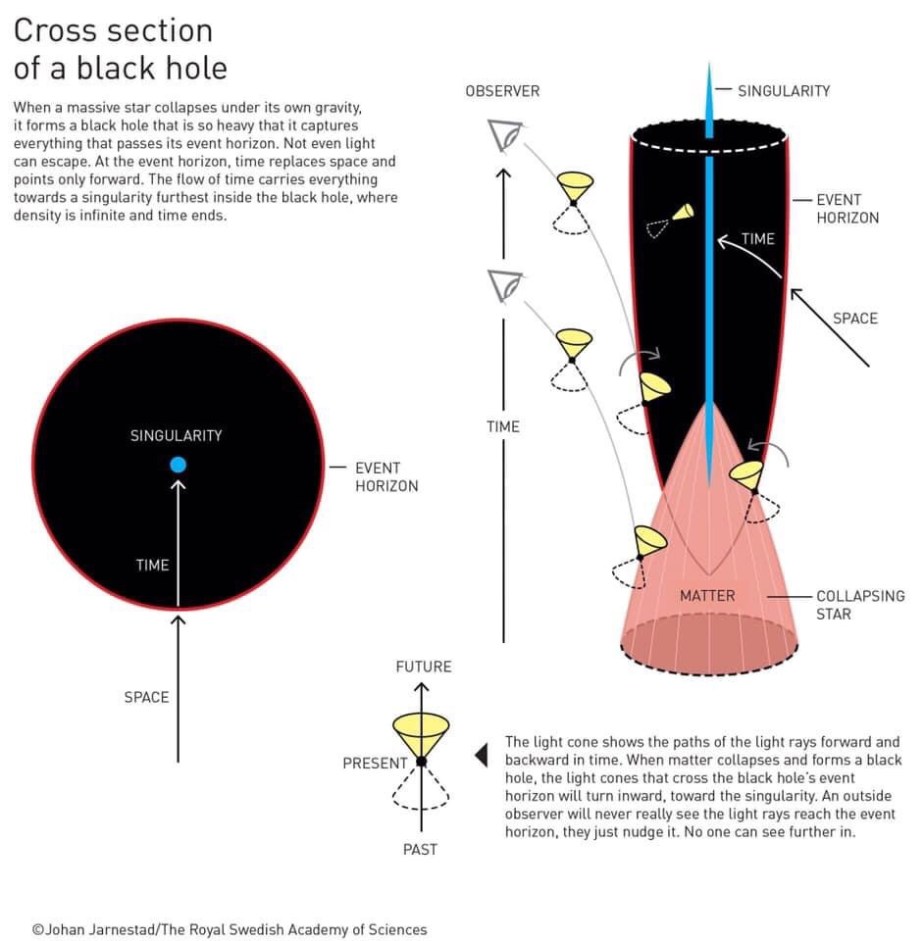
The Event Horizon Telescope Collaboration, called EHT, is a global network of telescopes that captured the first-ever photograph of a black hole. More than 200 researchers were involved in the project. They have worked for more than a decade to capture this. The project is named for the event horizon, the proposed boundary around a black hole that represents the point of no return where no light or radiation can escape.
A lot of people have heard the term “event horizon” That isn’t what we’re seeing in this image. The bright ring is light bending around the intense gravity of the black hole. The event horizon is actually a long way inside the black circular shadow.
The visual confirmation of black holes acts as confirmation of Albert Einstein’s theory of general relativity. In the theory, Einstein predicted that dense, compact regions of space would have such intense gravity that nothing could escape them. But if heated materials in the form of plasma surround the black hole and emit light, the event horizon could be visible.
“Black holes have sparked imaginations for decades. They have exotic properties and are mysterious to us. Yet with more observations like this one they are yielding their secrets. This is why NSF exists. We enable scientists and engineers to illuminate the unknown, to reveal the subtle and complex majesty of our universe.”
~ France Córdova, National Science Foundation Director
Source: CNN



 Mark Bere Peterson’s Counterculture, Urban Legends, Paganism & Witchcraft