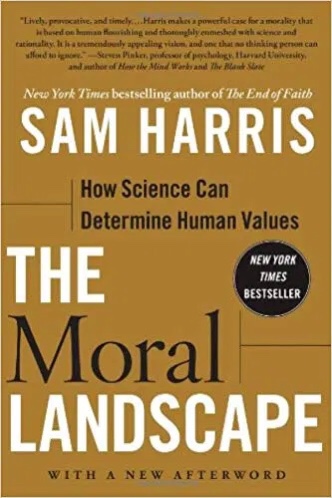
Evolutionary Ethics: Thoughts upon reading “The Moral Landscape” By Sam Harris (Originally Written 7/2011)
I find myself back in intensive care today having rushed to the ER throwing up blood. I have an endoscopy scheduled to see if they can find the bleed. I haven’t been here in Jacksonville long, but I have every faith that Mayo will discover what is wrong with me. There are a lot of medical questions I should be dominated with, but I’ll either survive this hospital stay or I won’t. There is nothing I can do about it so I am very calm. Instead my mind in preoccupied with morality. I just finished reading The Moral Landscape by Sam Harris and the questions he posits is morality defined and developed by religion or by science and specifically evolution is consuming me. It’s an interesting question and while he is firmly on the side of science, so many of my friends and family would argue the opposing point of view.
I’ve been on a religious search for meaning most of my adult life having tried on Christianity, Judaism, and finally Buddhism. Buddhist thought has carried a lot of weight with me for several years as I have an uneven practice. I will meditate and study for months on end and then nothing for a few months. As I lie here in the ICU though the desire to be able to pray to a loving God beseeches me. I can understand the comfort Christians receive
from such practices. The questions though with Christianity are too many and complex for me to find comfort. I’ve read the bible cover to cover three times, the first time back in college and the doctrine in not foreign to me in the least. The quote by an unattributed author keeps ringing in my head of the difference between philosophy and religion, “Philosophy is questions that may never be answered. Religion is answers that may never be questioned.”
Epicurus was an Ancient Greek philosopher who lived from 341–270 BC. He taught that pleasure and pain are measures of what is good and evil; death is the end of both body and soul and should therefore not be feared; the gods neither reward nor punish humans; the universe is infinite and eternal; and events in the world are ultimately based on the motions and interactions of atoms moving in empty space. Most of his writings have been lost, but among those saved was this question, “Is God willing to prevent evil, but not able? Then he is not omnipotent. Is he able, but not willing? Then he is malevolent. Is he both able and willing? Then whence cometh evil? Is he neither able nor willing? Then why call him God?”
Is there a universal morality which governs all of humanity upon which judgement can be placed as opposed to the predominantly liberal idea of cultural moral relativity? I argue yes and it is not tied to any religion, as a matter of fact religion confounds the matter and it is only through science and evolutionary theory that one might comprehend the overreaching standard of morality and how liberals, as well as conservatives, complicate this problem by allowing moral relativity to flourish. The desire not to judge other cultures and be a victim of ethnocentrism has taken on a life of its own in this politically correct world. This belief that there is no higher moral authority due to the fact that there are multiple faiths and each of those adherents believe they are living a moral life or promises of happiness and bliss in the next life. In Western culture for instance it is easy to judge Islam and their subjugation of women, gays, and infidels based on Judeo-Christian doctrine. I shall argue that it is a moral imperative to vanquish fundamentalism in all religions.
First to understand this argument there requires some understanding of some working definitions via the Oxford dictionary. Morality, principles concerning the distinction between right and wrong or good and bad behavior. Ethics, Moral principles that govern a person’s behavior or the conducting of an activity. Welfare, The health, happiness, and fortunes of a person or group. The absolute morality I am arguing is based upon the idea of that which increases the general welfare of humanity, or more simply for the greater good of society, as a whole is a moral framework. This is a human morality and not one simply for one ethnic, religious, or cultural group. You could argue for instance that slavery did indeed increase the welfare of the ancient Romans, but by all modern evaluations this is not seen as moral. For those of the Judeo-Christian faith for instance find the Old Testament of the bible is ripe with examples of God not only condoning, but embracing slavery. If God is indeed omnipotent and omniscient his condoning of slavery should be just as moral today as it was when the bible was first written. There are very few however who would argue that slavery is ethically right in this modern day.
Fundamentalists of virtually all faiths view their religious texts as the literal words of God. The prevalence of young earth creationists in Western civilization who believe the world is only approximately 6,000 years old is an example of this despite the overwhelming evidence to the contrary. The rallying cry of this demographic seems to be, “I’m not a scientist. Science and evolution is only a possible theory.” This issue stems from the ignorance of understanding the difference between the concept of a scientific theory and the common use of the word theory. According to a Gallup poll in 2014, 4 in 10 Americans believe God created the world within the last 10,000 years. Approximately 50% of Americans believe in evolution over millions of years, with the vast majority believing God guided this process. Only 19% of Americans believe in a non-God guided natural selection view of evolution. Of course this is at odds with scientific consensus which dictates the humans or those of Homo genus emerged of earth some 2.5 million years ago. When I refer to evolution I will be referring to the unguided naturalistic theory of evolution.
The forced subjugation of women in Islam and requiring them to wear a burqa by Western standards is seen as immoral. The cultural apologists will argue that you can not judge one culture by your own standards. I agree with this up to a point, you can not ethically judge Islamic law based upon your Judeo-Christian standards as intrinsically they are all flawed as morality has changed in the past thousands of years since biblical law was written. If you can not apply religious standards to morality to determine an absolute it is obvious the morality is a relative concept based upon the culture? No. Through evolution, adaptation and science we can answer some of these questions about what is ethically permissible in a modern society and world at this moment in our evolutionary journey. Can we through evolutionary theory determine an exact moral code? No of course not, but we can theorize where our collective morality is headed. An example of this is the instance of slavery and racism in the United States. It is hard for anyone to reasonably argue that we haven’t morally evolved through the dismemberment of a slave based society, through lynchings in the not too distant past, to where we currently stand in the civil rights movement. Is this to say there is no racism? Of course not, but a great amount of progress has been made in the last one hundred and fifty years or so.
How can we derive our ethics from religion when the major religions of Judaism, Christianity and Islam condone and embrace such concepts we find morally abhorrent such as slavery, severe punishment or death of an adulteress, forced marriage of a rape victim, misogyny, homophobia, genocide, etc. Is the golden rule moral because of an ancient text or do we recognize it as moral because we brought that belief with us to the reading of the bible? I argue the later. The golden rule or the ethic of reciprocity is found cross-culturally in virtually every religion from ancient Egypt, Judaism, Islam, Buddhism, Hinduism, etc. The ethic of reciprocity can not be argued stems from a Judeo-Christian worldview or even that it was borrowed from Ancient Egypt since there are unaffiliated cultures which predate Judaism in this belief. My argument is that it is basic human nature or in another words the result of thousands of years of adaptation and evolution.
I realize this belief is bound to be met with fierce opposition, but this is my personal philosophy shared by others such as Sam Harris, Richard Dawkins, and many scientists, but far from all of them. A new philosophical worldview is always met with fierce opposition, such is this case. Examples of morality derived through evolution and adaptation is ripe throughout the animal world. An example of this is monkeys will starve themselves to prevent their cage mates from receiving painful shocks. JH Masserman reported such adaptation in 1964, (Masserman JH. Wechkin S, and Terris W. 1964. “Altruistic” behavior in rhesus monkeys. American Journal of Psychiatry 121: 584-585.), “In one experiment, 15 rhesus monkeys were trained to get food by pulling chains. Monkeys quickly learned that one chain delivered twice as much food than the other. But then the rules changed. If a monkey pulled the chain associated with the bigger reward, another “bystander” monkey received an electric shock. After seeing their conspecific get a shock, 10 of the monkeys switched their preferences to the chain associated with the lesser food reward. Two other monkeys stopped pulling either chain—preferring to starve rather than see another monkey in pain.” This study is far from the only example: mice show greater distress at the suffering of familiar mice than unfamiliar ones, and chimpanzees have a demonstrable sense of fairness when receiving food rewards.
Sam Harris argued when faced with this philosophical as well as scientific point of view scientific ignorance is ripe and intervenes, “There is an epidemic of scientific ignorance in the United States. This isn’t surprising, as very few scientific truths are self-evident, and many are deeply counterintuitive. It is by no means obvious that empty space has structure or that we share a common ancestor with both the housefly and the banana. It can be difficult to think like a scientist (even, we have begun to see, if one is a scientist). But it would seem that few things make thinking like a scientist more difficult than religion.” (The Moral Landscape, p. 176). If we examine this from a Judeo-Christian perspective we are faced many inconsistencies that require answers. It is not my role here to argue whether religious faith is faulty or not, that is between you and what you believe in. It is my belief that morality is defined independent of any particular religion through evolution and adaptation.





 Mark Bere Peterson’s Counterculture, Urban Legends, Paganism & Witchcraft