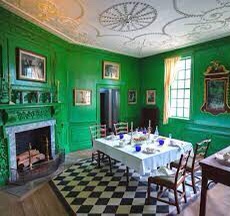
The Dining Room is part of the original house, built in 1734. Over the years, the room underwent a series of renovations. While George Washington was away commanding the Continental Army in 1775, the room was updated under the supervision of his cousin Lund Washington. In 1785, the striking verdigris-green paint was added. Washington believed the color to be “grateful to the eye” and less likely than other colors to fade; an overcoat of glaze further intensified the color.
In 1775 Washington decided to install an elaborately decorated plaster ceiling and add plaster ornaments above the fireplace. He hired an expert plasterer, identified simply as the “Stucco Man,” who spent five months completing the hand-tooled ceiling. A renovation in 2001 uncovered some of his original pencil drawings on the ceiling laying out the design.
George Washington created a formal courtyard on the west side of the Mansion. At its center is a large ellipse, its precise layout reflective of his surveying skill. By circling the ellipse, carriages could bring visitors directly to the door, and then easily continue around towards the stable. At one point this broad circle was paved in cobblestones.
Sitting to the north of the circle is the Servants’ Hall and to the south the Kitchen. The buildings form an open forecourt that frames the house. In the middle of the Mansion Circle sits a sundial. This was the most accurate timepiece available to 18th-century Americans. Mounted atop a white painted wood post, the sundial was a visual reminder of the hour to all who passed it.
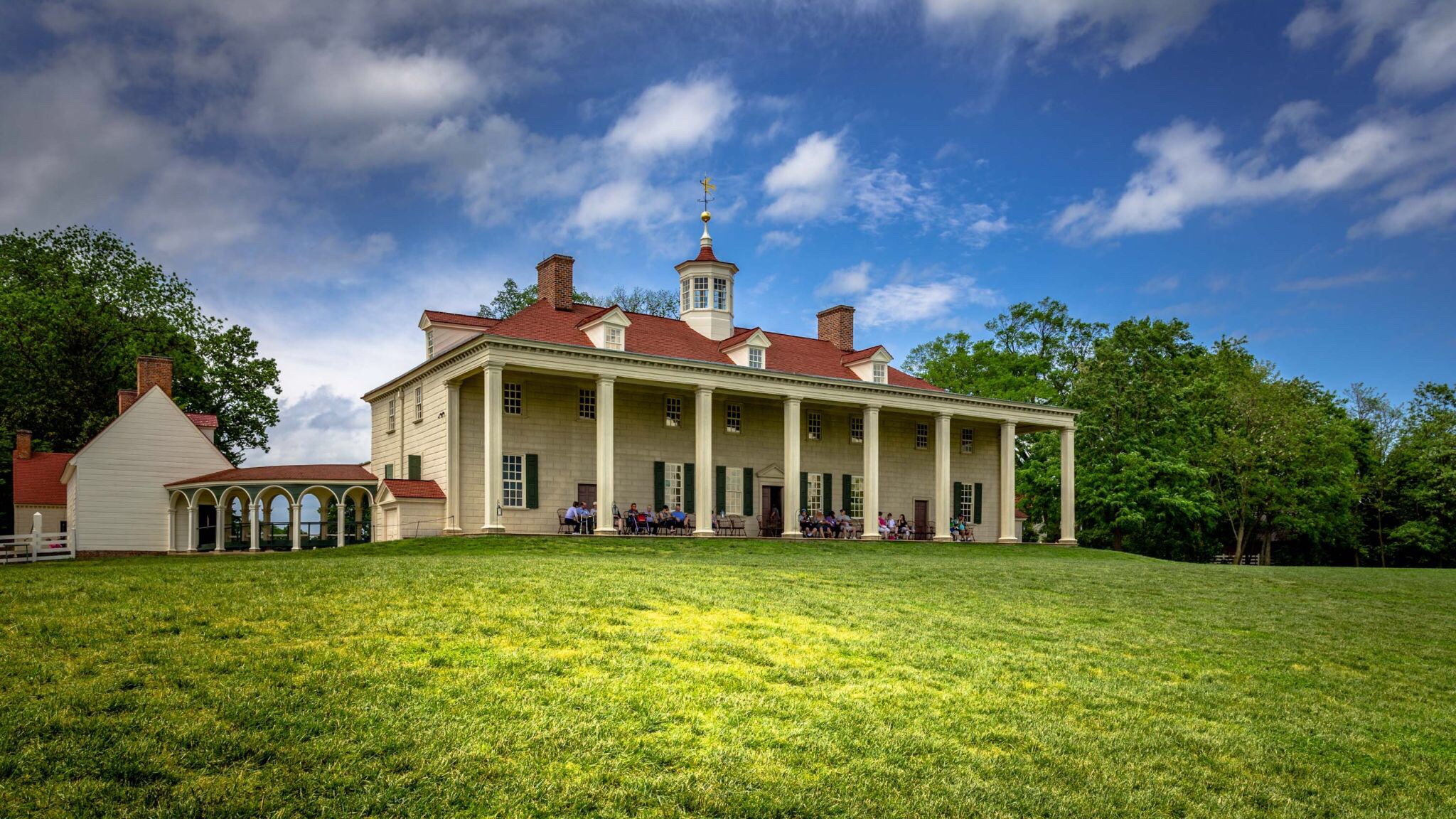
The building began as a one and one-half story house built in 1734 by George Washington’s father, Augustine Washington, and received its well-known name from his half-brother Lawrence Washington.
George Washington began running Mount Vernon in 1754, and over the next 45 years slowly enlarged the dwelling to create the 21-room residence we see today. Washington oversaw each renovation, advising on design, construction, and decoration, despite being away much of the time. Conscious that the world was watching, Washington selected architectural features that expressed his growing status as a Virginia gentleman and ultimately as the leader of a new nation.
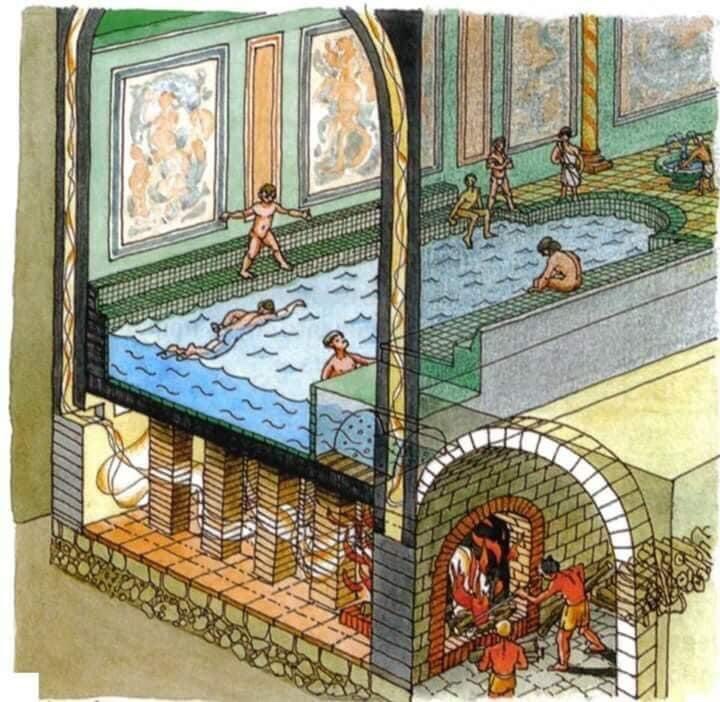
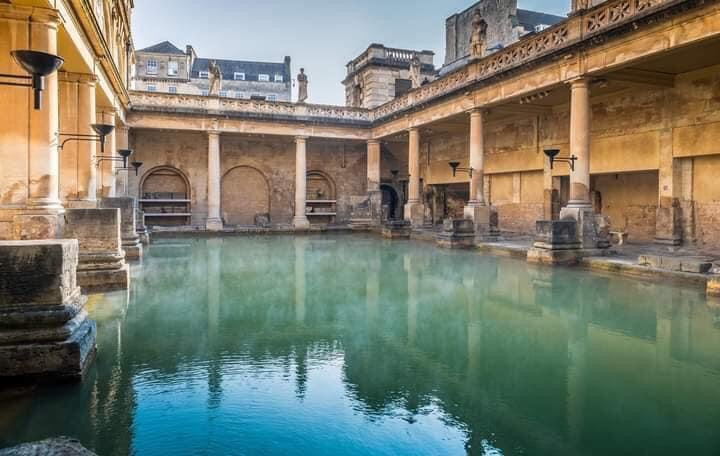
Roman baths, used for both socializing and cleaning, were a marvel of engineering. The water was heated by the fire lit under the pool and the hot air was circulated between the walls of the bath; so that both the water temperature and the temperature of the building would remain constant. The water used in the Roman baths was generally carried from the water source to the bath with the help of aqueducts.
The dirty water coming out of the baths had a function. These dirty waters were drained from the canal and used to clean the dirty canals of the latrinas (Public Toilet) next to the baths.
For the Romans, these baths were an important part of daily life. They would go every day and stay for a few hours. The wealthy Romans used to come with their slaves. The slaves brought in usually took on the task of carrying towels and drinks. Before bathing in Roman baths, sports exercises were done. Running, weight lifting and wrestling are examples of these. After the exercises, the servants would smear their masters with oil and then scrape off the oil with the help of a board or bone. In this way, great dirt would be removed.
In the Roman bath, body cleaning was done with an apparatus called strigilis. With this apparatus, sweat, sand and dust sticking to the body were removed, and then the body was lubricated in the area called aleipterion.
Roman baths were also present inside various palaces or castles. The Romans used the same name (Thermae) for them as well. The design of the baths is mentioned a lot on Vitruvius’ De architectura.
Since the limits of socialization were exceeded in some baths and there were incidents such as prostitution, it was decided that women would enter the bath from morning to noon and men would enter the bath in the afternoon. So they were prevented from entering to baths together.
For example, Emperor Trajan forbade men and women to bathe together in the Ephesus Bath in 98 AD.
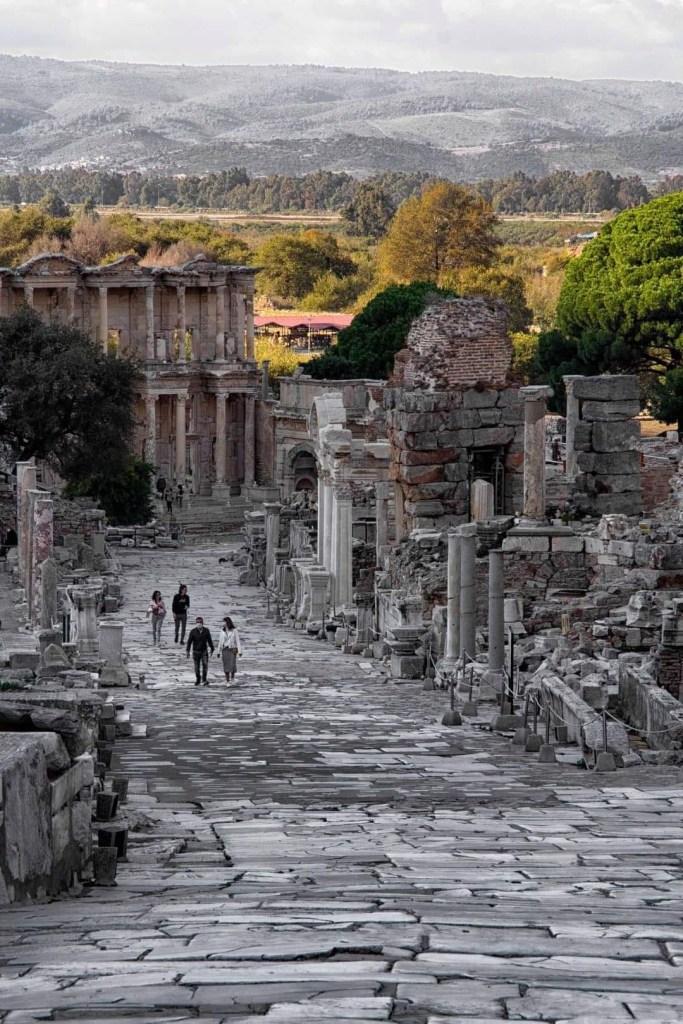
Ephesus is one of the largest Roman archaeological sites in the eastern Mediterranean. The visible ruins still give some idea of the city’s original splendour, and the names associated with the ruins are evocative of its former life.
The Temple of Artemis, one of the Seven Wonders of the Ancient World, once stood 418′ by 239′ with over 100 marble pillars each 56′ high. The temple earned the city the title “Servant of the Goddess”. Pliny tells us that the magnificent structure took 120 years to build but is now represented only by one inconspicuous column, revealed during an archaeological excavation by the British Museum in the 1870s.
Before turning their thoughts to the intriguing legends associated with these ruins, any person who strays off the marked footpaths and loses his or her footing on the edge of the precipices that drop away on every side of this aptly nicknamed “citadel in the sky.” And let us not forget that early in 1244 it was a feat of rock climbing that sealed the fate of the Cathars when they were besieged here by the army of King Louis IX. After seven months, during which traditional military strategies had brought nothing but failure, Hugues des Arcis, the commander of the forces encamped at the foot of this eagle’s nest, finally decided to send a small group of particularly agile soldiers up the cliff face. Under cover of darkness, this detachment reached the summit, captured a watchtower, and installed a trebuchet, with which it proceeded to bombard the interior of the castle without respite, making life impossible for the besieged, who were forced to surrender after a few weeks.
The fate of this community, the last bastion of the Cathar faith in France, is well known. One Sunday in March 1244, the day of the equinox, the believers—more than two hundred men and women—were led down to a pyre that had been set up at the foot of the hill, steadfastly refusing to renounce their faith. What else could they do, these pacifists who had taken a vow to show courage in the face of suffering and death? The name Cathar—from the Greek katharos, meaning “pure”—was given them by their contemporaries on account of their asceticism and refusal to compromise in any way. For the same reason, those who had undergone the rite of ordination called the consolamentum were known as perfecti, although among one another they preferred the terms “good man” and “good woman.” The band of sympathizers protecting the pacifist Cathars were allowed to go free provided they pledged to stop supporting heresy and swore allegiance to the king of France.
The Château de Montségur that stands today is not the same fortress that existed at the time of these dreadful events. Historians, archeologists, and local storytellers cannot agree on all the details. For example, was the Cathars’ place of martyrdom the prats dels cremats (“field of the burned”), as indicated today by a stele, or was it a neighboring hill? At this magnificent site, so many questions remain unanswered. There’s the legendary Cathar treasure, said to have been held in safekeeping at Montségur before being smuggled out to an unknown destination. And then there are the four men deputed by the community to slip away under the utmost secrecy prior to the ultimate surrender, carrying with them who knows what. Items of treasure? Precious documents? Mysterious keys enabling the Cathar tradition to be revived elsewhere? At Montségur nothing seems impossible. In the last century a team of German researchers came, with the blessing of the Nazi regime, to investigate, convinced that the castle housed the Holy Grail, the famous cup believed to have been used to catch Christ’s blood.
What should we make of the site’s architecture, of the spectacular alignment of the sun’s rays at solstice time, as if its architects had wanted the castle to function as a kind of astronomical calendar? And doesn’t its floor plan reflect the constellation of Boötes, with the donjon representing the star Arcturus? Is it also mere chance that “Cant del Boièr” (Song of the Herdsman) remains one of the most popular folk songs in the Occitanian canon, with some people reading into its words a coded message addressed to future generations?
“After seven hundred years the bay tree will flower again”—and with it, no doubt, the Cathar faith. Thus were the words of the troubadour in the Occitania of old. Or was it the last of the perfecti to be burned at the stake? Or even a poet born generations later? Basically, nobody knows. It is even possible that the bay tree could be an olive tree, and that the date is regularly adjusted so that it never loses its relevance. No matter. The legend remains perplexing enough for visitors to be drawn in by its verses while contemplating the ruins of what the inquisitors called “Satan’s synagogue” – but never quite managed to utterly destroy.
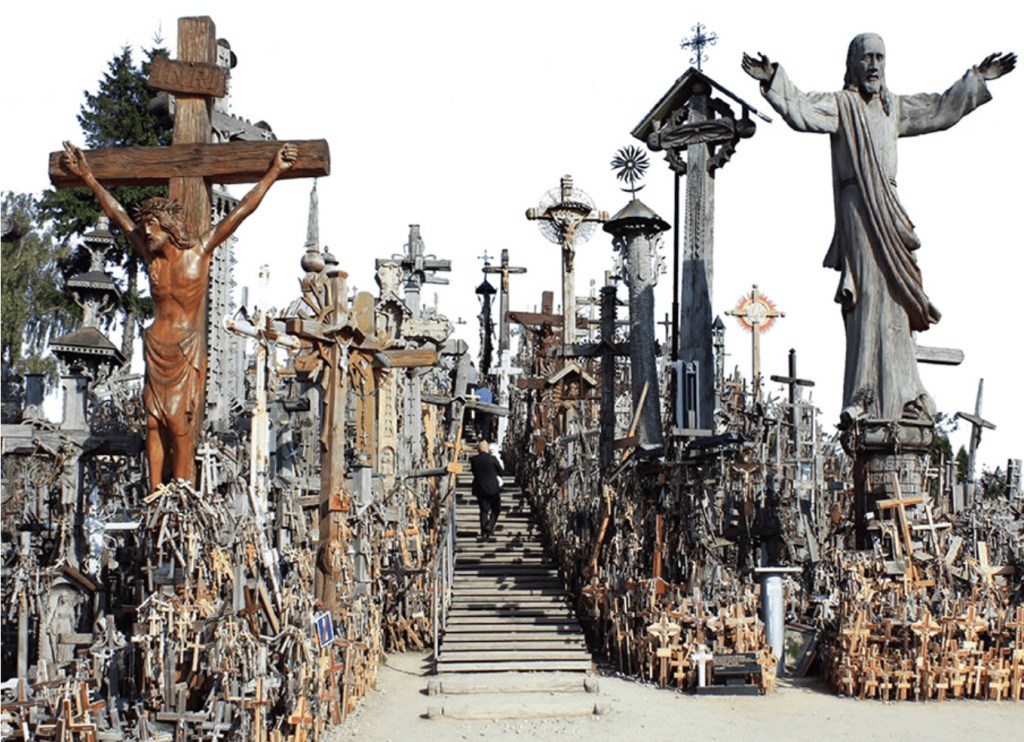
Hill of Crosses (Meškuičiai, Šiauliai – Lithuania)
Crosses have been accumulating on this small hill since the 14th century, when Teutonic Knights of the Holy Roman Empire occupied the nearby city of Šiauliai. New crosses tend to appear during periods of occupation or unrest as symbols of Lithuanian independence. This was particularly evident during a peasant uprising against Russian control in 1831, when people began placing crucifixes in remembrance of missing and dead rebels. By 1895, there were 150 large crosses on the site. In 1940, the number had grown to 400.
During the Soviet occupation, which lasted from 1944 to 1991, the Hill of Crosses was bulldozed three times. Each time, locals and pilgrims returned to put up more crosses. The site achieved worldwide fame when Pope John Paul II visited in 1993 to thank Lithuanians for their enduring symbol of faith.
There are now approximately 100,000 crosses on the hill. The faithful are welcome to add their contribution, in whatever form they wish—a crucifix made of Legos recently joined the collection.






 Mark Bere Peterson’s Counterculture, Urban Legends, Paganism & Witchcraft