Family Therapy

Family therapy is a type of psychological counseling (psychotherapy) that can help family members improve communication and resolve conflicts.

Family therapy is usually provided by a psychologist, clinical social worker or licensed therapist. These therapists have graduate or postgraduate degrees and may be credentialed by the American Association for Marriage and Family Therapy (AAMFT).

Family therapy is often short term. It may include all family members or just those able or willing to participate. Your specific treatment plan will depend on your family’s situation. Family therapy sessions can teach you skills to deepen family connections and get through stressful times, even after you’re done going to therapy sessions.

Why it’s done

Family therapy can help you improve troubled relationships with your partner, children or other family members. You may address specific issues such as marital or financial problems, conflict between parents and children, or the impact of substance abuse or a mental illness on the entire family.

Your family may pursue family therapy along with other types of mental health treatment, especially if one of you has a mental illness or addiction that also requires additional therapy or rehabilitation treatment. For example:

• Family therapy can help family members cope if a relative has a serious mental illness such as schizophrenia — but the person who has schizophrenia should continue with his or her individualized treatment plan, which may include medications, one-on-one therapy or other treatment.

• In the case of addiction, the family can attend family therapy while the person who has an addiction participates in residential treatment. Sometimes the family may participate in family therapy even if the person with an addiction hasn’t sought out his or her own treatment.

Family therapy can be useful in any family situation that causes stress, grief, anger or conflict. It can help you and your family members understand one another better and learn coping skills to bring you closer together.

How you prepare

You can ask your primary care doctor for a referral to a therapist. Family members or friends may give recommendations based on their experiences. You also can ask your employee assistance program, clergy, or state or local mental health agencies for suggestions for therapists.

Before scheduling sessions with a therapist, consider whether the therapist would be a good fit for your family. Here are some factors to consider and questions to ask:

• Education and experience. What is your educational and training background? Are you licensed by the state? Are you accredited by the AAMFT or other professional organizations? Do you have specialty training in family psychotherapy? What is your experience with my family’s type of problem?

• Location and availability. Where is your office? What are your office hours? Are you available in case of emergency?

• Length and number of sessions. How long is each session? How often are sessions scheduled? How many sessions should I expect to have?

• Fees and insurance. How much do you charge for each session? Are your services covered by my health insurance plan? Will I need to pay the full fee upfront? What is your policy on canceled sessions?

What you can expect

Family therapy typically brings several family members together for therapy sessions. However, a family member may also see a family therapist individually.

Sessions typically take about 50 minutes to an hour. Family therapy is often short term — generally about 12 sessions. However, how often you meet and the number of sessions you’ll need will depend on your family’s particular situation and the therapist’s recommendation.

During family therapy, you can:

• Examine your family’s ability to solve problems and express thoughts and emotions in a productive manner

• Explore family roles, rules and behavior patterns to identify issues that contribute to conflict — and ways to work through these issues

• Identify your family’s strengths, such as caring for one another, and weaknesses, such as difficulty confiding in one another

Example: Depression

Say that your adult son has depression. Your family doesn’t understand his depression or how best to offer support. Although you’re worried about your son’s well-being, conversations with your son or other family members erupt into arguments and you feel frustrated and angry. Communication diminishes, decisions go unmade, family members avoid each other and the rift grows wider.

In such a situation, family therapy can help you:

• Pinpoint your specific challenges and how your family is handling them

• Learn new ways to interact and overcome unhealthy patterns of relating to each other

• Set individual and family goals and work on ways to achieve them

Results

Family therapy doesn’t automatically solve family conflicts or make an unpleasant situation go away. But it can help you and your family members understand one another better, and it can provide skills to cope with challenging situations in a more effective way. It may also help the family achieve a sense of togetherness.

Ancient Greek Food: Sesame Honey Candy (Pasteli)

In Greek: παστέλι, pronounced pah-STEH-lee

In markets these days you can find sesame honey bars. The main difference is that the ancient Greeks did not have refined sugar. The sugar used today helps to harden the bars and make them crunchy. The ancient version was chewier, but simple to make with only two ingredients: sesame seeds and honey.

Warning: The quality and taste of the honey will have an effect on the final product.

Pasteli can be eaten as a candy at any time, or as an energy booster, and it is a wonderful accompaniment to tea.

Ingredients:

  • 1 1/3 cups honey
  • 3 cups hulled white sesame seeds
  • Optional: 1 strip lemon peel (about 1/4 x 1 inch)

Steps:

In a saucepan, bring honey and lemon peel, if using, to a boil. Add sesame seeds, stirring continuously and continue to cook while stirring to mix completely and thoroughly. When the seeds are fully mixed in and the mixture has boiled again, remove from heat. Remove lemon peel and discard.

Place a piece of baking parchment on a cool work surface and spread out the hot mixture thinly and evenly (about 1/4 inch high).

When the pasteli cools to room temperature, refrigerate on the parchment paper (it doesn’t need to be covered). Chill for at least 2 to 3 hours.

With kitchen shears, cut the pasteli together with parchment paper into small pieces, and serve.

To eat, peel off the parchment paper. Store in the refrigerator.

Ancient Egyptian Food: Falafel (Ta’amia)

Ta’amia was very popular with the Ancient Egyptians and continues to be popular in the middle east today. It was made with fava beans, but these can be substituted with chickpeas to make the well known version of Ta’amia known as falafel.

Ingredients

  • 1 lb fava beans or chickpeas soaked overnight and drained
  • 2 cloves garlic, finely chopped
  • 2 large onions, finely chopped
  • 1-2 teaspoons ground coriander
  • 1-2 teaspoons cumin
  • 1 teaspoon cayenne pepper
  • 1/2 teaspoon baking powder
  • 1/4 cup minced parsley
  • A pinch of salt
  • Black pepper to taste
  • Sesame seeds to coat the cakes
  • Olive oil for frying

Preparation

  1. Ensure the beans are soft and remove their skins. Mix the beans together with all of the ingredients except the oil and sesame seeds and either mash or blend them in a food processor until you have a thick paste.
  2. Set the paste aside for 30 minutes to allow the flavours to set.
  3. Knead the mixture and form into small round cakes about 2cm thick.
  4. Sprinkle each side of the cakes with sesame seeds and shallow fry in hot olive oil for two to three minutes until golden brown.
  5. Serve with flat bread and lettuce tossed in olive oil, lemon juice and pepper. Alternatively you can also serve with a tahini dip.

Ancient Egyptian Food: Date Candies

This recipe was found on an ostraca (pottery shard) that dates back to 1600 BC. Here’s is a modernized version:

1 cup of fresh pitted dates
1 teaspoon cinnamon
1/2 teaspoon cardamom seeds
1/2 cup ground walnuts
small amount of liquid honey
1/2 cup finely ground almonds

Put the dates, cardamom, cinnamon, and walnuts in a food processor and run at high speed to make a paste. Take chunks of this paste and form it into walnut sized balls. Brush these with some liquid honey and roll them in the ground almonds to coat them.

Adjustment Disorders: Symptoms

Adjustment disorders are stress-related conditions. You experience more stress than would normally be expected in response to a stressful or unexpected event, and the stress causes significant problems in your relationships, at work or at school.

Work problems, going away to school, an illness, death of a close family member or any number of life changes can cause stress. Most of the time, people adjust to such changes within a few months. But if you have an adjustment disorder, you continue to have emotional or behavioral reactions that can contribute to feeling anxious or depressed.

You don’t have to tough it out on your own, though. Treatment can be brief and it’s likely to help you regain your emotional footing.

Symptoms

Signs and symptoms depend on the type of adjustment disorder and can vary from person to person. You experience more stress than would normally be expected in response to a stressful event, and the stress causes significant problems in your life.

Adjustment disorders affect how you feel and think about yourself and the world and may also affect your actions or behavior. Some examples include:

• Feeling sad, hopeless or not enjoying things you used to enjoy

• Frequent crying

• Worrying or feeling anxious, nervous, jittery or stressed out

• Trouble sleeping

• Lack of appetite

• Difficulty concentrating

• Feeling overwhelmed

• Difficulty functioning in daily activities

• Withdrawing from social supports

• Avoiding important things such as going to work or paying bills

• Suicidal thoughts or behavior

Symptoms of an adjustment disorder start within three months of a stressful event and last no longer than 6 months after the end of the stressful event. However, persistent or chronic adjustment disorders can continue for more than 6 months, especially if the stressor is ongoing, such as unemployment.

Causes

Adjustment disorders are caused by significant changes or stressors in your life. Genetics, your life experiences, and your temperament may increase your likelihood of developing an adjustment disorder.

Risk factors

Some things may make you more likely to have an adjustment disorder.

Stressful events

Stressful life events — both positive and negative — may put you at risk of developing an adjustment disorder. For example:

• Divorce or marital problems

• Relationship or interpersonal problems

• Changes in situation, such as retirement, having a baby or going away to school

• Adverse situations, such as losing a job, loss of a loved one or having financial issues

• Problems in school or at work

• Life-threatening experiences, such as physical assault, combat or natural disaster

• Ongoing stressors, such as having a medical illness or living in a crime-ridden neighborhood

Your life experiences

Life experiences can impact how you cope with stress. For example, your risk of developing an adjustment disorder may be increased if you:

• Experienced significant stress in childhood

• Have other mental health problems

• Have a number of difficult life circumstances happening at the same time

Complications

If adjustment disorders do not resolve, they can eventually lead to more serious mental health problems such as anxiety disorders, depression or substance abuse.

Prevention

There are no guaranteed ways to prevent adjustment disorders. But developing healthy coping skills and learning to be resilient may help you during times of high stress.

If you know that a stressful situation is coming up — such as a move or retirement — call on your inner strength, increase your healthy habits and rally your social supports in advance. Remind yourself that this is usually time-limited and that you can get through it. Also consider checking in with your doctor or mental health professional to review healthy ways to manage your stress.

Sources: The Mayo Clinic, NAMI, NIH, NIMH

Ancient Egyptian Food: Bread

Ancient Egyptian bread was made of barley, millet, and once available, wheat. Though not always combined, sometimes two or all three of these were used in a single recipe. Bread was a very simplistic form. Yeast did not exist in Egypt until well into the Middle Kingdom and was not particularly popular until the New Kingdom era, so loaves were what we would consider today “flat” breads.

Bread consisted of only three simple ingredients:

  • Flour made from barley, millet or wheat.
  • Water
  • Leavening: leavening nowadays means yeast, but Egypt used sourdough starters or spent brewery grains which, unknown to them, had yeast in it.

To this basic recipe, flavorings were often added prior to baking: sesame seeds, honey, herbs, oil, egg washes, fruits and even sometimes bits of leftover chopped meat were added to help spice up these supplementary loaves.

Ancient Egyptian Bread Recipe:

  • Mix three parts flour to one part water. Mix with your hands until it forms a sticky dough. If needed, add more water. You’re looking for the dough to pull away from the side of the bowl, as in normal bread.
  • Use a sourdough starter or ground brewery grain if available. You can grind brewery grain in a food processor.
  • Let rise for thirty minutes, separate into rounds, place on a baking sheet and insert into a 300 degree oven. If you have an outdoor fireplace that is food safe or barbecue grill these work wonderfully to recreate the same sorts of cooking environments these recipes originally came from.
  • Cook for around 45 minutes. Check halfway through with a knife, when it comes out clean, pull your bread from the oven and let it cool.
  • Slice like a pizza and serve with the accompaniments of your choice.

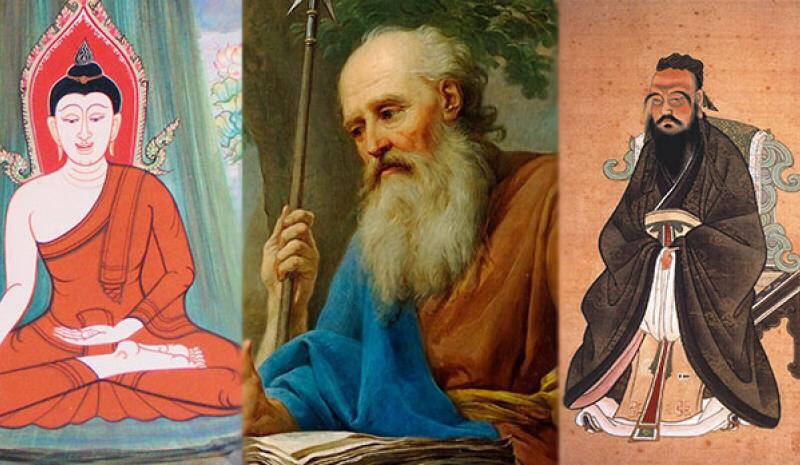
Three Great Minds

It’s interesting that approximately 2500 years ago three men were born who would change the world, in three distinct parts of the world that would have no interaction with each other. Confucius, The Buddha, and Socrates were born within 100 years of each other whose lives would overlap:

Confucius 551-479 B.C.
The sagacious Confucius, Kongzi, or Master Kung (551-479 B.C.) was a social philosopher whose values became dominant in China only after he died. Advocating living virtuously, he put emphasis on socially appropriate behavior.

Buddha c. 563-483 B.C.
Siddhartha Gautama was a spiritual teacher of enlightenment who acquired hundreds of followers in India and founded Buddhism. His teachings were preserved orally for centuries before they were transcribed on palm-leaf scrolls. Siddhartha may have been born c. 563 B.C. to Queen Maya and King Suddhodana of the Shakya in ancient Nepal. By the third century B.C. Buddhism appears to have spread to China.

Socrates c. 470-399 B.C.
Socrates, an Athenian contemporary of Pericles (c. 470 – 399 B.C.), is a central figure in Greek philosophy. Socrates is known for the Socratic method (elenchus), Socratic irony, and the pursuit of knowledge. Socrates is famous for saying that he knows nothing and that the unexamined life is not worth living. He is also well known for stirring up sufficient controversy to be sentenced to a death that he had to carry out by drinking a cup of hemlock. Socrates had important students, including the philosopher Plato.

#Confucius #Buddha #Socrates

Hecate (Hekate): Goddess of Witches, Magic and the Night

Greek Name: Ἑκατη Ἑκατα

Transliteration: Hekatê, Hekata

Latin Spelling: Hecate, Hecata

Translation: Worker from Afar

Hekate assisted Demeter in her search for Persephone, guiding her through the night with flaming torches. After the mother-daughter reunion became she Persephone’s minister and companion in Haides.

Three metamorphosis myths describe the origins of her animal familiars: the black she-dog and the polecat (a mustelid house pet kept by the ancients to hunt vermin). The dog was the Trojan Queen Hekabe (Hecuba) who leapt into the sea after the fall of Troy and was transformed by the goddess. The polecat was either the witch Gale, turned as punishment for her incontinence, or Galinthias, midwife of Alkmene (Alcmena), who was transformed by the enraged goddess Eileithyia but adopted by the sympathetic Hekate.

Her name means “worker from afar” from the Greek word hekatos. The masculine form of the name, Hekatos, was a common epithet of the god Apollon.

According to the most genuine traditions, she appears to have been an ancient Thracian divinity, and a Titan, who, from the time of the Titans, ruled in heaven, on the earth, and in the sea, who bestowed on mortals wealth, victory, wisdom, good luck to sailors and hunters, and prosperity to youth and to the flocks of cattle; but all these blessings might at the same time be withheld by her, if mortals did not deserve them. She was the only one among the Titans who retained this power under the rule of Zeus, and she was honoured by all the immortal gods.

“We are told that Helios (the Sun) had two sons, Aeetes and Perses, Aeetes being the king of Kolkhis (Colchis) and the other king of the Tauric Chersonese, and that both of them were exceedingly cruel. And Perses had a daughter Hekate (Hecate), who surpassed her father in boldness and lawlessness.”

~ Diodorus Siculus, Greek historian 1st Century B.C.

“If you think Latona [Leto] a goddess, how can you not think that Hecate is one, who is the daughter of Latona’s sister Asteria?”

~ Cicero, Roman rhetorician 1st Century B.C.

“Hekate whom Zeus the son of Kronos (Cronus) honoured above all. He gave her splendid gifts, to have a share of the earth and the unfruitful sea. She received honour also in starry heaven, and is honoured exceedingly by the deathless gods . . . For as many as were born of Gaia (Gaea, Earth) and Ouranos (Uranus, Heaven) [the Titanes] amongst all these she has her due portion. The son of Kronos [Zeus] did her no wrong nor took anything away of all that was her portion among the former Titan gods: but she holds, as the division was at the first from the beginning, privilege both in earth, and in heaven, and in sea. Also, because she is an only child, the goddess receives not less honour, but much more still, for Zeus honours her.”

~ Hesiod, 8th or 7th Century B.C.

Oracle of Delphi

4D353C64-BC13-4F81-B092-4BEAF7971DBE

Delphi (Greek: Δελφοί) is famous as the ancient sanctuary that grew rich as the seat of Pythia, the oracle who was consulted about important decisions throughout the ancient classical world. Moreover, the Greeks considered Delphi the navel, or center, of the world, as represented by the stone monument known as the Omphalos of Delphi.

Illustration from ÒAn Encyclopedia outline of Masonic, Hermetic, Quabbalistic and Rosicrucian Symbolical PhilosophyÓ by Manly P. Hall Illustration by J. Augustus Knapp titled ÒConsulting the Oracle of DelphiÓ, Mythology, Greek, myths, Delphic, wisdom, be

Delphi is perhaps best known for its oracle, the Pythia, the sibyl or priestess at the sanctuary dedicated to Apollo. According to Aeschylus in the prologue of the Eumenides, the oracle had origins in prehistoric times and the worship of Gaea. Gaea is the personification of the Earth and one of the Greek primordial deities. Gaea is the ancestral mother of all life: the primal Mother Earth goddess.

07151BEE-9D07-4670-8C83-9411FF6CB9E8

Apollo spoke through his oracle. She had to be an older woman of blameless life chosen from among the peasants of the area. Alone in an enclosed inner sanctum she sat on a tripod seat over an opening in the earth (the “chasm”). According to legend, when Apollo slew Python (Python was the serpent, sometimes represented as a medieval-style dragon, living at the centre of the earth, believed by the ancient Greeks to be at Delphi.) its body fell into this fissure and fumes arose from its decomposing body. Intoxicated by the vapours, the sibyl would fall into a trance, allowing Apollo to possess her spirit. In this state she prophesied. The oracle could not be consulted during the winter months, for this was traditionally the time when Apollo would live among the Hyperboreans. Dionysus would inhabit the temple during his absence.

B1A2796E-3F48-4C74-BBF6-0C66D15DB658

The site was first settled in Mycenaean times in the late Bronze Age (1500-1100 BCE) but took on its religious significance from around 800 BCE. The original name of the sanctuary was Pytho after the snake which Apollo was believed to have killed there. Votive offerings at the site from this period include small clay statues (the earliest), bronze figurines, and richly decorated bronze tripods.

Delphi was also considered the centre of the world, for in Greek mythology Zeus released two eagles, one to the east and another to the west, and Delphi was the point at which they met after encircling the world. This fact was represented by the omphalos (or navel), a dome-shaped stone which stood outside Apollo’s temple and which also marked the spot where Apollo killed the Python.

C15452DF-CA45-4DF6-938B-FECDD1222349

Perhaps the most famous consultant of the Delphic oracle was Croesus, the fabulously rich King of Lydia who, faced with a war against the Persians, asked the oracle’s advice. The oracle stated that if Croesus went to war then a great empire would surely fall. Reassured by this, the Lydian king took on the mighty Cyrus. However, the Lydians were routed at Sardis and it was the Lydian empire which fell, a lesson that the oracle could easily be misinterpreted by the unwise or over-confident.

The first temple in the area was built in the 7th century BCE and was itself a replacement for less substantial buildings of worship which had stood before it. The focal point of the sanctuary, the Doric temple of Apollo, was unfortunately destroyed by fire in 548 BCE. A second temple, again Doric in style, was completed in c. 510 BCE with the help of the exiled Athenian family, the Alcmeonids. Measuring some 60 by 24 metres, the facade had six columns whilst the sides had 15. This temple was destroyed by earthquake in 373 BCE and was replaced by a similarly proportioned temple in 330 BCE. This was constructed with poros stone coated in stucco. Marble sculpture was also added as decoration along with Persian shields taken at the Battle of Marathon. This is the temple which survives, albeit only partially, today.

Other notable constructions at the site were the theatre (with capacity for 5,000 spectators), temples to Athena (4th century BCE), a tholos with 13 Doric columns (c. 580 BCE), stoas, stadium (with capacity for 7,000 spectators), and around 20 treasuries, which were constructed to house the votive offerings and dedications from city-states all over Greece. Similarly, monuments were also erected to commemorate military victories and other important events. For example, the Spartan general Lysander erected a monument to celebrate his victory over Athens at Aegospotami. Other notable monuments were the great bronze Bull of Corcyra (580 BCE), the ten statues of the kings of Argos (c. 369 BCE), a gold four-horse chariot offered by Rhodes, and a huge bronze statue of the Trojan Horse offered by the Argives (c.413 BCE). Lining the sacred way, which wound from the sanctuary gate up to the temple of Apollo.

The site was ‘re-discovered’ with the first modern excavations being carried out in 1880 CE by a team of French archaeologists. Notable finds were splendid metope sculptures from the treasury of the Athenians (c. 490 BCE) and the Siphnians (c. 525 BCE) depicting scenes from Greek mythology.  In addition, a bronze charioteer in the severe style (480-460 BCE), the marble Sphinx of the Naxians (c. 560 BCE), the twin marble archaic statues – the kouroi of Argos (c. 580 BCE) and the richly decorated omphalos stone (c. 330 BCE) – all survive as testimony to the cultural and artistic wealth that Delphi had once enjoyed.

#ClassicalHistory #AncientGreece #OracleOfDelphi #Appolo

Antidepressants and Weight Gain?

Weight gain is a possible side effect of nearly all antidepressants. However, each person responds to antidepressants differently. Some people gain weight when taking a certain antidepressant, while others don’t.

Generally speaking, some antidepressants seem more likely to cause weight gain than others. These include:

• Certain tricyclic antidepressants, such as amitriptyline, imipramine (Tofranil) and doxepin

• Certain monoamine oxidase inhibitors (MAOIs), such as phenelzine (Nardil)

• Paroxetine (Paxil, Pexeva), a selective serotonin reuptake inhibitor (SSRI)

• Mirtazapine (Remeron), which is an atypical antidepressant — medication that doesn’t fit neatly into another antidepressant category

While some people gain weight after starting an antidepressant, the antidepressant isn’t always a direct cause. Many factors can contribute to weight gain during antidepressant therapy. For example:

• Overeating or inactivity as a result of depression can cause weight gain.

• Some people lose weight as part of their depression. In turn, an improved appetite associated with improved mood may result in increased weight.

• Adults generally tend to gain weight as they age, regardless of the medications they take.

If you gain weight after starting an antidepressant, discuss the medication’s benefits and side effects with your doctor. If the benefits outweigh the side effect of weight gain, consider managing your weight by eating healthier and getting more physical activity while enjoying an improved mood due to the medication.

You can also ask your doctor if adjusting the dose or switching medications might be helpful — but again, be sure to discuss the pros and cons before making such a decision.

Sources: The Mayo Clinic, NAMI, NIMH