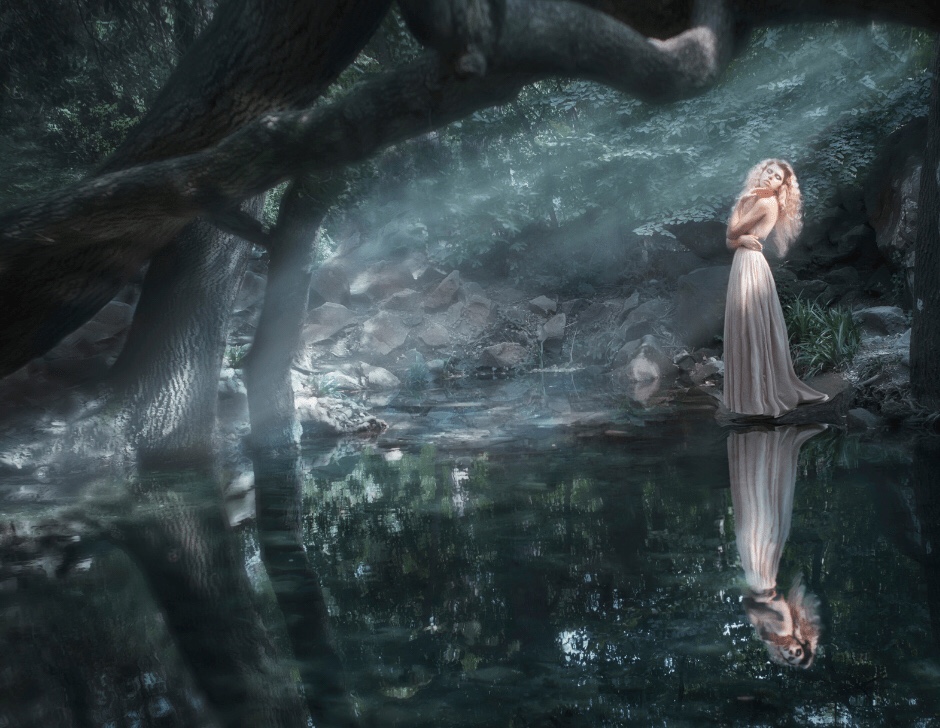
A Lady of the Lake is a magical water faery and enchantress who lives in lakes and ponds to keep watch over them and maintain their purity. Their legends and mythology have spread across many cultures, and no one knows their exact origins.
In Arthurian legend, she is a mystifying faery queen who (along with three other faery queens) brings Arthur’s injured body to Avalon.
Some people believe a Lady of the Lake is a representation of the Morrìgan. Other’s believe she’s the Celtic goddess Àine or Coventina. It’s also been speculated that they descended from a mermaid.
Traunsee in Austria is said to be home to a stunning, but evil, Lady of the Lake. On moonlit nights she can be found near the waterfall. Any mortal who sees her will suffer great tragedy and sorrow. Fishermen are reported to vanish from the lakeshore and never return.
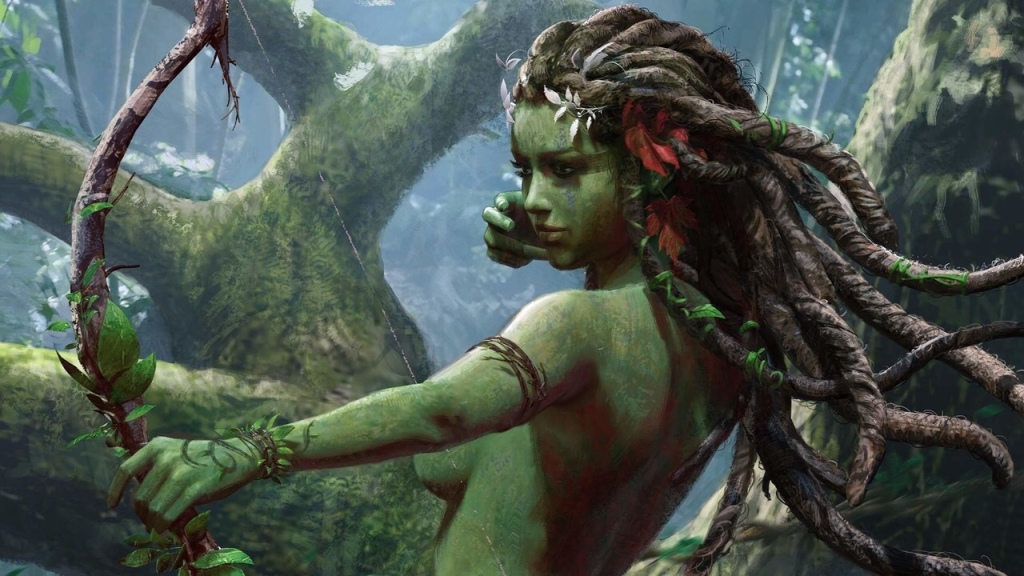
Dryads are wood nymphs and tree spirits who live in trees. Their names come from the Greek word Drys, meaning oak.
Dryads are known for fiercely guarding trees and you’lloften find them chatting to the trees they protect. These types of fae believe it’s their duty to punish anyone who commits crimes against Nature and their wrath is not something you want to encounter.
It’s often said if the tree a Dryad is protecting dies, so would the Dryad.
A Boggart is a shapeshifting spirit or creature from English folklore that inhabits both moors and marshes and is sometimes called a Boggard or Bag. Some legends say that boggarts haunt the swamps of northern England, Scotland, and Wales.
In many Scottish and northern English folklore, there are numerous household boggarts who act similar to a Brownie by doing household chores. However, Boggarts tend to be more malevolent by destroying household items if not rewarded or mistreated, whereas Brownies tend to be more friendly.
These types of fae can appear in a variety of forms and act like a demon or poltergeist.
Boggarts are notorious for their deception and seldom have a description because they rarely appear, and when they do they take on other forms. Boggarts who manifest as people are typically more violent than those who manifest as animals.
Boggarts were featured in the Harry Potter series written by J.K Rowling. Stephen King is also a Boggart.
Another [story] tells of the Boggart of the Brook, at Garstang in Yorkshire, which appears as a woman in a hooded cloak at the roadside requesting a lift from travelers, usually those on horseback. When the “hitchhiker” has become a passenger, she reveals herself to be a skeleton, and her demonic cackle and clawing grip spur the traveler into a frenzied ride, causing injury or death.
~ Carol Rose – Spirits, Fairies, Gnomes, and Goblins
Specific flowers, such as buddleia, attract butterflies and fairies alike. Wild flowers that are bell-shaped, such as foxgloves and bluebells, work in much the same way. Planting certain flowers will encourage fairies to come in their droves and bring an extra sparkle of magic to your back yard:
Bluebell: The indigo hue attracts fairies. They love to dance on bluebell-carpeted woodland.
Buttercup: The golden cup brings confidence and awareness of your own abilities.
Clover: Three- or four-leaved clover can be carried as a protective charm.
Cowslip: Thought to be a portal into the fairy dimension.
Daffodil: This yellow trumpet ushers in the spring and brings clarity and new beginnings.
Daisy: Holds both the strong male energy of the sun and the soft feminine energy of the moon.
Heather: Perfect for fairies to feed from.
Honeysuckle: Its potent fragrance evokes old memories and buried feelings.
Lavender: Its therapeutic fragrance soothes, cleanses and calms and induces sleep.
Marigold: Connected to the warmth of the sun, it has magical potency at noon.
Poppy: Bringer of dreams and visions, inspiration and creativity – when used carefully.
Primrose: Portal to the fairy realm. Protects the household from harm.
Rose: Bringer of love, healer of the heart and feminine energy.
Snapdragon: Repels negativity and reveals hidden truths.
Tulip: Shaped like a chalice, this ‘cup of love’ assists with feeling the blessings of nature.”
Although worship of the Scandinavian gods for the most part ended a thousand years ago, and the myths are now exotic and foreign to most people in the English-speaking world, we make implicit reference to the gods and myths almost every day of our lives. That is because the names of the weekdays Tuesday, Wednesday, Thursday, and Friday all contain the names of old Scandinavian gods (Týr, Odin, Thor, and Frigg; the Old English forms were Tiw, Wodæn, Thunor, and Friija), and the choice of the gods for each of these days was based on myths about them.
Furthermore, when we read about or travel in places like Odense, Denmark (probably best known outside Denmark as the birthplace of Hans Christian Andersen), we see a place-name that once bore the name of the god Odin. There are hundreds of these in Scandinavia, but they are seldom obvious, except in Iceland, where there are places with names like Þórsmörk (Thor’s forest), a favorite place for hiking and camping. And if you are acquainted with or have heard of anyone called Freyja, Thor, Baldur (a not uncommon name in Iceland), or any Scandinavian name beginning with Tor, you know of the persistence of the names of the gods in personal naming systems.
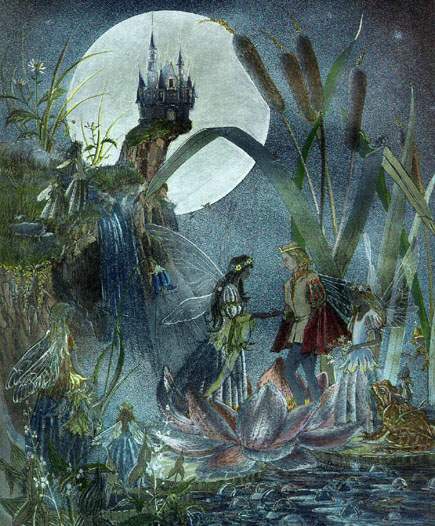
In faerie lore there is the tradition where the fae whisk away humans to fairyland. Humans also run the risk of accidentally wandering into fairyland, which is why one might want to stay away from bluebell fields and other fairy-rich environments, and avoid consuming fairy food or drink, which could leave one vulnerable to being tricked into making a little visit there. The fairies don’t really need a reason to do so, but they might take a young man or woman who’s especially desirable to be the husband or bride of a fairy ruler; there are stories of fairies using humans as slaves in their palaces, and young mothers were desirable for their milk, which apparently is of better quality than the fairies’. And of course if you betray or upset the fairies, all bets are off.
Here are a few tips to help you avoid this tragic fate:
Do not step in mushroom rings.
If you hear music from an unidentifiable source, try not to listen.
Take off your coat or shirt and turn it inside out if you think fairies may be near. It sounds odd, but it works. It doesn’t so much repel them, but it does confuse them long enough for you to escape.
Fairies hate iron, which is like poison to them. Carry some with you—a nail or small object—just in case.
To avoid being taken by fairies, keep on their good side. Show them respect. Leave them a bowl of milk (or bread, cream, butter, or ale) outside your door.
As you walk by a natural body of water, throw in a piece of silver as a gift for them.
By all means, if you ever take anything from nature, leave a small biodegradable gift in token.
Never, ever say thank-you to fairies for anything they’ve done. A human thank-you offends them, because they feel it trivializes their contribution and effort.
Do not accept fairy gifts. If you do so, you owe them. And they can ask for anything in return.
Never tell a fairy your name. Names have great power. If a fairy ever gives you his or her true name, it’s a huge sign of trust and not to be misused.
Always be polite.
If you do find yourself trapped in fairyland, do not eat or drink anything, no matter how alluring and delectable. You may still be able to escape as long as you follow this rule.
Be prepared for time to have passed differently in fairyland if you ever have need to go there. You can never visit the fairies and leave unchanged.
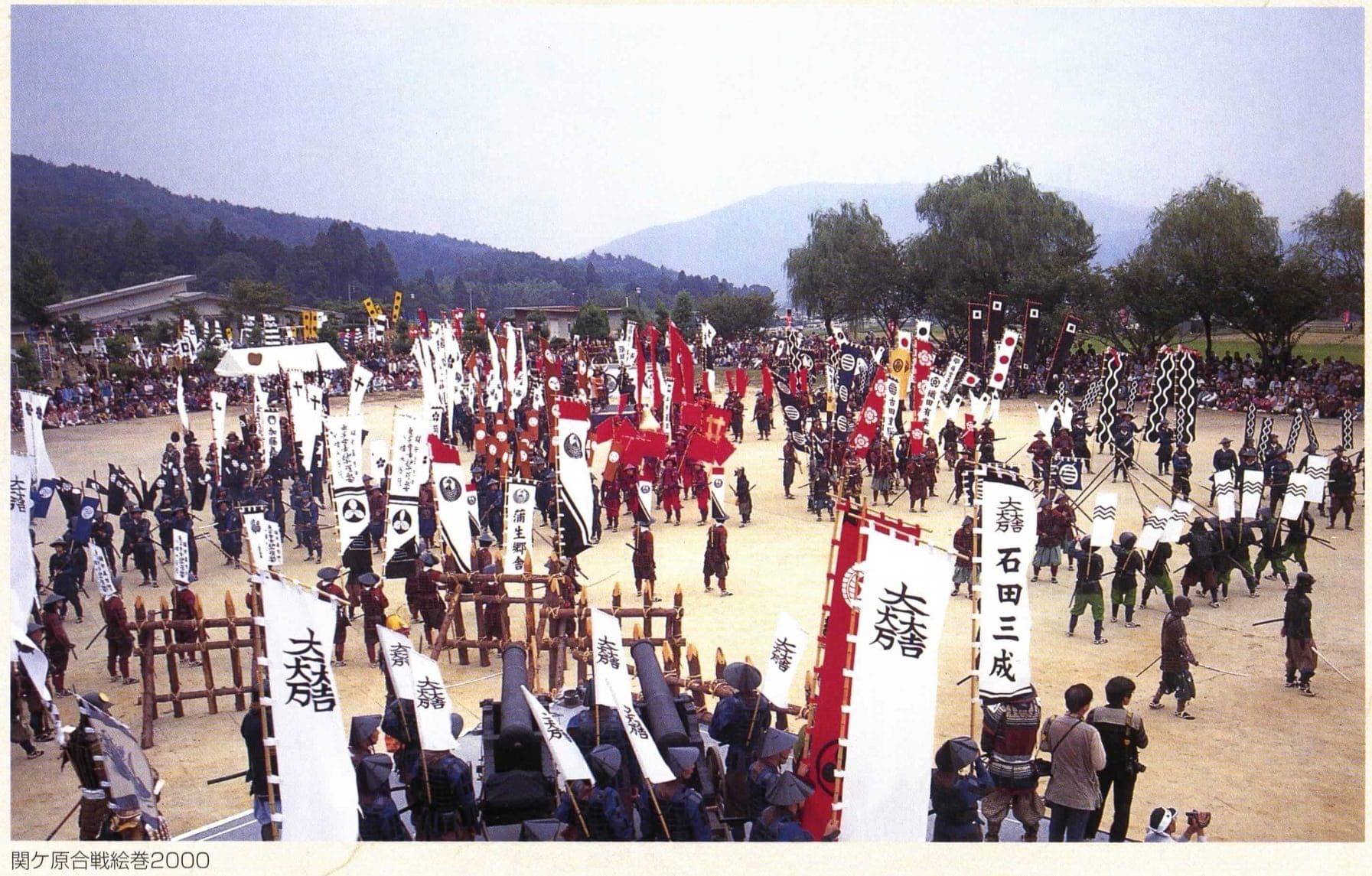
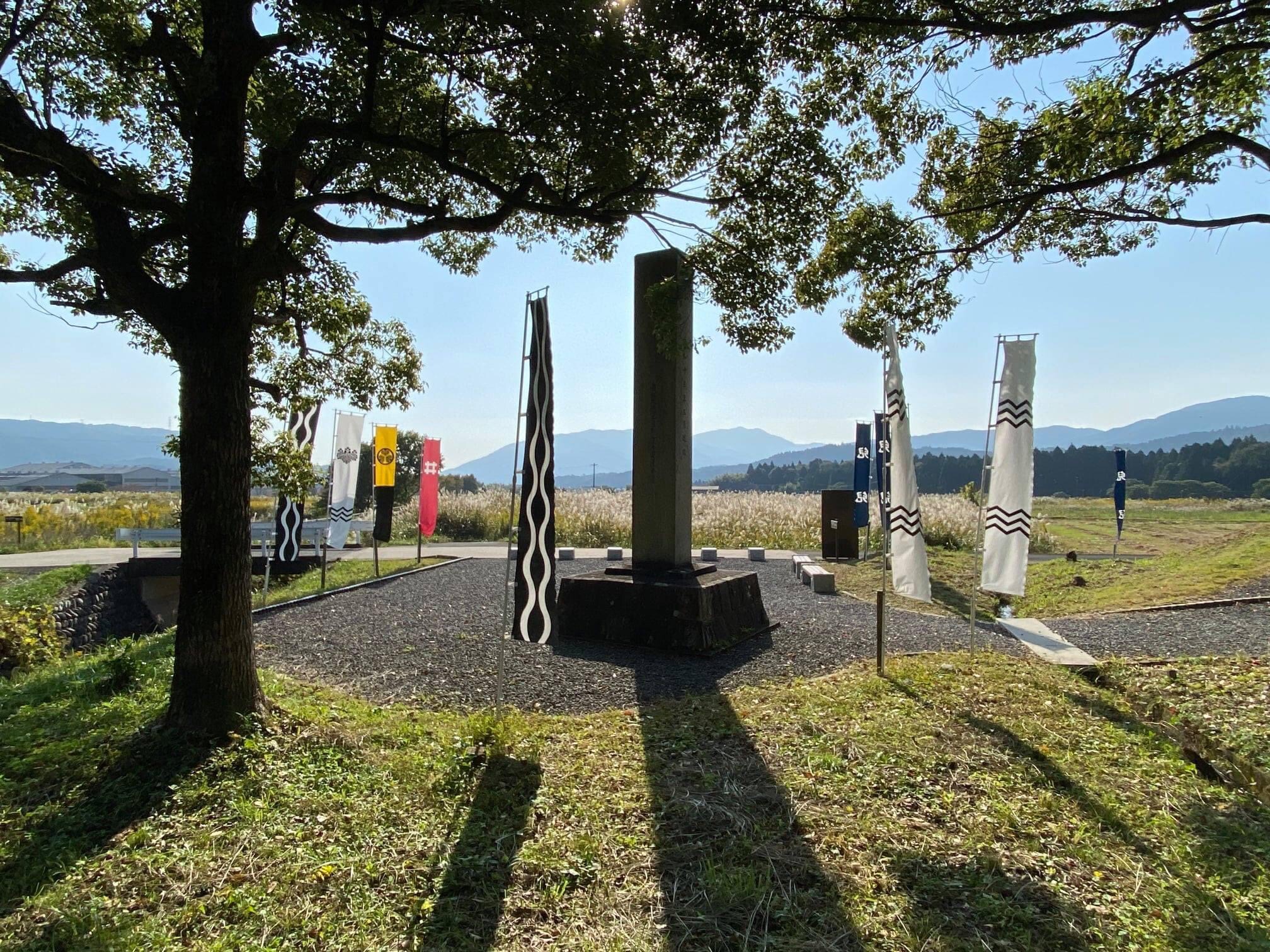
October 21, 1600,…421 years ago, the great Battle of Sekigahara was fought and won by the Tokugawa.
Sekigahara was the greatest, most violent and decisive samurai field battle in history.
Japan had long been at civil war until brought under the rule of first Oda Nobunaga, and upon his death at the hands of a traitorous general, that of Toyotomi Hideyoshi, who completed the unification of Japan and brought unknown peace. However, following Hideyoshi’s death, a power struggle emerged between those loyal to the Toyotomi, and the second most powerful warlord, Tokugawa Ieyasu. With Hideyoshi gone, Ieyasu made moves that brought the ire of a number of his contemporaries, and soon the entire country was divided into two great armies, East and West. Leading the loyalist cause was Ishida Mitsunari, a samurai, but not of the warrior faction, but the administrative faction.
Both sides hurried to take strategically vital highways and castles. These attacks and sieges culminated in the decisive Battle of Sekigahara that took place on the morning of Saturday October 21, 1600. Over 160,000 troops had filled the 2x2km wide basin between the mountains that divided Japan into east and west at Sekigahara.
The battle lasted just over six hours but saw the deaths of an estimated 30,000 samurai, the destruction of a number of noble families and the creation of the Tokugawa Shogunate that was to rule Japan for 260 years of relative peace. The loyalist Western forces, despite having commenced with superior numbers, the higher ground and excellent battle formations, were defeated as a number of Western troops defected midway, turning the tide of the battle.
Victory was claimed by Tokugawa Ieyasu and his Eastern coalition forces. Victory at Sekigahara changed Japan’s history forever, leading to the Tokugawa or Edo period, during which Japan was at relative peace for 260 years.
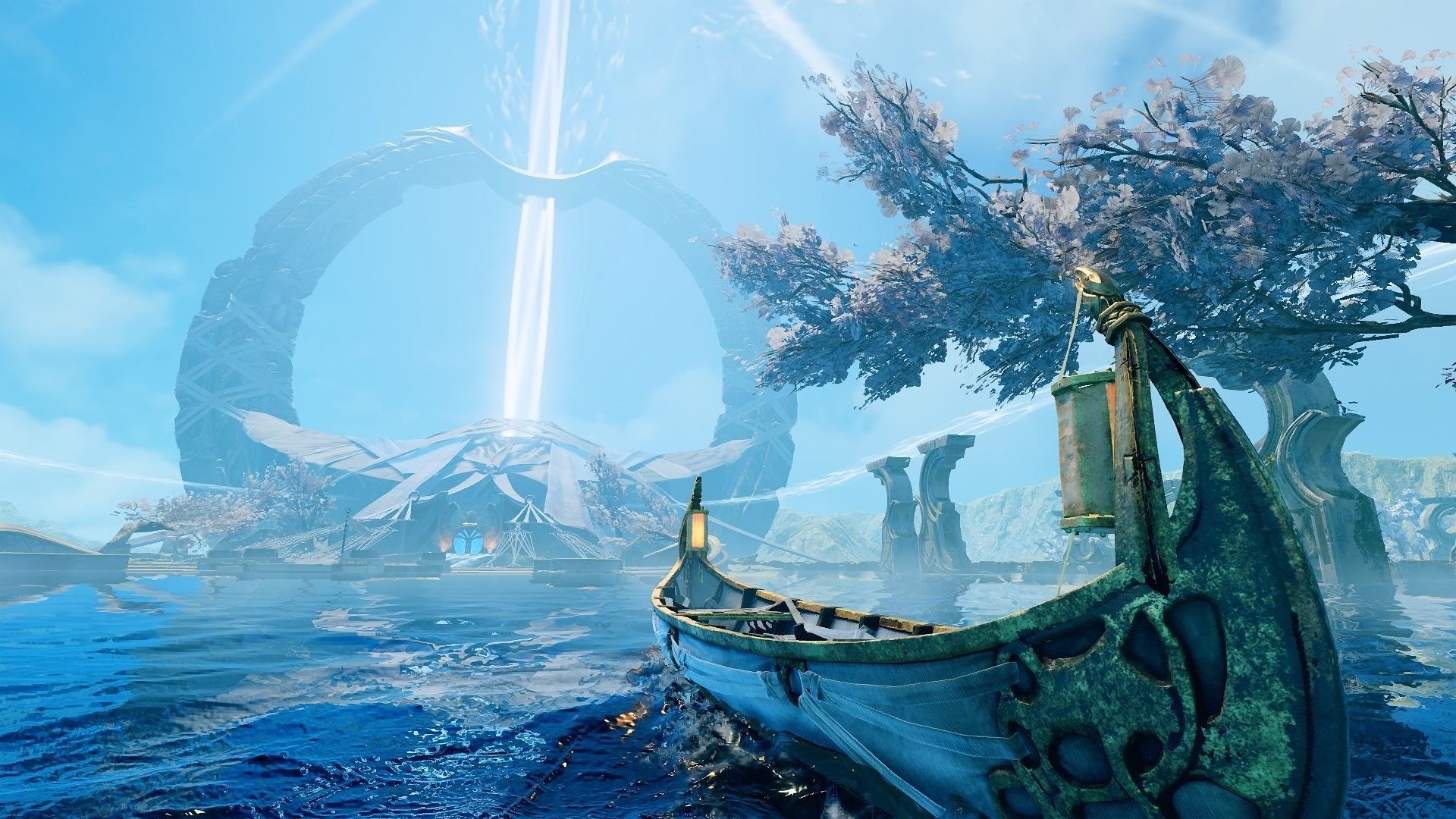
Alfheim (“elf home”), in Norse mythology, is one of the nine worlds. It is located on the highest level of the Norse universe. Also found on this level are the worlds of Asgard and Vanaheim. Alfheim is the palace of the god Freyr and the homeland of the elves of light. Neither the elves of light nor the elves of darkness, who live in Svartalfheim, participate in any of the events described in the Norse myths. Elves do, however, have active roles in the literature of quite a few of the other branches of Indo-European mythology.
Alfheim is never described in the sources that form the basis of our current knowledge of heathen Germanic religion, but is rather merely mentioned in passing in a few places. However, the elves are described as being luminous and “more beautiful than the sun,” so we may suppose that their homeland was a gracious realm of light and beauty. Although the realms that comprise the Nine Worlds of the Norse cosmology are never listed, it seems highly probable that, given the prominence of the elves in Germanic religion, Alfheim was one of them.
The Vanir god Freyr is said to be the ruler of Alfheim. Scholars have long puzzled over what to make of this, and no wholly satisfactory conclusions have been put forth. The relationship between the elves and the Vanir is highly ambiguous and involves considerable overlap between the two groups. Freyr’s position as lord of Alfheim, therefore, while hard to interpret with much precision, shouldn’t be entirely surprising.
Fenrir (or Fenris) is a gigantic and terrible monster in the shape of a wolf. He is the eldest child of Loki and the giantess Angrboda. The gods learned of a prophecy which stated that the wolf and his family would one day be responsible for the destruction of the world. They caught the wolf and locked him in a cage. Only the god of war, Tyr, dared to feed and take care of the wolf. When he was still a pup they had nothing to fear, but when the gods saw one day how he had grown, they decided to render him harmless. However, none of the gods had enough courage to face the gigantic wolf. Instead, they tried to trick him. They said the wolf was weak and could never break free when he was chained. Fenrir accepted the challenge and let the gods chain him. Unfortunately, he was so immensely strong that he managed to break the strongest fetters as if they were cobwebs.
After that, the gods saw only one alternative left: a magic chain. They ordered the dwarves to make something so strong that it could hold the wolf. The result was a soft, thin ribbon: Gleipnir. It was incredibly strong, despite what its size and appearance might suggest. The ribbon was fashioned of six strange elements: the footstep of a cat; the roots of a mountain; a woman’s beard; the breath of fishes; the sinews of a bear; and a bird’s spittle. The gods tried to trick the wolf again, only this time Fenrir was less eager to show his strength. He saw how thin the chain was, and said there was no pride in breaking such a weak chain. Eventually, though, he agreed, thinking that otherwise his strength and courage would be doubted. Suspecting treachery however, he in turn asked the gods for a token of good will: one of them had to put a hand between his jaws. The gods were not overly eager to do this, knowing what they could expect. Finally, only Tyr agreed, and the gods chained the wolf with Gleipnir. No matter how hard Fenrir struggled, he could not break free from this thin ribbon.
In revenge, he bit off Tyr’s hand.Being very pleased with themselves, the gods carried Fenrir off and chained him to a rock (called Gioll) a mile down into the earth. They put a sword between his jaws to prevent him from biting. On the day of Ragnarok, Fenrir will break his chains and join the giants in their battle against the gods. He will seek out Odin and devour him. Vidar, Odin’s son, will avenge his father by killing the wolf.
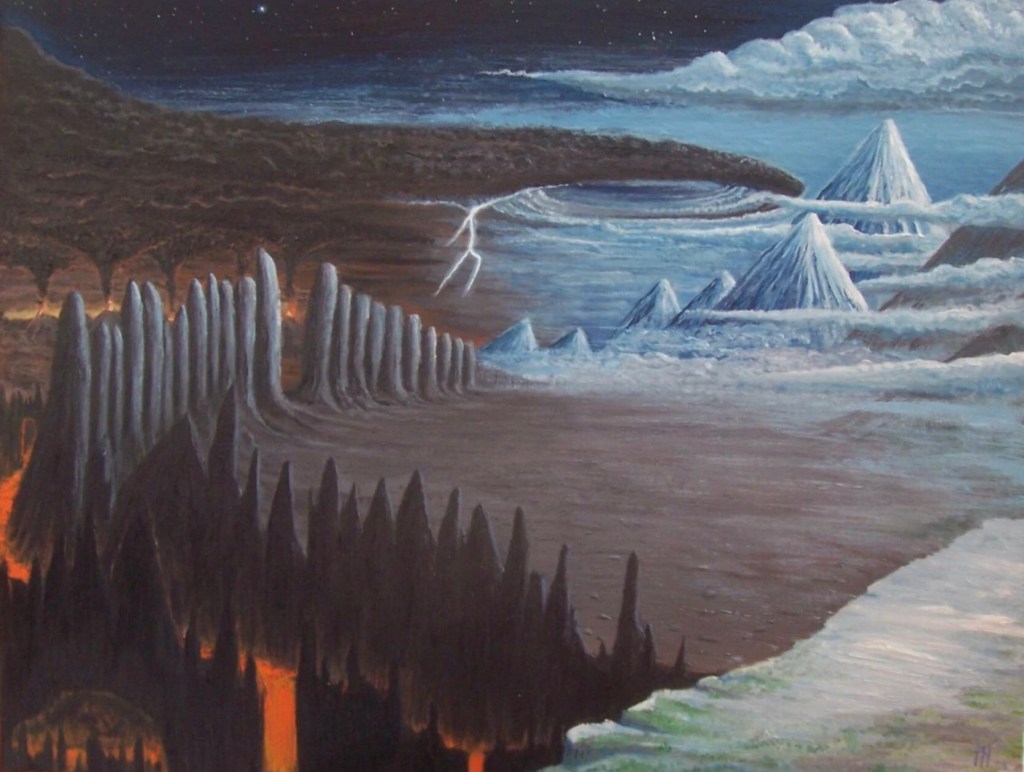
Ginnungagap (“seeming emptiness”), in the cosmology of Norse mythology, is the primordial void separating Niflheim and Muspell, the land of eternal ice and snow and the land of eternal heat and flame.In the beginning, before the world of men and gods existed, the spring Hvergelmir, deep in the frozen wastes of Niflheim, gave rise to eleven rivers known as the Elivagar. Over a long period of time, water of the Elivagar ran across Niflheim and poured into the northern part of Ginnungagap. The water froze, forming vast sheets of ice in the void. Hot air from Muspell melted some of the ice, creating a zone of meltwater amid the ice and snow. Here life began, and the first living thing was a frost giant.






 Mark Bere Peterson’s Counterculture, Urban Legends, Paganism & Witchcraft