Cotton Gin Invented

After the Revolutionary War the South was looking for a new crop to replace Indigo, whose trade it had lost during the war to India. One possibility was cotton. However, traditional cotton, known as long staple, or Egyptian cotton, could only be grown on the Atlantic Islands of the US. It required a very long growing season and sandy soil. The alternative was short season cotton. Though that cotton has sticky seeds that were very difficult to separate. Then, Eli Whitney came on to the scene.

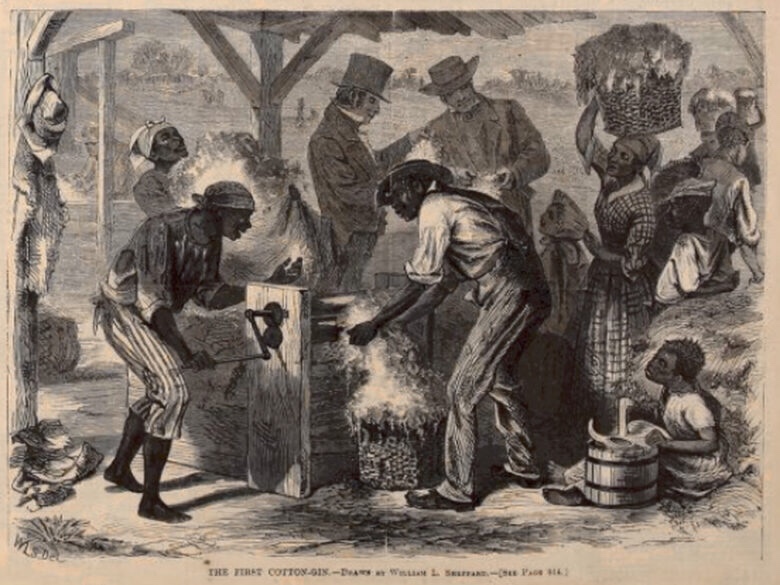
Whitney heard about how difficult it was to gin (or clean) cotton. He thought of a machine that would be able to do it. He studded a roller with nails, one half inch apart. The roller could then be turned and the nails would pass through a grid. The roller pulled the cotton lint through the grid, leaving the seed behind. The lint would then be pulled off the nails while the seeds would fall off separately. A single laborer could now gin what it took 25 laborers to get done before. This made farming upland cotton economically feasible for the first time.

The effect of the development the cotton gin was unprecedented. In 1793, the United States produced about five million pounds of cotton– almost all of it the Sea Island type. This represented less than 1% of the world’s production of cotton. By 1860, the US was producing 2 billion pounds of cotton– over 75% of the world’s cotton production.

The effect of the growth of the cotton industry on slavery was overwhelming. Before the introduction of the Gin, the need for slaves was modest, and slaves were not considered that valuable. Before the Gin, a slave was could be bought for $300. By the time of the Civil War, the cost for a slave was $3,000. Cotton farming was a labor-intensive endeavor– even with the Cotton Gin. However, slavery made the labor of cotton very profitable.

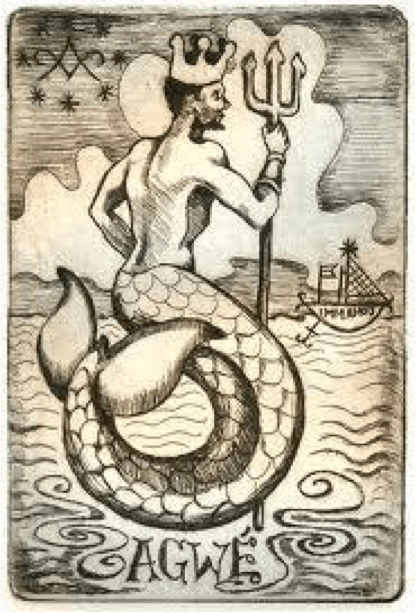
Agbe (or Agwe): Vodun of the Sea

Agbe is the third-born son of Mawu and Lisa. He is the one who is given dominion over the seas and sea life. There aren’t many stories based on Agbe, but as we look back to Mawu’s creation of the world, Agbe’s role within the world becomes obvious. When Mawu built the world, she was afraid that the earth would drown from the added weight, so her snake came in to save it. However, the waters can still be unpredictable, rough, and sometimes cause a whole host of problems.

The land is resting on an outline of great waters, waters that can engulf the land when disturbed. So Agbe functions to keep the waters at bay, provide safety, and protect from powerful storms. Agbe also has some effects on the land that the people experience. For instance, when earthquakes happen, they can be explained by his activity–he has made the water do something that makes the land shake. The serpent is primarily there to keep the world from sinking. The Fon being a fishing people, might have also worshipped Agbe for his luck.

So we see Agbe as the protector, provider, and calmer of seas. He’s not the only one who performs these roles, but he is one of the most powerful to do so. Again, we see how together each god’s roles feed on each other or strengthen each other. While Sakpata pushes for progress, Agbe is the one holding forces that threaten peace and the very land we live on intact.

You can pray to him for protection, maintenance, and calm in your life. These are, in a nutshell, where the spirit excels. But when displeased, it may be a source of chaos, destruction, especially the kind that upends people’s lives. So he is a potent spirit.

Source: Vodun. Monique Joiner Siedlak

U.S. Navy Created

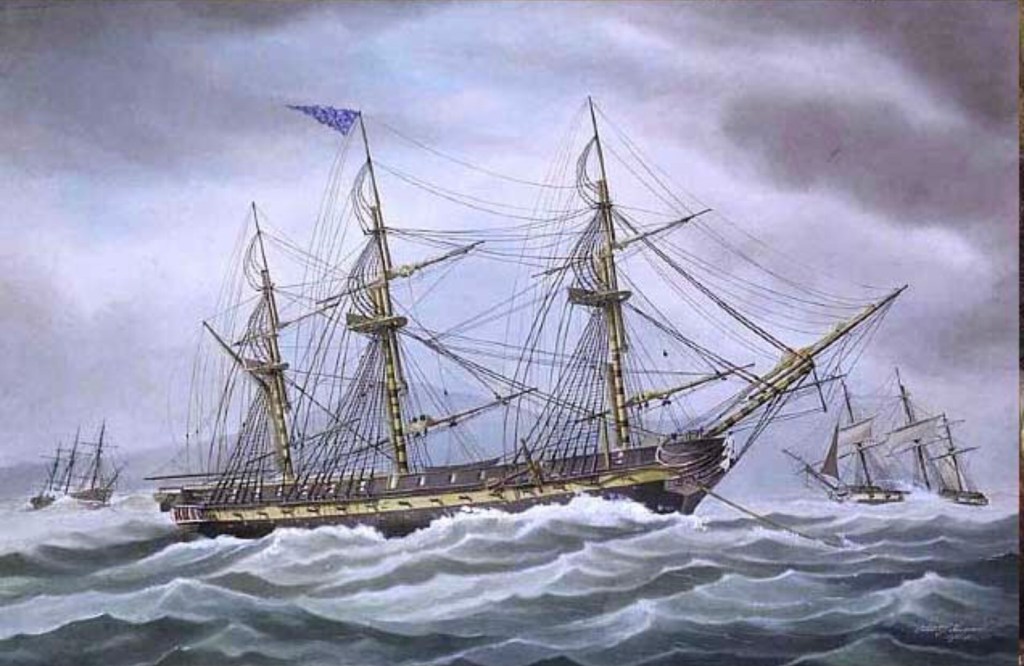
The Continental Congress capped a number of months of debate when it authorized on October 13th 1775 the arming of two sailing ships with guns. The two ships were then ordered to try to intercept two British ships on the way to Canada with armaments. Some of the members of the Congress led by John Adams had been advocating for the establishment of the Naval forces for many months, arguing that they could help protect coastal communities and disrupt British communications. The Southern delegates opposed the move which they felt as too radical and would do little to protect Southern ports. An initial proposal by the Rhode Island delegation to establish an American naval fleet was attacked as too vague and never came to a vote. Circumstances changed when news reached the Congress that the British were sending two unarmed ships laden with arms to Canada.

At the same time Congress received a report from General Washington in which he reported that he had enlisted three coastal schooners into his forces to help intercept British ships. Since the US now effectively had naval ships, authorizing the arming of additional ones no longer seemed a stretch for members of Congress. Thus on October 13th they so authorized the action While the US navy during the Revolutionary War could never really threaten the British Naval superiority, it fielded over 50 ships of various kinds during the war, and captured 200 British ships. The Navy was key in maintaining the American communications to Europe and bringing vital supplies to the US.

The Louisiana Crawfish Boil Experience

1. When is crawfish season?
  • You’ll see them as early as December, and they hit their peak around March-April and disappear come July
  • New Orleans has four seasons: Mardi Gras (winter), crawfish (spring), snowballs (summer), football (fall)
  • When it’s festival season, it’s usually a great time for crawfish
2. In New Orleans they don’t call them crayfish, crawdads or mudbugs: they’re crawfish.
3. Breaux Bridge, La. is the “crawfish capital of the world.”
4. What to throw in the boil:
  • 4-5 pounds crawfish per person
  • Basic — garlic, boil seasoning, lemon halves, celery
  • Classic – add red potatoes, corn, sausage, artichokes
  • Classic redux – add sweet potatoes, Brussels sprouts, pineapple, pork chops
  • Asian-Cajun – add orange wedges, lemongrass stalks 
  • You’ll also need…
  • Newspaper = makeshift table clothes
  • Plastic trays
  • Rolls of paper towels
  • Dipping sauce for potatoes
  • Traditionally lots of beer
5. Random tips/facts:
  • Don’t eat the straight ones
  • Look for the rare blue crawfish and less rare white crawfish
  • Make crawfish étouffée with leftover tails (if you have any), spicy potato salad with leftover potatoes, or a garlic mash to spread on bread with the leftover garlic
  • Don’t forget to get some meat from the claws!

The Casket Girls of New Orleans

What exactly are casket girls? The filles à la cassette (“women with suitcases”) traveled to French colonies in America. They arrived in the New World with a trunk, or cassette, containing their belongings. The word “cassette” morphed into “casquette” over time, and that translaed to “casket”. History recorded these women as “casket” girls. The filles à la cassette were some of the original “mothers” of New Orleans. Here’s their story.

Legends:

“Caskets” conjure up images quite different from a suitcase of dresses and petticoats these woman were known to carry on the long voyage to New Orleans. These suitcases were relatively small, so that the women could carry them without assistance. Many of the photos of “original” cassettes stretch this concept, literally, so that the suitcases appear to be large enough to carry a body.

By the time the storytellers told the tale of these women, their suitcases took on a new perspective. Why did young women bring “caskets” to the new world? Did their luggage contain more than petticoats? Paranormal Fiction writers love old New Orleans. The city’s mix of Catholicism and voudon set in a location influenced by Africans, French, Spanish, British, and Asian is nirvana for writers. It’s natural for writers to run with this and tell vampire tales.

Most of the vampire-themed stories centering on the filles focus on two things: the caskets and the convent. Perhaps one of the most interesting legends relating to vampires are the stories about the third floor of the 1751 convent building. The legend is that the third floor was sealed off. The windows were permanently shuttered. While some stories say those shutters were nailed down with nails blessed by a pope, Pope John Paul II was the first pontiff to visit New Orleans in 1987. One might assume these nails were brought to Rome for blessing, then shipped across the Atlantic. In spite of the holes in the stories, many are still fun to read. Don’t pass up the opportunity to visit the Old Ursuline Convent to decide for yourself. In the meantime, here’s a little history about the casket girls.

History of the casket girls:

The founders of New Orleans were explorers, trappers, and traders who established encampments along the lower part of the Mississippi River.  The French established three main outposts along the Gulf Coast: Mobile, Biloxi, and later, New Orleans. Because the early explorers were mostly male, Catholic priests in the region became concerned that, without wives, the future of Christian evangelism in the French territory was at risk. They turned to bishops and mayors of French port cities, who gladly agreed to empty their jails and brothels. This was essentially “transportation” of “undesirable” women.

These women did not make good domestic partners for the colonial men. The priests sought an alternative plan. They asked King Louis IV for assistance. The King tasked the Bishop of Québec with appealing to convents and orphanages in France. They sought out young women who they could contract to come to the colonies. The bishop’s expectation was that virtuous women from the convents to be good candidates for marriage. The “casket girls” were contracted to be wives of men in the colonies.

Most of the Casket Girls didn’t see much of their spouses. French women used to working in convents and orphanages now took charge of households. The men of the colony in the 1720s-1730s were fur trappers and traders. The trappers spent long periods away from home, collecting the merchandise they sold for export. The traders took manufactured goods from Europe to the farms, plantations, and outposts for sale.

The climate of the colony also required a good bit of adjustment for these women. The weather was hot and the clothing they brought from France was likely wrong for the climate. They adapted to the city as they established households and raised children.

Source: https://gonola.com

Sakpata: Vodun of Earth

When Mawu was dividing the world between her children, Sakpata was given dominion over the earth, at the displeasure of his sister Sogbo. Sakpata came down from heaven with plants, crops, tools, and skills that humans could use for development. Because he had taken so much with him, he did not have space for other necessary elements like water and fire, which were stolen later.

Humans were excited when Sakpata descended from the heavens with these tools of wealth. There was a lot of promise in them, and they hoped they would see their lives improve. Legba, Sakpata’s youngest sibling, told Sogbo, who was given control of the skies, to withhold rain in the sky. Knowing that their mother noticed, Legba went to Mawu and told her water would not be enough for everyone on earth, including the plants. Alarmed, Mawu ordered Legba to tell Sogbo to withhold the rains, which he had already done.

Sakpata soon realized that his crops needed rain, but none came. A drought ensued that caused everything to become dry and brittle. Humans began getting angry with Sakpata. They harassed him and cursed him for lying to them about the prosperity and convenience he had promised. Legba came down and found his brother in a messy state. That was when he told Sakpata he would talk to Mawu on his behalf. He told Sakpata to watch for a messenger, wututu bird, who would say to him what to do when the time came. When the bird returned, it told Sakpata to instruct the others to light a great fire, so the smoke could rise to heaven, signaling their distress.

Because it was so dry, everything caught fire very quickly, and the fire leaped into the sky. When Legba saw, he went to Mawu and told her that the earth was burning and the fire was so high and powerful it might spread to the heavens. Alarmed, Mawu told Legaba to order Sogbo to release the rain. The rain put out the flames and returned fertility to the land. It was decided that although Sogbo controlled the sky, people can call for rain when needed.

What does this story reveal? In this context, it describes the role and power of the spirit of the earth, Sakpata. Sakpata is not the Vodun of Agriculture or fertility, but he is the god of progress and elevating society. When the spirit comes to rule over men, he brings them the tools of trade, crops they can domesticate, and abilities such as woodworking and carpentry skills. These are ways in which this spirit facilitates that mission of progress and growth by equipping humans with the capabilities to prosper, the right tools, and the right environment to do so.

Source: Vodun. Monique Joiner Siedlak

Xevioso: Vodun of Thunder

Xevioso is the god or lord of thunder. A god of thunder is one of the most common in cultures around the world. In Yoruba’s version, he is considered the strongest. He represents wrath, aggression, and punishment. In other words, Xevioso is understood as primarily a spirit of explosive, uncontrollable emotion like anger, violence, and tremendous power. This is a double-edged sword as he can protect those who honor him, but if they offend him in any way, he will likely turn on them.

This is the spirit you turn to when you are looking for justice. Still, anger is usually a sign that something isn’t as it should be, or there has been a violation of some agreement or law.

In most cases, spirits host and govern over the earth, and there is a set of agreements we have towards one another: a type of an unspoken agreement. We go into the world having agreed on a particular set of rules like not stealing from or hurting each other, and so forth. And when someone steals from us, we feel violated, and we have a right to be angry about it, even more so if we know they are getting away with it. Your anger is a sign that someone is not playing by the rules, an injustice has been done. Given this, it is not illogical to suggest that exercising your anger would restore justice and, therefore, balance the world. In other words, Xevioso is the protector and dispenser of justice. Through his acts, he enforces and keeps relations between the gods in check and us. It is not senseless, aimless, unexplainable anger, or fury. Although we may not understand it sometimes, it adds up on a cosmic scale.

Source: Vodun. Monique Joiner Siedlak

Prayer to Marie Laveau

PRAYER TO MARIE LAVEAU

Holy Mother of New Orleans Voudou, hear my prayer.
I humbly request your assistance.
Through you I feel the gentle power of Divine Justice.
Give me strength to stand against my enemies and protect me from those who wish me harm,

Sweet Heart of Marie, Show me your wisdom
That I shall speak the truth and elevate the Ancestors
Madame Marie, Bless me with the protection of Johnny Conker
That he shall always have my back.

Holy Mother of New Orleans Voudou, Bless me with the powers of the Sacred Serpent Li Grand Zombi
That I may walk in balance, equally male and female.
Holy Mother of New Orleans Voudou, Bless me with the spirit of St. Maroon

That I shall never take for granted the freedoms that I have.
And with the light that emanates from your Spirit, Madame Laveaux, all darkness is Obsolete.

Holy Mother of New Orleans Voudou, pray for me.
Holy Mother of New Orleans Voudou, hear my plea.
Holy Mother of New Orleans Voudou, Madame Marie, pray for me. Ashe!

Source: The Magic of Marie Laveau

Food Through Culture: Mulatto Rice

The dynamic duos of rice and beans and peas and rice have their roots in the Akan, Aja, Yoruba and Igbo kitchens in Ghana, Senegal, Nigeria and Gabon. When Africans arrived in the Americas, they continued cultivating these crops, so rice and beans dishes can be found throughout the African diaspora: red beans and rice; Hoppin’ John (black-eyed peas and rice); black beans and rice; and pigeon peas and rice. The popularity of these dishes as staples and special occasion foods continued after the abolition of slavery.

In the seventeenth century, West Africans from Cape Verde to the Gold Coast cultivated large amounts of rice. They grew so much rice, in fact, that they became known as the people of the Rice Coast. White rice planters in the South sought out West Africans for purchase as slaves because of their knowledge of rice cultivation. These West Africans brought their methods of cooking long-grain rice with them to the colonial South. The African cook made her greatest culinary mark on areas like Savannah, where blacks outnumbered Europeans. Mulatto rice is evidence of diasporic links between Africa and several regions of the Americas. Zora Neale Hurston begins and concludes her classic novel Their Eyes Were Watching God with rice and bean dishes. While Janie tells her friend Phoebe about how her grandmother escaped from slavery in Savannah and migrated first to Atlanta and then to West Florida, Janie is enjoying a plate of mulatto rice. “Mah mulatto rice ain’t so good dis time. Not enough bacon grease, but Ah reckon it’ll kill hungry,” says Phoebe. “Ah’ll tell you in a minute,” Janie says, lifting the cover off the plate. “Gal, it’s too good. You switches a mean fanny round in a kitchen.”

Mulatto Rice Recipe

6 strips bacon
½ cup onions, minced
2 cups water
1 cup tomatoes, diced
1 cup rice

Fry bacon in a pan then remove the bacon and brown a minced onion in the bacon grease. Next, add diced tomatoes. After it is hot, add a pint of rice to the mixture, and cook slowly until the rice is done.

Source: Zora Neale Hurston on Florida Food: Recipes, Remedies and Simple Pleasures