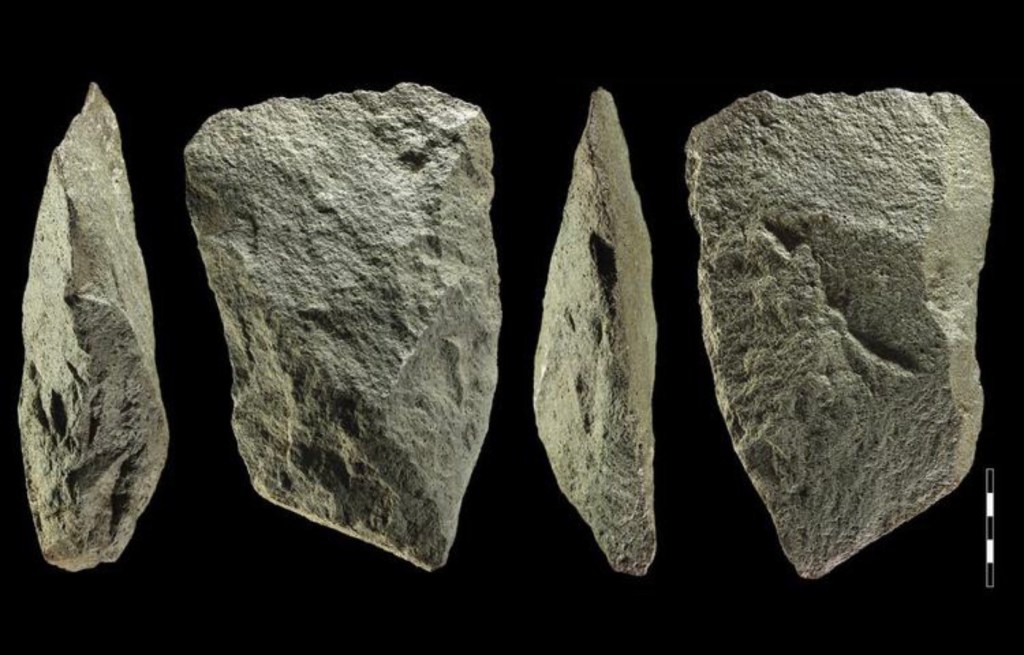
Stone Tools Used By Homo Erectus Discovered

Archaeologists have discovered hundreds of stone tools in a goldmine where Homo erectus would have inhabited 700,000 years ago in the eastern part of the Sahara Desert, 70 km east of the modern city of Atbara in Sudan.

Homo erectus (meaning “upright man”) is an extinct species of archaic human from the Pleistocene, with its earliest occurrence about 2 million years ago. Studies of surviving fossils suggest that the species had a humanlike gait and body proportions, and was the first human species to have exhibited a flat face, prominent nose, and possibly sparse body hair coverage.

A gold rush in the eastern Sahara Desert has led to many open-cast mines being excavated in search of the valuable ore. The mining activity has allowed archaeologists to study exposed layers containing large tools with a transverse cutting edge, and almond-shaped cleaver tools with chamfered edges on both sides, which form a pointed tip at the junction.

Archaeologists believe that the site was a workshop for the manufacturing of stone tools, evident by the discovery of associated flakes formed during their production.

Layers of earth and sand lying just above the tools have been analysed using optically stimulated luminescence (OSL), which dates the earthen-sand layer to around 390 thousand years ago.

Professor Mirosław Masojć from the Institute of Archaeology of the University of Wrocław said: “This means that the layers below are certainly older. Based on the style of workmanship of the tools, I believe that they may be over 700,000 years old, and perhaps even a million years old – similar to their counterparts in South Africa”.

The researchers suggest that the site is the oldest known example of tool manufacturing within the areas of Egypt and the Sudan that has a well-confirmed chronology, in which Masojć adds: “Yes, ancient tools are found in deserts, but never before have they come from layers that we can safely determine their age”.

Source: HeritageDaily

Lovers’ Quarrel Massage Oil

Heal a lovers’ quarrel or learn to forgive yourself.

  • 1 drop angelica essential oil (Angelica archangelica)
  • 5 drops German chamomile essential oil (Matricaria recutita)
  • 3 drops rose geranium essential oil (Pelargonium graveolens)
  • 8 drops lavender essential oil (Lavandula angustifolia)
  • 3 drops lime essential oil (Citrus latifolia)
  • 1.3 ounces jojoba oil
  • 1 drop or 1 gel cap vitamin E

Mix all oils in a dark-colored glass

For massage blends, a dilution of 2.5 percent is recommended (15 drops of synergy per ounce of carrier oil). Vitamin E is a good preservative for your massage oils, 10 drops per 8 fluid ounces of carrier oil.

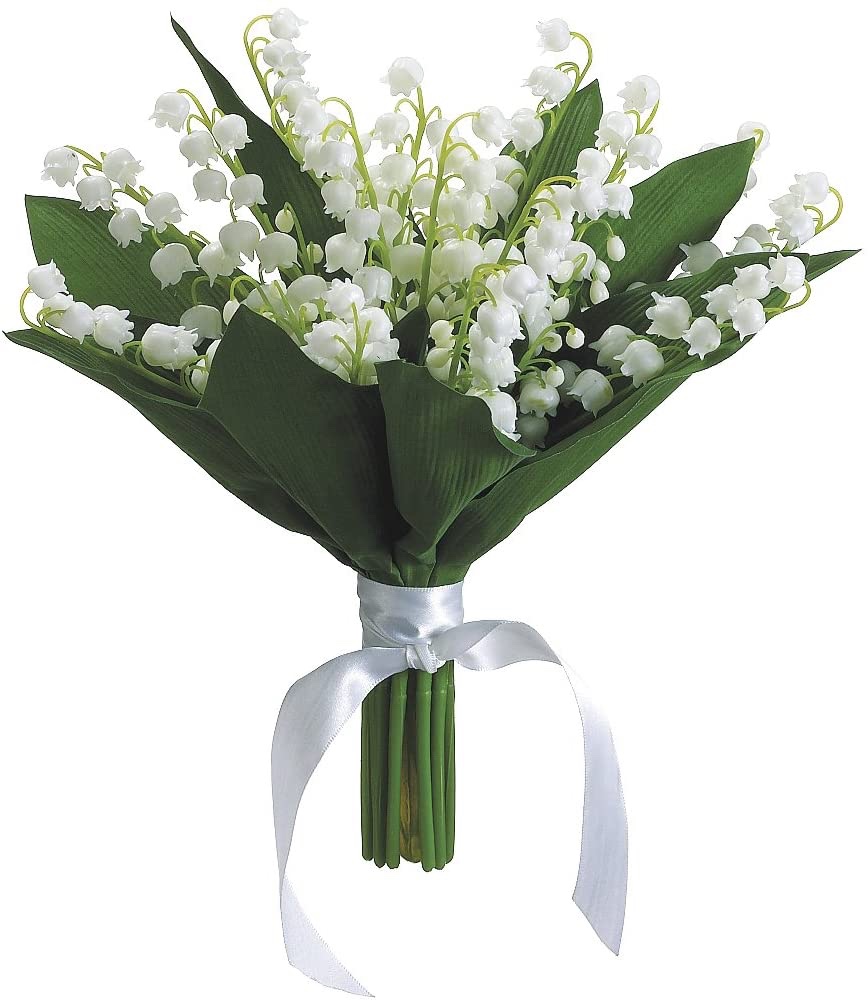
Lily of the Valley (convallaria majalis)

Lily of the Valley (convallaria majalis)

One of the most popular Victorian garden plants on account of its perfume, lily of the valley contains three glycosides; convallarin, convallamarin, and convallotoxin. Convallotoxin is one of the most active natural substances affecting the heart. It causes irregular, slow pulse rates and can cause heart failure. In addition, the plant contains saponins, which cause gastrointestinal poisoning.

There was a superstition that anyone planting a bed of lily of the valley would be dead within 12 months. Gerard recommended it ‘because it restores speech to those who have the ‘dumb palsy’ and is a treatment for gout. The flowers, put in a sealed glass jar and set in an anthill for a month, will yield a liquor which is an excellent ointment for treating gout.’

Magical propensities for drawing peace and tranquillity; repels negativity; empowering happiness; mental powers. Use in magical workings to stop harassment.

Trows

A term found in the Shetland and Orkney Islands of Scotland, likely imported to there from Norse areas during occupation periods. Possibly a variant of the word trolls. Trow is considered roughly synonymous to other Scottish terms for fairies including sighean.

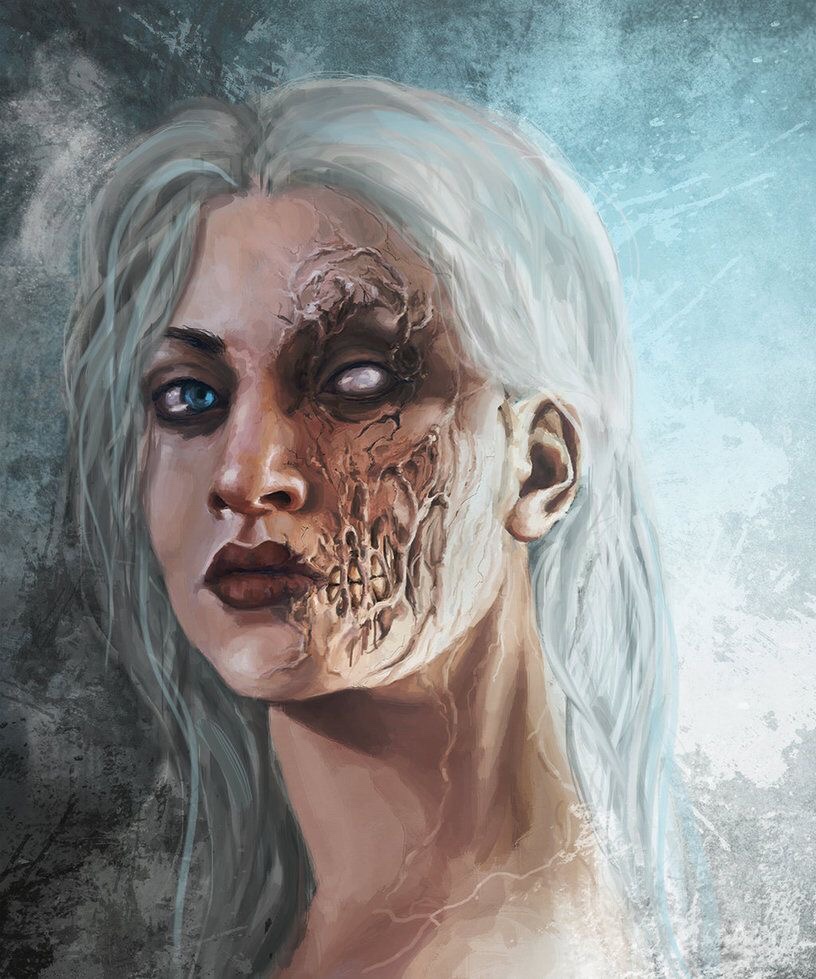
In some folklore Trows are described as very human in appearance, although they may appear old, shrivelled, or physically deformed. In other stories, however, they are described as clearly inhuman, unattractive, and twisted, even in sometimes appearing as a mix of human and horse. They are often described in unflattering terms as having oversized feet, large noses, flat faces, and short limbs. They can range in height from three to six feet depending on the story. They are often said to dress in grey, although sometimes they appear in green, red, white, or black.

It was claimed that the witches in these areas dealt with the trows, much as we see the witches in other areas dealing with fairies, and as in other areas the trows were known for shooting magical arrows that caused illness and death and for swapping changelings for beings they wanted.  In Shetland the Trows prefer night time and fear the sun which traps them on earth until it sets.  Like some other kinds of fairies Trows will make themselves welcome in human homes at night while the inhabitants are sleeping, coming in to sit by the fireside; they are known to dislike people who lock their doors for this reason.  Trows live in mounds that are often called knowes and like other fairies they will steal humans, most often brides, and enjoy music and causing mischief.


Tanngrisrnir and Tanngnjostr (Thor’s Goats)

Tanngrisrnir and Tanngnjostr

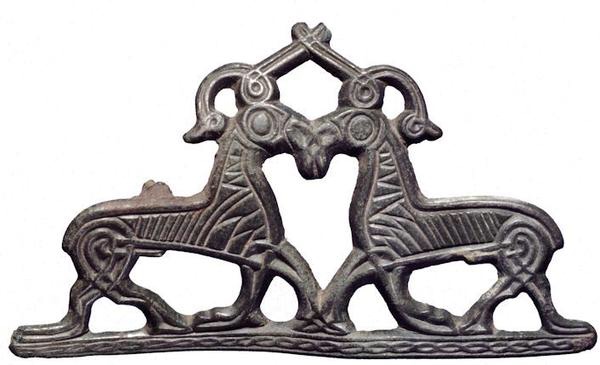
Tanngrisrnir and Tanngnjostr were the goats of Thor. They pulled Thor’s chariot across the sky. Everytime Thor crossed the sky with his goat-drawn chariot, there came the sound of thunder. 

In Norse mythology, Thor killed his goats for the food. And in the following day, he would resurrect his goats with his Mjolnir hammer. 

The symbol of Tanngrisrnir and Tanngnjostr also presented Thor and his presence. The goats symbolised the boundless endless and the masculinity. Modern archaeologists have excavated Viking artifact of the goats (as pictured).

Harpokrates Stelae

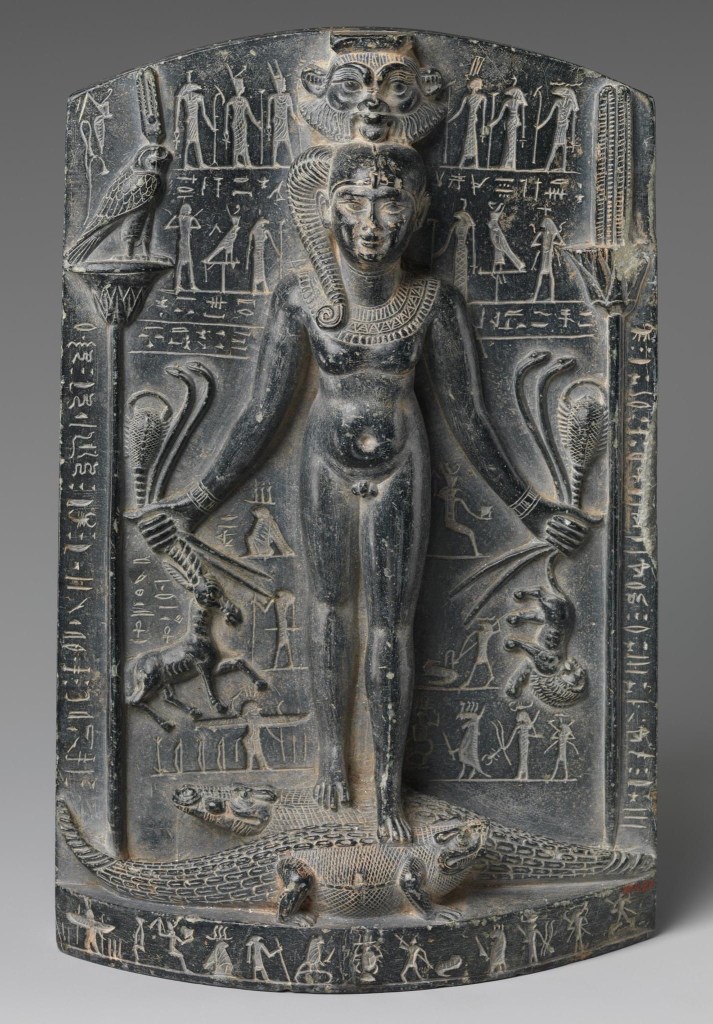
An amuletic plaque of the god Harpokrates (Horus the Child) standing in the center on the heads of two crocodiles and beneath a mask of Bes, a god especially associated with the protection of children and of pregnant women and those giving birth. In each hand Harpokrates clutches a scorpion by the stinger as well as two serpents. He also grasps a quadruped by the horns with his right while his left grips a lion by the tail. In addition, he is flanked by standards in the form of lotus and papyrus columns.

The plaque is extensively inscribed with magical spells to protect against scorpions, snakes, and the other noxious forces subdued by the god, and to heal the stings and bites of wild creatures.

The object is made of chlorite schist and is dated to the Ptolemaic Period (304-30 BCE). This type of stelae was often set up in homes, but examples have also been found in burials. This suggests that they were believed to extend their protective powers to the deceased.

This piece is now in the Metropolitan Museum of Art, New York, USA.

Golden Milk

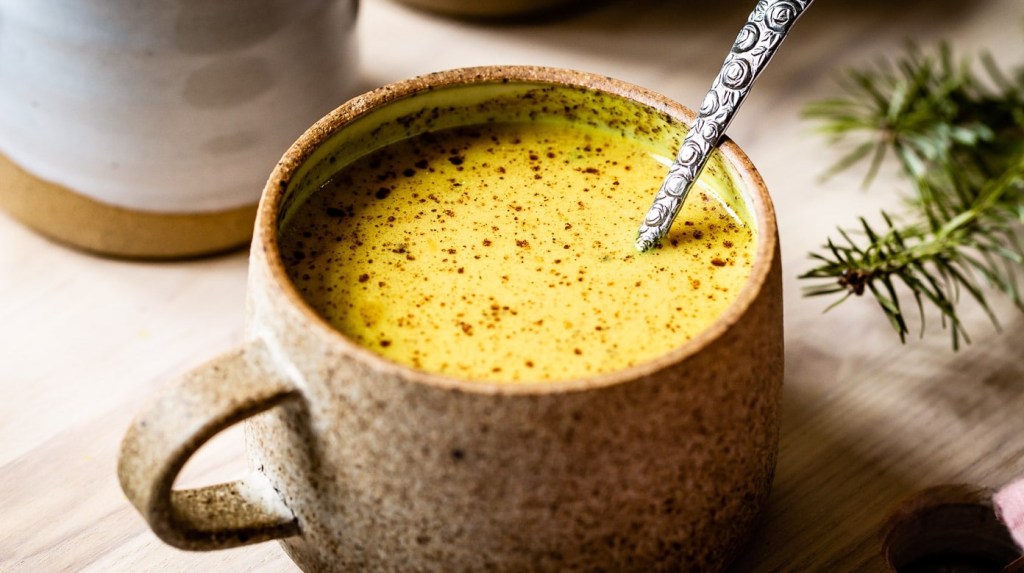
This golden tonic milk is based on a traditional Ayurvedic recipe. Made with anti-inflammatory turmeric and sedative poppy seeds (these nourish the nervous system, aiding in a peaceful night’s sleep), along with cardamom and vanilla, it soothes and relaxes the muscles and mind. Drink a mugful before bed to slip into a deep slumber.

1 mugful of almond or oat milk
1 teaspoon freshly grated turmeric or turmeric powder
1 teaspoon ground poppy seeds
½ cinnamon stick
3 cardamom pods
½ vanilla pod
1 teaspoon coconut oil
1–2 teaspoons honey or unrefined sugar


Heat the milk, herbs and spices in a saucepan, bring to a simmer, cover and turn the heat off. Leave to steep for 5–10 minutes, strain mixture into a mug and then stir in the coconut oil and honey or sugar. Serve, stirring between sips.

Mood Tea

In depression, it is important to take time for self care. Take a moment to make a healing, herbal tea at least once a day to help lift the spirits.

2 ounces dried rose

2 ounces dried skullcap

2 ounces dried St John’s wort

2 ounces dried vervain

Pour all the herbs into a sterilized jar and shake to mix them together. Seal, label and date.

Make an infusion with 1–2 teaspoons of the dried herb in a cup of boiling water, cover and steep for 15 minutes. Strain and drink.

Drink up to three times per day.

Shelf Life Keep the dried herb mix in a cool, dark place for up to 1 year.

Caution Check with a herbalist before taking St John’s wort with other medications.

The Children of Loki

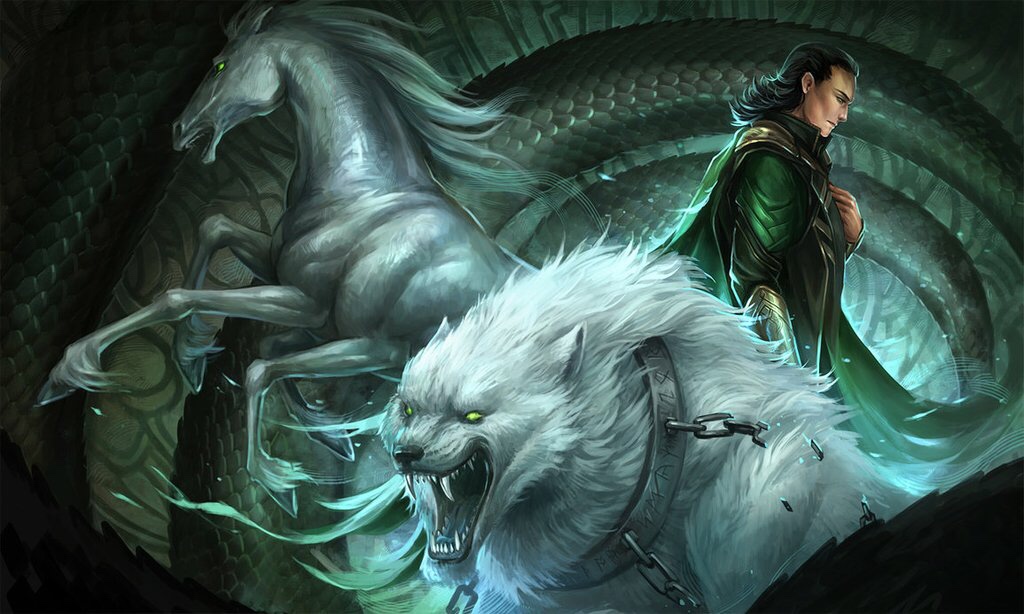
Loki the most complicated Norse character and the giantess Angrboda (“She who Brings Anguish”) had three notorious children. His first son was the Jormungandr the Midgard Serpent, the second daughter was Hel the Queen of Helheim, and the last one was Wolf Fenrir the God of Destruction.

Jormungandr

Jormungandr was also known as the Midgard Serpent. He was cast into the deep ocean by Odin the Allfather as a precaution against the Ragnarok. Deep under the ocean laid Jormungandr who quickly grew large enough to encircle the whole Midgard. Jormungandr held his own tail in his mouth. He was the sworn enemy of Thor. These two (Jormungandr and Thor) had encountered each other once before the days of Ragnarok. 

As Ragnarok was looming large, Jormungandr raised from the ocean and accompanied Loki’s army to enter Asgard. This Midgard Serpent had his last battle with Thor and got killed by the blow from Mjölnir hammer. Thor, unfortunately, was slain by the venom of the dead Jormungandr.

Hel

The only daughter of Loki, Hel, was banished into the land of Helheim located deep under the root of Yggdrasil tree. There, Hel built up her own kingdom of the dead and presided over that place. She was the queen of the deceased and the land of Helheim. According to the myth, if one soul belonged to Hel, without her permission, that soul could not do anything but serve in the land of Helheim. No one could ever interfere with this practice, even Odin the Allfather.

Hel joined the army of the Jotun to battle against Aesir gods. She brought the dead alongside.

Fenrir

Hardly could any villain in Norse myth rival the reputation of Wolf Fenrir. Fenrir was the worst nightmare to the Norse gods because Fenrir was predicted to swallow Odin in Ragnarok. As the gods scared that this scenario would come into being, they decided to raise the wolf by themselves. When the wolf grew up at an incredible speed, they bound Fenrir with a magical fetter. Fenrir then was sent to a middle-of-no-where place until he broke free on the threshold of Ragnarok.

In Ragnarok, Fenrir and his father, Loki, led the giant army to fight against the gods. Fenrir opened his enormous mouth with his jaw stretching from heaven to earth and swallowing anything that hindered him. When battling with Odin, Fenrir gained the upper hand and swallowed the god, proving the prophecy to be true.

Other Children of Loki

Sleipnir – Sleipnir was the result of one-night chase between Loki and a stallion Svadilfari. This happened when Loki wanted to prevent Svadilfari from finishing building Asgard Wall. Loki in disguise as a mare seduced Svadilfari to distract the stallion from finishing its task. As a result, a little horse was brought to life. Sleipnir was his name. And in fact, Loki was the mother of Sleipnir horse. Yes, Loki was the mother! Sleipnir horse then was given to Odin the Allfather by Loki. Sleipnir was a true treasure as he could travel not only on land but also over the sea and through the air. Odin rode Sleipnir into the battle of Ragnarok where he met Wolf Fenrir.

Nari and Vali – these two children of Loki had little material about them. The most well-known tale about these two was in the Punishment of Loki. The ironic story told that Vali in the form of a wolf killed his brother Nari. The gods used the entrails of Nari to bind Loki to the rocks as Loki’s most severe punishment for causing trouble to the gods.

Seelie

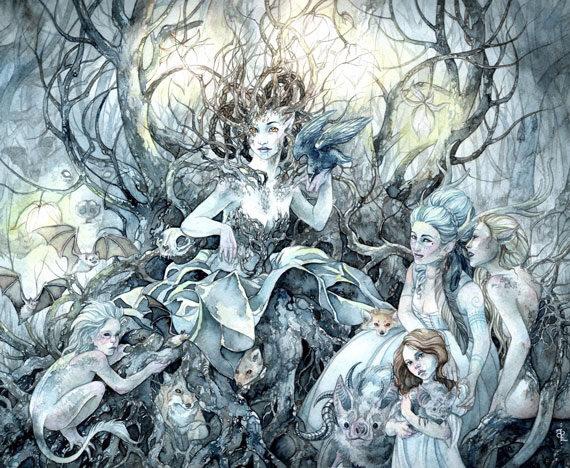
The seelie and unseelie courts of Scottish fairies are a particular feature of the folklore of that country; the clear separation of the faes into good and bad groupings that’s entailed is almost unique in folklore. Moreover, the notion of the two courts has, in recent years, attracted considerable attention and popularity- notwithstanding the fact that they are not mentioned in the majority of the Scottish faery-lore texts and collections. Probably the majority of recorded Scottish folklore relates to the Highlands and Islands, the Gaelic (and Norse) speaking regions, which may explain why we have relatively little material documenting the two courts.

The Scots word ‘seelie’ derives from the Anglo-Saxon (ge)sælig/ sællic meaning ‘happy’ or ‘prosperous.’  The evolution of the word in Middle English and Scots seems to have been in two directions.  One sense was ‘pious,’ ‘worthy,’ ‘auspicious’ or ‘blessed.’  The second development extended the meaning incrementally through ‘lucky,’ ‘cheerful,’ ‘innocent,’ and ‘simple,’ from whence it was a short final step to ‘simple-minded,’ as the modern English ‘silly’ denotes.  Because of this evolution, as well as because of the dialectical differences between English and Scots, it is preferable to use ‘seelie’ rather than to try to translate it.  In passing, we might observe that Scots is in many cases far nearer to original Anglo-Saxon than modern English, which has imported so many French and Latin words.

By late medieval and early modern times, ‘seelie’ or ‘seely’ in Scots meant happy or peaceable, as in ‘seely wights,’ and the ‘seely court,’ which was the ‘happy or pleasant court.’ It followed from this that ‘unseelie’ or ‘unsilly’ described something that was unhappy or wretched. The poet Dunbar referred to Satan’s “unsall meyne” (his “wretched troop of followers”), a phrase which could be a very appropriate term for the fairies.

The Scots word with a variety of spellings, particularly sely, and meanings including “lucky, happy, blessed”; the adjective is applied euphemistically to fairies in Scotland. This term is used in relation to the Scottish fairies, calling them both ‘Seelie court’ and ‘gude wichts’.  Court in this sense meaning a group or company, and wichts meaning beings. Seelie fairies are those who are benevolently inclined towards humans and likely to help around homes and farms. It should be remembered though that they are as able and likely to cause harm as any fairy. The use of the term Seelie in relation to fairies dates back to at least the 15th century in Scotland and can be found in a book from 1801; in the ‘Legend of the Bishop of St Androis’ it says:

“Ane Carling of the Quene of Phareis

that ewill win gair to elphyne careis;

Through all Braid Albane scho hes bene

On horsbak on Hallow ewin;

and ay in seiking certayne nyghtis

As scho sayis, with sur sillie wychtis.”

“One woman of the Queen of Fairies

that ill gotten goods to Elphin carries

through all broad Scotland she has been

on horseback on Halloween

and always in seeking certain nights

as she says, with our Seelie wights.”