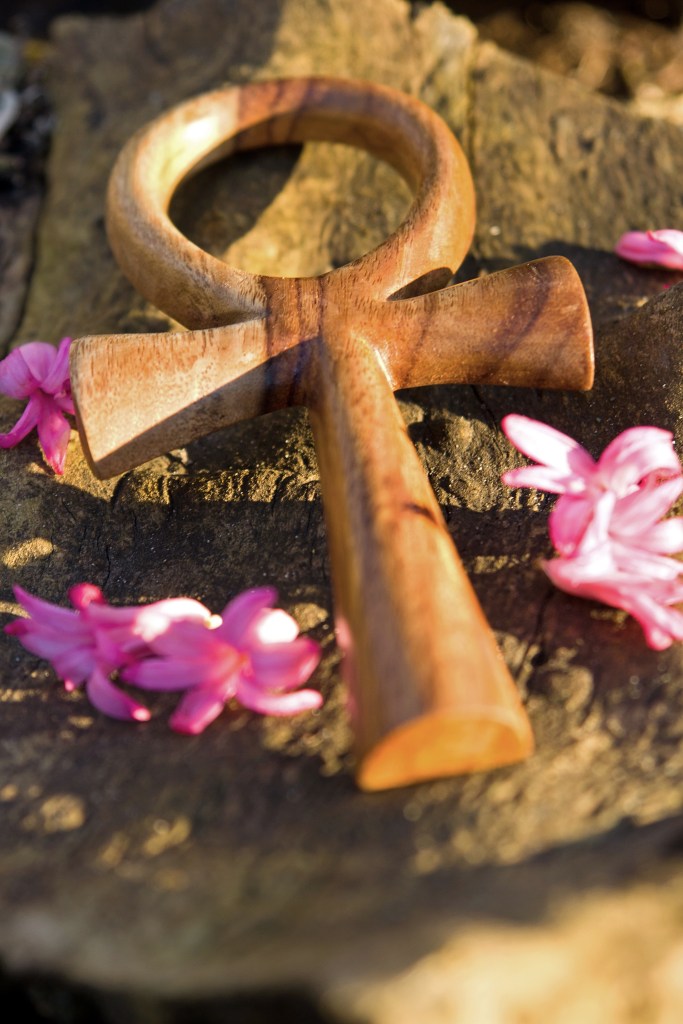
Ankh

One of the most recognizable ancient Egyptian symbols, the ankh, is one of the few vestiges to survive the decay of the old religions and still be in use today.

What Is the Ankh?

The ankh is an ancient Egyptian hieroglyph or symbol known as the cross of life or key of life and dates back to the Early Dynastic period (3150 BC – 2613 BC). The symbol resembles a cross with a loop on the top. The ankh is seen in the hands of almost every deity, carried by the loop or with arms crossed and one in each hand. The symbol was found as far afield as Persia and Mesopotamia in dig sites and was said to connote both mortal existence as well as eternal life.

Origin

Various theories exist about the origin of the symbol, but popular opinion suggests the origin is unknown. In 1869, mythologist Thomas Inman believed the ankh was a sexual symbol, and Egyptologist E. A. Wallis Budge similarly thought it may symbolize the belt buckle of Isis or Tyet. The ceremonial girdle or Knot of Isis, was alleged to represent female genitalia and fertility. Egyptologist Alan Gardiner posited it represented a sandal strap, as the word sandal and ankh came from the same root word. His theory was further affirmed by the fact that the sandal was a part of daily life in Egypt and the ankh also represented life. In a more recent publication, The Quick and the Dead, the authors claim the ankh ties to ancient cattle culture.

Usage

The symbol was portrayed on amulets, with the Djed (meaning stability) or Was (meaning strength) – symbols which were said to provide the protection of the gods to the wearer. Ptah is also seen making offerings with these three symbols in images representing him. The ankh was associated with the purifying power of water. This was evident on numerous temples where the king was depicted with two gods pouring a stream of ankhs over his head to cleanse him.

Gods and kings are frequently depicted holding the ankh to show their immortality and command over life and death. For those that had passed into the afterlife, the symbol was carried when their souls were weighed or aboard the boat of the Sun God, indicating their desire for immortality like the gods. According to the Dictionary of Symbols by Jean Chevalier and Alain Gheerbrant, it also represents the spring of eternal life and divine virtues. When it was held by the loop, usually in funeral rites, it may have been perceived as the key to opening the gateway to the Fields of Aalu, the Egyptian version of the Elysium Fields. Chevalier and Gheerbrant further postulated that when the ankh was placed between the eyes, it symbolized the duty of the person to keep the mystery he was initiated into a secret.

Early Dynastic and Old Kingdom Period

In the Early Dynastic period, the symbol became popular through the rise of the cult of Isis and Osiris. Isis is seen holding the ankh more frequently than other deities. Since the cult of Isis promised immortality through personal resurrection, the symbol became imbued with greater meaning and potency.

During the Old Kingdom Period, the ankh was well known as a symbol of eternal life. The dead were called ankhu and the symbol appeared frequently on sarcophagi and caskets.

Middle Kingdom and New Kingdom Period

The word ’nkh became associated with mirrors, from the Middle Kingdom Period onward. The Egyptians believed mirrors were magical and used them in divination. An ankh-shaped gilded mirror was found in Tutankhamun’s tomb. The Egyptians believed the afterlife was a perfect reflection of life on earth – a mirror image. During a particular festival, called the Festival of Lanterns, the Egyptians would light oil lamps to create a night sky of stars on earth to mirror the stars in the sky and the afterlife. When they did this, it was said to help them commune with the dead who had passed on the Fields of Aalu or Field of Reeds.

During the New Kingdom, the ankh was used in ceremonies and became associated with the cult of Amun. During the Amarna period, images of Aten the sun-disk often contained ankhs at the end of the sun’s rays.

Knot of Isis

The Tyet, or Knot of Isis, is very similar to the ankh. The arms of the cross are bent downward, differentiating the Knot of Isis from its counterpart, but it similarly means life or welfare. Sources claim the Tyet combines the concept of life and immortality with the knots which fasten mortal life to earth. To savor immortal life, the knot purportedly needs to be unraveled.

Modern Use

The symbol is used by modern Pagans as a symbol of faith, in healing and to promote psychic communication. It is viewed as a symbol of life by various new age religions. Thelemites, followers of the religion created by Aleister Crowley, also make use of the ankh as a union of opposites, a symbol of advancing one’s destiny or of divinity.
On Anubis

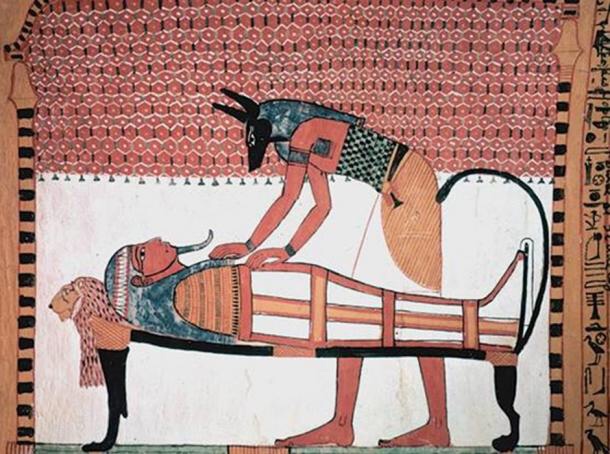
“Anubis was the guardian of all kinds of magical secrets. In the Papyrus Jumilhac, he appears as the leader of the armed followers of Horus. His ferocity is a match for the violence of Seth. In magical texts of a similar date, Anubis is named as ‘Lord of the Bau’. Whole battalions of messenger demons are under his command. In the magical papyri dating to Roman times, Anubis acts as the main enforcer of curses. The gracious deities of the cult temples are scarcely recognizable in the pitiless gods and goddesses encountered in everyday magic. (…) A story in Papyrus Jumilhac (c. 300 BC) explains the custom by relating how Seth once turned himself into a panther after attacking the body of Osiris. Anubis captured and branded the panther, creating the leopard’s spots. The jackal god decreed that leopard skins should be worn by priests in memory of his victory over Seth.”

~ Geraldine Pinch, Egyptologist

Aesir Gods

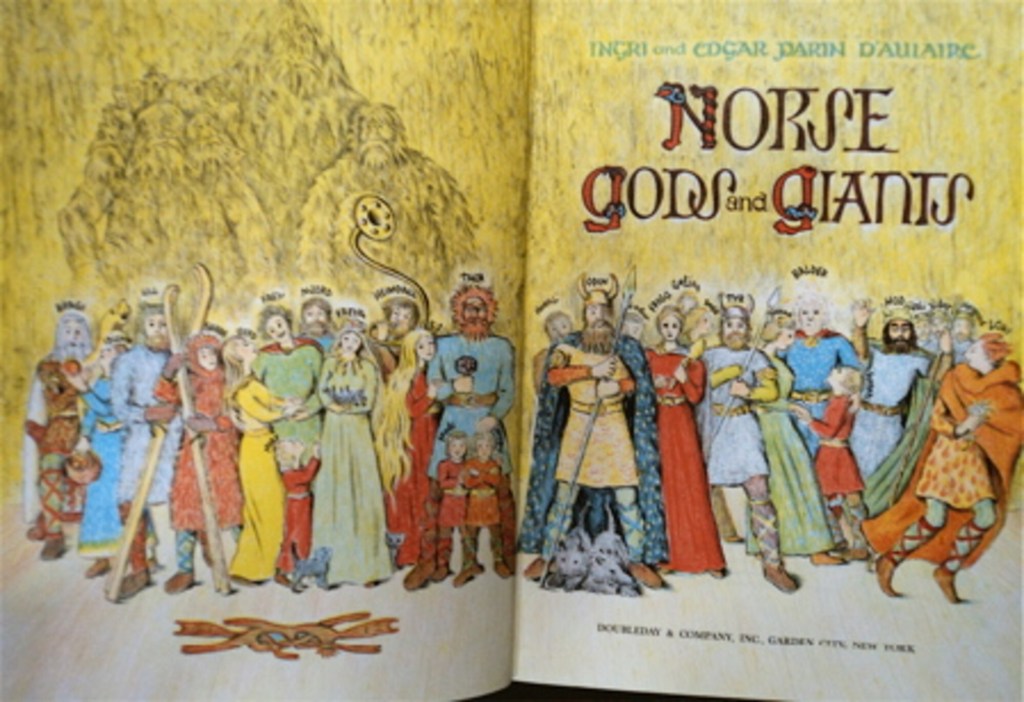
They are one of two clans of Norse gods, the other being the Vanir. The Aesir and Vanir were in conflict for quite some time, leading to the Aesir-Vanir war. Later on, however, they seemed to get along just fine and the Vanir were eventually considered to be a sub-group of the Aesir.

Therefore, depending on the time in which a specific myth is set, the word Aesir may refer to all Norse gods or only to the ones that began as Aesir.

In Norse mythology, there are nine world that various beings may inhabit. These worlds are held in the branches of the World Tree, also known as Yggdrasil. We humans live in Midgard, whereas the Aesir live in Asgard. The Vanir have their own world: Vanaheim.

Although they lived in a different world to humans, they actively ruled over the lives of men. Norse people would call on the different gods who represented specific aspects of life when they needed aid or blessing. There are many stories surrounding the Aesir, such as that of Odin the Allfather coming to Midgard. They would teach people lessons or otherwise influence what happened in Midgard.

The Aesir also acted in other worlds in Yggdrasil, such as Jotunheim, where the ice giants live. One of their most important duties is to keep the ice giants at bay, protecting the worlds from them.

Interestingly, although the Aesir are the principal gods of Norse mythology, they are not the creators of the cosmos. They are, however, the creators of mankind and the worlds within the cosmos.

In the beginning, there were two worlds: Muspelheim and Niflheim. Muspelheim was the realm of fire, while Niflheim was the realm of ice. Between them lay an empty void known as the Ginnungagap. The fire and ice met and filled the gap, and from this event, the first giant, Ymir, was formed. Ymir’s sweat produced further giants, who were the first beings in the cosmos. As the frost melted, the cow Audhumbla emerged to feed Ymir. The cow lived on the saltlicks in the ice. Her licking revealed Buri, the first Aesir, who had apparently been stuck in the ice.

Buri went on to marry a giant, Bestla, so his children Odin (who is the most famous), Vili and Ve were all half-giants. These three brothers decided to end Ymir’s life and, in a rather grisly development, used the various parts of his body to make the world. For example, his blood became the oceans, and the dome of his skull became the sky.

These gods then got around to creating us, the humans of Midgard. The first humans were a male and female pair with the names Ask and Embla. When they had finished jump-starting humanity, the gods decided to give humans their own world, a fenced-off region they named Midgard.

But why did they feel the need to slay Ymir? The most likely reason is that Ymir was a being of chaos, and the Aesir’s purpose is to bring order to the cosmos. That’s also the root of their main struggle with the ice giants, who want to destroy the world during Ragnarok, restoring the primordial chaos of the Ginnungagap.

Ouroboros

“The snake that gives birth to itself also incestuously makes love to itself, putting its own tail in its mouth; it is the seminal member and womb of creation in one. It represents the source and origin of all life and the place where it comes to renew itself in time. The uroboros is both alpha and omega, an image of death drive and sexuality intertwined; both self-fertilization and rebirth come to be as one. The notion of this life force or “cosmic” sexual energy is always found at the heart of mythology.” ​
~ Norland Tellez

Image: The serpent Ouroboros, from Cyprianus, 18th Century

Ancient Greeks and the Nature of Matter

The fundamental questions of what the world is made of, and where matter came from, are some of the oldest. In the 6th century BCE, Greek philosophers such as Thales and Anaximenes proposed that all substances were modifications of more intrinsic substances, the main candidates being water, air, earth, and fire. In the 5th century BCE, Empedocles claimed that everything was a mixture of all four of these substances, or elements. His near-contemporary Democritus developed the idea that the universe is made of an infinite number of indivisible particles called atoms. Finally, in the 4th century BCE the influential scholar Aristotle added a fifth element, ether, to Empedocles’four. Although Aristotle was skeptical of the idea of atoms, it is remarkable that the concepts of both atoms and elements had been proposed more than 2,000 years before either was proved to exist.

Gua Sha

This practice of strategically “scraping” body surfaces is performed to relieve pain, reduce inflammation, increase circulation, and boost the immune system. Traditionally this is done with a small, flat jade stone with rounded edges, which can be used on the body, muscles, acupressure points, and/or meridians to release heat, toxins, and so on. You usually scrape in the direction of the meridians only until you see small red dots (called petechia). These red dots indicate that blood has been brought to the surface of the skin, where it is able to release the heat and toxins. Chinese medicine calls this “raising the sha,” which is said to eliminate stagnation and inflammation in the blood and protect the immune system for days or even weeks after the treatment. You can easily learn to do this at home for certain conditions, such as when you are feeling vulnerable to a cold, have tight or sore muscles, or are feeling inflamed in a particular part of your body. For chronic conditions such as cancer or autoimmune disease, or if there are lumps, cysts, or fibroids, I recommend working with a practitioner before performing gua sha.

Lewis and Clark Expedition

One year after the United States doubled its territory with the Louisiana Purchase, the Lewis and Clark expedition leaves St. Louis, Missouri, on a mission to explore the Northwest from the Mississippi River to the Pacific Ocean.

Even before the U.S. government concluded purchase negotiations with France, President Thomas Jefferson commissioned his private secretary Meriwether Lewis and William Clark, an army captain, to lead an expedition into what is now the U.S. Northwest. On May 14, the “Corps of Discovery”—featuring approximately 45 men (although only an approximate 33 men would make the full journey)—left St. Louis for the American interior.

The expedition traveled up the Missouri River in a 55-foot long keelboat and two smaller boats. In November, Toussaint Charbonneau, a French-Canadian fur trader accompanied by his young Native American wife Sacagawea, joined the expedition as an interpreter. The group wintered in present-day North Dakotabefore crossing into present-day Montana, where they first saw the Rocky Mountains. On the other side of the Continental Divide, they were met by Sacagawea’s tribe, the Shoshone Indians, who sold them horses for their journey down through the Bitterroot Mountains. After passing through the dangerous rapids of the Clearwater and Snake rivers in canoes, the explorers reached the calm of the Columbia River, which led them to the sea. On November 8, 1805, the expedition arrived at the Pacific Ocean. After pausing there for the winter, the explorers began their long journey back to St. Louis.

On September 23, 1806, after almost two and a half years, the expedition returned to the city, bringing back a wealth of information about the region (much of it already inhabited by Native Americans), as well as valuable U.S. claims to OregonTerritory.

Source: history.com

Who Were The Puritans?

The roots of Puritanism are to be found in the beginnings of the English Reformation. The name “Puritans” (they were sometimes called “precisionists”) was a term of contempt assigned to the movement by its enemies. Although the epithet first emerged in the 1560s, the movement began in the 1530s, when King Henry VIII repudiated papal authority and transformed the Church of Rome into a state Church of England. To Puritans, the Church of England retained too much of the liturgy and ritual of Roman Catholicism.

Well into the 16th century, many priests were barely literate and often very poor. Employment by more than one parish was common, so they moved often, preventing them from forming deep roots in their communities. Priests were immune to certain penalties of the civil law, further feeding anticlerical hostility and contributing to their isolation from the spiritual needs of the people.

In the early decades of the 17th century, some groups of worshipers began to separate themselves from the main body of their local parish church where preaching was inadequate and to engage an energetic “lecturer,” typically a young man with a fresh Cambridge degree, who was a lively speaker and steeped in reform theology. Some congregations went further, declared themselves separated from the national church, and remade themselves into communities of “visible saints,” withdrawn from the English City of Man into a self-proclaimed City of God.

One such faction was a group of separatist believers in the Yorkshire village of Scrooby, who, fearing for their safety, moved to Holland in 1608 and then, in 1620, to the place they called Plymouth in New England. We know them now as the Pilgrims of Plymouth Rock. A decade later, a larger, better-financed group, mostly from East Anglia, migrated to Massachusetts Bay. There, they set up gathered churches on much the same model as the transplanted church at Plymouth (with deacons, preaching elders, and, though not right away, a communion restricted to full church members, or “saints”).

The main difference between the Pilgrims and the Puritans is that the Puritans did not consider themselves separatists. They called themselves “nonseparating congregationalists,” by which they meant that they had not repudiated the Church of England as a false church. But in practice they acted–from the point of view of Episcopalians and even Presbyterians at home–exactly as the separatists were acting. 

By the 1640s, their enterprise at Massachusetts Bay had grown to about 10,000 people. They soon outgrew the bounds of the original settlement and spread into what would become Connecticut, New Hampshire, Rhode Island, and Maine, and eventually beyond the limits of New England.

The Puritan migration was overwhelmingly a migration of families (unlike other migrations to early America, which were composed largely of young unattached men). The literacy rate was high, and the intensity of devotional life, as recorded in the many surviving diaries, sermon notes, poems, and letters, was seldom to be matched in American life.

The Puritans’ ecclesiastical order was as intolerant as the one they had fled. Yet, as a loosely confederated collection of gathered churches, Puritanism contained within itself the seed of its own fragmentation. Following hard upon the arrival in New England, dissident groups within the Puritan sect began to proliferate–Quakers, Antinomians, Baptists–fierce believers who carried the essential Puritan idea of the aloneness of each believer with an inscrutable God so far that even the ministry became an obstruction to faith.

Puritanism gave Americans a sense of history as a progressive drama under the direction of God, in which they played a role akin to, if not prophetically aligned with, that of the Old Testament Jews as a new chosen people.

Perhaps most important, as Max Weber profoundly understood, was the strength of Puritanism as a way of coping with the contradictory requirements of Christian ethics in a world on the verge of modernity. It supplied an ethics that somehow balanced charity and self-discipline. It counseled moderation within a psychology that saw worldly prosperity as a sign of divine favor. Such ethics were particularly urgent in a New World where opportunity was rich, but the source of moral authority obscure.

Source: history.com