John Muir

John Muir was born April 21, 1838 also known as “John of the Mountains”, was an American naturalist, author, environmental philosopher, glaciologist and early advocate for the preservation of wilderness in the United States. His letters, essays, and books describing his adventures in nature, especially in the Sierra Nevada, have been read by millions. His activism has helped to preserve the Yosemite Valley, Sequoia National Park and many other wilderness areas. The Sierra Club, which he founded, is a prominent American conservation organization. The 211-mile (340 km) John Muir Trail, a hiking trail in the Sierra Nevada, was named in his honor. Other such places include Muir Woods National Monument, Muir Beach, John Muir College, Mount Muir, Camp Muir and Muir Glacier. In Scotland, the John Muir Way, a 130-mile-long route, was named in honor of him.

In his later life, Muir devoted most of his time to the preservation of the Western forests. He petitioned the U.S. Congress for the National Park bill that was passed in 1890, establishing Yosemite National Park. The spiritual quality and enthusiasm toward nature expressed in his writings has inspired readers, including presidents and congressmen, to take action to help preserve large nature areas. Today Muir is referred to as the “Father of the National Parks” and the National Park Service has produced a short documentary about his life.

John Muir has been considered “an inspiration to both Scots and Americans”. Muir’s biographer, Steven J. Holmes, believes that Muir has become “one of the patron saints of twentieth-century American environmental activity,” both political and recreational. As a result, his writings are commonly discussed in books and journals, and he is often quoted by nature photographers such as Ansel Adams. “Muir has profoundly shaped the very categories through which Americans understand and envision their relationships with the natural world,” writes Holmes. Muir was noted for being an ecological thinker, political spokesman, and religious prophet, whose writings became a personal guide into nature for countless individuals, making his name “almost ubiquitous” in the modern environmental consciousness. According to author William Anderson, Muir exemplified “the archetype of our oneness with the earth”, while biographer Donald Worster says he believed his mission was “…saving the American soul from total surrender to materialism.” On April 21, 2013, the first ever John Muir Day was celebrated in Scotland, which marked the 175th anniversary of his birth, paying homage to the conservationist.

“Keep close to Nature’s heart… and break clear away, once in awhile, and climb a mountain or spend a week in the woods. Wash your spirit clean.”
~ John Muir

Leonardo da Vinci

Today in 1452 Leonardo da Vinci was born. Leonardo di ser Piero da Vinci (15 April 1452 – 2 May 1519), more commonly Leonardo da Vinci or simply Leonardo, was an Italian polymath whose areas of interest included invention, painting, sculpting, architecture, science, music, mathematics, engineering, literature, anatomy, geology, astronomy, botany, writing, history, and cartography. He has been variously called the father of palaeontology, ichnology, and architecture, and is widely considered one of the greatest painters of all time. Sometimes credited with the inventions of the parachute, helicopter and tank, he epitomised the Renaissance humanist ideal.

Many historians and scholars regard Leonardo as the prime exemplar of the “Universal Genius” or “Renaissance Man”, an individual of “unquenchable curiosity” and “feverishly inventive imagination”. According to art historian Helen Gardner, the scope and depth of his interests were without precedent in recorded history, and “his mind and personality seem to us superhuman, while the man himself mysterious and remote”. Marco Rosci notes that while there is much speculation regarding his life and personality, his view of the world was logical rather than mysterious, and that the empirical methods he employed were unorthodox for his time.

Born out of wedlock to a notary, Piero da Vinci, and a peasant woman, Caterina, in Vinci in the region of Florence, Leonardo was educated in the studio of the renowned Florentine painter Andrea del Verrocchio. Much of his earlier working life was spent in the service of Ludovico il Moro in Milan. He later worked in Rome, Bologna and Venice, and he spent his last years in France at the home awarded to him by Francis I of France.

Leonardo was, and is, renowned primarily as a painter. Among his works, the Mona Lisa is the most famous and most parodied portrait and The Last Supper the most reproduced religious painting of all time. Leonardo’s drawing of the Vitruvian Man is also regarded as a cultural icon, being reproduced on items as varied as the euro coin, textbooks, and T-shirts. Perhaps fifteen of his paintings have survived. Nevertheless, these few works, together with his notebooks, which contain drawings, scientific diagrams, and his thoughts on the nature of painting, compose a contribution to later generations of artists rivalled only by that of his contemporary, Michelangelo.

Leonardo is revered for his technological ingenuity. He conceptualised flying machines, a type of armoured fighting vehicle, concentrated solar power, an adding machine, and the double hull. Relatively few of his designs were constructed or even feasible during his lifetime, as the modern scientific approaches to metallurgy and engineering were only in their infancy during the Renaissance. Some of his smaller inventions, however, such as an automated bobbin winder and a machine for testing the tensile strength of wire, entered the world of manufacturing unheralded. A number of Leonardo’s most practical inventions are nowadays displayed as working models at the Museum of Vinci. He made substantial discoveries in anatomy, civil engineering, geology, optics, and hydrodynamics, but he did not publish his findings and they had no direct influence on later science.

Today, Leonardo is widely considered one of the most diversely talented individuals ever to have lived.

#LeonardoDaVinci #RenaissanceMan #Artist #Scientist

The Beatles and Astrid Kirchherr

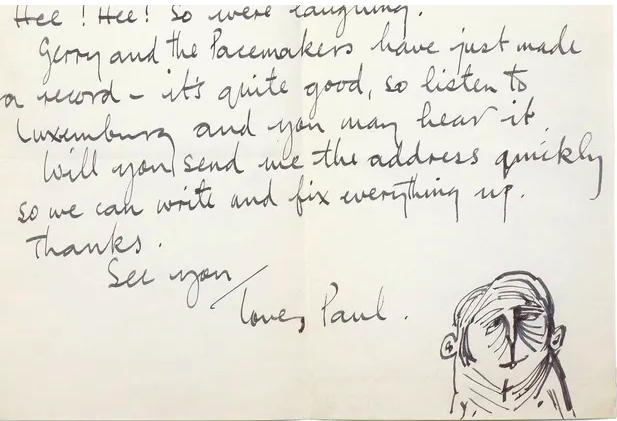
If you’re a Beatles fan, the Guardian has a good article on Astrid Kirchherr, once engaged to the ex-Beatle Stu Sutcliffe, and who photographed, mothered, and molded the style of the Beatles (i.e., suggesting their “mop top” haircuts) when they played in Hamburg before they were famous. She also received lots of letters from the Beatles, One is below, along with a photo of her with Ringo and John.

Kirchherr died in 2020, and the letters are up for auction.

The Beatles Monopolize Top 5 Billboard Hits

Today in music history —> On this date in 1964, the Fab Four monopolized the top five on the Billboard Hot 100, marking the only act ever to lock up the region in a week.

On the Billboard Hot 100 dated April 4, 1964, the Beatles made history as the only act ever to occupy the chart’s top five positions in a week.

With a 27-1 second-week blast to the top for “Can’t Buy Me Love,” the Fab Four locked up the chart’s entire top five:

No. 1, “Can’t Buy Me Love”

No. 2, “Twist and Shout”

No. 3, “She Loves You”

No. 4, “I Want to Hold Your Hand”

No. 5, “Please Please Me”

Leni Riefenstahl (1902-2003)

Leni Riefenstahl (1902-2003)

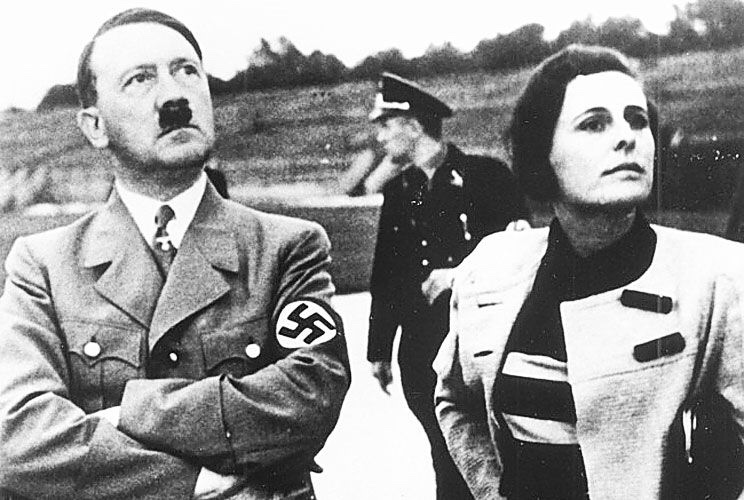
I have a deep appreciation for the film innovations of Leni Riefenstahl over her long career. To be clear I am not saying I admire her affiliation with Nazi Germany. I am not saying that I feel her propaganda work during the 1930’s & 1940’s is something that inspires me or I admire. I do however recognize the brilliance of the work she did during that time from a strictly artistic point-of-view and as an effective form of propaganda for a morally reprehensible regime that unfortunately existed in a dark period of human history. Whether you believe her claims that she was unaware of the Nazi war crimes they were committing or not I leave up to your own conscience. For what it is worth she won over fifty libel cases against people accusing her of knowing of the Nazi crimes. She would later go onto say of meeting Hitler, “It was the biggest catastrophe of my life. Until the day I die people will keep saying, ‘Leni is a Nazi’, and I’ll keep saying, ‘But what did she do?”

Her most infamous and historically significant film was “Triumph of the Will” (Named by Hitler) of the 1934 Nazi Party rally at Nuremberg.  According to reports she originally did not wish to make the film, but Hitler convinced her on the condition that she not be required to make further films for the party.  She did however make a few more films for the Nazi party such as an eighteen minute follow up film at the 1935 party rally focusing on the army which felt they were not fairly represented in the first film.  She went on to claim to never have intended to make a pro-Nazi propaganda film and was disgusted it was used that way.  Whether that is true or not “Triumph of the Will” has been universally recognized as a masterful, innovative example of documentary filmmaking.  Years later the Economist (magazine) wrote that Triumph of the Will “sealed her reputation as the greatest female filmmaker of the 20th century.”  The film scholar Mark Cousins went on to claim, “Next to Orson Welles and Alfred Hitchcock, Leni Riefenstahl was the most technically talented Western film maker of her era”.

In 1936 with the Olympics approaching she traveled to Greece to film the location of the original Olympics at Olympia.  This footage became part of the film “Olympia” a highly successful film.  It was noted for its technical as well as aesthetic achievements.  Her use of tracking shots as well as slow motion of the athletes has been seen as a major influence on modern sports photography.  She is noted to have filmed footage of all races at the Olympics, including the American Jesse Owens.  Upon its release in the United States the American philanthropist and former Olympic athlete (1912 Olympics) Avery Brundage said it was, “The greatest Olympic film ever made.”

During the invasion of Poland she worked as a war correspondent.  On September 12th, 1939 thirty civilians were executed and there are claims she attempted to intervene, but a German soldier held her at gunpoint and threatened to shoot her if she continued.  Whether that is true or not, close-up photos of a distraught Riefenstahl still exist from that day.  She would later claim she did not realize the civilians were Jews.  Nevertheless a month later she filmed Hitler’s victory parade in Warsaw.  It was the last Nazi related film of her career.

After the war she was held in American and French run detention camps and prisons from 1945-1948.  She is reported to have reacted with horror and tears when shown photos of the concentration camps.  She was tried four times but never found guilty of anything but being a “fellow traveler” who was sympathetic to the Nazis.  Through the 1950’s and 1960’s she attempted many times (15 by her count) to make films but they were always met with resistance, public protests and sharp criticism.

In the 1960’s her focus made the transition to still photography.  She became enamored with Africa, inspired by Hemingway’s book “The Green Hills of Afruca,” and the photography of George Rodger.  She traveled many times to Sudan to photograph the Nuba tribes.  She lived with them sporadically learning their culture so she could photograph them more easily.  She was eventually granted Sudanese citizenship for her services to the country, becoming the first foreigner to have a Sudanese passport.  Her two books of the tribes, “The Last of the Nuba,” and “The People of Kau,” published in the 1970’s were both international bestsellers.  She photographed the 1972 Olympic games in Munich.  Later she photographer Mick Jagger, Siegfried and Roy, and was a friend of Andy Warhol.  She was a guest of honor at the 1976 Olympics in Montreal.

At age 72 she became interested in underwater photography.  She lied about her age (by 20 years) and became certified to scuba dive.  In 1978 she published a book of coral gardens and then in 1990 her book “Wonder Under Water.”  On her 100th birthday she released her final film, “Underwater Impressions” an idealized documentary of life in the oceans.  It was her first film in twenty-five years.  At age 100 she was still photographing marine life and gained distinction as the world’s oldest scuba diver.  She continued to be active in her late life being a member of Greenpeace for eight years.   In 2000 she was in a helicopter crash while attempting to determine the fate of her Nuba friends during the Sudanese civil war.  On Auguest 22nd, 2003 she celebrated her 101st birthday and married her longtime friend and cameraman Horst Kettner, who was forty years her junior.  On September 8th she died from cancer.

As the daily telegraph wrote upon her death :

“[Leni Riefenstahl] was perhaps the most talented female cinema director of the 20th century; her celebration of Nazi Germany in film ensured that she was certainly the most infamous…Critics would later decry her fascination with the athletes’ [Olympia] physiques as fascistic; but in truth her interest was born not of racist ends but of the delight she, as a former dancer, took in the human form.”

“Opinions will be divided between those who see her as a young, talented and ambitious woman caught up in the tide of events which she did not fully understand, and those who believe her to be a cold and opportunist propagandist and a Nazi by association.”

Ken Burns NYT Interview

The NYT has an interesting interview with documentary filmmaker Ken Burns, Would he make his classic series, “The Civil War” (still one of my favorite t.v. documentary of all time) differently in light of the present Zeitgeist? Was Shelby Foote a Confederate sympathizer? And why was Burns so changed by the early death of his mother?

#Documentaries #KenBurns

https://www.nytimes.com/interactive/2021/03/15/magazine/ken-burns-interview.html?action=click&module=Editors%20Picks&pgtype=Homepage

The Merry Cemetery (Săpânţa, Maramureş, Romania)

The Merry Cemetery (Săpânţa, Maramureş, Romania)

At the Cimitirul Vesel, or “Merry Cemetery,” over 600 colorful wooden crosses bear the life stories, dirty details, and final moments of the bodies that lie below. Displayed in bright, cheery pictures and annotated with limericks are the stories of almost everyone who has died in the town of Săpânţa. Illustrated crosses depict soldiers being beheaded and a townsperson being hit by a truck. The epigraphs are surprisingly frank and often funny: “Underneath this heavy cross lies my mother-in-law . . . Try not to wake her up. For if she comes back home, she’ll bite my head off.”

The cemetery’s unique style was created by a local named Stan Ioan Pătraş, who at the age of 14 had already begun carving crosses for the graveyard. By 1935, Pătraş was carving clever and ironic poems—done in a rough local dialect—about the deceased, as well as painting their portraits on the crosses, often depicting the way in which they died.

Pătraş died in 1977, having carved his own cross and leaving his house and business to his most talented apprentice, Dumitru Pop. Pop has spent the last three decades continuing the carving work, and has also turned the house into the Merry Cemetery’s workshop-museum. Despite the occasionally darkly comic—or merely dark—tones of the crosses, Pop says no one has ever complained about the work:

“It’s the real life of a person. If he likes to drink, you say that; if he likes to work, you say that . . . There’s no hiding in a small town . . . The families actually want the true life of the person to be represented on the cross.”

Source: Atlas Obscura

The Astronomical Clock of Besançon Cathedral (Besançon, Franche-Comté, France)

Besançon Cathedral, located in the center of France’s 19th-century clock-making capital, is home to a 19-foot-tall (5.8 m) clock with 30,000 pieces. It is one of the most complicated horological devices ever made. Installed in 1860, the clock shows the local time in 17 places around the world, as well as the time and height of the tides in eight French ports, a perpetual calendar with leap-year cycles, and the times of sunrise and sunset.

The many dials of what may be the most complicated horological device ever constructed.

The Rotting Body of René de Chalon (Bar-Le-Duc, Lorraine, France)

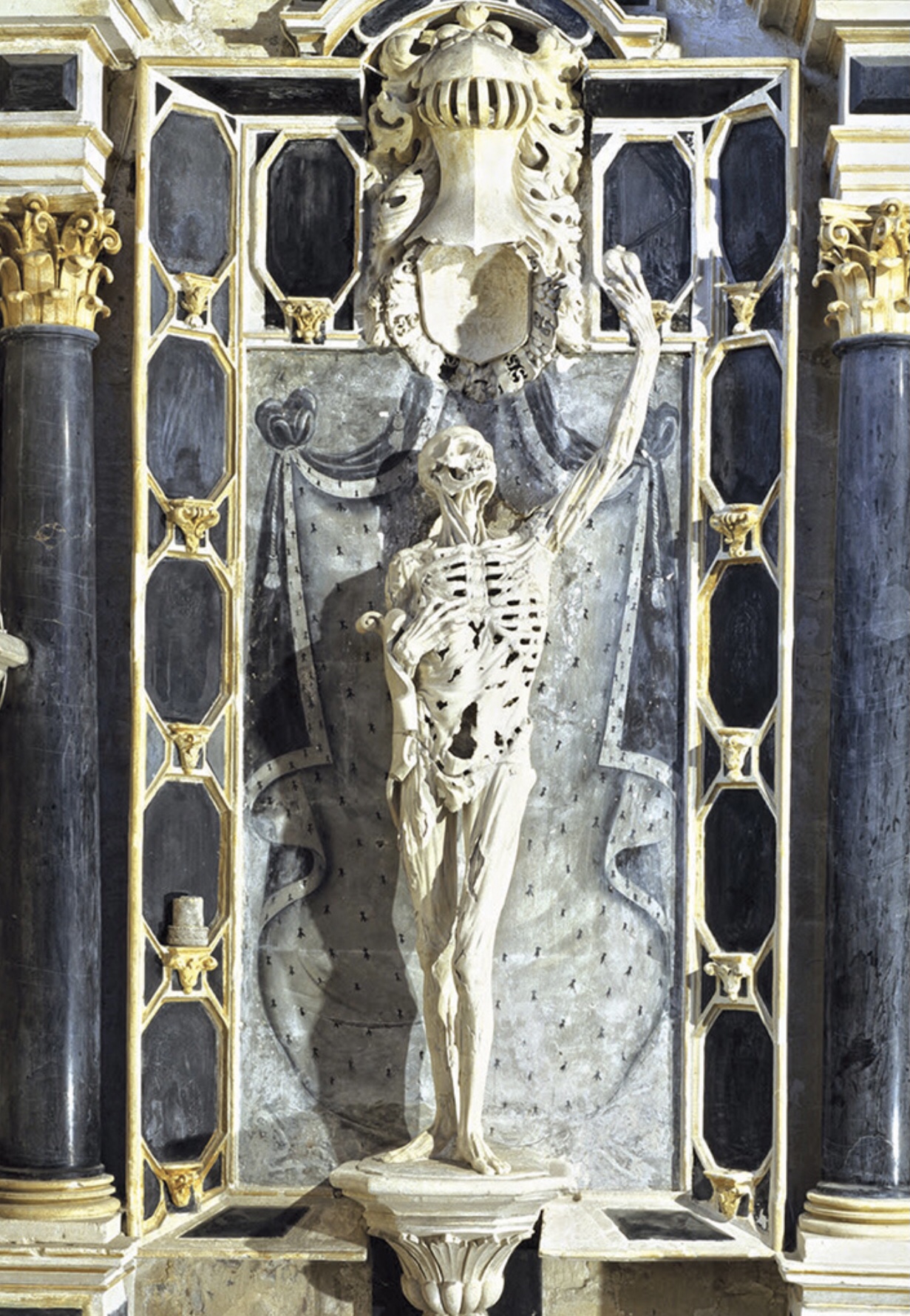
Saint-Étienne church, in the city of Bar-le-Duc, is home to a statue of a rotting corpse. Visible musculature and skin hang in flaps over the hollow carcass. The exposed skull looks toward a raised left hand, which once held the dried heart of René de Chalon, the 16th-century prince the statue depicts. (The heart is believed to have gone missing sometime around the French Revolution.)

The life-size sculpture by Ligier Richier is part of the “transi” Renaissance art form—stone sculptures of rotting bodies that served as a reminder of temporary flesh and eternal afterlife.

The postmortem statue of René de Chalon once held the man’s own dried heart.