Stonehenge: Was it Relocated?

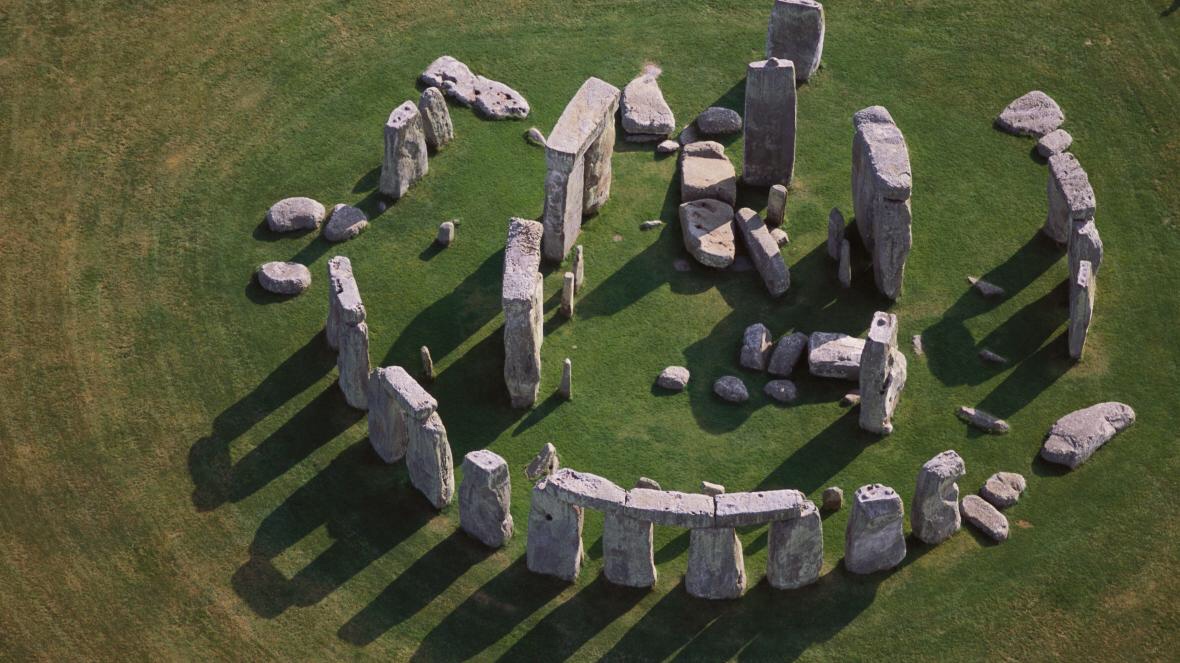
The discovery of a dismantled stone circle—close to Stonehenge’s bluestone quarries in west Wales—raises the possibility that a 900-year-old legend about Stonehenge being built from an earlier stone circle contains a grain of truth. Radiocarbon and OSL dating of Waun Mawn indicate construction c. 3000 BC, shortly before the initial construction of Stonehenge. The identical diameters of Waun Mawn and the enclosing ditch of Stonehenge, and their orientations on the midsummer solstice sunrise, suggest that at least part of the Waun Mawn circle was brought from west Wales to Salisbury Plain. This interpretation complements recent isotope work that supports a hypothesis of migration of both people and animals from Wales to Stonehenge.

In the oldest story of Stonehenge’s origins, the History of the Kings of Britain (c. AD 1136), Geoffrey of Monmouth describes how the monument was built using stones from the Giants’ Dance stone circle in Ireland. Located on legendary Mount Killaraus, the circle was dismantled by Merlin and shipped to Amesbury on Salisbury Plain by a force of 15,000 men, who had defeated the Irish and captured the stones. According to the legend, Stonehenge was built to commemorate the death of Britons who were treacherously killed by Saxons during peace talks at Amesbury. Merlin wanted the stones of the Giants’ Dance for their magical, healing properties.

This 900-year-old legend is fantasy: the Saxons arrived not in prehistory, but only 700 years before Geoffrey’s own time, and none of Stonehenge’s stones came from Ireland. Yet the fact that Stonehenge’s ‘bluestones’ derive from Wales—far to the west of Salisbury Plain—has led to speculation that there may be some truth in Geoffrey’s pseudo-history. Moreover, at the time Geoffrey was writing, this region of south-west Wales was considered Irish territory. One possibility is that the bluestones did indeed derive from a stone circle in west Wales, which was dismantled and re-erected as Stonehenge. A similar conclusion was reached a century ago by geologist Herbert Thomas, who established that the spotted dolerite bluestones at Stonehenge originated in the Preseli Hills of west Wales, where, he suspected, they had originally formed a “venerated stone-circle”

Source: Journal Antiquity
The Rök Stone

The Rök Stone is one of Sweden’s most interesting rune stones. A man called Varin erected it in honour of his dead son’s memory in the 9th century. The stone stands beside Röks Church on the plains of the province of Östergötland. Its complicated web of stories continues to baffle scholars.

The Rök Stone stands two and a half metres above ground and around one metre beneath ground. The boulder of pale grey, fine-grained granite probably originates close to where it was found. The surface is strewn with runes; there are around 280 on the front and 450 on the back side. The stone engraver composed the placement of his text so brilliantly that a person standing upright can read the meandering runes. The stone is now protected by a pyramid-shaped roof in the outdoor museum that was established in 1991.

Varin’s contemporaries must have perceived the Rök Stone as a literary and artistic masterpiece. A rune stone carver with a distinct sense of form and ornament has created the decorative text. He also appears to have been a learned poet, familiar with mythic tales and conceptions of the period. It seems like he wanted to put the reader’s acumen and education on trial. Nowadays, scholars agree about how to read the Rök Stone, but not on how to interpret it. The stone consists of convoluted legends, obscure myths and various epics, as well as accounts of Varin’s own family history.

The monumental size and rich ornamentation of the Rök Stone suggests that the man called Varin belonged to an influential family. Furthermore, the appearance of Thor, a pagan God, in the latter part of the text, could be an effort to give a divine legitimacy to Varin and his family. In that sense, the stone served as a memorial of a lost son, as well as a status symbol for the family.

Source: Swedish National Museum

Medieval Cats

Detail of miniatures of cats catching mice, mice stealing eucharistic wafers, and (below), an ancestor of Keyboard Cat: a later marginal doodle of a cat playing a stringed instrument; from a bestiary, England (Salisbury?), 2nd quarter of the 13th century.

Detail of a miniature of a nun spinning thread, as her pet cat plays with the spindle; from the Maastricht Hours, the Netherlands (Liège), 1st quarter of the 14th century.

Now this is the weirdest one by far. (The story, of course, is bogus.):

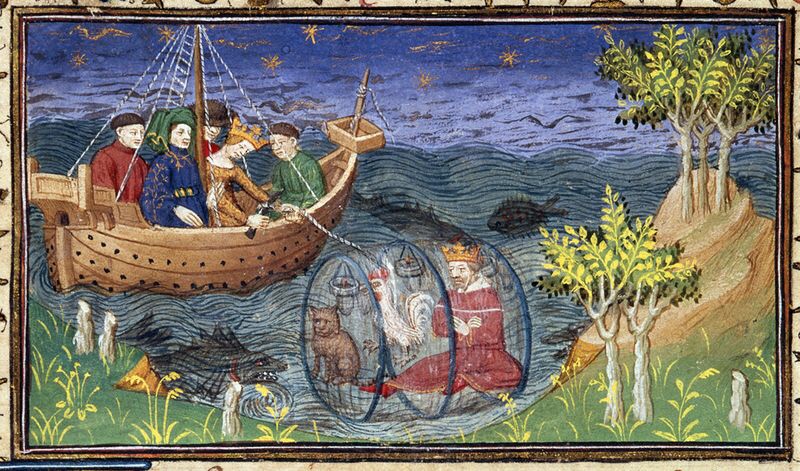
Alexander the Great, whose fictional explorations of the natural world were retold throughout the Middle Ages, included a cat, along with the cock and the dog, as his companions in a proto-submarine. Here, the animal was not merely a pet, but a natural rebreather, purifying the air so Alexander would not stifle in the enclosed space. The dog was more unfortunate, chosen as an emergency escape mechanism: water, medieval readers were assured, would expell the impurity of a dog’s dead carcasse. If Alexander encountered danger, he had only to kill the dog, which would be expelled to the surface, bringing Alexander with it. As for the cock – everyone knows how valuable they are for telling time with their crows, a useful function underwater, out of sight of the sky.

Time to take back Viking history and Symbolism from racists and white supremacists

“All manner of Viking symbols and misconceptions about a golden age of Nordic racial purity have been appropriated by racist extremists looking to justify their xenophobia and acts of violence, according to the University of Alberta researcher.

Van Deusen said the age of racial purity never existed and she is determined to debunk the corrosive myth at every turn, especially in the classroom.

Viking symbols are everywhere among the ultra-right. When the Unite the Right rally took place in Charlottesville in 2017, some protesters carried banners featuring the Norse god Thor’s hammer, popular among the Nazis and neo-Nazi groups.

The perpetrator of New Zealand’s Christchurch massacre last year wrote, “See you in Valhalla”-referring to the great hall where heroes of Norse mythology go after they die-at the end of his manifesto.

Closer to home, the Soldiers of Odin-a Finnish white supremacist movement named after another Norse god in 2015-have recently emerged in Alberta and throughout Canada.

“The precedent was set with the Nazis,” said Van Deusen. “National Socialism and Hitler idealized the Norse people-those who lived in the Nordic areas. Even the swastika is based in part on a symbol based on Viking artifacts.”

Source: https://www.ualberta.ca/folio/2020/07/white-supremacists-are-misappropriating-norse-mythology-says-expert.html

Galloway Hoard

“National Museums Scotland acquired the Galloway Hoard, as it came to be known, in 2017. Since then, conservators have been working to clean and restore the items, all of which spent more than 1,000 years buried in the Scottish field. This week, the National Museum of Scotland (NMS) released new images of the latest object to undergo conservation: an intricately decorated Anglo-Saxon cross.

After a millennium underground, the cross was encrusted with dirt. Wrapped in a coiled silver cord made out of wire bundled around an animal-gut core, it proved difficult to clean. Improvising, conservators turned to a carved porcupine quill—a tool “sharp enough to remove the dirt yet soft enough not to damage the metalwork,” according to a statement.”

Source: Smithsonian Magazine Online

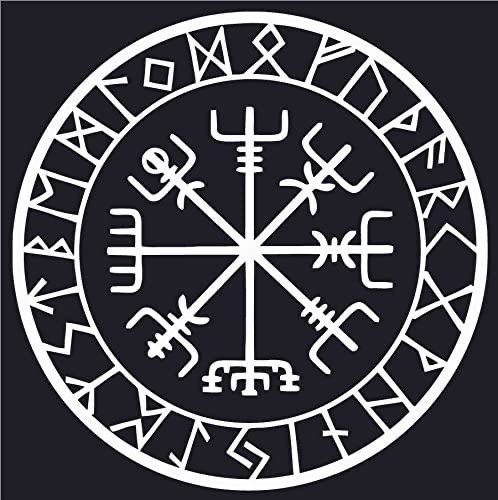
Viking Runes Introduction

By the beginning of the Viking Age, the Scandinavian rune-masters had developed an alphabet, or “futhark” (from the value of the first six characters), of sixteen characters that was quite distinct from the rest of the Germanic peoples. This alphabet was known as the “younger futhark”.

However, even within Scandinavia, there was no standard form for the characters and there are variations from inscription to inscription, but basically there were two main forms of futhark: the Common or Danish futhark (although it occurs outside of Denmark), and the Swedo-Norwegian futhark (although this also occurs outside of Sweden and Norway.

One can see that there are shortcomings with these alphabets. For example, there are characters for b, k and t, but there are none for p, g and d (this is because the futhark does not distinguish between these voiced and voiceless pairs. Therefore the rune-master had to use b for p, k for g and t for d.

There were other peculiarities: although there were two characters for the two different types of a, there were no symbols for e and o. This meant that the name “Svein” appears as in runes “suin” and the name “Gormr” appears as “kurmR”.

It becomes even more complicated, as the spelling practice allowed n to be omitted when it occurred before a consonant. Therefore the name Thormundr appears as thurmutR.

This of course means that many runic inscriptions can be very difficult to read and there can be a great deal of dispute about their true meaning.

Despite the difficulties in reading runic inscriptions, they can provide a good deal of useful information.

Source: Swedish National Museum Heritage Board’s website, but that page no longer exists.

Dr. William Price

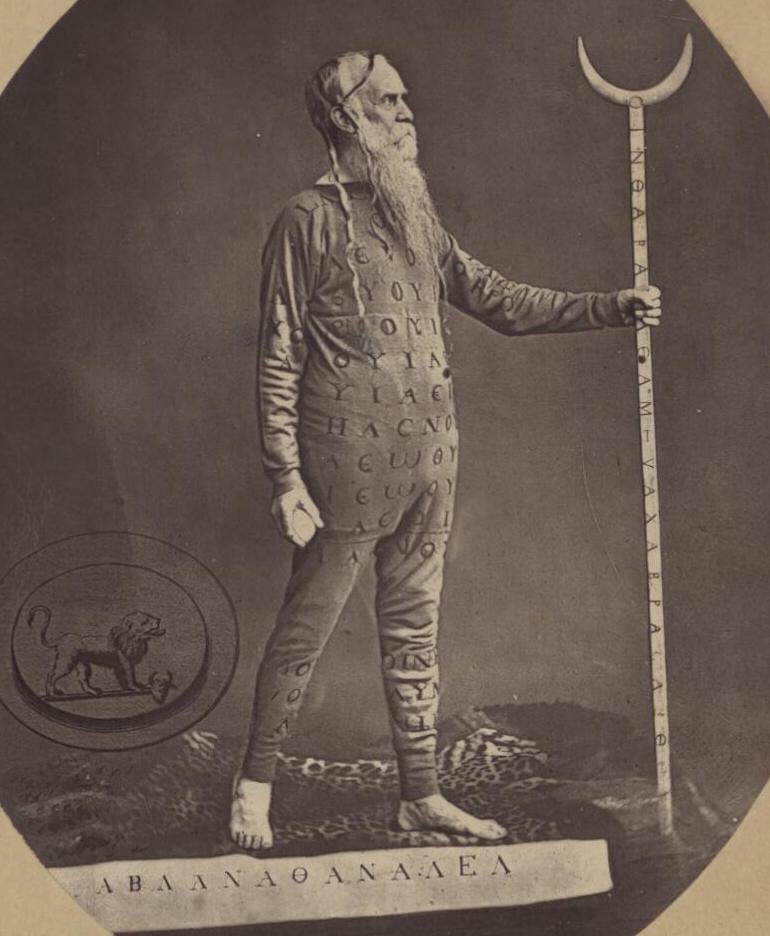
Today in weird history —> On January 18, 1884 Dr. William Price attempts to cremate the body of his infant son, Jesus Christ Price, setting a legal precedent for cremation in the United Kingdom. Price, a Welshman, was an interesting character in many ways. He adopted the Druid “religion” for many years; here he is onstage in 1884 wearing Druidic attire. At the time he cremated his infant son, cremation was illegal in England, but his action helped change the law…

#WeirdHistory #WilliamPrice #Cremation #Druid

The Euphronios Krater

Today in Museum History —> On this day in 2008 – The Euphronios Krater is unveiled in Rome after being returned to Italy by the Metropolitan Museum of Art.

Here’s a picture of that beautiful Greek vase, created by Euphronios about 515 B.C.

The Euphronios Krater (or Sarpedon Krater) is an ancient Greek terra cotta calyx-krater, a bowl used for mixing wine with water. Created around the year 515 BC, it is the only complete example of the surviving 27 vases painted by the renowned Euphronios and is considered one of the finest Greek vase artifacts in existence. Part of the collection of the Metropolitan Museum of Art from 1972 to 2008, the vase was repatriated to Italy under an agreement negotiated in February 2006, and it is now in the collection of the Archaeological Museum of Cerveteri as part of a strategy of returning stolen works of art to their place of origin

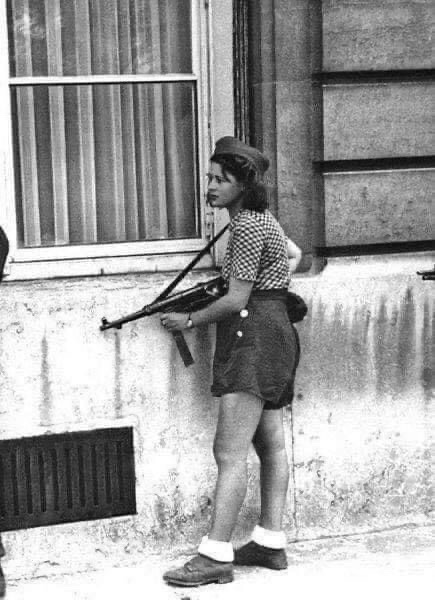
Simone Segouin

Simone Segouin, mostly known by her codename, Nicole Minet, was only 18-years-old when the Germans invaded. Her first act of rebellion was to steal a bicycle from a German military administration, and to slice the tires of all of the other bikes and motorcycles so they couldn’t pursue her. She found a pocket of the Resistance and joined the fight, using the stolen bike to deliver messages between Resistance groups.

She was an extremely fast learner and quickly became an expert at tactics and explosives. She led teams of Resistance fighters to capture German troops, set traps, and sabotage German equipment. As the war dragged on, her deeds escalated to derailing German trains, blocking roads, blowing up bridges and helping to create a German-free path to help the Allied forces retake France from the inside. She was never caught.

Segouin was present at the liberation of Chartres on August 23, 1944, and then the liberation of Paris two days later. She was promoted to lieutenant and awarded several medals, including the Croix de Guerre. After the war, she studied medicine and became a pediatric nurse. She is still going strong, and this October (2021) she will turn 96.