Marie de France

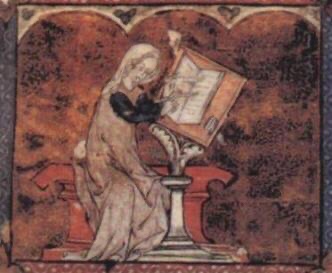
Marie de France (12th Century)

Very little is actually known of Marie de France as both her given name and where she lived is only known through her manuscripts. She was a medieval poet who probably was born in France and lived in England in the late 12th century. She lived and wrote at an unknown or undisclosed court, but was at least known of in the royal court of King Henry II of England. Some have suggested that she was perhaps a half-sister of Henry II.

She wrote a form of Anglo-Norman French and was proficient in Latin and English as well. She translated “Aesop’s Fables” into Anglo-Norman French from Middle English, and the “Legend of the Purgatory of St. Patrick” from Latin. She is best known as the writer of “The Lais Of Marie de France” which are still quite widely read and were a great influence on the romance genre (heroic literature) such as Chaucer’s “Canterbury Tales.”

“The Lais of Marie de France” are a series of twelve short (a few hundred lines each) Breton Lais. They are rhymed stanzas of 6-16 lines with 4-8 syllables per line which focus on glorifying the concept of courtly love through the adventure of the main character. The series of lais presents a contrast of the positive and negative actions that can result from love through magical situations, themes and imagery. Romantic themes include lovers in a hostile world, oppressive marriages and dichotomy social conventions, conflicts between love, chivalry and marriage, freedom of desire, love as an escape, and the psychological issues of love manifested in treachery and selfishness. They are also considered to have an ambiguous moral message especially for the time.

“Love is an invisible wound within the body, and, since it has its source in nature, it is a long-lasting ill.”

“Anyone who intends to present a new story must approach the problem in a new way and speak so persuasively that the tale brings pleasure to people.”

“It would be less dangerous for a man to court every lady in an entire land than for a lady to remove a single besotted lover from her skirts, for he will immediately attempt to strike back.”

~ Marie de France

Sylvia Plath

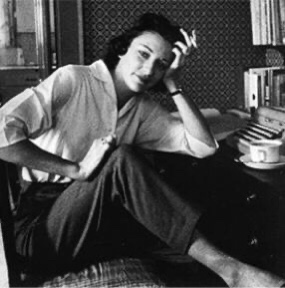
One of my favorite writers was born on this day in 1932, Sylvia Plath:

Sylvia Plath was an American poet, novelist, and short story writer. Born in Boston, Massachusetts she studied at Smith College and Newnham College. She married poet Ted Hughes in 1956 and had two children Frieda and Nicholas. After a long struggle with depression she committed suicide in 1963. To this day controversy surrounds both her life and death, as well as her writing and legacy. She along with some of her contemporaries (Anne Sexton and Robert Lowell among others) advanced the genre of confessional poetry. She is best known for her two collections of poetry “The Colossus and Other Poems,” and “Ariel,” as well as her semi-autobiographical novel “The Bell Jar.” In 1982 she became the first poet to win the Pulitzer Prize posthumously for “The Collected Poems of Sylvia Plath.”

Growing up in Winthrop, Massachusetts an eight year old Plath published her first poem in the children’s section of the “Boston Herald.” In addition to her writing, she showed a lot of promise as an artist winning an award for her painting from The Scholastic Art & Writing Awards in 1947. Her father died when she was eight due to untreated diabetes and led to her having a loss in faith and remained ambivalent about religion for the rest of her life. In 1942 her mother moved the family to Wellesley, Massachusetts.

In 1950 while attending Smith College she wrote to her mother, “The world is splitting open at my feet like a ripe, juicy watermelon.” The summer after her third year of college she spent a month in New York City as a guest editor of “Mademoiselle” magazine. It did not go as well as planned. That summer she was refused admission to the Harvard writing seminar and began an emotional downward spiral. In August 1953 she made her first suicide attempt by crawling under her house and taking her mother’s sleeping pills. She was not found for three days. Later she would write of the experience, “blissfully succumbed to the whirling blackness that I honestly believed was eternal oblivion.” She would spend the next six months at McLean Psychiatric Hospital. While under the care of Dr. Ruth Beuscher she would receive insulin and electric shock treatments. She appeared to recover and returned to Smith College.

Plath and English poet Ted Hughes were married on June 16th, 1956. Plath described Hughes as, “a singer, story-teller, lion and world-wanderer with a voice like the thunder of God.” In 1957 they moved to the United States with Plath first teaching at Smith College, and then moving to Boston in 1958 where she worked as a receptionist in the psychiatric unit at Massachusetts General Hospital while in the evening attending a creative writing class by Robert Lowell (Anne Sexton was also in attendance). During this time both Lowell and Sexton encouraged her to write from her own experience. She openly discussed her depression with Lowell, and her suicide attempt with Sexton. At this time she began to see herself as a more serious and focused poet and storyteller. She also began a lifetime friendship with the poet W. S. Merwin. In December she resumed her treatment with Dr. Ruth Beuscher.

In December of 1959 Plath and Ted Hughes moved to London. She remained anxious about writing confessional poetry from her own experience. Around this time she would explain that she learned, “to be true to my own weirdnesses.” In 1960 she released her first book of poetry. In 1961 her second pregnancy ended in a miscarriage, severely of her poems address this including, “Parliament Hill Fields.” In January of 1962 her son Nicholas was born. In June she was in a car accident which she would explain as one of her many suicide attempts. That July she would discover Ted Hughes was having an affair and they would separate in September.

Beginning in October of 1962 she would enter into the greatest burst of creativity of her career. It is at this time she would write almost all of the poems for which she is remembered and released posthumously in the collection “Ariel.” Her novel “The Bell Jar” came out in January 1963 to critical indifference. On February 11th, 1963 Plath was found dead having committed suicide by carbon monoxide poisoning in the kitchen with her head in the oven and the gas turned on. Hughes was devastated and in a letter wrote, “That’s the end of my life. The rest is posthumous.”

In the years following her death there were many accusations that Hughes had been abusive to Plath. The feminist poet Robin Morgan published a poem which openly accused Hughes of assault and her murder. In 1989 Hughes wrote an article in “The Guardian,” with this quote, “In the years soon after [Plath’s] death, when scholars approached me, I tried to take their apparently serious concern for the truth about Sylvia Plath seriously. But I learned my lesson early. […] If I tried too hard to tell them exactly how something happened, in the hope of correcting some fantasy, I was quite likely to be accused of trying to suppress Free Speech. In general, my refusal to have anything to do with the Plath Fantasia has been regarded as an attempt to suppress Free Speech […] The Fantasia about Sylvia Plath is more needed than the facts. Where that leaves respect for the truth of her life (and of mine), or for her memory, or for the literary tradition, I do not know.”

Hughes inherited the Plath estate and has been condemned in some circles for burning Plath’s last journal. He lost another journal and an unfinished novel and instructed a collection of her papers and journals should not be released until 2013. In 1998 he would publish a collection of poems called, “Birthday Letters,” which consists of 88 poems about his relationship with Plath. It would go on to win the Forward Poetry Prize, T.S. Eliot Prize for poetry, and the Whitebread Poetry Prize. He would die later that year of cancer.

A couple of quotes :

“If you expect nothing from anybody, you’re never disappointed.”

“Perhaps when we find ourselves wanting everything, it is because we are dangerously close to wanting nothing.”

“Death must be so beautiful. To lie in the soft brown earth, with the grasses waving above one’s head, and listen to silence. To have no yesterday, and no to-morrow. To forget time, to forgive life, to be at peace.”

~ Sylvia Plath

Tulips – By Sylvia Plath

The tulips are too excitable, it is winter here.

Look how white everything is, how quiet, how snowed-in

I am learning peacefulness, lying by myself quietly

As the light lies on these white walls, this bed, these hands.

I am nobody; I have nothing to do with explosions.

I have given my name and my day-clothes up to the nurses

And my history to the anaesthetist and my body to surgeons.

They have propped my head between the pillow and the sheet-cuff

Like an eye between two white lids that will not shut.

Stupid pupil, it has to take everything in.

The nurses pass and pass, they are no trouble,

They pass the way gulls pass inland in their white caps,

Doing things with their hands, one just the same as another,

So it is impossible to tell how many there are.

My body is a pebble to them, they tend it as water

Tends to the pebbles it must run over, smoothing them gently.

They bring me numbness in their bright needles, they bring me sleep.

Now I have lost myself I am sick of baggage —-

My patent leather overnight case like a black pillbox,

My husband and child smiling out of the family photo;

Their smiles catch onto my skin, little smiling hooks.

I have let things slip, a thirty-year-old cargo boat

Stubbornly hanging on to my name and address.

They have swabbed me clear of my loving associations.

Scared and bare on the green plastic-pillowed trolley

I watched my teaset, my bureaus of linen, my books

Sink out of sight, and the water went over my head.

I am a nun now, I have never been so pure.

I didn’t want any flowers, I only wanted

To lie with my hands turned up and be utterly empty.

How free it is, you have no idea how free —-

The peacefulness is so big it dazes you,

And it asks nothing, a name tag, a few trinkets.

It is what the dead close on, finally; I imagine them

Shutting their mouths on it, like a Communion tablet.

The tulips are too red in the first place, they hurt me.

Even through the gift paper I could hear them breathe

Lightly, through their white swaddlings, like an awful baby.

Their redness talks to my wound, it corresponds.

They are subtle: they seem to float, though they weigh me down,

Upsetting me with their sudden tongues and their colour,

A dozen red lead sinkers round my neck.

Nobody watched me before, now I am watched.

The tulips turn to me, and the window behind me

Where once a day the light slowly widens and slowly thins,

And I see myself, flat, ridiculous, a cut-paper shadow

Between the eye of the sun and the eyes of the tulips,

And I hve no face, I have wanted to efface myself.

The vivid tulips eat my oxygen.

Before they came the air was calm enough,

Coming and going, breath by breath, without any fuss.

Then the tulips filled it up like a loud noise.

Now the air snags and eddies round them the way a river

Snags and eddies round a sunken rust-red engine.

They concentrate my attention, that was happy

Playing and resting without committing itself.

The walls, also, seem to be warming themselves.

The tulips should be behind bars like dangerous animals;

They are opening like the mouth of some great African cat,

And I am aware of my heart: it opens and closes

Its bowl of red blooms out of sheer love of me.

The water I taste is warm and salt, like the sea,

And comes from a country far away as health.

#SylviaPlath #Poet #Author #MentalHealth #ABellJar

Marguerite Porete

Marguerite Porete (?-1310)

Marguerite Porete was a French mystic and the author of “The Mirror of Simple Souls.” It is a Christian Spiritual work concerning divine love. When she refused to remove her book form circulation and recant her views she was burned at the stake as a heretic in 1310. Little is known of her life except through her trial for heresy and it is certainly biased and incomplete. She has been a rather obscure figure until recent years as until 1946 her work had been published anonymously since her death.

Porete was officially warned by the Church that her works were heretical and they were publically burned by the Bishop of Cambrai. She had written her book in Old French as opposed to Latin and was ordered not to circulate her ideas ever again. She was eventually arrested by the local inquisitor. Twenty-one theologians scoured her book for evidence of heresy. In the end three bishops passed final judgment on her. After a year and a half in prison in Paris her trial began. She refused to recant her ideas or cooperate with the authorities. Because she did not recant she was found guilty and burnt at the stake. As she died the crowd is said to have been moved to tears by her calmness.

“The Mirror of Simple Souls,” is an allegorical conversation between Love, Reason, Soul, and Truth. It deals with Porete’s belief that when the soul is full of God’s love it is united with God and in a union which transcends the contradictions of the world. In this state one cannot sin because the soul is united with God’s will and incapable of such. A few quotes:

“O Truth, says this Soul, for god’s sake, do not say
That of myself I might ever say something of Him,
save through Him;
And this is true, do not doubt it,
And if it pleases you to know whose I am,
I will say it through pure courtesy:
Love holds me so completely in her domain,
That I have neither sense, nor will,
Nor reason to do anything,
Except through her, as you know.”

“Theologians and other clerks,
You won’t understand this book,
— However bright your wits —
If you do not meet it humbly,
And in this way, Love and Faith
Make you surmount Reason, for
They are the protectors of Reason’s house. ”

“God has nowhere to put his goodness, if not in me no place to put himself entire, if not in me. And by this means I am the exemplar of salvation, and what is more, I am the salvation itself of every creature, and the glory of God.”
~ Marguerite Porete

Hildegard of Bingen

Hildegard of Bingen (circa 1098-1179)

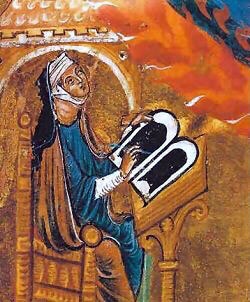
Hildegard of Bingen was a German writer, composer, philosopher, Christian mystic, Benedictine abbess, visionary and polymath (a person whose expertise spans a significant number of different subject areas. An example of another famous polymath would be Leonardo da Vinci). She wrote theological, botanical, and medicinal texts, as well as letters, liturgical songs, poems, a morality play, also supervising over miniature illuminated manuscripts. Her morality play is the oldest surviving example of its form. In 1136 she was elected a magistra (teacher) by her fellow nuns. In 1150 she founded the monastery of Rupertsberg and in 1165 Eibingen.

It is believed she was born about 1098, but the exact date of her birth is unknown. She was the tenth child of a family of free nobles and was sickly from birth. From a very young age Hildegard experienced visions. Perhaps due to her visions her parents offered her as a tithe to the church. Her enclosure date is cloudy and there is no written record of the next twenty-four years of her life in the convent. She was enclosed with another girl Jutta who also had visions and attracted many visitors. Jutta taught her to read and write, but not how to interpret biblical meaning. The two of them likely prayed, meditated, read scripture and did some type of handwork together. It is also believed it was at this time she learned to play the ten string psaltery. Upon Jutta’s death in 1136 Hildegard was unanimously elected magistra of her community by her fellow nuns. She wanted more independence and requested Abbot Kuno to be able to move the convent to Rupertsberg. This was to be a move towards poverty. She was denied. Hildegard in return went over his head and was granted permission from the archbishop. In 1150 Hildegard and twenty nuns made the move and were granted their own monastery.

At age 43 she received a vision from God to write down all that she had seen. Her first book the “Scivias” (Know the Ways) was the result. In it she described her struggles from within:
“But I, though I saw and heard these things, refused to write for a long time through doubt and bad opinion and the diversity of human words, not with stubbornness but in the exercise of humility, until, laid low by the scourge of God, I fell upon a bed of sickness; then, compelled at last by many illnesses, and by the witness of a certain noble maiden of good conduct [the nun Richardis von Stade] and of that man whom I had secretly sought and found, as mentioned above, I set my hand to the writing. While I was doing it, I sensed, as I mentioned before, the deep profundity of scriptural exposition; and, raising myself from illness by the strength I received, I brought this work to a close – though just barely – in ten years. […] And I spoke and wrote these things not by the invention of my heart or that of any other person, but as by the secret mysteries of God I heard and received them in the heavenly places. And again I heard a voice from Heaven saying to me, ‘Cry out therefore, and write thus!”

In addition to her writing she composed sixty-nine musical compositions including the oldest surviving morality play “Ordo Virtutum.” This is one of the largest outputs among all medieval composers. She also wrote over 400 letters to people ranging from Popes, Emperors, abbots, and abbesses. In addition she wrote two volumes on natural medicines and cures, an invented language called, “Lingua ignota,” a gospel commentary, two works of hagiography (writings about holy people such as saints), and finally three volumes of visionary theology : the “Scivias (Know the Ways)”, “Liber vitae meritorum (Book of Life’s Merits)” and “Liber divinorum operum (Book of Divine Works)”. In each of these texts she first describes the vision and then interprets them throughout the Bible. The books were celebrated in the Middle Ages in part because of the approval given by Pope Eugenius III. She also wrote “Physica” and “Causae at Curae”. Well known for her healing ability in these texts she describes the natural world including the cosmos, animals, plants, stones and minerals. She particularly focused on the healing abilities of plants, animals and stones. She also created her own alphabet with abridged words of a form of Latin. It is believed she used this alphabet to increase solidarity among her nuns.

Her belief was man and woman had complimentary roles and wrote:

“Man and woman are in this way so involved with each other that one of them is the work of the other. Without woman, man could not be called man; without man, woman could not be named woman. Thus woman is the work of man, while man is a sight full of consolation for woman. Neither of them could henceforth live without the other. Man is in this connection an indication of the Godhead while woman is an indication of the humanity of God’s Son”
~ Hildegard of Bingen

Christine de Pizan

Christine de Pizan (1363-circa 1430)

Christine de Pizan (or Pisan) was a Venetian born late medieval woman poet. She was highly regarded in her own day and during her thirty year career as Europe’s first professional woman writer completing forty-one works. She tirelessly challenged misogyny and the stereotypes of the late medieval period. She was widowed by age twenty-four and much of her motivation for her writing came from her need to earn a living for not only herself but her children. Her early poetry was of the courtly genre and marked by her knowledge of aristocratic custom and fashion of the day involving women and the practice of chivalry. In recent decades her works have once again returned to prominence through the scholarly efforts of those such as Simone de Beauvoir among others. There is some argument among scholars as whether to see her as an early feminist or that her beliefs were not progressive enough.

In 1390 with the death of her husband she was faced with the prospect of being left to support her mother, a niece and her two children. She began writing love ballads which garnered the attention of several patrons within the court who commissioned her to compose texts of their romantic exploits as they were intrigued by the novelty of having a woman writer. It is estimated that between 1393 and 1412 she was quite prolific having composed over three-hundred ballads and shorter poems. In 1401-1402 she engaged in a debate over Jean de Meun’s portrayal of women as nothing much more than seducers in his work “Romance of the Rose.” The result of the debate was more profound for her than the actual conclusions as it established her reputation as a female intellectual in a male dominated realm.

By 1405 she had completed her most successful literary works, “The Book of the City of Ladies,” and “The Treasure of the City of Ladies.” In these two works she argued and showed the importance of women’s past contributions to society and then attempted to illustrate and teach women how to cultivate qualities to counteract the growth of misogyny. She argues that women must recognize and promote their ability to make peace between their husband and his subjects. She believed that slanderous speech destroys the sisterly bond among women, “skill in discourse should be a part of every woman’s moral repertoire.” The works give a fascinating portrait of women in the 1400’s offering advice for women’s lives from the lady in the castle to the servant, peasant and even the prostitute. Through all of this she asserts than woman’s influence is realized when her speech unifies value to chastity, virtue and restraint.

Simone de Beauvoir in 1949 described her as, “the first time we see a woman take up her pen in defense of her sex.” Perhaps this makes her the western world’s first feminist.

A few quotes :

“Just as women’s bodies are softer than men’s, so their understanding is sharper.”

“I say it to thee again, and doubt never the contrary, that if it were the custom to put the little maidens to the school, and they were made to learn the sciences as they do to the men-children, that they should learn as perfectly, and they should be”

“Ah, child and youth, if you knew the bliss which resides in the taste of knowledge, and the evil and ugliness that lies in ignorance, how well you are advised to not complain of the pain and labor of learning.”

“Not all men (and especially the wisest) share the opinion that it is bad for women to be educated. But it is very true that many foolish men have claimed this because it displeased them that women knew more than they did.”
~ Christine de Pizan

Edith Wharton

Edith Wharton (1862-1937)

Edith Wharton is well known as one the more prolific American writers of the twentieth century, being a novelist and short story writer as well as a garden and interior designer. In 1921 she became the first woman to win the Pulitzer Prize for one of her best known novels, “The Age of Innocence.” It has been made into at least three movies, the most recent being the Martin Scorsese film released in 1993. In 1923 she became the first woman to receive an honorary doctorate from Yale.

During her long life her literary endeavors were encouraged by a varied group friends of both the literary elite and other notable public personalities such as: Henry Wadsworth Longfellow, Henry James, Jean Cocteau, Andre Gide and Theodore Roosevelt. Additionally she met both Sinclair Lewis and F. Scott Fitzgerald. Her upbringing and varied group of friends and influences provided her with unique insights into the upper class. Through all her life her polished prose and humor produced fiction which appealed to a large audience. She received the French Legion of Honor for her philanthropic work during World War I, and was additionally a member of the National Institute of the Arts and Letters, and the American Academy of Arts and Letters.

In addition to notable novels such as “The Age of Innocence,” “The House of Mirth,” and “Ethan Frome,” she also wrote at least eighty-five short stories and non-fiction dealing with her European travels and Interior and Garden design such as “Italian Villas and Their Gardens,” and “French Ways and Their Meaning.” She is best known for her novels with portraits of New York’s upper class during pre-World War I society. She used both humor and empathy to discuss their vanishing world at the beginning of the twentieth century. In such novels as “Ethan Frome” she was much more harsh and critical of the rural lower class of Massachusetts.

A few short quotes :

“Nothing is more perplexing to a man than the mental process of a woman who reasons her emotions.”

“If only we’d stop trying to be happy, we could have a pretty good time.”

“Life is always either a tightrope or a feather bed. Give me the tightrope.”
~ Edith Wharton

Dorothy Parker

Dorothy Parker (1893-1967)

Dorothy Parker was an American poet, short story writer, critic, screenwriter, and satirist best known for her wit and wisecracks especially in the 1920’s when she was a member of the Algonquin Round Table group or writers, critics, actors and artists. The Algonquin Round Table or “The Vicious Circle” circle as they dubbed themselves met for lunch every day at the Algonquin Hotel from 1919-1929. At these luncheons they engaged in wisecracks, wordplay and witticisms. Several of its members gained national reputations for their contributions to literature and for their wit. There was no official membership, however the founding or charter members included : Dorothy Parker, Robert Benchley (humorist and actor), Franklin Pierce Adams (columnist), Heywood Broun (columnist and sportswriter), Marc Connelly (playwright), Ruth Hale (Freelance writer and feminist), George S. Kaufman (playwright and director), Harold Ross (the “New Yorker” editor), Robert E. Sherwood (author and playwright), John Peter Toohey (publicist), and Alexander Wollcott (critic and journalist).

In later years Dorothy Parker would go on to criticize the group, “These were no giants. Think who was writing in those days—Lardner, Fitzgerald, Faulkner and Hemingway. Those were the real giants. The Round Table was just a lot of people telling jokes and telling each other how good they were. Just a bunch of loudmouths showing off, saving their gags for days, waiting for a chance to spring them….There was no truth in anything they said. It was the terrible day of the wisecrack, so there didn’t have to be any truth…” While it may be true that some members are perhaps now “famous for being famous” as opposed to their literary output, members did significantly contribute to the literary landscape. Including Pulitzer prizes won by Kaufman, Connelly and Sherwood (who won four), also sometime member author and playwright Edna Ferber also won a Pulitzer Prize. The continuing legacy of Ross’s New Yorker is also of major significance.

Parker sold her first poem to “Vanity Fair” in 1914 and a few months later was hired as an editorial assistant to another Condé Nast magazine, “Vogue.” She would move to “Vanity Fair” two years later as a staff writer. In 1918 she began writing theater criticism, originally as a stand in for a vacationing P.G. Wodehouse and her career really took off. It was here that she formed a close friendship with Robert Benchley and Robert E. Sherwood. The three of them began lunching at the Algonquin Hotel. In 1920 she was fired from “Vanity Fair” after her criticisms and caustic wit caused too many producers to be offended. Benchley and Sherwood both resigned in protest. With the founding of the “New Yorker” both Parker and Benchley were part of its board of editors set up to allay concerns of the investors. Her first piece for the magazine appeared in the second issue.

She became famous for her short, viciously humorous poems, many about her unsuccessful romantic affairs and her considering the appeal of suicide. In the 1920’s she published some three-hundred poems in “Vanity Fair,” “Vogue,” “The Coming Tower,” “New Yorker,” Life,” “McCall’s,” and “The New Republic.” In 1926 she published her first collection of poetry, “Enough Rope.” It garnered good reviews and sold 47,000 copies. “The Nation,” reviewed it as, “caked with a salty humor, rough with splinters of disillusion, and tarred with a bright black authenticity.” The volume helped to solidify her reputation for sparkling wit. She would go on to publish two more volumes of poetry, “Sunset Gun (1928),” and “Death and Taxes (1931).” She also published three short story collections “Laments for the Living (1930),” “After Such Pleasures (1933),” and “Not So Deep a Well (1936).” Her best known short story “Big Blonde” was awarded the O. Henry Award as the best short story of 1929. In the late 1920’s she began to become politically aware and active to a lifetime commitment to left-leaning causes which would eventually lead to her being blacklisted.

In 1934 she married Alan Campbell and they moved to Hollywood. They signed a 10 week contract with Paramount with Campbell earning $250 per week and Parker $1,000 per week. They would eventually earn up to $5,000 per week freelancing for various studios. They worked on more than fifteen films together.
With the entry of the United States she entered into a collaboration with Alexander Collcott on an anthology of her work with Viking Press for servicemen stationed overseas. It was released in 1944 in the United States as “The Portable Dorothy Parker,” One of only three in the series to continuously be in print, the other two being Shakespeare and the Bible.

During the 1930’s and 1940’s she became a vocal advocate for civil liberties, civil rights, and a critic of authority. She would report on the loyalist cause in Spain for the “New Masses” magazine. In 1936 she helped found the Hollywood anti-Nazi league. Its membership eventually grew to over 4,000. She was also chair of the Joint Anti-Fascist Rescue Committee. She helped to transport loyalist veterans to Mexico, headed the Spanish Children’s relief and allowed her name to be associated with many left-wing causes and organizations. In the 1950’s Parker was listed as a communist by the publication “Red Channels.” During the McCarthy era the FBI built a 1,000 page dossier on her and as a result was placed on the Hollywood blacklist by the movie studios.

She moved back to New York in 1952 and from 1957 to 1962 wrote book reviews for “Esquire.” She died June 7th, 1967 of a heart attack at age 73. She bequeathed her estate to Dr. Martin Luther King Jr. Following his death her estate was passed on to the NAACP. Her ashes remained unclaimed for some seventeen years. In 1988 the NAACP claimed her remains and designated a memorial garden for them outside their Baltimore headquarters. The Plaque reads:

“Here lie the ashes of Dorothy Parker (1893–1967) humorist, writer, critic. Defender of human and civil rights. For her epitaph she suggested, ‘Excuse my dust’. This memorial garden is dedicated to her noble spirit which celebrated the oneness of humankind and to the bonds of everlasting friendship between black and Jewish people. Dedicated by the National Association for the Advancement of Colored People. October 28, 1988.” On August 22nd, 1992 the 99thanniversary of her birth the United States Postal Service issued a commemorative stamp in the Library of Arts series. In 1987 The Algonquin Hotel was designated a New York City Historic Landmark.

A few short quotes :

“Heterosexuality is not normal, it’s just common.”

“You can lead a whore to culture, but you can’t make her think.”

“I’d like to have money. And I’d like to be a good writer. These two can come together, and I hope they will, but if that’s too adorable, I’d rather have money.”

“If you have any young friends who aspire to become writers, the second greatest favor you can do them is to present them with copies of The Elements of Style. The first greatest, of course, is to shoot them now, while they’re happy.”

Resume
Razors pain you;
Rivers are damp;
Acids stain you;
And drugs cause cramp.
Guns aren’t lawful;
Nooses give;
Gas smells awful;
You might as well live.
~ Dorothy Parker

Charlotte Perkins Gilman

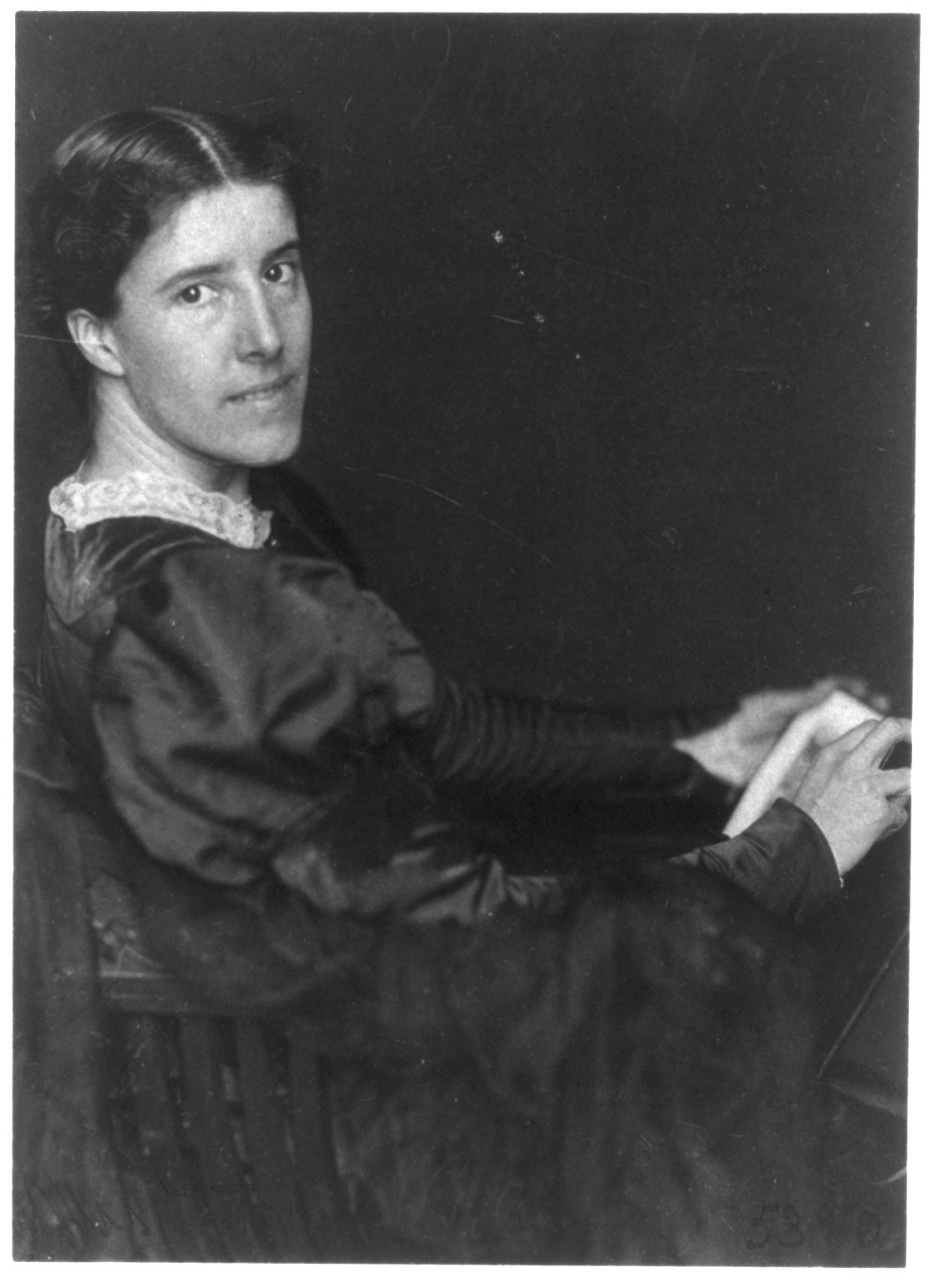
Charlotte Perkins Gilman (1860-1935)

She is best known today for her short story “The Yellow Wallpaper,” a semi-autobiographical account of a severe bout of postpartum psychosis. She was a Utopian Feminist (women’s suffrage as well as women’s economic independence) and a prominent sociologist, novelist, writer of short-stories, non-fiction and poetry. Her book “Women and Economics : A Study of the Economic Relation Between Men and Women as a Factor in Social Evolution,” was published in 1898 and considered by many her greatest work. Her contention was that humans were the only species in which women were dependent upon the male for survival. They paid for this dependence through domestic services of “sex functions”. Here belief that this awkward distribution of power within the sex roles were detrimental to both genders. Her novel “Herland” published in 1915 is a utopian novel describing an isolated society entirely of women who reproduced asexually and thus had an idea social order – free of war, conflict and domination. Perhaps her greatest literary achievement was self-publishing a magazine, “The Forerunner”, for seven years (1909-1916), she wrote the entirety of every issue – editorials, critical articles, book reviews, essays, poems, stories, and six serialized novels including “Herland” and the sequel “With Her In Ourland.”

She married twice, separating from her first husband in 1888 and finally divorcing 1894. She bore one child with her first husband, Katherine. She married her second husband in 1900 and they remained happily married until 1934 when he died of a sudden cerebral hemorrhage. In 1932 she learned she had incurable breast cancer. She was an advocate for the right-to-die and thus on August 17th, 1935 she committed suicide by taking an overdose of chloroform. Both her autobiography and suicide note stated she “chose chloroform over cancer.” One of her more famous quotes comes from her suicide note…

“Human life consists in mutual service. No grief, pain, misfortune, or broken heart, is excuse for cutting off one’s life while any power of service remains. But when all usefulness is over, when one is assured of an unavoidable and imminent death, it is the simplest of human rights to choose a quick and easy death in place of a slow and horrible one.”
~ Charlotte Perkins Gilman

“There is no female mind. The brain is not an organ of sex. Might as well speak of a female liver.”

Anne Sexton

Anne Sexton (1928-1974)

Anne Sexton was an American poet best known for her personal autobiographical style of confessional verse. In 1967 she won the Pulitzer Prize for poetry for her book “Live or Die.” Additionally she was a fellow of the Royal Society of Literature and the first woman to be a member of the Harvard chapter of Phi Beta Kappa. The main themes of her poetry consisted of her suicidal tendencies, her battle with depression, isolation, and personal details of her intimate life including her marriage and children. In 1928 she was born in Newton, Massachusetts and would remain in the Boston area for the rest of her forty-five years. She married in 1948 and had two daughters. She was diagnosed with what is now called bipolar disorder and struggled with it much of her life, including several suicide attempts and a long relationship with Glenside Hospital. On October 4th, 1974 she put on her mother’s fur coat, removed her rings, poured herself a glass of vodka, locked herself in her garage turning on the car and committed suicide by carbon monoxide poisoning.

Besides her reoccurring themes of depression, isolation and suicide she also focused on certain issues specific to women which were not commonly addressed in poetry up to that point such as menstruation and abortion. She also more broadly addressed such subjects as masturbation and adultery all subjects that were taboo up until that point. Early in her career she focused almost entirely on autobiographical verse, but as her career progressed she made attempts to reach outside her own personal experience. One of her most successful of these was the book, “Transformations,” in which she retold Grimm’s fairy tales. Kurt Vonnegut, Jr. commented after reading the book, “God love her.” The poet Denise Levertov said of her death, “We who are alive must make clear, as she could not, the distinction between creativity and self-destruction.”
A link to Anne Sexton reading her poem “Her Kind” :
http://www.poets.org/viewmedia.php/prmMID/15297

A few quotes :
“All I wanted was a little piece of life, to be married, to have children…. I was trying my damnedest to lead a conventional life, for that was how I was brought up, and it was what my husband wanted of me. But one can’t build little white picket fences to keep the nightmares out.”

“Death, I need my little addiction to you. I need that tiny voice who, even as I rise from the sea, all woman, all there, says kill me, kill me.”

“The beautiful feeling after writing a poem is on the whole better even than after sex, and that’s saying a lot.”

Wanting To Die – By Anne Sexton

Since you ask, most days I cannot remember.
I walk in my clothing, unmarked by that voyage.
Then the almost unnameable lust returns.
Even then I have nothing against life.
I know well the grass blades you mention,
the furniture you have placed under the sun.
But suicides have a special language.
Like carpenters they want to know which tools.
They never ask why build.
Twice I have so simply declared myself,
have possessed the enemy, eaten the enemy,
have taken on his craft, his magic.
In this way, heavy and thoughtful,
warmer than oil or water,
I have rested, drooling at the mouth-hole.
I did not think of my body at needle point.
Even the cornea and the leftover urine were gone.
Suicides have already betrayed the body.
Still-born, they don’t always die,
but dazzled, they can’t forget a drug so sweet
that even children would look on and smile.
To thrust all that life under your tongue!–
that, all by itself, becomes a passion.
Death’s a sad Bone; bruised, you’d say,
and yet she waits for me, year after year,
to so delicately undo an old wound,
to empty my breath from its bad prison.
Balanced there, suicides sometimes meet,
raging at the fruit, a pumped-up moon,
leaving the bread they mistook for a kiss,
leaving the page of the book carelessly open,
something unsaid, the phone off the hook
and the love, whatever it was, an infection.

Seven Important Post-1900 Jewish Novels

“What a fate: to be condemned to work for a firm where the slightest negligence at once gave rise to the gravest suspicion! Were all the employees nothing but a bunch of scoundrels, was there not among them one single loyal devoted man who, had he wasted only an hour or so of the firm’s time in the morning, was so tormented by conscience as to be driven out of his mind and actually incapable of leaving his bed?” 
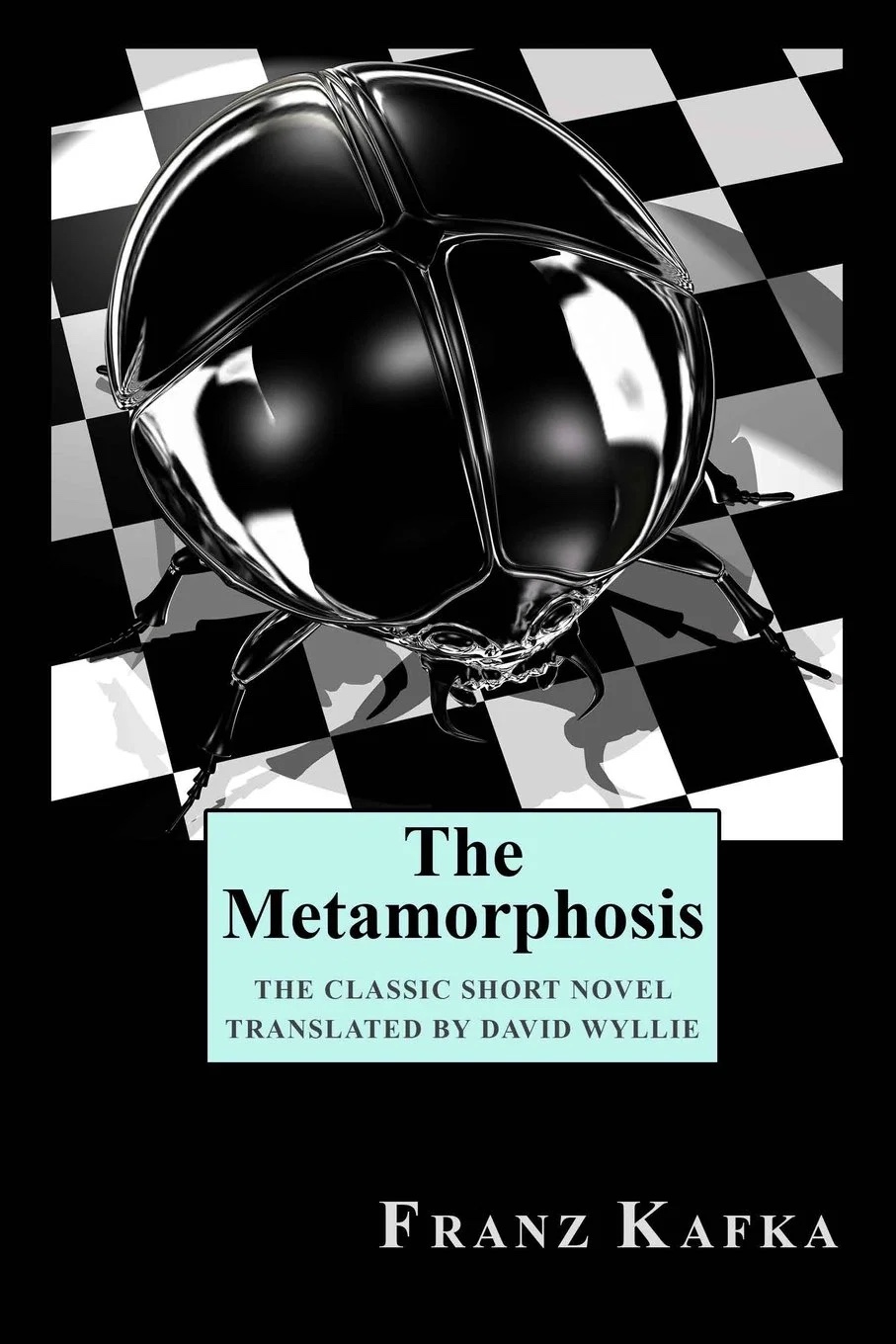
~ Franz Kafka, The Metamorphosis

  1. The Metamorphosis (1915) by Franz Kafka

One of Kafka’s best-known works, The Metamorphosis tells the story of salesman Gregor Samsa who wakes one morning to find himself inexplicably transformed into a huge insect and subsequently struggling to adjust to this new condition. The novella has been widely discussed among literary critics, with differing interpretations being offered.

  1. In Search of Lost Time (1913) by Marcel Proust

It is considered to be his most prominent work, known both for its length and its theme of involuntary memory, the most famous example being the “episode of the madeleine.” It gained fame in English in translations by C. K. Scott Moncrieff and Terence Kilmartin as “Remembrance of Things Past”, but the title In Search of Lost Time, a literal rendering of the French, has gained usage since D. J. Enright adopted it for his revised translation published in 1992.

  1. Portnoy’s Complaint (1969) by Philip Roth

The novel tells the humorous monologue of “a lust-ridden, mother-addicted young Jewish bachelor,” who confesses to his psychoanalyst in “intimate, shameful detail, and coarse, abusive language.”Many of its characteristics (such as comedic prose, themes of sexual desire and sexual frustration, and a self-conscious literariness) went on to become Roth trademarks.

  1. Death of a Salesman (1949) by Arthur Miller

It won the 1949 Pulitzer Prize for Drama and Tony Award for Best Play. The play premiered on Broadway in February 1949, running for 742 performances, and has been revived on Broadway four times,winning three Tony Awards for Best Revival. It is widely considered to be one of the greatest plays of the 20th century.

  1. The Catcher in the Rye (1951) by J.D. Salinger

A classic novel originally published for adults, it has since become popular with adolescent readers for its themes of teenage angstand alienation. It has been translated into almost all of the world’s major languages. Around 1 million copies are sold each year, with total sales of more than 65 million books. The novel’s protagonist Holden Caulfield has become an icon for teenage rebellion. The novel also deals with complex issues of innocence, identity, belonging, loss, and connection.

  1. The Trial (1925) by Franz Kafka

One of his best-known works, it tells the story of Josef K., a man arrested and prosecuted by a remote, inaccessible authority, with the nature of his crime revealed neither to him nor to the reader.

  1. Herzog (1964) by Saul Bellow

Herzog is set in 1964 in the United States, and is about the midlife crisis of a Jewish man named Moses E. Herzog. At the age of forty-seven, he is just emerging from his second divorce, this one particularly acrimonious. He has two children, one by each wife, who are growing up without him. His career as a writer and an academic has floundered. He is in a relationship with a vibrant woman, Ramona, but finds himself running away from commitment.