Mary Wollstonecraft Birthday

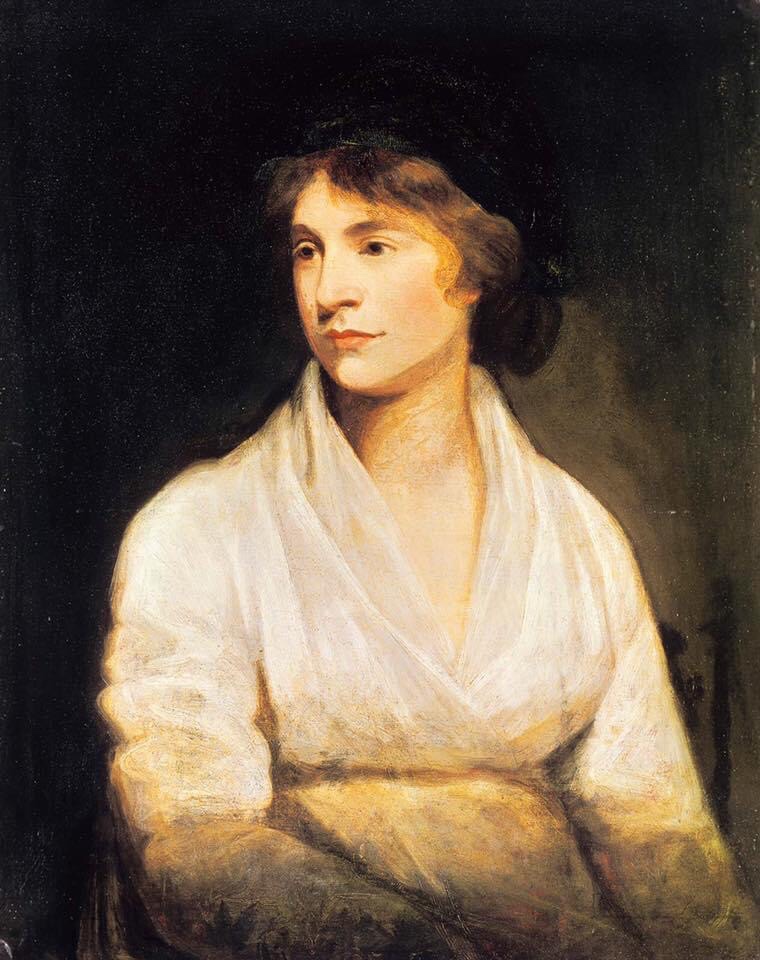
On this date in 1759, Mary Wollstonecraft was born in London, the second of seven children. The industrious young woman worked as a companion, governess and then opened her own school. Her first book, Thoughts on the Education of Daughters, was published in 1786, followed by a novel, a children’s book (re-issued with illustrations by William Blake), a translation, and The Female Reader. When Edmund Burke read her review of a sermon by dissenting minister Richard Price, he wrote a famous attack on the American and French Revolutions. Mary was the first to rebut his polemic. A Vindication of the Rights of Men was published five weeks later, rejecting all arguments from authority or precedent. Her seminal A Vindication of the Rights of Woman was published in 1792. The first influential book calling for the equality of the sexes, it urged that women be educated and treated as “rational creatures.” Wollstonecraft championed dress reform, breast-feeding, early education and a national system of coeducational primary schools. She warned of those who practice “on the credulity of women.”

She gave birth to a daughter in an unhappy liaison with Gilbert Imlay, then married atheist William Godwin in 1797. Following an uneventful pregnancy, 38-year-old Mary gave birth to a second daughter, Mary. The new mother died of a childbirth infection after ten intense days of suffering. Her daughter Mary ran off as a teenager with poet Percy Shelley, and wrote Frankenstein at age 19. Wollstonecraft was an ardent rationalist and Deist who adopted an agnostic point of view toward the end of her life. D. 1797.

“. . . the being cannot be termed rational or virtuous who obeys any authority but that of reason.”
~ Mary Wollstonecraft, A Vindication of the Rights of Woman (1792)

William Shakespeare on Religion

On this date in 1564, William Shakespeare was born in England. He died in 1616. The “master” playwright was eulogized by 19th century agnostic orator Robert Green Ingersoll. In one of his famous lectures, Ingersoll said that when he read Shakespeare, “I beheld a new heaven and a new earth.” (The Works of Robert G. Ingersoll, Interviews, Vol. IV, p. 39.) “All well-educated ministers know that the Bible suffers by a comparison with Shakespeare.” (Vol. VIII, p. 297) “If Shakespeare could be as widely circulated as the Bible . . . nothing would so raise the intellectual standard of mankind. Think of the different influence on men between reading Deuteronomy and ‘Hamlet’ and ‘King Lear’ . . . The church teaches obedience. The man who reads Shakespeare has his intellectual horizon enlarged.”

No one knows Shakespeare’s personal religious views, although he certainly was not orthodox, and put many different types of sentiments into the mouths of his characters. His philosophy seems most succinctly described in the famous “Seven Ages of Man” speech from “As You Like It,” which begins: “All the world’s a stage/ And all the men and women merely players:/ They have their exits and their entrances;. . .” ending with “mere oblivion./ Sans teeth, sans eyes, sans taste, sans everything.” Below are several of Shakespeare’s most famous irreverencies. D. 1616.

“In religion, what damned error but some sober brow will bless it, and approve it with a text, . . .?”
~ “The Merchant of Venice,” Act III, Sc. II

Peter Watson

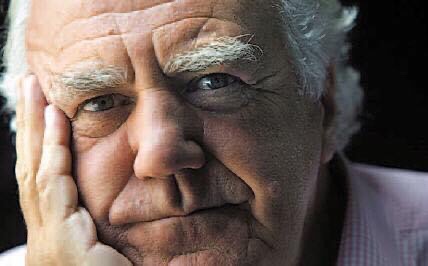
On this date in 1943, author Peter Watson was born in Birmingham, England. An intellectual historian and investigative journalist, he was educated at the universities of Durham, London and Rome, later living in the United States. He has written for The Observer, The New York Times, Punch and The Spectator, and is the author of fiction, as well as many books on art history, biography, psychology, and true crime. His books include: The Medici Conspiracy: The Illicit Journey of Looted Antiquities from Italy’s Tomb Raiders to the World’s Greatest Museums (2006, with Cecilia Todeschini), Ideas: A History of Thought and Invention, from Fire to Freud (2005), Modern Mind: An Intellectual History of the 20th Century (2001) (also published as A Terrible Beauty), Sotheby’s: The Inside Story (1998), Landscape of Lies (1989) and The Caravaggio Conspiracy (1984). In Ideas: A History of Thought and Invention, Watson seeks a new way to tell the history of the world from prehistory to modern day, asserting that human knowledge is divided into two realms: inward (philosophy and religion) and outward (observation and science). His stance supports the latter. Twins: An Uncanny Relationship? (1982), explores behavior patterns shared by identical twins, “to offer a rational alternative to mumbo jumbo for explaining many of the coincidences reported in twin studies, ” according to a Los Angeles Times review. “A few saints and a little charity don’t make up for all the harm religion has done over the ages,” he has said (CBC News, May 5, 2007).

When asked about the good that religion has done in the world in an interview by The New York Times Magazine (December 11, 2005), Watson replied: “I lead a perfectly healthy, satisfactory life without being religious. And I think more people should try it.” He went on to say, “I do not believe in the inner world. I think that the inner world comes from the exploration of the outer world–reading, traveling, talking. I do not believe that meditation or cogitation leads to wisdom or peace or the truth.” Since 1998, Watson has been a research associate at the McDonald Institute for Archaeological Research, at the University of Cambridge. He lives in London, England.

“Religion has kept civilization back for hundreds of years, and the biggest mistake in the history of civilization, is ethical monotheism, the concept of the one God. Let’s get rid of it and be rational.”
~ Peter Watson interview, CBC News (May 5, 2007)

Clémence-Auguste Royer

On this date in 1830, Clémence-Auguste Royer was born in Nantes, France. Her parents were Catholic royalists, and Royer’s early education took place in a convent school. Royer became a republican following the Revolution of 1848, and began to question other common views at that time. Royer obtained a teaching certificate and taught at girls schools in Wales, where she mastered English, and in France. She read widely on science in these school libraries. In 1855, as a result of her inquiries, she rejected Catholicism thoroughly, and devoted herself to science. She began to offer lectures on science and logic for women in Lausanne, Switzerland, in 1858. Royer translated Charles Darwin’s Origin of Species into French in 1863. She famously wrote a preface to the work which used Darwin’s mechanism for evolution as part of an anti-religious argument which Darwin himself did not make — by this time, the book was in its third English edition and contained several strong references to a creator. Royer had been an evolutionist before reading Darwin, having been strongly influenced by the writings of Jean Baptiste LaMarck. French scientists, especially atheists and anthropologists, were strongly influenced by evolution and natural selection as framed by Royer, who also discussed the implications of evolutionary theory for human beings and society in her introduction (it would be almost ten years before Darwin himself grappled with these issues in The Descent of Man). Royer continued as Darwin’s official French translator until the third French edition of Origin was published in 1870.

Royer, despite not being a research scientist, remained a popular interpreter of science as well as a philosopher of science throughout her life. As a woman, she was denied access to many learned societies, as well as university teaching positions. It has been argued by Jennifer Michael Hecht, among others, that Royer opened doors to women within the freethinking movement. Royer was a feminist who argued passionately for the rights of women, married and unmarried, to child custody, property, education and equality with men. In 1866, she had a son by her lover and life partner, Pascal Duprat, a married man, which sharpened her concern about the major legal obstacles then present to unwed mothers and their children. She published many books and articles throughout her life, and considered the pinnacle to be 1900’s Natura rerum, her theory of nature. In 1900, Royer was named a Chevalier of the Legion of Honor for her contributions as “a woman of letters and a scientific writer.” D. 1902

“Yes, I believe in revelation, but a permanent revelation of man to himself and by himself, a rational revelation that is nothing but the result of the progress of science and of the contemporary conscience, a revelation that is always only partial and relative and that is effectuated by the acquisition of new truths and even more by the elimination of ancient errors. We must also attest that the progress of truth gives us as much to forget as to learn, and we learn to negate and to doubt as often as to affirm.”
~ Clémence Royer, preface to Charles Darwin, L’origine des espèces, in Jennifer Michael Hecht, The End of the Soul

Charlotte Bronte

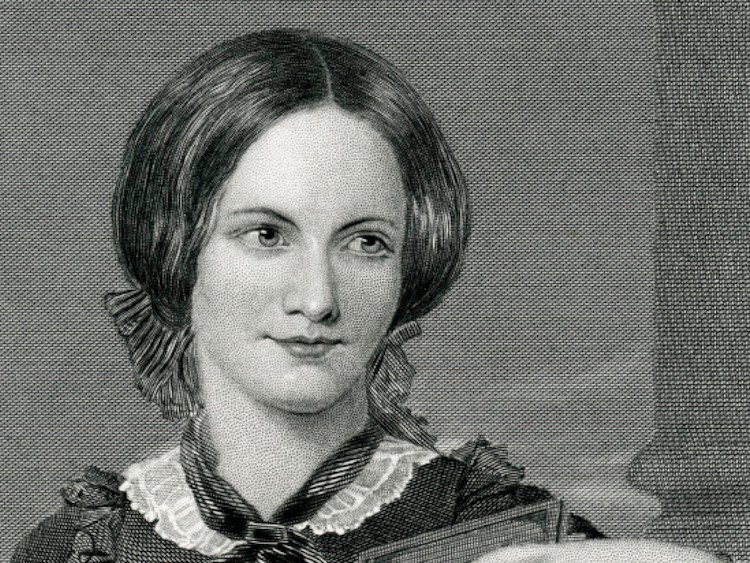
Charlotte Brontë was born the 21 April 1816 was an English novelist and poet, the eldest of the three Brontë sisters who survived into adulthood and whose novels have become classics of English literature. She first published her works (including her best known novel, Jane Eyre) under the pen name Currer Bell.

Jane Eyre had immediate commercial success and initially received favourable reviews. G. H. Lewes wrote that it was “an utterance from the depths of a struggling, suffering, much-enduring spirit,” and declared that it consisted of “suspiria de profundis!” (sighs from the depths). Speculation about the identity and gender of the mysterious Currer Bell heightened with the publication of Wuthering Heights by Ellis Bell (Emily) and Agnes Grey by Acton Bell (Anne). Accompanying the speculation was a change in the critical reaction to Brontë’s work, as accusations were made that the writing was “coarse”, a judgement more readily made once it was suspected that Currer Bell was a woman. However, sales of Jane Eyre continued to be strong and may even have increased as a result of the novel developing a reputation as an “improper” book.

“Averse to personal publicity, we veiled our own names under those of Currer, Ellis and Acton Bell; the ambiguous choice being dictated by a sort of conscientious scruple at assuming Christian names positively masculine, while we did not like to declare ourselves women, because — without at that time suspecting that our mode of writing and thinking was not what is called “feminine” – we had a vague impression that authoresses are liable to be looked on with prejudice; we had noticed how critics sometimes use for their chastisement the weapon of personality, and for their reward, a flattery, which is not true praise.”
~ Charlotte Bronte

David John Chalmers

On this date in 1966, philosopher David John Chalmers was born in Australia. Chalmers earned a bachelor’s degree in mathematics and computer science from the University of Adelaide in 1986. He was briefly a Rhodes Scholar at Oxford University, but transferred to Indiana University at Bloomington, where he obtained a Ph.D. in 1993 in philosophy and cognitive science. He worked at Washington University in St. Louis from 1993 to 1995, and at the University of California – Santa Cruz from 1995 to 1998. He worked in the Department of Philosophy and the Center for Consciousness Studies at the University of Arizona from 1999 to 2004. Since 2004, Chalmers is professor of philosophy and director of the Centre for Consciousness at Australian National University. As of 2009, he is also a part-time professor of philosophy at New York University. His 1996 book, The Conscious Mind, is considered a seminal work on consciousness. His numerous papers and books have had great influence in the realms of cognitive science, philosophy of the mind and philosophy of language.

“Now I have to say I’m a complete atheist. I have no religious views myself and no spiritual views, except very watered down humanistic spiritual views. And consciousness is just a fact of life. It’s a natural fact of life.”
~ David Chalmers in an interview on “Encounter” with Margaret Coffey for Australian ABC National Radio, April 10, 2011

Joseph Campbell on Immortality

“Those who know, not only that the Everlasting lives in them, but that what they, and all things, really are IS the Everlasting, dwell in the groves of the wish-fulfilling trees, drink the brew of immortality, and listen everywhere to the unheard music of eternal concord. These are the immortals.”

~ Joseph Campbell, from “The Hero with a Thousand Faces”

#JosephCampbell #Mythology #FavoriteBooks

Emile Zola

On this date in 1840, Emile Zola was born in Paris. The novelist pioneered naturalistic writing, believing ugly problems could not be solved as long as they stayed hidden. As a struggling young writer, Zola supported himself as a clerk. Legend has it he sometimes resorted to trapping birds on his windowsill in order to eat. Zola also moonlighted as a political reporter and critic. He was fired from a publishing house after an early autobiographical novel created notoriety. His breakthrough novel was Therese Raquin (1867). By the time his book L’Assammoir (“The Drunkard,” 1878) appeared, Zola was France’s most famous writer, yet he was barred his entire life from the Academy. His book Germinal (1885), about conditions in a coal mine leading to a strike, was denounced by the rightwing. Nana (1880) examined sexual exploitation.

Zola’s most enduring work is his open letter “J’Accuse,” about the Dreyfus case. He campaigned with Clemenceau to free the the French Jewish army officer falsely accused of spying. Zola was sentenced to imprisonment for writing “J’Accuse” in 1898, escaping to England until he could safely return after Dreyfus’ name had been cleared. Zola, who was baptized Catholic, was a notable critic of the Roman Catholic Church (and vice versa). The Church particularly condemned his books Lourdes, Rome, and Paris (1894-98). The agnostic was an honorary associate of the British Press Association in England. D. 1902.

“When truth is buried underground it grows, it chokes, it gathers such an explosive force that on the day it bursts out, it blows up everything with it.”

“The truth is on the march, and nothing shall stop it.”

~ Emile Zola, “J’Accuse!” L’Aurore, Jan. 13, 1898

Amos Oz on Fanaticism

“Fanaticism dates back much earlier than Islam. Earlier than Christianity and Judaism. Earlier than all the ideologies in the world. It is an elemental fixture of human nature, a “bad gene.” People who bomb abortion clinics, murder immigrants in Europe, murder Jewish women and children in Israel, burn down a house in the Israeli-occupied territories with an entire Palestinian family inside, desecrate synagogues and churches and mosques and cemeteries—they are all distinct from al-Qaeda and ISIS in the scope and severity of their acts, but not in their nature. Today we speak of “hate crimes,” but perhaps a more accurate term would be “zealotry crimes,” and such crimes are carried out almost daily, including against Muslims.

Genocide and jihad and the Crusades, the Inquisition and the gulags, extermination camps and gas chambers, torture dungeons and indiscriminate terrorist attacks: none of these are new, and almost all of them preceded the rise of radical Islam by centuries.

As the questions grow harder and more complicated, people yearn for simpler answers, one-sentence answers, answers that point unhesitatingly to a culprit who can be blamed for all our suffering, answers that promise that if we only eradicate the villains, all our troubles will vanish.

“It’s all because of globalization!” “It’s all because of the Muslims!” “It’s all because of permissiveness!” or “because of the West!” or “because of Zionism!” or “because of immigrants!” or “because of secularism!” or “because of the left wing!” All one needs to do is cross out the incorrect entries, circle the right Satan, then kill that Satan (along with his neighbors and anyone who happens to be in the area), thereby opening the gates of heaven once and for all.

More and more commonly, the strongest public sentiment is one of profound loathing—subversive loathing of “the hegemonic discourse,” Western loathing of the East, Eastern loathing of the West, secular loathing of believers, religious loathing of the secular. Sweeping, unmitigated loathing surges like vomit from the depths of this or that misery. Such extreme loathing is a component of fanaticism in all its guises.

For example, concepts that only half a century ago seemed innovative and exciting—multiculturalism and identity politics—quickly morphed, in many places, into the politics of identity hatred. What began with an expansion of cultural and emotional horizons is increasingly deteriorating into narrower horizons, isolationism, and hatred of the other. In short, a new wave of loathing and extremism assails us from all sides.”

~ Amos Oz, from “Dear Zealots.” 2002.