Grounding

What is grounding?

Grounding is a set of simple strategies to detach from emotional pain (for example, drug cravings, self-harm Impulses, anger, sadness). Distraction works by focusing outward on the external world– rather than Inward toward the self. You can also think of it as “distraction,” “centering,” “a safe place,” “looking outward,” or “healthy detachment.”

Why do grounding?

When you are overwhelmed with emotional pain, you need a way to detach so that you can gain control over your feelings and stay safe. As long as you are grounding, you cannot possibly use substances or hurt yourself! Grounding “anchors” you to the present and to reality.

Many people with ptsd and substance abuse struggle with either feeling too much (overwhelming emotions and memories) or too little (numbing and dissociation). In grounding, you attain balance between the two– conscious of reality and able to tolerate it.

Guidelines

  • grounding can be done any time, any place, anywhere and no one has to know.
  • use grounding when you are: faced with a trigger, having a flashback, dissociating, having a substance craving, or when your emotional pain goes above 6 (on a 0-10 scale). Grounding puts healthy distance between you and these negative feelings.
  • keep your eyes open, scan the room, and turn the light on to stay in touch with the present.
  • rate your mood before and after to test whether it worked.before grounding, rate your level of emotional pain (0-10, where means “extreme pain”). Then re-rate it afterwards. Has it gone down?
  • no talking about negative feelings or journal writing. You want to distract away from negative feelings, not get in touch with them.
  • stay neutral– no judgments of “good” and “bad”. For example, “the walls are blue; i dislike blue because it reminds me of depression.” Simply say “the walls are blue” and move on.
  • focus on the present, not the past or future.
  • note that grounding is not the same as relaxation training.grounding is much more active, focuses on distraction strategies, and is intended to help extreme negative feelings. It is believed to be more effective for Ptsd than relaxation training.

Mental grounding

  • Describe your environment in detail using all your senses. For example, “the walls are white, there are five pink chairs, there is a wooden bookshelf against the wall…” Describe objects, sounds, textures, colors, smells, shapes, numbers, and temperature. You can do this anywhere. For example, on the subway: “i’m on the subway. I’ll see the river soon. Those are the windows. This is the bench. The metal bar is silver. The subway map has four colors…”
  • play a “categories” game with yourself. Try to think of “types of dogs”, “jazz musicians”, “states that begin with ‘a’”, “cars”, “tv shows”, “writers”, “sports”, “songs”, “european cities.”
  • do an age progression. If you have regressed to a younger age (e.g., 8 years old), you can slowly work your way back up (e.g., “i’m now 9”; “i’m now 10”; “i’m now 11”…) until you are back to your current age.
  • describe an everyday activity in great detail. For example, describe a meal that you cook (e.g., “first i peel the potatoes and cut them into quarters, then i boil the water, i make an herb marinade of oregano, basil, garlic, and olive oil…”).
  • imagine. Use an image: glide along on skates away from your pain; change the tv channel to get to a better show; think of a wall as a buffer between you and your pain.
  • say a safety statement. “my name is ____; i am safe right now. I am in the present, not the past. I am located in _____; the date is _____.”
  • read something, saying each word to yourself. Or read each letter backwards so that you focus on the letters and not on the meaning of words.
  • use humor. Think of something funny to jolt yourself out of your mood.
  • count to 10 or say the alphabet, very s..l..o..w..l..y.
  • repeat a favorite saying to yourself over and over (e.g., the serenity prayer).

Physical grounding

  • run cool or warm water over your hands.
  • grab tightly onto your chair as hard as you can.
  • touch various objects around you: a pen, keys, your clothing, the table, the walls. Notice textures, colors, materials, weight, temperature. Compare objects you touch: is one colder? Lighter?
  • dig your heels into the floor– literally “grounding” them! Notice the tension centered in your heels as you do this. Remind yourself that you are connected to the ground.
  • carry a grounding object in your pocket– a small object (a small rock, clay, ring, piece of cloth or yarn) that you can touch whenever you feel triggered.
  • jump up and down.
  • notice your body: the weight of your body in the chair; wiggling your toes in your socks; the feel of your back against the chair. You are connected to the world.
  • stretch. Extend your fingers, arms or legs as far as you can; roll your head around.
  • walk slowly, noticing each footstep, saying “left”,”right” with each step.
  • eat something, describing the flavors in detail to yourself.
  • focus on your breathing, noticing each inhale and exhale. Repeat a pleasant word to yourself on each inhale (for example, a favorite color or a soothing word such as “safe,” or “easy”).

Soothing grounding

  • say kind statements, as if you were talking to a small child. E.g., “you are a good person going through a hard time. You’ll get through this.”
  • think of favorites. Think of your favorite color, animal, season, food, time of day, tv show.
  • picture people you care about (e.g., your children; and look at photographs of them).
  • remember the words to an inspiring song, quotation, or poem that makes you feel better (e.g., the serenity prayer).
  • remember a safe place. Describe a place that you find very soothing (perhaps the beach or mountains, or a favorite room); focus on everything about that place– the sounds, colors, shapes, objects, textures.
  • say a coping statement. “i can handle this”, “this feeling will pass.”
  • plan out a safe treat for yourself, such as a piece of candy, a nice dinner, or a warm bath.
  • think of things you are looking forward to in the next week, perhaps time with a friend or going to a movie.

What if grounding does not work?

  • practice as often as possible, even when you don’t “need” it, so that you’ll know it by heart.
  • practice faster. Speeding up the pace gets you focused on the outside world quickly.
  • try grounding for a looooooonnnnngggg time (20-30 minutes).and, repeat, repeat, repeat.
  • try to notice whether you do better with “physical” or “mental” grounding.
  • create your own methods of grounding. Any method you make up may be worth much more than those you read here because it is yours.
  • start grounding early in a negative mood cycle. Start when the substance craving just starts or when you have just started having a flashback.

Exercise Addiction

Obviously, there are many health benefits to working out regularly. It’s good for our cardiovascular system, can relieve stress, and it releases feel good chemicals like endorphins. But just like anything, it’s best in moderation, and when exercise is done excessively, it can come with some dangerous health complications of its own.

So let’s jump into what exercise addiction is: simply put, it’s an unhealthy obsession with physical fitness and working out and we feel helpless to stop even if we know it’s not good for us or is out of control. It’s that second portion, the part about not being able to stop, that differentiates this from professional athletes, olympians, and marathon runners. Sure those people could have exercise addiction, but it’s not just the amount of exercise we do that’s an indicator of this, it’s much more than that.

If we think about it, we can imagine a lot of reasons why someone would become addicted to exercise: it’s a distraction, it makes us feel good, and it’s something our society supports. And it’s not a big jump from that for us to understand why those of us with eating disorders can struggle with it as well. Since eating disorders are coping skills, and exercise can reduce stress and make us feel good. Not to mention that it still feeds into that ED voice by giving us a false sense of control and makes us think that we are achieving something worthwhile.

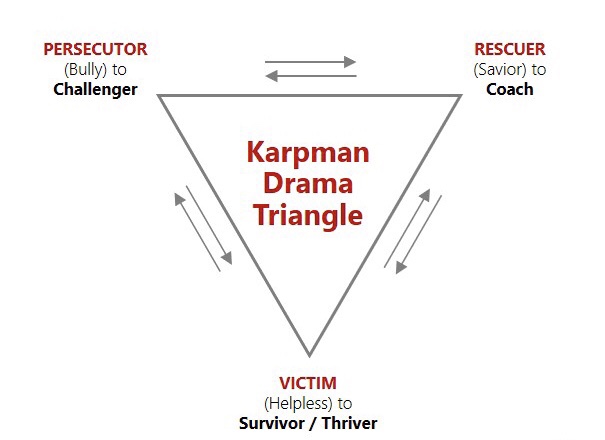
The Karpman Victim – Drama Triangle

The magical tool to figure this pattern out is called the Drama Triangle. Stephen Karpman created the model in 1968 within the framework of Transactional Analysis. Thanks to this tool we can analyze clearly what is happening in the relationships since the Drama Triangle sheds light on the automatic and dysfunctional interaction between 2 (or more) people.

In a relationship within the Drama Triangle, there are 2 main characters (male or female) who shift from one role to another:

  • The Rescuer
  • The Persecutor
  • The Victim.

The Three Roles In The Drama Triangle

What do the roles entail? 

The Rescuer

Rescuers get involved in other people’s lives eagerly waiting for recognition and approval. By making assumptions on other people’s needs they are stepping in to help before anyone has asked them for anything and create a debt of gratitude. They believe that others need them and they impose their solution. In doing so they prevent others from solving their problems themselves. At the same time they manifest their moral superiority.

Feeling responsible for others

Since Rescuers feel responsible for the happiness and well-being of others, they immediately strive to comfort, pacify or calm people down so that these people don’t get to feel their disagreeable emotions like pain, anger, disappointment or sadness. Rescuers also want to have good relationships with everyone, as they like harmony. That is why they avoid conflicts or standing their ground at all costs, even if they end up wasting their time, money or energy. They have a tendency to please people in order to avoid criticism and rejection. After all, they aspire to feel accepted and loved by everyone.

Emotionally disconnected

For all these reasons they are disconnected from their own emotions. Therefore, it is difficult, if not impossible, to have emotional intimacy in a relationship with them. They will flee in “doing”, they are busy at all times … the evidence is their diary: they don’t have a minute.

Codependent relationships

Despite having good intentions, they need Victims to be Rescuers. As a result their behavior encourages the Victim’s dependence and lack of autonomy. Rescuers will continue to be involved in codependent relationships (as with addicts, for example) that are harming them because they do not realize how damaging they are for them. 

Saying no is difficult

Rescuers have an imperative need to feel useful to cover up their anxiety and low self-esteem … in short, to give their life meaning. They never stop giving; basically because they don’t know how to say no. However, if they dare to say no, they will feel guilty and label themselves as selfish or stingy. They prioritize others’ needs ignoring their own, because they project on others their own unmet needs. Most of all they have difficulties in identifying their needs and desires.

Am I just nice or too nice? 

In short, they sacrifice themselves because they want to prove that they are good, generous and selfless people, who deserve love and recognition. And when someone tells them: “You are too nice”, they feel accordingly offended.

But Rescuing creates resentment and anger in themselves and in the Victims, not recognition, nor gratitude or respect. Whereupon Rescuers confirm their belief that Victims are ungrateful and take advantage of them.

Benefice of the coaching sessions for the Rescuer

When Rescuers attend coaching sessions, working on boundaries and the Drama Triangle guarantees favorable results. Once they have understood the detrimental dynamics and know what their needs are, they are able to control their eagerness to rescue and consequently to change their behavior.

The Persecutor

Am I right  or … am I totally right? 

Persecutors know everything and are always right. Those who are wrong are the others. Therefore they pretend to know what is best for other people. They characteristically see everything either in black or in white; Grey does not exist. Their motto is: either you are with me or you are against me.

Like Rescuers, they feel morally superior and need Victims in order to play their role as a Persecutor.

Discounting others 

They ignore not only other people’s feelings but also their value. That is why they criticize, find fault, persecute, blackmail and abuse their power. In particular they use shame and guilt to manipulate. They can even punish (if only with their moodiness or their silence) so that Victims feel anxious and inferior. Persecutors always find a culprit or an enemy: the other. Thus there is no way to resolve a conflict with them since in each conversation you have to tread carefully and not contradict them. They use threats to get what they want because they have a sense of entitlement. And what they want is for others not only to learn their lesson and to agree with them, but also to change and do things the Persecutor’s way.

Relationships based on power and control

Persecutors feel a lot of anger and righteous indignation, which they vent on “innocent” Victims with gusto. They do not consider themselves as abusive or aggressive though because they believe that the Victims deserve their lot.
In order to feel safe Persecutors want to be in control and they fight for the power in the relationship. They impose their point of view to establish a Winner-Loser relationship that allows them to cover up their inferiority complexes, their insecurity and their vulnerability that they don’t recognize. Moreover they confuse having needs with being needy. Consequently they won’t accept any help or will refuse even to consider that someone can do something for them.

Others are to blame 

But there will always be somebody to blame, somebody who doesn’t meet their expectations. When something goes wrong, Persecutors hold others accountable for what happens to avoid blaming themselves. With that attitude it seems unlikely that they will attend coaching sessions since the person responsible or the culprit is always the other. They project on others (outside of themselves) what they don’t want to see in themselves. In effect, they would call others arrogant because they are not able to recognize and accept their own arrogance.

Childhood trauma 

As they have often suffered some kind of abuse in childhood, they always get defensive. They reproduce the behavior of the abuser because they hope that by dominating others they will preventively protect themselves from abuse or contempt.

The Victim

Discounting themselves

Victims feel powerless, incompetent, stuck and sometimes desperate. They discount their skills and their resources. They don’t recognize their own ability to change things or to influence their destiny either. Besides, precisely because life happens to them, they often suffer from depression. And if by miracle something good happens, they attribute it to luck.

Not owning it 

According to Victims they can’t be blamed for anything because they are not responsible. What’s happening is not their fault. They are convinced that life is very hard, that nobody understands them and that no matter what they do they will be unable to change their lot. They always find excuses that justify their situation.

Avoiding responsibilities 

Victims take any opportunity to complain; even their usual tone of voice is querulous. They are the eternal victims of life itself and manage to get sick, have ailments and attract misfortunes. As soon as they get stressed, which happens very easily, they make a mountain out of a molehill. They simply avoid responsibilities and don’t want to make decisions for fear of being wrong.

In addition, you can recognize Victims by their usual way of apologizing for everything and nothing. You can often hear them say “Sorry!”, “Excuse me!”, “I beg your pardon!”.

“A Victim is someone who is waiting for something bad to happen … and it usually does.”

~ Barry K. Weinhold

Not only do they live in an illusory world composed of all the things they imagine or assume (dire consequences, negative emotions or adverse reactions of others, …), they also make assumptions without relying on reality, without having sound evidence that would justify their beliefs.

Passivity

Of course Victims adopt a passive behavior: they don’t take action, they don’t make any effort to get out of the pothole. They are experts in manipulating others to get what they need without getting too involved in the result. They usually sabotage the help they receive and secretly rejoice in their failures. No matter how often they attend coaching sessions, their passivity and lack of commitment may cause the attempt to fail, so that they can blame the coach for the lack of results and prove them incompetent.

Two types of Victims 

Victims attract either Rescuers or Persecutors. On the one hand, Victims create codependence – an excessive emotional or psychological dependence on the Rescuer. This attitude encourages a passive behavior that prevents them from developing fully their abilities. On the other hand, Victims confirm their belief that life is hard and unfair when they are abused by Persecutors.

Therefore, to play their role as Victims they need Rescuers or Persecutors … or both.

Nutrition & Mental Health

Amazingly, people often don’t seem to understand the connection between nutrition and mental health. Time and again people struggling with their mental health don’t eat breakfast, skip lunch, or don’t bother to eat until later in the day. Sometimes people simply forget to eat because they’re busy. Some people lose their appetite because of emotional distress, and others just can’t be bothered to eat properly. Whatever the reason, it’s imperative to understand the connection between poor eating habits and mood and anxiety, as this will underscore the importance of eating properly.

Everybody has heard the cliché you are what you eat, but for some reason many people don’t connect that adage with how they feel mentally and emotionally. What you eat doesn’t affect just physical health; it can also affect general mood on a day-to-day basis. In order for the brain to communicate with the rest of the body, it needs neurotransmitters, such as serotonin, which are made from the nutrients in the foods we eat. Not eating enough, or not eating a well-balanced, nutritious diet, prevents the body from being able to create enough of these chemicals, and depression and anxiety can result.

Skipping meals can make blood sugar levels fall too low, and that eating starchy, sugary foods or simple carbohydrates can cause blood sugar levels to increase too much. These fluctuations in blood sugar levels can make a person irritable, forgetful, or sad. In addition, not eating enough can lead to emotional reactivity, higher stress levels, and an overall sense of reduced well-being. Research in children has shown that skipping breakfast has negative consequences on problem solving, short-term memory, and concentration, and that eating breakfast increases positive mood, contentment, and alertness.

Of course, if a person has anorexia or bulimia, this must be addressed in therapy, either by your therapist or by someone who has experience with eating disorders—and sooner rather than later due to the health risks these disorders present. Besides treating the eating disorder, make sure to see a medical doctor and declared physically healthy enough to do this kind of work.

Sources: DBT Made Easy

Balancing Sleep

It’s difficult to function without enough sleep, yet the average person is sleep deprived, getting about one hour less of sleep each night than what the body requires.  Given the busy world we live in you get all sorts of excuses for why it’s not possible to sleep more: the commute, the kids’ swimming lessons, the housework, and so on. In any case, it always comes back to the fundamental reality that you can’t force others to do what you know will be helpful for them. You can point out that making sleep (and self-care in general) more of a priority is acting from their wise self, and that just as going to work isn’t really negotiable, self-care shouldn’t be either, but in the end you must give people room to make the decision for themselves.

Sleep deprivation impairs memory, is associated with reduced attention and alertness, and increases irritability and emotional instability. Further, sleep loss appears to differentially disrupt the learning of affective experiences, potentially creating a dominance of negative emotional memory.  In other words, sleep deprivation causes people to remember emotional situations as being more negative than they actually were.

Of course, not all people are sleep deprived by choice. Some people suffer from insomnia. They may have tried all of the suggestions for improving sleep to no avail and may finally agreed to a trial of medications with their psychiatrist to see if this might improve his sleep. For most people, however, there are things they can do to improve sleep.

Here are some examples:

  • Going to bed earlier or getting up later
  • Cutting down or eliminating caffeine, nicotine, and other stimulants
  • Taking sleeping medications (and other medications) as prescribed, or using herbal remedies approved by a doctor or pharmacist, such as valerian, melatonin, or chamomile tea
  • Eating earlier in the evening and not going to bed on an empty stomach
  • Ensuring the bedroom is a comfortable temperature with reduced light and noise, and that the bed is used only for sleep (and sex), rather than for watching television, working on the computer, and so on
  • Establishing an end-of-day routine that allows time for activities that get the body ready for sleep; for example, watching nonstressful television programs, light reading, taking a hot bath, listening to a relaxation CD, saying prayers or meditating, and so on

Sources: DBT Made Simple

Reducing Use of Mood-Altering Substances

Drugs and alcohol are called mood-altering substances for a reason: They alter a person’s mood, and the person has no control over how his mood is altered. People commonly report that they use alcohol to help them relax, but the disinhibiting effects of alcohol often turn into physical aggression, yelling and screaming, tears, and so on. If a person already has difficulties managing his emotions, is it wise to add the unpredictable effects of drugs or alcohol?

Some people use alcohol to help them sleep. It’s important to understand that alcohol actually has a negative effect on sleep due to a rebound effect. Four to five hours after consuming alcohol, the rebound effect kicks in and people usually find themselves awake. In addition, researchers have found that consuming alcohol within an hour of bedtime seems to disrupt the second half of the sleep period, so people don’t get the same deep sleep they otherwise would.

Then there are people who use drugs or alcohol to help numb their emotions so they don’t have to deal with them. This makes sense, and we therefore need to validate it, indicating that we understand it, and at the same time encourage them to see this as a goal to work on, as it’s unhealthy and possibly even self-destructive.

Your first challenge may be to just get a person to see that drugs and alcohol are a problem. But even when people can see that a behavior is problematic, they still might not want to change it. In this case, the next challenge is getting them to set small goals around reducing their use—keeping in mind that if a person isn’t willing to set something as a goal yet, you need to accept this and gently continue to push for change over time.

Sources: DBT Made Simple

Three Styles of Thinking in DBT (Dialectical Behavioral Therapy)

Three Styles of Thinking in DBT

Marsha Linehan outlines three states of mind, or ways we have of thinking about things: the reasoning self, the emotional self, and the wise self.

The Reasoning Self:

The reasoning self: the part of ourselves that we use when we’re thinking logically or reasoning something out. When we use this part of ourselves, there are few or no emotions involved. If there are emotions present, they don’t significantly influence how we behave. Rather, the focus is on thinking logically about something: organizing your day at work, leaving instructions for the babysitter, deciding whether you should drive or take the subway to work, taking minutes at a meeting, and so on. It may take a while and you may need to help, but you can usually come up with at least one example.

The Emotional Self:

Usually we have more difficulties coming up with examples of times when we’ve acted from their emotional self—the part that often gets us into trouble, as our behaviors are controlled by the emotion we’re feeling in the moment. Some general examples, such as feeling angry and lashing out at someone, feeling anxious and avoiding whatever is causing the anxiety, or feeling depressed and withdrawing and isolating. Try to come up with some examples of your own: When have you acted from your emotional self? Usually you can relate to this thinking style and examples come rather easily.

The Wise Self:

The difficulty often lies in being able to see that you have a wise self, which is the combination of the reasoning self, the emotional self, and intuition.  In other words, we feel our emotions and are still able to think straight, and we weigh the consequences of our actions and choose to act in a way that’s in our best interests in the long run, even if that means behaving in a way that’s quite difficult. Again, some examples: You’re having an argument with your partner, and instead of saying something hurtful that comes to mind, you bite your tongue because you know you’ll regret it later. You have an urge to drink, but part of you recognizes this as an ineffective way of coping, so you call your mother or go to an AA meeting instead.

It’s also important to understand that acting from your wise self doesn’t necessarily entail a humongous achievement. Some smaller examples: You wake up in the morning and feel down; it’s cold, it’s still dark outside, and your first impulse is to call in sick. But instead you roll over, turn off the alarm, and get out of bed. This is your wise self. Or say it’s 5:00 p.m., your “partner’s going to be home from work soon, and you promised you would cook dinner, but you’re exhausted and don’t feel like it. Yet you do it anyway. This is your wise self.

Sometimes you’ll say something like, “But I have to go to work because I have to pay the bills; that’s not acting wisely.  But the truth is, no one has to go to work, we choose to go to work. We could choose to not go and the bills wouldn’t get paid. When you make a choice to get out of bed and go to work, that choice comes from your wise self. You weighed the consequences and decided what would be more effective in the long run, even though it wasn’t necessarily the easy thing to do.

Sources: DBT Made Simple by Sheri Van Dijk

Validation in Dialectical Behavioral Therapy (DBT)

This is the main dialectic in DBT: balancing pushing clients to make changes in life while at the same time accepting the way they are and the life they’re leading, as well as encouraging them to accept themselves. If the therapist pushes too hard for change and doesn’t focus enough on acceptance, the client will feel invalidated and will be unable to work effectively in therapy. But too much acceptance and not enough push for change will create a sense of hopelessness, which will also result in an inability to work effectively in therapy.

Linehan (1997) outlines six different levels of validation:

Listening and observing: The therapist actively tries to understand what the client is saying, feeling, and doing, demonstrating genuine interest in her and actively working to get to know her. This entails paying close attention to both verbal and nonverbal communication and remaining fully present.

Accurate reflection: The therapist accurately and nonjudgmentally reflects back the feelings, thoughts, behaviors, and so on expressed by the client. At this level, the therapist is sufficiently in tune with the client to identify her perspective accurately.

Articulating the unverbalized: The therapist communicates to the client that she understands the client’s experiences and responses that haven’t been stated directly. In other words, the therapist interprets the client’s behavior to determine what the client feels or thinks based on her knowledge of events. The therapist picks up on emotions and thoughts the client hasn’t expressed through observation and speculation based on her knowledge of the client. This type of validation can be very powerful because, while clients often observe themselves accurately, they can also invalidate themselves and discount their own perceptions because of the mistrust fostered in them by their environment.

Validating in terms of sufficient (but not necessarily valid) causes: The therapist validates client behavior in relation to its causes, communicating to the client that her feelings, thoughts, and behaviors make sense in the context of her current and past life experience and her physiology (e.g., biological illness). This level of validation goes against the belief of many clients that they should be different in some way (for example, “I should be able to manage my emotions better”)”

Validating as reasonable in the moment: The therapist communicates that the client’s behavior is understandable and effective given the current situation, typical biological functioning, and life goals. It’s important for the therapist to find something in the response that’s valid, even if it’s only a small part of the response (for example, letting a client know that it’s understandable she would resort to cutting herself because it provides temporary relief, even though it doesn’t help her reach her long-term goals).

Treating the person as valid—radical genuineness: The therapist sees the client as she is, acknowledging her difficulties and challenges, as well as her strengths and inherent wisdom. The therapist responds to her as an equal, deserving of respect, rather than seeing her as just a client or patient, or, worse, as a disorder. Linehan (1997) points out that level 6 validation involves acting in ways that assume the individual is capable, but that this must come from the therapist’s genuine self, and that at this level, almost any response by the therapist can be validating: “The key is in what message the therapist’s behavior communicates and how accurate the message is”

Sources: DBT Made Simple

Brene Brown on Loving with your Whole Heart

“But there’s another way, and I’ll leave you with this. This is what I have found: to let ourselves be seen, deeply seen, vulnerably seen; to love with our whole hearts, even though there’s no guarantee — and that’s really hard, and I can tell you as a parent, that’s excruciatingly difficult — to practice gratitude and joy in those moments of terror, when we’re wondering, “Can I love you this much? Can I believe in this this passionately? Can I be this fierce about this?” just to be able to stop and, instead of catastrophizing what might happen, to say, “I’m just so grateful, because to feel this vulnerable means I’m alive.” And the last, which I think is probably the most important, is to believe that we’re enough. Because when we work from a place, I believe, that says, “I’m enough,” then we stop screaming and start listening, we’re kinder and gentler to the people around us, and we’re kinder and gentler to ourselves.”

-Brene Brown.

Anxiety: Can Diet Make a Difference

Anxiety symptoms can make you feel unwell. Coping with anxiety can be a challenge and often requires making lifestyle changes. There aren’t any diet changes that can cure anxiety, but watching what you eat may help.

Try these steps:

Eat a breakfast that includes some protein. Eating protein at breakfast can help you feel fuller longer and help keep your blood sugar steady so that you have more energy as you start your day.

Eat complex carbohydrates. Carbohydrates are thought to increase the amount of serotonin in your brain, which has a calming effect. Eat foods rich in complex carbohydrates, such as whole grains — for example, oatmeal, quinoa, whole-grain breads and whole-grain cereals. Steer clear of foods that contain simple carbohydrates, such as sugary foods and drinks.

Drink plenty of water. Even mild dehydration can affect your mood.

Limit or avoid alcohol. The immediate effect of alcohol may be calming. But as alcohol is processed by your body, it can make you edgy. Alcohol can also interfere with sleep.

• Limit or avoid caffeine. Avoid caffeinated beverages. They can make you feel jittery and nervous and can interfere with sleep.

Pay attention to food sensitivities. In some people, certain foods or food additives can cause unpleasant physical reactions. In certain people, these physical reactions may lead to shifts in mood, including irritability or anxiety.

Try to eat healthy, balanced meals. Healthy eating is important for overall physical and mental health. Eat lots of fresh fruits and vegetables, and don’t overeat. It may also help to eat fish high in omega-3 fatty acids, such as salmon, on a regular basis.

Changes to your diet may make some difference to your general mood or sense of well-being, but they’re not a substitute for treatment. Lifestyle changes, such as improving sleep habits, increasing social support, using stress-reduction techniques and getting regular exercise, also may help. Be patient, as it may take some time before these changes have an effect on your anxiety.

If your anxiety is severe or interferes with your day-to-day activities or enjoyment of life, you may need counseling (psychotherapy), medication or other treatment.

Sources: Mayo Clinic, Craig N. Sawchuk, Ph.D., L.P.