E. Fuller Torrey On Deinstitutionalization

Deinstitutionalization:

“It is important to understand the magnitude of deinstitutionalization. In 1955, when the United States had a population of 164 million people, there were over 558,000 mentally ill individuals in public mental hospitals. In 2006, the United States had a population of almost 300 million; if in 2006 we had had the same number of individuals in public mental hospitals as we had in 1955 in proportion to the population, the number of hospitalized patients would have been just over one million. In 2006, there were in fact only approximately 40,000 individuals in public mental hospitals.

Deinstitutionalization was not a onetime experiment that might be easily reversed. Once a patient was discharged from the hospital, that bed was no longer available for that person to return to or for a new patient to use. Eventually, at least forty state mental hospitals were closed altogether. Many of the seriously mentally ill individuals…who today are homeless, incarcerated, victimized, violent, or otherwise not receiving treatment have never been hospitalized at all.”

~ E. Fuller Torrey, from The Insanity Offense: How America’s Failure to Treat the Seriously Mentally Ill Endangers Its Citizens

#MentalHealth #Deinstitutionalization #TheInsanityOffense #MySchizLife

What is Rape Culture?

What is the “Rape Culture?”

Rape Culture is an environment in which rape is prevalent and in which sexual violence against women is normalized and excused in the media and popular culture.  Rape culture is perpetuated through the use of misogynistic language, the objectification of women’s bodies, and the glamorization of sexual violence, thereby creating a society that disregards women’s rights and safety.

Rape Culture affects every woman.  The rape of one woman is a degradation, terror, and limitation to all women. Most women and girls limit their behavior because of the existence of rape. Most women and girls live in fear of rape. Men, in general, do not. That’s how rape functions as a powerful means by which the whole female population is held in a subordinate position to the whole male population, even though many men don’t rape, and many women are never victims of rape.  This cycle of fear is the legacy of Rape Culture.

Examples of Rape Culture
  • Blaming the victim (“She asked for it!”)
  • Trivializing sexual assault (“Boys will be boys!”)
  • Sexually explicit jokes
  • Tolerance of sexual harassment
  • Inflating false rape report statistics
  • Publicly scrutinizing a victim’s dress, mental state, motives, and history
  • Gratuitous gendered violence in movies and television
  • Defining “manhood” as dominant and sexually aggressive
  • Defining “womanhood” as submissive and sexually passive
  • Pressure on men to “score”
  • Pressure on women to not appear “cold”
  • Assuming only promiscuous women get raped
  • Assuming that men don’t get raped or that only “weak” men get raped
  • Refusing to take rape accusations seriously
  • Teaching women to avoid getting raped instead of teaching men not to rape
How can men and women combat Rape Culture?
  • Avoid using language that objectifies or degrades women
  • Speak out if you hear someone else making an offensive joke or trivializing rape
  • If a friend says she has been raped, take her seriously and be supportive
  • Think critically about the media’s messages about women, men, relationships, and violence
  • Be respectful of others’ physical space even in casual situations
  • Always communicate with sexual partners and do not assume consent
  • Define your own manhood or womanhood. Do not let stereotypes shape your actions.
  • Get involved! Join a student or community group working to end violence against women.

Exercise Addiction

Obviously, there are many health benefits to working out regularly. It’s good for our cardiovascular system, can relieve stress, and it releases feel good chemicals like endorphins. But just like anything, it’s best in moderation, and when exercise is done excessively, it can come with some dangerous health complications of its own.

So let’s jump into what exercise addiction is: simply put, it’s an unhealthy obsession with physical fitness and working out and we feel helpless to stop even if we know it’s not good for us or is out of control. It’s that second portion, the part about not being able to stop, that differentiates this from professional athletes, olympians, and marathon runners. Sure those people could have exercise addiction, but it’s not just the amount of exercise we do that’s an indicator of this, it’s much more than that.

If we think about it, we can imagine a lot of reasons why someone would become addicted to exercise: it’s a distraction, it makes us feel good, and it’s something our society supports. And it’s not a big jump from that for us to understand why those of us with eating disorders can struggle with it as well. Since eating disorders are coping skills, and exercise can reduce stress and make us feel good. Not to mention that it still feeds into that ED voice by giving us a false sense of control and makes us think that we are achieving something worthwhile.

The Karpman Victim – Drama Triangle

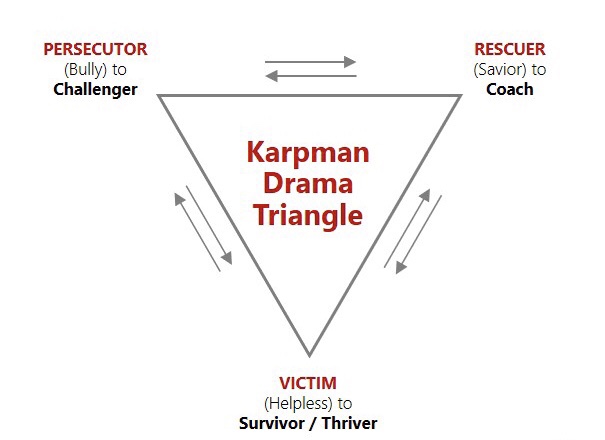
The magical tool to figure this pattern out is called the Drama Triangle. Stephen Karpman created the model in 1968 within the framework of Transactional Analysis. Thanks to this tool we can analyze clearly what is happening in the relationships since the Drama Triangle sheds light on the automatic and dysfunctional interaction between 2 (or more) people.

In a relationship within the Drama Triangle, there are 2 main characters (male or female) who shift from one role to another:

  • The Rescuer
  • The Persecutor
  • The Victim.

The Three Roles In The Drama Triangle

What do the roles entail? 

The Rescuer

Rescuers get involved in other people’s lives eagerly waiting for recognition and approval. By making assumptions on other people’s needs they are stepping in to help before anyone has asked them for anything and create a debt of gratitude. They believe that others need them and they impose their solution. In doing so they prevent others from solving their problems themselves. At the same time they manifest their moral superiority.

Feeling responsible for others

Since Rescuers feel responsible for the happiness and well-being of others, they immediately strive to comfort, pacify or calm people down so that these people don’t get to feel their disagreeable emotions like pain, anger, disappointment or sadness. Rescuers also want to have good relationships with everyone, as they like harmony. That is why they avoid conflicts or standing their ground at all costs, even if they end up wasting their time, money or energy. They have a tendency to please people in order to avoid criticism and rejection. After all, they aspire to feel accepted and loved by everyone.

Emotionally disconnected

For all these reasons they are disconnected from their own emotions. Therefore, it is difficult, if not impossible, to have emotional intimacy in a relationship with them. They will flee in “doing”, they are busy at all times … the evidence is their diary: they don’t have a minute.

Codependent relationships

Despite having good intentions, they need Victims to be Rescuers. As a result their behavior encourages the Victim’s dependence and lack of autonomy. Rescuers will continue to be involved in codependent relationships (as with addicts, for example) that are harming them because they do not realize how damaging they are for them. 

Saying no is difficult

Rescuers have an imperative need to feel useful to cover up their anxiety and low self-esteem … in short, to give their life meaning. They never stop giving; basically because they don’t know how to say no. However, if they dare to say no, they will feel guilty and label themselves as selfish or stingy. They prioritize others’ needs ignoring their own, because they project on others their own unmet needs. Most of all they have difficulties in identifying their needs and desires.

Am I just nice or too nice? 

In short, they sacrifice themselves because they want to prove that they are good, generous and selfless people, who deserve love and recognition. And when someone tells them: “You are too nice”, they feel accordingly offended.

But Rescuing creates resentment and anger in themselves and in the Victims, not recognition, nor gratitude or respect. Whereupon Rescuers confirm their belief that Victims are ungrateful and take advantage of them.

Benefice of the coaching sessions for the Rescuer

When Rescuers attend coaching sessions, working on boundaries and the Drama Triangle guarantees favorable results. Once they have understood the detrimental dynamics and know what their needs are, they are able to control their eagerness to rescue and consequently to change their behavior.

The Persecutor

Am I right  or … am I totally right? 

Persecutors know everything and are always right. Those who are wrong are the others. Therefore they pretend to know what is best for other people. They characteristically see everything either in black or in white; Grey does not exist. Their motto is: either you are with me or you are against me.

Like Rescuers, they feel morally superior and need Victims in order to play their role as a Persecutor.

Discounting others 

They ignore not only other people’s feelings but also their value. That is why they criticize, find fault, persecute, blackmail and abuse their power. In particular they use shame and guilt to manipulate. They can even punish (if only with their moodiness or their silence) so that Victims feel anxious and inferior. Persecutors always find a culprit or an enemy: the other. Thus there is no way to resolve a conflict with them since in each conversation you have to tread carefully and not contradict them. They use threats to get what they want because they have a sense of entitlement. And what they want is for others not only to learn their lesson and to agree with them, but also to change and do things the Persecutor’s way.

Relationships based on power and control

Persecutors feel a lot of anger and righteous indignation, which they vent on “innocent” Victims with gusto. They do not consider themselves as abusive or aggressive though because they believe that the Victims deserve their lot.
In order to feel safe Persecutors want to be in control and they fight for the power in the relationship. They impose their point of view to establish a Winner-Loser relationship that allows them to cover up their inferiority complexes, their insecurity and their vulnerability that they don’t recognize. Moreover they confuse having needs with being needy. Consequently they won’t accept any help or will refuse even to consider that someone can do something for them.

Others are to blame 

But there will always be somebody to blame, somebody who doesn’t meet their expectations. When something goes wrong, Persecutors hold others accountable for what happens to avoid blaming themselves. With that attitude it seems unlikely that they will attend coaching sessions since the person responsible or the culprit is always the other. They project on others (outside of themselves) what they don’t want to see in themselves. In effect, they would call others arrogant because they are not able to recognize and accept their own arrogance.

Childhood trauma 

As they have often suffered some kind of abuse in childhood, they always get defensive. They reproduce the behavior of the abuser because they hope that by dominating others they will preventively protect themselves from abuse or contempt.

The Victim

Discounting themselves

Victims feel powerless, incompetent, stuck and sometimes desperate. They discount their skills and their resources. They don’t recognize their own ability to change things or to influence their destiny either. Besides, precisely because life happens to them, they often suffer from depression. And if by miracle something good happens, they attribute it to luck.

Not owning it 

According to Victims they can’t be blamed for anything because they are not responsible. What’s happening is not their fault. They are convinced that life is very hard, that nobody understands them and that no matter what they do they will be unable to change their lot. They always find excuses that justify their situation.

Avoiding responsibilities 

Victims take any opportunity to complain; even their usual tone of voice is querulous. They are the eternal victims of life itself and manage to get sick, have ailments and attract misfortunes. As soon as they get stressed, which happens very easily, they make a mountain out of a molehill. They simply avoid responsibilities and don’t want to make decisions for fear of being wrong.

In addition, you can recognize Victims by their usual way of apologizing for everything and nothing. You can often hear them say “Sorry!”, “Excuse me!”, “I beg your pardon!”.

“A Victim is someone who is waiting for something bad to happen … and it usually does.”

~ Barry K. Weinhold

Not only do they live in an illusory world composed of all the things they imagine or assume (dire consequences, negative emotions or adverse reactions of others, …), they also make assumptions without relying on reality, without having sound evidence that would justify their beliefs.

Passivity

Of course Victims adopt a passive behavior: they don’t take action, they don’t make any effort to get out of the pothole. They are experts in manipulating others to get what they need without getting too involved in the result. They usually sabotage the help they receive and secretly rejoice in their failures. No matter how often they attend coaching sessions, their passivity and lack of commitment may cause the attempt to fail, so that they can blame the coach for the lack of results and prove them incompetent.

Two types of Victims 

Victims attract either Rescuers or Persecutors. On the one hand, Victims create codependence – an excessive emotional or psychological dependence on the Rescuer. This attitude encourages a passive behavior that prevents them from developing fully their abilities. On the other hand, Victims confirm their belief that life is hard and unfair when they are abused by Persecutors.

Therefore, to play their role as Victims they need Rescuers or Persecutors … or both.

Nutrition & Mental Health

Amazingly, people often don’t seem to understand the connection between nutrition and mental health. Time and again people struggling with their mental health don’t eat breakfast, skip lunch, or don’t bother to eat until later in the day. Sometimes people simply forget to eat because they’re busy. Some people lose their appetite because of emotional distress, and others just can’t be bothered to eat properly. Whatever the reason, it’s imperative to understand the connection between poor eating habits and mood and anxiety, as this will underscore the importance of eating properly.

Everybody has heard the cliché you are what you eat, but for some reason many people don’t connect that adage with how they feel mentally and emotionally. What you eat doesn’t affect just physical health; it can also affect general mood on a day-to-day basis. In order for the brain to communicate with the rest of the body, it needs neurotransmitters, such as serotonin, which are made from the nutrients in the foods we eat. Not eating enough, or not eating a well-balanced, nutritious diet, prevents the body from being able to create enough of these chemicals, and depression and anxiety can result.

Skipping meals can make blood sugar levels fall too low, and that eating starchy, sugary foods or simple carbohydrates can cause blood sugar levels to increase too much. These fluctuations in blood sugar levels can make a person irritable, forgetful, or sad. In addition, not eating enough can lead to emotional reactivity, higher stress levels, and an overall sense of reduced well-being. Research in children has shown that skipping breakfast has negative consequences on problem solving, short-term memory, and concentration, and that eating breakfast increases positive mood, contentment, and alertness.

Of course, if a person has anorexia or bulimia, this must be addressed in therapy, either by your therapist or by someone who has experience with eating disorders—and sooner rather than later due to the health risks these disorders present. Besides treating the eating disorder, make sure to see a medical doctor and declared physically healthy enough to do this kind of work.

Sources: DBT Made Easy

Justice system and mental health

Justice system and mental health:

~ 2 million people with mental illness are newly incarcerated each year.

~ Recent findings show that there are 10 times more individuals with serious mental illness in prisons and jails than in state mental hospitals.

~ 83% of inmates with mental illness did not have access to treatment after release.

~ In a recent outcome study, 64% of inmates with mental illness released from prison were rearrested within 18 months, and 48% were hospitalized within the same time period.

Balancing Sleep

It’s difficult to function without enough sleep, yet the average person is sleep deprived, getting about one hour less of sleep each night than what the body requires.  Given the busy world we live in you get all sorts of excuses for why it’s not possible to sleep more: the commute, the kids’ swimming lessons, the housework, and so on. In any case, it always comes back to the fundamental reality that you can’t force others to do what you know will be helpful for them. You can point out that making sleep (and self-care in general) more of a priority is acting from their wise self, and that just as going to work isn’t really negotiable, self-care shouldn’t be either, but in the end you must give people room to make the decision for themselves.

Sleep deprivation impairs memory, is associated with reduced attention and alertness, and increases irritability and emotional instability. Further, sleep loss appears to differentially disrupt the learning of affective experiences, potentially creating a dominance of negative emotional memory.  In other words, sleep deprivation causes people to remember emotional situations as being more negative than they actually were.

Of course, not all people are sleep deprived by choice. Some people suffer from insomnia. They may have tried all of the suggestions for improving sleep to no avail and may finally agreed to a trial of medications with their psychiatrist to see if this might improve his sleep. For most people, however, there are things they can do to improve sleep.

Here are some examples:

  • Going to bed earlier or getting up later
  • Cutting down or eliminating caffeine, nicotine, and other stimulants
  • Taking sleeping medications (and other medications) as prescribed, or using herbal remedies approved by a doctor or pharmacist, such as valerian, melatonin, or chamomile tea
  • Eating earlier in the evening and not going to bed on an empty stomach
  • Ensuring the bedroom is a comfortable temperature with reduced light and noise, and that the bed is used only for sleep (and sex), rather than for watching television, working on the computer, and so on
  • Establishing an end-of-day routine that allows time for activities that get the body ready for sleep; for example, watching nonstressful television programs, light reading, taking a hot bath, listening to a relaxation CD, saying prayers or meditating, and so on

Sources: DBT Made Simple

Reducing Use of Mood-Altering Substances

Drugs and alcohol are called mood-altering substances for a reason: They alter a person’s mood, and the person has no control over how his mood is altered. People commonly report that they use alcohol to help them relax, but the disinhibiting effects of alcohol often turn into physical aggression, yelling and screaming, tears, and so on. If a person already has difficulties managing his emotions, is it wise to add the unpredictable effects of drugs or alcohol?

Some people use alcohol to help them sleep. It’s important to understand that alcohol actually has a negative effect on sleep due to a rebound effect. Four to five hours after consuming alcohol, the rebound effect kicks in and people usually find themselves awake. In addition, researchers have found that consuming alcohol within an hour of bedtime seems to disrupt the second half of the sleep period, so people don’t get the same deep sleep they otherwise would.

Then there are people who use drugs or alcohol to help numb their emotions so they don’t have to deal with them. This makes sense, and we therefore need to validate it, indicating that we understand it, and at the same time encourage them to see this as a goal to work on, as it’s unhealthy and possibly even self-destructive.

Your first challenge may be to just get a person to see that drugs and alcohol are a problem. But even when people can see that a behavior is problematic, they still might not want to change it. In this case, the next challenge is getting them to set small goals around reducing their use—keeping in mind that if a person isn’t willing to set something as a goal yet, you need to accept this and gently continue to push for change over time.

Sources: DBT Made Simple

Dissociation

Dissociation is when our brain (and rest of our nervous system) feel overwhelmed and unable to deal with what’s going on in the moment and they pull us away. I have always talked about dissociation as our brain pulling the ripcord on reality because it’s just too much! When it comes to the DSM they call any dissociation DPDR or depersonalization/ derealization disorder.

Now depersonalization is when we feel out of our body like we are watching ourselves from above or in a haze and derealization is when we feel separated from our environment and it can feel like we are in a dream or like everything around us isn’t real. These experiences are really common, it’s estimated that half of all adults have had at least one episode of DPDR! 50%! That’s a lot of people, so know that you are not alone!