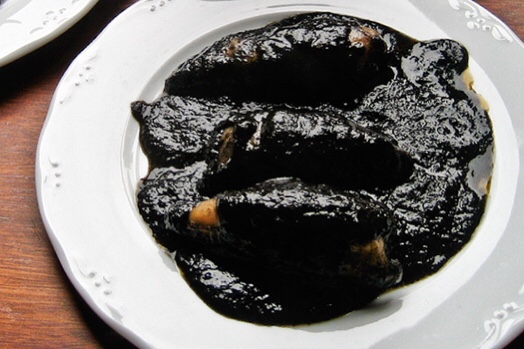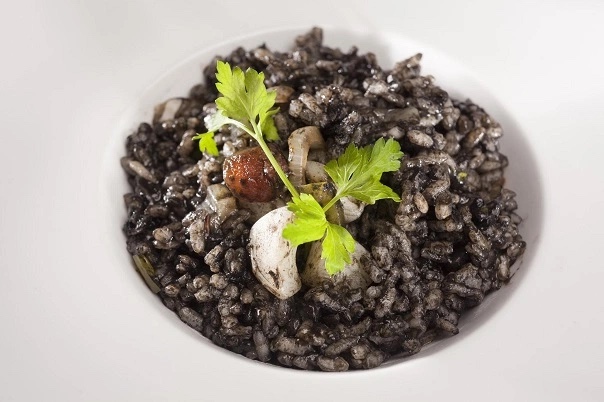
Salsa Tinta (Basque Squid Ink Sauce) – Spanish

Considered by many to be the Basque national sauce whether it’s used in risotto, a vinaigrette or squid in their own ink.

5 Spanish onions, halved and thinly sliced
1 green bell pepper, seeded and cut into small dice
1½ tablespoons extra-virgin olive oil
Kosher salt
2 cups water
½ cup canned whole plum tomatoes, crushed by hand
1½ tablespoons squid ink
Pinch of sugar

In a heavy saucepan, combine the onions, bell pepper, oil, and a little salt, cover, place over medium-low heat, and sweat the onions, stirring occasionally until the onions are soft and melty but not caramelized beyond a light blond. Raise the heat to medium, add the tomatoes, then bring to a boil and cook for about 5 minutes, until the tomato has lost some of its acidity.

Turn down the heat to a simmer and add the squid ink, cooking for a couple of minutes. Add the water and continue to cook for about 30 minutes, stirring occasionally, until the onions and pepper have almost entirely melted out and the sauce is sweet and complex.

Taste the sauce and adjust the salt. The sauce should have a very light hint of sweetness, so add sugar only if necessary. Blend in a blender until completely smooth. Use immediately or freeze for up to 3 months.

“Williamsburg Inn” Inspired Chicken & Dumplings

  • 1 Stewing chicken (4 to 5 Pounds)
  • 1 small onion sliced
  • 1 Carrot sliced
  • 2 Ribs celery chopped
  • 1 teaspoon Salt
  • 4 tablespoon butter
  • 6 tablespoons of flour
  • 1⁄8 teaspoon Paprika
  • 1⁄2 cup light cream
  • Pepper, to taste

Dumplings

  • 2 cups All-purpose flour
  • 1 teaspoon Salt
  • 4 teaspoons baking powder
  • 1 tablespoon Shortening
  • 3⁄4 cup Milk

Simmeri the chicken, onion, carrot, celery, and salt in enough water to cover until the chicken is done, 1 ½ to 2 hours.  Remove the chicken from the broth.  When it is cool enough handle, remove the skin and bones and dice the chicken.

Strain the stock and, if necessary, add enough water to make 1 quart.  Melt the butter in a saucepan.  Stir in the flour mixed with the paprika.  Add the chicken stock gradually, stirring constantly; cook for 2 minutes.

Add the chicken, cream, and pepper and adjust the seasoning to taste.

For dumplings combine the dry ingredients. Blend in the shortening with a fork.  Add the milk and mix well.

Spoon the dumplings on top of the gently bubbling chicken mixture and cover.  Cook for 15 minutes without lifting the lid.

Serve.

Suicide Statistics

statistics from the cdc:

There are on average 41,149 deaths by suicide in the United States each year. Suicide is the 10th leading cause of death; homicide ranks 16th. It is the second leading cause of death for 15 – 24 year olds. Suicide results in an estimated $51 billion in combined medical and work loss costs. An estimated 9.3 million adults reported having suicidal thoughts in the past year. An estimated 1.3 million adults aged 18 or older attempted suicide in the past year. Of the most at risk population: Patients diagnosed with a serious mental illness die 25 years earlier than other Americans.

Take a moment to think about it. We have a little over 112 suicide deaths everyday. If 112 people were dying in a terrorist attack everyday the spending would be astronomical to prevent it. Will we ever reduce the suicide rate to zero? Of course not, but a large percentage of these deaths are preventable through proper funding, therapy, and reducing the stigma of mental illness.

#EndStigma #IncreaseMentalHealthFunding #MentalHealth #MentalIllness

Hot Pepper Shaved Ice Oyster

1 standard 5-ounce bottle Tabasco or favorite hot sauce
¼ cup simple syrup
1 cup water

Simple Syrup

Pour 1 cup of sugar and 1 cup of water in a saucepan and bring to a boil.  Stir until sugar is dissolved completely.  Cool.

Directions 
Combine all ingredients in a bowl and mix well. Pour into a wide and shallow container and freeze. When thoroughly frozen, scrape with a fork to create a shaved ice.

Managing Your Anxiety

Imagine a situation that makes you nervous. Maybe it’s getting on a plane or giving a presentation to colleagues.

Your pulse quickens. Your face flushes. Your breath speeds up and becomes uneven as adrenaline pumps through your veins.

For some, the fear and anxiety becomes strong enough that they avoid the situation. Avoidance, however, affects how you live by limiting how you engage life.

By practicing a few techniques, you can learn how fear affects your body and how you can control your stress response.

Listen to your body to change your emotions

Fear has a physical response — rapid heart rate, quicker breaths and other physiological responses. Stressful situations produce these physical responses, which your mind interprets as, “You are afraid.”

When you physically feel fear, take a moment to listen to your body and gain back control. Are you breathing quickly or hard? Take a few deep breaths and slow your breathing.

Controlling your physical response to fear can influence your emotional response.

Get past your own thoughts

Fear is largely caused by your thoughts. Your body gives you a fear stimulus and your mind takes off, giving you all kinds of irrational reasons you should be scared.

Of course the reasons aren’t always logical — you aren’t going to make a complete fool of yourself if you have to make a speech — but these irrational thoughts fill your mind and intensify your fear.

Don’t believe them!

Instead, identify those thoughts that are causing you fear. Challenge them. What evidence is there you’ll make a complete fool of yourself? None. You might not receive a standing ovation, but that is OK, your goal is to give a professional presentation where your audience can learn from you. Reappraise the situation and distance yourself from overly critical thoughts.

How you think about a circumstance impacts how you feel about it. Approaching your fear rationally, realistically and changing how you think will help you overcome its strong irrational stimuli.

Use your imagination to lessen your fears

As vividly as you can, imagine a situation that causes you fear. Feel your anxiety grow, but then add new information. Ask yourself, what are you worried about? What are the likeliest outcomes? Then imagine what you want to happen.

Adding new information and associations to your fears will help lessen their effects when you feel them in real life. This can be challenging to accomplish without professional guidance, so if needed, see a licensed mental health professional with expertise in anxiety management.

Sources: Mayo Clinic, NAMI, NIMH

On Depression

On Depression:

“Depression, contrary to popular belief, isn’t simply sadness; it’s physical exhaustion. It’s dragging a corpse through your life. It’s the inability to care about or enjoy most parts of your life, even the things you used to like. And if you find yourself enjoying something, it’s usually somewhat separated from you, like seeing a loved one through prison glass. It’s there, but not as you hoped it would be.”

~ Thomas Wallingford, The Mighty Contributor

#MentalHealth #Depression #EndStigma

On Schizoaffective Disorder

On Schizoaffective Disorder & Hallucinations:

“I awoke, went to drink a glass of water and walked back toward my room. I stopped dead in my tracks. My room was red and four cloaked figures floated above my bed with fire circling around them. Inside of the cloaks was a black abyss and I knew they had come for me. As long as I stayed out of my room they wouldn’t see me. I stared at them for what seemed like an hour before they went away. I slept on the couch that night.”

~ Thomas Wallingford, The Mighty Contributor

#MentalHealth #SchizoaffectiveDisorder #Hallucinations #EndStigma

Roasted Chicken – Thomas Keller (Video)

Thomas Keller is considered by many, and rightfully so, the preeminent American Chef. He has won multiple James Beard Foundation awards and is annual winner in the Top 50 Restaurants in the World.  His restaurant include: The French Laundry, Bouchon, Ad Hoc, and Per Se.  He has been awarded three stars (the highest rating) by the Michelin Guide for both his New York restaurant Per Se and his Napa valley restaurant The French Laundry.  With these two awards he holds the distinction of being the only American chef to be awarded three stars by Michelin for two restaurants at the same time.

His passion for food is obvious and can be seen in his roasting of a simple chicken:

On Self-Care

On Self-Care:

“A few short years of twee self-care tips has convinced mentally-well people everywhere that depression is something you can just wash off in a bubble bath.

Tip: if a mentally ill person is talking about self-care, they probably mean brushing their teeth or making a sandwich. In my experience and from the stories of others, self-care is rarely a candlelit bubble bath with luxurious pampering.

If YOU personally are mentally ill and bubble baths help YOU, I’m not saying that YOU are doing it wrong. My complaint is that people who aren’t mentally ill believe “take a bubble bath!” is the cure for mental illness.

Part of the problem is that a lot of us who are mentally ill do not have the energy or the voice to write seventy thinkpieces a week about yoga and bubblebaths that “allies” do.

If a bubblebath is your mental health self-care, there’s nothing wrong with that and I’ve yet to say that there is. My issue is with the perception that self-care is always some sumptuous, instagram-worthy moment of beautifully staged decadence.”

~ Jenny Trout, Author

#MentalHealth #SelfCare #EndStigma