Vignette of The Past

Vignette of The Past

I sit at the end of the bar,
A tattered copy of Percy Bysshe Shelley before me,
An ashtray overflowing with Camel Straight cigarette butts,
The fifth double Vodka-Tonic of the night resting upon a stained coaster,
Three shots of Jamison Irish Whiskey in a rocks glass,
I down a swallow of the whiskey, followed by a gulp of Vodka-Tonic,
And finally a slow drag from my cigarette,
Silent pleasures of a life already lived.

Schizoaffective Disorder, DBT, and Mindfulness

The day I sat there in my psychiatrist’s office the words that I had been diagnosed with schizoaffective disorder was both one of the scariest and best days of my life. Hearing schizo anything is frightening, it is one of those mental illnesses you are brought up to fear by our society. Schizophrenia is bad enough, but knowing I had those symptoms (hallucinations and delusions) as well as a mood disorder (major depression) seemed like the end of my life yet a relief at the same time. I finally had an answer to what those voices were that had plagued my head and living nightmare for years. Thus I began on my long journey to discovering the right cocktail of medications, the most effective form of therapy, and the support structure I needed. It was a long struggle which ended up leading me to a cocktail of three medications, additionally a combination of meditation, mindfulness, and DBT (Dialectical Behavioral Therapy) before I found true beginnings of progress. Before this occurred I would spend two six weeks sessions of partial hospitalization an all day outpatient therapy at a local mental hospital in a little over a year.

On a trip to Boston I was spending the afternoon at Harvard Square waiting to meet up with a friend. I was eating, having coffee, and visiting various bookstores all while admiring Harvard. A man mistaking me for a friend wrapped his arms around me from behind. I lost it. I don’t know any easier way to put it. The next thing I would know I was in a crowded Starbucks, a latte in front of me, and a gap of over an hour missing from my life. A blackout. To this day I have no idea how I got there, what I did for that hour, what had transpired. Piecing that hour back together is not what would truly frighten me though, that was my racing mind jumping from one delusion to the next each one a little more fantastic. In a matter of moments I went from being convinced that my friend had been in accident, then murdered, then all the patrons of the coffeehouse could read my mind, to implanting their thoughts and desires in my head. I had a conversation with someone who wasn’t there. A new kind of therapy was needed. I couldn’t go on living this way. That’s when I told my therapist I wanted to up my meds and try DBT.

First question first, what is mindfulness?

Mindfulness is no longer just for practitioners of Zen and Buddhism but has moved into the mainstream Mental Health counseling. It has become one of the primary techniques employed among many therapists and coupled with meditation has shown tremendous amounts of improvements in otherwise non-responsive patients. As science furthers more and more we are seeing them recognize the benefits of Zen in daily practice. As NAMI (National Alliance on Mental Illness) describes it, “While the combination of therapy and medication is crucial to recovery, the addition of self-awareness tools and skills can also be beneficial. Whether you are just beginning your recovery or are further along on your journey, the holistic practices can be an excellent complement to therapy and medication.”

While many treatment programs employ the use of mindfulness, I will focus on DBT (Dialectical Behavioral Therapy) in my analysis. So what is DBT? “Dialectical Behavior Therapy (DBT), is a comprehensive cognitive-behavioral treatment that was originally developed to treat chronically suicidal individuals suffering from borderline personality disorder (BPD). DBT has been found especially effective for those with suicidal and other multiply occurring severely dysfunctional behaviors. Research has shown DBT to be effective in reducing suicidal behavior, psychiatric hospitalization, treatment dropout, substance abuse, anger, and interpersonal difficulties,” (behavioraltech.org). So what exactly does all that mean? It is a non-judgmental way of the patient accepting that they have a problem with how they think, and rather than judge it, they can make changes to make their thinking more balanced using mindfulness as one of the primary techniques.

What is mindfulness within this context? The best and simplest definition I have come across is, “doing one thing at a time, in the present moment, with your full attention, and with acceptance,” (DBT Made Simple). This can be further broken down into two parts for the patient. First, awareness and focusing on the present moment. The second part is acceptance, and this is the part that seems to be overlooked. This requires not judging what you are doing mindfully. A large percentage of patients respond well to this primarily, in my opinion, because they are taking control of their mind. Most patients, as is the case with most people in general spend far too much time in the past reliving negative things and mindfulness is a way to put a stop sign up to this harmful cycle.

How is mindfulness employed? There are a multitude of ways this is employed in your everyday life, but I will briefly cover seven of them:

1. Counting breaths. Count your breaths up to ten. One on the inhale and two on the exhale and so on. When you find your mind has wandered, simply return to counting your breath without judgment.
2. Observing sounds. Sitting silently focus your mind on any sounds which you hear: the sound of your breath, the traffic outside, the air-conditioner, etc. When you catch your mind wandering, take note of it without judgment and return to observing sounds.
3. Observing an object. Pick an object, any object. Examine the object with all of your five senses. Touch it. Smell it. Take note of any sound it makes when you move it. When you mind wanders, simply bring your attention back to the object.
4. Observing your thoughts in a cloud. Also could be called labeling your thoughts. You imagine yourself lying in a field of grass looking up at the sky. In each cloud is a thought and as it floats by you label what kind of thought it is without judging yourself for having that thought. For instance if you think this is a stupid exercise, that would be an anger thought. If you think how will I pay my house payment next month, that would be a worry thought.
5. Focusing on a thought. Pick a meaningful thought or short sentence and focus on the thought as you breathe. For instance if you think wise as you breathe in and think mind as you breathe out. When your mind wanders return to your thought without judging yourself.
6. Being the gatekeeper to your mind. This is more simply observing your thoughts. As a gatekeeper would watch people coming through a gate, you will simply experience and observe each thought as it passes over you without judging it. Experience thoughts and emotions as they come to you, do not try to block them. When your mind wanders or you feel yourself trying to stop thoughts simply return to the practice of observing them without judging the thoughts or yourself.
7. Being in your body. Quietly sitting, focus on the different sensations you experience in your body. For example, the feel of your bottom on the chair or your arms against the armrests. Take notice of any emotions you might be feeling, such as worry over a presentation you have at work next week. When your mind wanders simply return your thoughts to your body without judgment.

I went through a litany of excuses each week with my therapist as to why I wasn’t applying what we went over in our sessions. Throughout this period my symptoms were getting worse, I was in partial hospitalization programs due to my poor coping techniques including among other things self harm – slamming my head against the wall and routinely cutting myself with a razor blade, suicidal thoughts, ideation, and plans. Eventually though due to my therapist’s dedication and persistence things began to slowly improve. It’s now been over two years since I employed any of those negative coping methods and I owe a great deal of that to finding a therapist I trust, have a connection with and was dedicated enough to believe in me. The practice of mindfulness takes patience and dedication and the litany of excuses not to practice are endless, but I will attempt to debunk a few of the more common ones.

“It makes me more anxious”

Some people, especially people with anxiety issues, find practicing mindfulness increases their anxiety. This is an understandable reaction, but not enough to give up on the practice. It is often found that the exercises focusing on breathing cause the most anxiety. Simply focus on the non-breathing focused exercises to begin and once you become comfortable with mindfulness practice come back to the breathing exercises.

“I just can’t do it”

What exactly does the person mean by this? Is it just too hard? Are they having difficulties concentrating? Do they believe to be successful thoughts and feeling never intrude? Many people say they can’t do it when they just mean it is really hard. Truth is practicing mindfulness is a hard skill and the only way to get better is to keep pursuing it.

“I don’t have time”

This is one of the simplest problems to fix. You can practice mindfulness anytime, doing anything. If what you mean is you don’t have time for formal practice, let me remind you some of the exercises only take a few to ten minutes. It is better to spend 10 minutes fully dedicated than an hour half-heartedly. Try setting aside 10 minutes in the morning to practice mindfulness.

“I can’t stay focused”

Mindfulness is simply about staying in the present moment with acceptance. Please throw any other expectations out the window. The object of practicing mindfulness for many is to feel better. It is with this in mind that we reach a paradox. To feel better you must practice mindfulness, but if you focus on feeling better you have trouble staying focused on mindfulness. So throw away the goal while practicing mindfulness and you will achieve that goal.

“I fall asleep”

Some people find they drift off when they practice mindfulness. If the person has trouble sleeping this can be a good thing, simply practice mindfulness of part of your preparing for bed routine. There are several factors to consider if this is a common issue:

~ Do you need more sleep? If you are sleep deprived your body will want to take advantage of this quiet time.
~ Is there a better time of day to practice? If at the end of the day you are always exhausted, simply begin practicing in the morning.
~ Did you eat a big meal shortly before practicing? Watch out for a food coma!
Is there a different position you can try? If you practice mindfulness lying down, simply try it is a sitting position.
~ Are you closing your eyes? Keep your eyes open while practicing.

“You have to plan for the future”

Some people believe that practicing mindfulness means you never consider the past or the future. This simply is not the case, but you may be able to do those things mindfully whereas you do not currently. Often planning for the future isn’t planning at all, but instead it is worrying. Mindfulness actually helps you in planning for the future by keeping you grounded in reality of the present moment.

It’s been a long journey for me over just a few years since I came to the conclusion that self-care was my full time job. I no longer look to find blame for this condition, but accept this is my reality. I now meditate for a minimum of two hours a day, and if I miss a session I notice it the next day. I came to the acceptance that I need a maximum dose of an antidepressant, a high dose of an antipsychotic, and anxiety medication. I periodically meet with my therapist, but not nearly as often as I used to. She saved my life and I am grateful. I keep a gratitude journal and pull it out when depression is rearing its head. I attend support groups as much as I feel I need them to keep grounded and help others who are where I was a few years ago. I now have a core group of friends who understand my condition and I lean on them when I need to. Am I cured? Absolutely not, but I am no longer ignoring my condition or looking for the answer in the bottom of a bottle of whiskey. Daily I remind myself how far I’ve come and damn it I’m proud of the hard work I’ve put in. The other day the friend I’ve leaned on the hardest, the one that was there through my partial hospitalizations, he’s seen me at my worst and he sent me a short note, “You knew what, the guy you are today is way different than the guy we all met. Congratulations, you overcame so much. I’m so glad you’re enjoying life.” He’s absolutely right for I am enjoying life. Finally after all those years I’m living, as opposed to merely existing.

What is Psychosis? (Video)

This is an excellent short video exploring what psychosis is like and the different stages. I highly recommend watching it if you have a psychotic disorder such as Schizophrenia and Schizoaffective disorder or if you have a friend, family member or in a relationship with someone susceptible. Sometimes or often times you might recognize the signs before the person slipping into psychosis. Catching it early may prevent hospitalization being needed.

Night Terrors

Struggling to sleep – the night is an all too familiar refrain,
The ceaseless conversations overwhelming my mind,
His voice always piercing, always breaking through the din,
The laugh always mocking who I was, who I’ve become,
That face ever taunting, ever gloating, always judging,
I blink imploring for some release, some distraction,
Alas the eternal vision persists, mocking my sanity,
The eyes glaring, judging, satisfied at what I’ve become,
“Shut up!” The laugh, never allowing me a moment of solitude,
Clenching my eyes the eternal vision persists,
Failure, pathetic, weak – the labels swirl in my unquiet mind.

Lurching my body upright I stare through the blackness,
My breathing is short, shallow and tight in my chest,
My hands trembling, my eyes consumed with horror,
Swallowing hard I sense the ever present knife,
This time not a razor-edge between life and death,
But a choice between life and his domination of my sanity,
Why do I let him control my decisions, make me so weak,
How is it I make choices simply to defy the bastard,
Why am I overwhelmed with guilt and shame,
Every time I ask for help, set foot in the therapist’s office,
How is it that I believe he has won over me.

I Stare Into the Darkness

I stare into the darkness of my room,
of my mind.
Thoughts and images penetrate my consciousness,
moments, images, memories of the night I just lived.
My skin burns,
as my heart races buried within my chest.
What is this sensation, this feeling,
which consumes me?
Sleep, I must sleep,
things will make sense in the morning.
A scent, a whisper, a touch,
attempt to devour me.
My mind has become flooded,
drowning in moments from the past,
the present,
the possibilities that lie before me.
I hear the vehicles pass my house,
why are they so loud tonight?
The cat cries in the next room,
why can’t silence be mine, peace be mine.
I awake in a cold sweat,
my mind hasn’t been quieted.
I scratch for a semblance of sanity,
as I futilely attempt to sleep.
Enough, I cry out,
my eyes clenched shut.
The visions of his hands around my throat,
permeate my mind.
The tender touch of her cheek brushing mine,
supersedes my immortal nightmare.
A sigh in the darkness of my room,
and I am back.

Guilt, Pity and Envy

Guilt, Pity and Envy

I met Guilt, Pity and Envy in a black corridor,
They conceived a bastard love child,
He grows within my gut, tearing my belly asunder.

“Fuck off,” I screamed at the bastard buckling over,
His parents glared at me, surrounding me,
Their laugher echoes in my mind.

Guilt, Pity and Envy closed in on me,
I felt their breaths on the nape of my neck,
I smelled their foul air, the odor made me wretch.

I could feel the bastard consuming me from the inside,
Filling me up with a perverse version of his parent’s being,
Guilt, Pity, Envy and now Deceit.

“I will not succumb,” I cried, my eyes rolling into the back of my head,
I arched my back, contorting my body into a twisted mangle of flesh,
My body poured with sweat and tears, “You won’t take me without a fight.”

Their claws tore into my flesh,
Ripping my gut open,
Spilling my bowels across the floor.

“You can’t have me,” I snarled.
Their voices echoed in a gibberish I strained to comprehend,
Deep within my consciousness.

Guilt, Pity, and Envy swirled within me, whispering half-truths,
Deceit tears at me from inside, the bastard love child,
I see the straight razor glistening before me on the counter.

I hack open my throbbing wrists,
Spilling out all the Guilt,
All the Envy, All the Pity.

The bastard’s hands are around my throat,
Choking off my breaths, extinguishing my free will,
Deceit vanquishes my meager resistance.

I tear the bastard from me; he is not what I envisioned him to be,
The love child, Deceit, is a tall lustful shameless blond,
Dressed in a pristine glistening backless black latex gown.

“Stay out of my fucking head,” I scream, glaring at the bitch,
She smiles wryly, with a wink; she blows me a kiss,
I sigh deeply, Am I this pathetic?

Defiantly I raise the back of my hand to strike her,
Deceit’s talons burrow deeper into my flesh,
My hand drops submissively, pathetically, longingly.

Tears stream down my cheeks, my eyes smolder with an unfamiliar intensity,
“Enough whore,” I cry my eyes rolling back into my head,
I glare into her eyes, mine lowering to her neck, my fingers caress the razor.

Guilt, Pity and Envy, their laughter echoes in my mind,
Deceit steps forward grinding her body against my own,
I gasp as my body reacts to her touch, “Fucking bitch,” I mutter.

Her embrace is intense not quite tender; I feel her sucking my freewill.
“I despise you,” I whisper in desperation,
My eyes close to the clatter of the razor hitting the floor.

A silent sob,
The taste of blood on my lips,
She has won…

Schizophrenia Simulator (Video)

I found this simulation to be a tad over the top, but not completely unrealistic. This would be me if I was off my meds or during a psychotic episode. I lived for many years due to my stubbornness off psychiatric medications, instead I self-medicated with lots of alcohol and sometimes drugs. It’s hard to believe now, but in my late teens and twenties I believed everyone heard voices and I was just poor at dealing with them.

Therapy: Depressive Schizoaffective Disorder

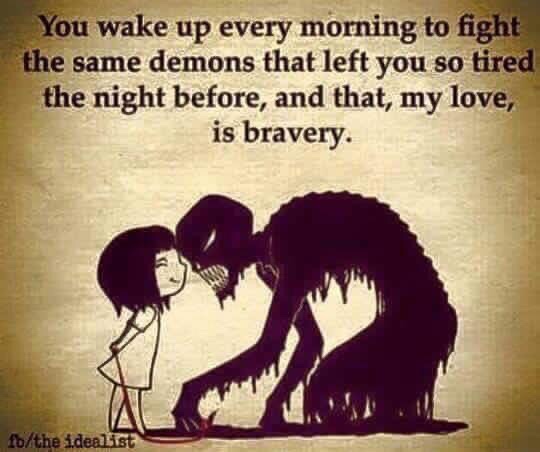
Brave maybe, but exhausting

I sat there the silence deafening staring blankly at AnneMarie, my therapist for the past year and a half. I trusted her completely, trusted her with my life. I knew I’d be dead without her. Times had been rough after my liver transplant in 2011. When I should be putting my life back together filled with hope, mine was crashing around me. Today I was numb.  I’d been numb for weeks, feeling nothing. Failure, you’re fucking worthless.  The depths of clinical depression, of schizoaffective disorder is horrible, but the numbness is worse, much worse. No highs, no lows, not feeling anything at all, just the unceasing voices screaming at me from inside my head. I can’t imagine anything worse than fighting your own brain everyday, every night, every morning when you wake up.

“Mark,” she repeats no impatience in her voice only concern, “let’s see your arms.”  I roll up my left sleeve. The cuts aren’t deep, but repeated. Parallel line after line up the length of my arm where I had dragged the razor blade over my tender skin. It was pink, inflamed, not infected but obviously sore.  Cut deeper you failure, the screaming continued.  I’ve been cutting myself off and on since I was sixteen.  It slows the racing thoughts, quiets the voices, allows me to feel something, anything. “How many times did you cut yourself since I last saw you?”

“Maybe a hundred,” I reply calmly without a sense of regret.  It had been less than a week. “It’s better than the numbness.”

“You don’t deserve this,” I shrug my shoulders.  “As I said earlier, I’m leaving it up to you, River Point Behavioral Health or Wekiva Springs for an evaluation. I’ll give you through tomorrow.”

“I won’t go inpatient,” I stammer, “not here, not in Florida.”  Florida is 49th in mental health funding.  I’ve flatly refused to go inpatient here in the past even though I’ll admit I probably needed it. There are two hospitals I’m willing to go to: Johns Hopkins in Baltimore and McLean outside Boston.  Both are long shots at best, perhaps that is the idea.

“You’re critical Mark.  I never said inpatient just an evaluation and possibly a partial hospitalization or intensive outpatient (IOP).  If you don’t I’ll have to baker act you.”  I know she doesn’t say this lightly. Just imagining the police taking me involuntarily is frightening.  The threat of Involuntary commitment rings in my ears.  It’s not the first time she’s threatened commitment, nor will it be the last. She knows it will get me to do what is in my best interest.

“Fine,” I shrug. I know it’s for the best, but that doesn’t mean I’m happy about it. “I’ll go this afternoon.”

“Are you okay to drive.”

“I think so, yes.”

“Have you been having anymore visual hallucinations?”  I shake my head the pit of depression opening up again swallowing me whole as I’m resigned to my course.  You’re fucking pathetic, tell her no, the voice snaps.  At best I’ll be spending weeks at the mental hospital. I just went through IOP a few months ago and returning is not what I had envisioned for me.  “How are the voices?”

“Constant,” I say matter of factly.

“What are the saying?”

“That I’m worthless.  I’d be better off dead.  They’re laughing at me.  To cut myself.  The usual.”

“You’re listening to them then?”

“Sometimes,” I concede.

“Are you suicidal, having suicidal thoughts?”

“Thoughts yes.  No plans though.”  She nods understanding that I do not intend to kill myself.  In the past when I’ve been suicidal I’ve had very intricate plans: listen to particular music, a last meal, the exact outfit I plan to wear, etc.   “I fantasized about swimming out into the ocean until I didn’t have the strength to go any further.”

“Is that your plan?”

“No I’d throw myself in front of a train,” I confess, “It’s quick and a sure thing.”

“When did you come to that decision?”

“Recently,” I admit. “I can’t though. I owe it to my donor’s family to survive.”

“Yes you do.  How’s your sleep?”

“Terrible. I’m getting only three hours a night or less.”

“Nightmares?”

“The same as always. Jerked awake in a cold sweat, my heart racing.  Always the same dream.  I relive it every night. Every night since I was sixteen.”

“Are you meditating?”

“Every evening before bed.”

“I think you should try meditation in the morning as well. Keep meditating at night as well as the rest of your evening routine. We have to get you more sleep.  Are you taking your trazadone?”

“No.  It makes me loopy all the next morning.”

“I understand, but you need some sleep.  You need to focus on how far you’ve come the past couple of years. You are healthy physically after your transplant.  You are sober.  Those are major accomplishments.”

“I try.”  There are currently 120,000 people on the organ waiting list, 17,000 people on the liver transplant waiting list. Only 6,000 receive a liver annually. The guilt that I didn’t deserve one is consuming me.  The fact that I lied my way through the Mayo Clinic psych evaluation haunts my memory. Am I sorry for that?  No, it was the only way to get a transplant. I’d have been listed as potentially noncompliant.  Did I deserve the organ?  I don’t think so.  Add it to the list of my issues.

A Guilt That Consumes

The criss-crossing clash of tiny dishes echo in my mind,
The self-orchestrated visions of my past resurface,
Times of glory, times of disgust and hate,
I scream in the darkness of my mind,
As the ether mask is placed over my mouth, choking my protests.

A guilt that consumes,
A guilt that devours,
Reaches down wrenching out my soul,
I shudder, my legs tremor,
My back stiffens,
A gasp released from my lungs.

I stare in disbelief at my guilt,
As it actualizes before me,
It twists, it turns and swirls,
Taking a perverse form before me,
I drop to my knees, body rigid,
Offering myself in prayer to my guilt, to my soul.

Do I deserve what I desperately require,
Is it fair to ask this of the world,
My mind spins to the ringing chorus of answers,
To each of my pertinent questions,
I cringe straining to make out their replies,
Is this my personal hell?

I formed and molded my private hell,
Out of each decision along my road,
Stretching back as far as I can remember,
“No,” I don’t deserve what I seek,
The voice echoing in my mind,
Whispers with a mocking laugh.

A laugh I shall not be soon to forget,
Mockingly the voices swirl within my mind,
I stumble from question to question,
All the while the laughing echoes,
Into the recesses of my vacant soul,
Tears flow down my ashen face.

My jaws are pried wide open in horror,
The ceiling spins, the walls melt away into darkness,
My eyes blink as the needle impales my vein,
Insecurity washes over and through me,
Will I succumb to the voices, will it wash hope away.