Seelie

The seelie and unseelie courts of Scottish fairies are a particular feature of the folklore of that country; the clear separation of the faes into good and bad groupings that’s entailed is almost unique in folklore. Moreover, the notion of the two courts has, in recent years, attracted considerable attention and popularity- notwithstanding the fact that they are not mentioned in the majority of the Scottish faery-lore texts and collections. Probably the majority of recorded Scottish folklore relates to the Highlands and Islands, the Gaelic (and Norse) speaking regions, which may explain why we have relatively little material documenting the two courts.

The Scots word ‘seelie’ derives from the Anglo-Saxon (ge)sælig/ sællic meaning ‘happy’ or ‘prosperous.’  The evolution of the word in Middle English and Scots seems to have been in two directions.  One sense was ‘pious,’ ‘worthy,’ ‘auspicious’ or ‘blessed.’  The second development extended the meaning incrementally through ‘lucky,’ ‘cheerful,’ ‘innocent,’ and ‘simple,’ from whence it was a short final step to ‘simple-minded,’ as the modern English ‘silly’ denotes.  Because of this evolution, as well as because of the dialectical differences between English and Scots, it is preferable to use ‘seelie’ rather than to try to translate it.  In passing, we might observe that Scots is in many cases far nearer to original Anglo-Saxon than modern English, which has imported so many French and Latin words.

By late medieval and early modern times, ‘seelie’ or ‘seely’ in Scots meant happy or peaceable, as in ‘seely wights,’ and the ‘seely court,’ which was the ‘happy or pleasant court.’ It followed from this that ‘unseelie’ or ‘unsilly’ described something that was unhappy or wretched. The poet Dunbar referred to Satan’s “unsall meyne” (his “wretched troop of followers”), a phrase which could be a very appropriate term for the fairies.

The Scots word with a variety of spellings, particularly sely, and meanings including “lucky, happy, blessed”; the adjective is applied euphemistically to fairies in Scotland. This term is used in relation to the Scottish fairies, calling them both ‘Seelie court’ and ‘gude wichts’.  Court in this sense meaning a group or company, and wichts meaning beings. Seelie fairies are those who are benevolently inclined towards humans and likely to help around homes and farms. It should be remembered though that they are as able and likely to cause harm as any fairy. The use of the term Seelie in relation to fairies dates back to at least the 15th century in Scotland and can be found in a book from 1801; in the ‘Legend of the Bishop of St Androis’ it says:

“Ane Carling of the Quene of Phareis

that ewill win gair to elphyne careis;

Through all Braid Albane scho hes bene

On horsbak on Hallow ewin;

and ay in seiking certayne nyghtis

As scho sayis, with sur sillie wychtis.”

“One woman of the Queen of Fairies

that ill gotten goods to Elphin carries

through all broad Scotland she has been

on horseback on Halloween

and always in seeking certain nights

as she says, with our Seelie wights.”


Fairy Path

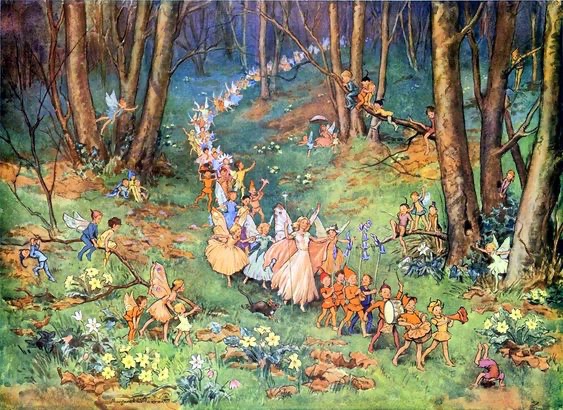
A Fairy Path or Fairy Road is the route by which the fairies regularly travel between any two locations. These paths can be found in many places and are invisible to anyone without the Second Sight, unless they happen to catch the Fairy folk unaware. Fairy Paths are often said to stretch between known fairy hills or locations but may also be found in more obscure locations.

It is considered very bad luck to build on a fairy path and those who do so always suffer for it one way or another. In the most benign cases the building will suffer from disturbances, often at night, as the fairies pass through the building following their accustomed route. As one source says:

When the house happens to have been built in a fairy track, the doors on the front and back, or the windows if they are in the line of the track, cannot be kept closed at night, for the fairies must march through.

In other instances attempts at building would be destroyed as soon as they were begun by being knocked down and a noted method of testing for a fairy path by those who “could not see them was to put up posts where the building was meant to go and see if they remained standing the next day. In extreme cases the person attempting to build might be killed or suffer extreme misfortune.

The Welsh Tylwyth Teg (“Fair Family”) have fairy paths as the Irish and Scottish fairies do, although their reputation is more dangerous. As one anecdotal source says:

“…the Tylwyth Teg have paths (precisely like those reserved for the Irish good people or for the Breton dead), and that it is death to a mortal while walking in one of these paths to meet the Tylwyth Teg.”

The fairies were known to move their homes at certain times of year, notably on the quarter days, and when they did so they would travel along these fairy paths to get from one hill to another. At any time of year, however, a Fairy Path could be perilous.

Faun

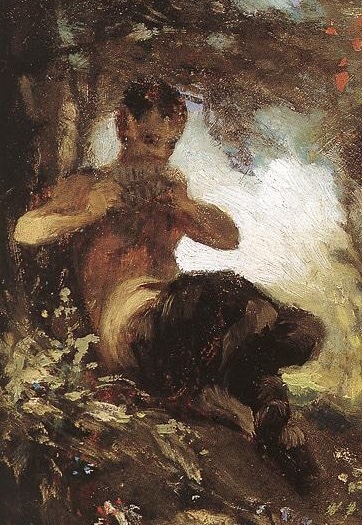
Fauns are mythical creatures with both human and goat features. They are notorious for their love of the forest, music, and beautiful women, and they are generally charming to the people they encounter as they trot along their happy, woodland paths.

Fauns are a peculiar, chimeric race: half goat, half human. With horns, hairy legs, hooves, and a twitchy tail, they might not sound like the loveliest characters, but they have their own undeniable charm. You can’t help but love their faces, which combine pointy ears and a head full of woolly curls with youthful features, sparkling eyes, and a roguish smile.

Above the waist, these woodland creatures have handsome male bodies with lithe limbs. Below the waist, they have two goat legs, which make them extremely nimble dancers. While they’re not especially fond of clothing, they like to adorn themselves with crowns of leaves and berries from their woodland home, especially before one of their legendary parties.

Fauns are merry creatures, and they have a talent for brightening the hearts of others. If you are waylaid by a group of them, you can be sure that you’re not going to get away any time soon. The little creatures will lure you into their festivities with their dancing, jokes, and delicious food.

Of course, they are best known for their flute playing. With just a small, wooden flute, they can hypnotize you with fantastic melodies. Hardly anyone can resist a Faun with a flute, and in truth, the power of their flutes has led some of them to act up, luring travelers into the forest, where they get lost, or stealing the hearts of beautiful maidens away from the rest of the world.

In Greek culture, Fauns are associated with Pan, the god of shepherds, mountain wilds, meadowlands, wooded groves, fertility, and rustic music. They join Pan in his merrymaking and act as his servants when he needs aid. In return, Pan has gifted them with his trademark musical instrument, the pan-flute. Like many Greek gods, Pan was eventually handed down into Roman culture under a new name, Faunus. His troop of Fauns made this transition with him.

Fauns and satyrs are commonly confused because they have some striking similarities in appearance and personality. However, they are separate creatures. Satyrs are followers of Dionysus, the god of harvest, wine-making, and ecstasy. Like Fauns, they love music, women, and parties, but they are far less innocent than their light-hearted cousins. Satyrs are crafty creatures, and they can be downright destructive when they are bent on enjoying themselves, no matter the cost. They are also less physically charming than their woodland cousins. Their faces are less human, and their lower bodies are mightier, more like a horse or a donkey than a harmless, furry goat.

Fauns were popular characters in both Greek and Roman mythology. They are mentioned in ancient texts that describe the gods’ grandest parties, and they are frequently written into the entourage of lovers who pursue nymphs. For example, they follow in the march of Bacchus, a half-god who wandered the earth teaching men how to cultivate vineyards before making a glorious march home to Greece, and in the myth of Vertumnus and Pomona, they are competitors against Vertumnus for the beautiful Pomona’s heart.

During the Hellenistic period, the mythical revelers became popular models for statues. In some of these statues, they were portrayed without any goat-like features, appearing as soft, romantic young men with flutes or beautiful women. The most famous of these statues is the Barberini Faun, which shows a young, handsome man exhausted after a long party.

Fauns were revitalized during the Romantic period, when fairytales gained wild popularity. They were separated from the old Gods of Greek and Roman mythology and became independent, magical creatures of the forest.

One of the Romantic period’s most famous authors, Nathaniel Hawthorne, nodded to the mythical creatures with his acclaimed novel The Marble Faun, while poet Stephane Mallarme composed a masterpiece around the charming chimera with “L’apres-midi d’un Faune.” This poem later inspired both a symphony composition and a ballet.

Remarkably, Fauns have changed very little from their early Greek play-days to their appearances in modern literature. Although they seem to have gotten out from under Pan’s thumb, they still have the same rustically charming appearance, fun-loving temper, and musical talent.

Today’s most famous Faun is Mr. Tumnus, a flute-playing creature who welcomes Lucy Pevensie to the world of Narnia. Mr. Tumnus captures an age-old personality, acting both as an agent of mischief and as a kind-hearted guide for Lucy, the human girl who has captured his fancy.

The Dagda

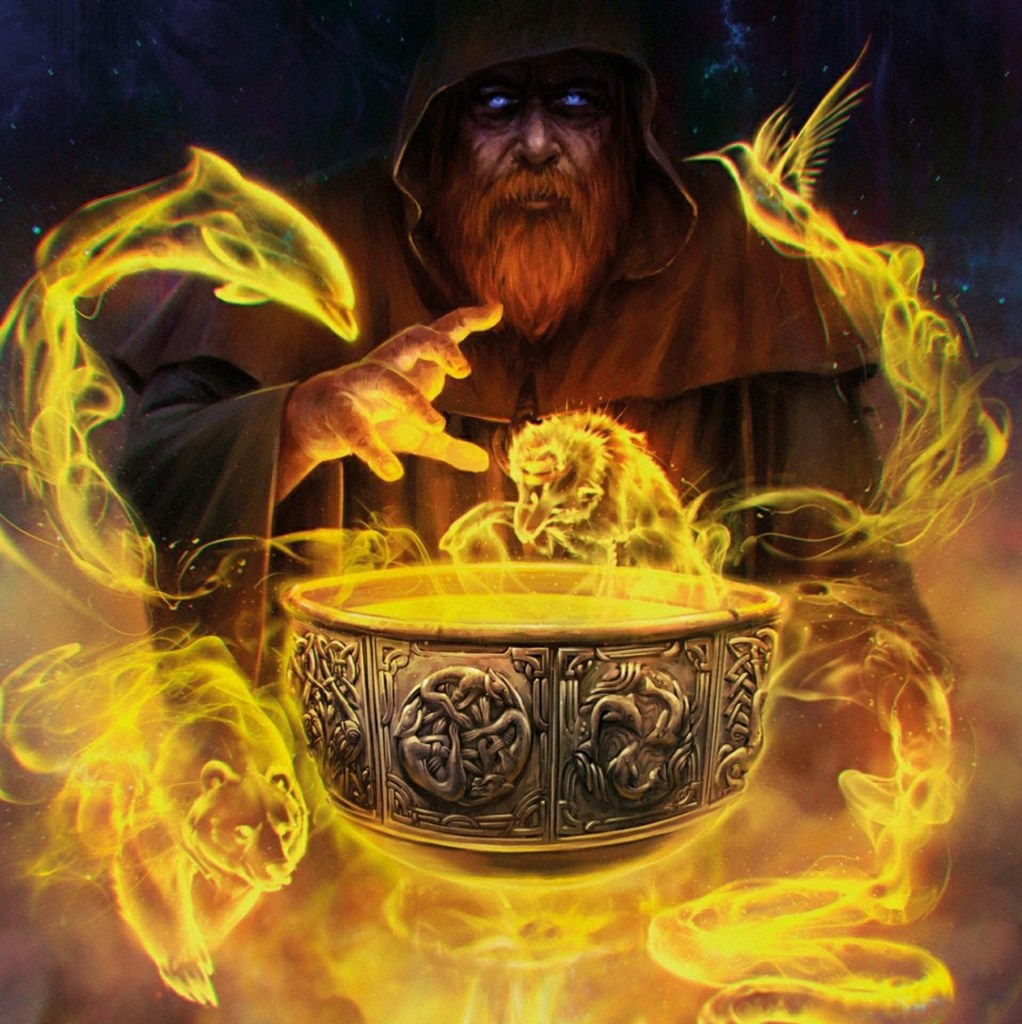
The Dagda was chief of the Tuatha dé Danann, the foremost of the Irish ancestral gods or faeries. Highly skilled and wise beyond measure, he was not only the god of life and death, but of seasons, agriculture, fertility, magic, and druidry as well. He wielded three sacred treasures: a cauldron of plenty, a club of life and death, and a harp that controlled men and seasons alike.

His children were plentiful, as were his lovers. His dwelling place was Brú na Bóinne.

The Dagda often carried three sacred relics with him that defined several of his many talents:

The coire ansic, a cauldron that could produce a bountiful feast; one could never be found wanting in the company of the Dagda. This particular relic was one of the Four Treasures of the Tuatha dé Danann, which were crafted in Murias.

The lorg mór, a mighty club (or staff) that possessed two distinct powers; its head had the power to slay nine men in a single swing while its handle could revive the slain with but a touch.

The uaithne, an ornate harp carved of oak. This harp could place the seasons in the proper order and command the wills and emotions of men. With these potent abilities, the Dagda was often seen as a god of order putting everything in its place, every time in its season, and every man to their rightful action.

In additions to these items, the Dagda owned two pigs—one always growing, the other always roasting—and an orchard that bore perennial sweet fruit.

The Dagda’s primary dwelling was at Brú na Bóinne, a series of Neolithic mounds on the banks of the River Boyne in County Meath. These ancient mounds were constructed around 3200 BCE, and as such are older than famous landmarks such as Stonehenge and the Great Pyramids. A mound called Newgrange aligned with the rising sun during winter solstice, representing the Dagda’s significance as lord of seasons and his mastery over day and night.

The Lebor Gabála Érenn laid out the coming of the Tuatha dé Danann, the fifth group of settlers to arrive in mythical Ireland. This group hailed from four cities north of the Emerald Isle, where they had learned the arts and sciences of their time, including magic. At this time, the Dagda was their chief. Though he did not hold the title of king, he was consulted and respected by many as if he was one.

The Dagda was also compared to the Germanic Odin and the Roman Dis Pater, as they bore certain similarities to him.


Banshee

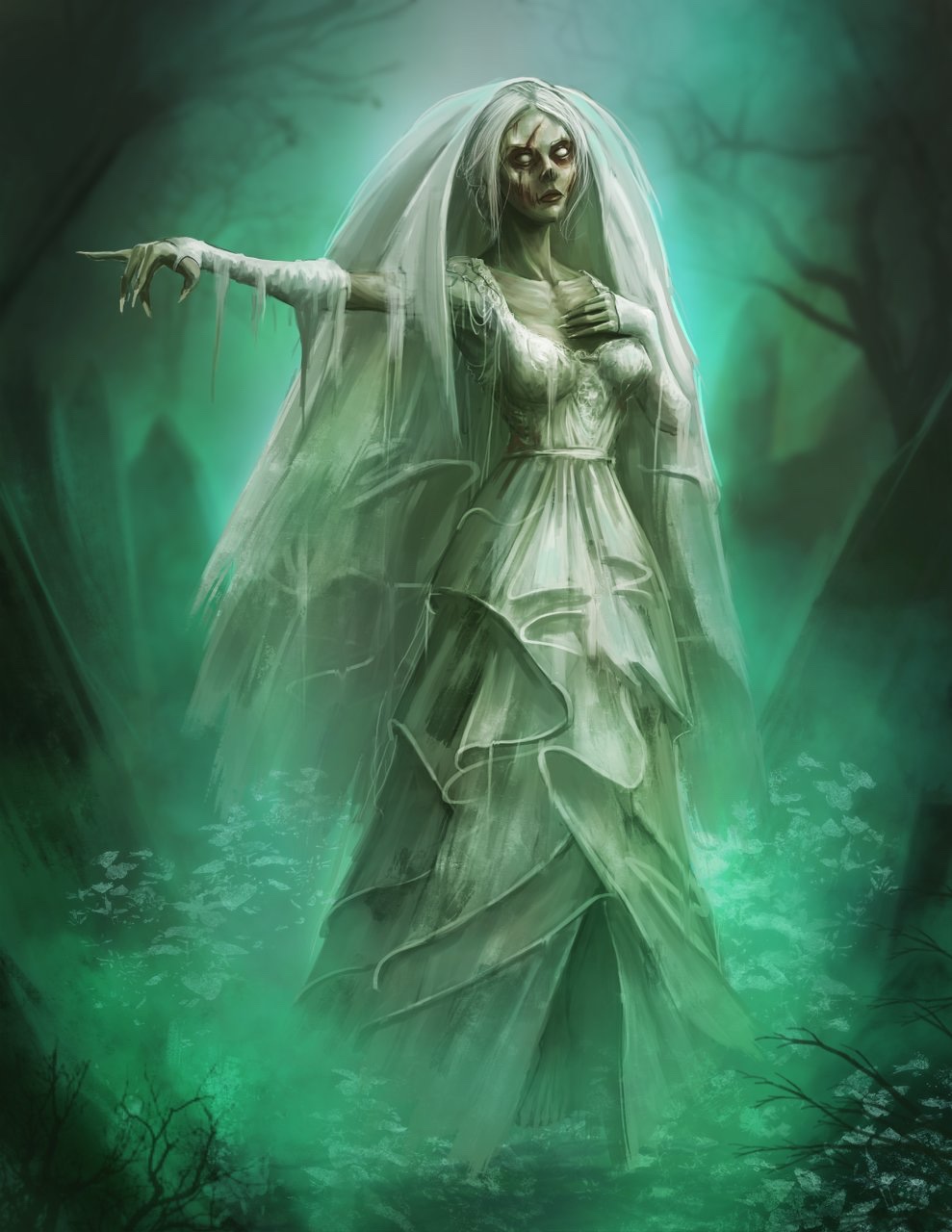
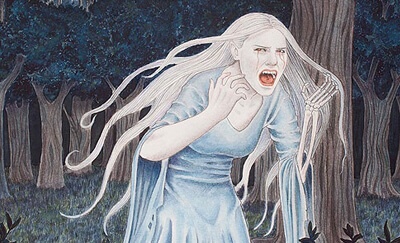
Banshee – actually should be spelled Bean Sidhe. She’s an Irish death spirit. Their keening fortells a death. They have very long, flowing hair and wear green dresses with grey cloaks. Their eyes are bright red because of their continuous weeping; or Benshee – an Irish faery attached to a house. Common name for the Irish Bean Sidhe. In Scotland the banshee is known as caoineag (wailing woman) also Bean-Nighe and, although seldom seen, she often heard in the hills and glens, by lakes or running water.

Bean Sidhe – In Irish folklore, the Bean Sidhe (woman of the hills) is a spirit or fairy who presage a death by wailing. She is popularly known as the Banshee. She visits a household and by wailing she warns them that a member of their family is about to die. When a Banshee is caught, she is obliged to tell the name of the doomed. The antiquity of this concept is vouched for by the fact that the Morrigan, in a poem from the 8th century, is described as washing spoils and entrails. It was believed in County Clare that Richard the Clare, the Norman leader of the 12th century, had met a horrible beldame, washing armor and rich robes “until the red gore churned in her hands”, who warned him of the destruction of his host. The Bean Sidhe has long streaming hair and is dressed in a gray cloak over a green dress. Her eyes are fiery red from the constant weeping. When multiple Banshees wail together, it will herald the death of someone very great or holy. The Scottish version of the Banshee is the Bean Nighe. Aiobhill is the banshee of the Dalcassians of North Munster, and Cliodna is the banshee of the MacCarthys and other families of South Munster.

Bean-Nighe – pronounced “ben-neeyah”; type of Banshee around streams in Scotland and Ireland. She washed bloodstained clothing of people who will soon die. They are rumored to be the ghosts of women who died in childbirth and will continue to wash until the day they should have died. The Washer at the Ford.

Aeval, Celtic Faerie Queen

Aeval was a Celtic faerie queen of northern Munster. She was part of the Tuatha Dé Danann tribe and associated with the O’ Brien Clan. She Became the Banshee of the O’Brien Family and began her lament whenever one of the family members died. Her name means beautiful. She made Craig Liath her home which mean Gray Rock. She held a midnight court to determine if Husbands were satisfying their wives sexual needs. When found to be remiss the husband would to ordered to over come there prudishness and give their wives what they need.

Aeval had a lover once who was a servant of Murchadh named Dudhlaing Ua Artigan. Murchadh was the eldest son of Brian Boru. Aeval placed a druid mist around her lover to ensure that he would not go into battle in the Battle of Clontarf and be killed. Aeval went to Brian Boru’s tent to tell him that he would be victorious in battle but that he would loose his own life and the first son to visit him in his tent would become king. Brian sent for his eldest son Murcahd, but Murchadh decided to delay to change clothing. So instead his other son Donnchadh was the first to enter the tent. Murchadh went into battle with Dudhlaing, and they struck their enemies a mighty blow on either side. Murchadh said they he heard the sound of Dudhlaing’s blows but could not see him. It seems that Dudhlaing did not want to keep the magick mist about him when Muchadh could not see him, so he withdrew from the druid cloack. They went to the plain where Aeval was because they thought she could give them news of the battle. Aeval pleaded with the two men to stop and stay away from the battle. Murchadh refused and said that fear of his mortality would not keep him from going into battle, and that if he fell, he would bring the enemy down with him. She pleaded with Dudhlaing that if he stayed with her he would know 200 years of happiness to which he replied that he will not soil his good name for gold or silver. Aeval told the two men that they would fall in battle and that by tomorrow your blood will be spilt on the plains.

Aeval had a harp whose music was sweet and beautiful, but deadly to mortals. It is said that whoever heard the music of the harp would die shortly afterwards. The harp did not have to be strummed or plucked by her. It would play whatever it was told to play by her. The victims of her harp were usually young men. It is said that she gifted her harp to the son of Meardha when he was learning at the school of the Sidhe at Connacht. He learned that his father had been killed by the King of Lochlann. The son of Meardha went to where the three sons of the King of Lochlann were, and played his harp. The three sons died shortly afterward.

Fand

Fand – In Celtic myth Fand is a faery queen, who was once married to the sea god Manannan. After he left her she was preyed upon by three Fomorian warriors in a battle for control of the Irish Sea. Her only hope in winning the battle was to send for the hero Cuchulainn who would only agree to come, if she would marry him. She reluctantly acquiesced to his wishes, though when she met him, she fell as deeply in love with him as he was with her. Manannan knew that the relationship between the human world and the world of the faery could not continue without in eventually destroying the faeries. He erased the memory of one from the other by drawing his magical mantle between the two lovers.

Fand was also a minor sea goddess who made her home both in the Otherworld and on the Islands of Man. With her sister, Liban, she was one of the twin goddesses of health and earthly pleasures. She was also known as “Pearl of Beauty”. Some scholars believe she was a native Manx deity who was absorbed in the Irish mythology.

Lavender Wands

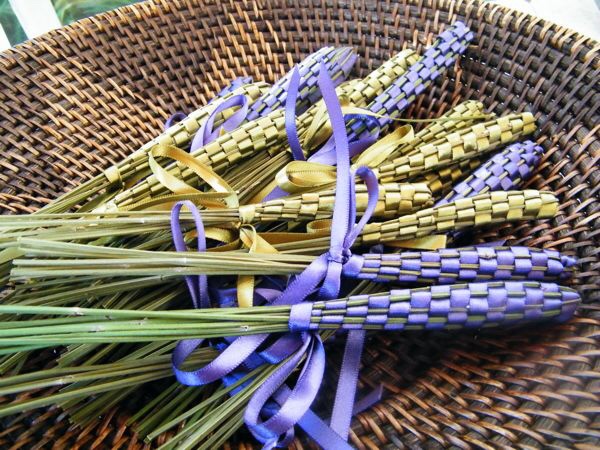
The wand is made by weaving a ribbon over and under adjacent stalks, so you must use an odd number of stalks. (I suggest using 13). Harvest only the most robust and straight flower stalks.

• 6 feet 1/4-inch satin ribbon
• 13 stalks fresh, straight, long-stemmed lavender
• Heavy thread
• Clippers
• Scissors

1. Align the flower heads and wrap the thread tightly below the flowers, including one end of the ribbon. Knot the thread and trim the ends; leave 1/4 inch tail of the ribbon.

2. Turn the wand so the flowers point downward. One at a time, bend the stalks over the thread. (Pressing your thumbnail into the stalk above the thread as you bend it prevents breakage if the stalks have dried out a little.) Space stalks evenly like the spines of an umbrella.

3. Bring the ribbon to the outside of the umbrella and begin to weave over and under adjacent stalks. As you weave, pull on the ribbon fairly hard and make sure the flowers inside are covered. As the pulling causes the stalks to twist, realign them after weaving three rounds so they are once again straight and evenly spaced. Repeat this step if necessary after the sixth round.

4. After weaving beyond the flower heads, form a handle by weaving the ribbon tightly for 4 to 5 inches. Tie it off in a bow. After the wand dries, reweave the ribbon on the now shrunken handle and retie the bow.

Source: Mother Earth Living

Huldufólk

In Iceland and the Faroe Islands, elves are often called the Huldufólk (the hidden folk). They are mysterious and mischievous, at times acting helpful and at other times playing tricks. Tradition says they make their homes in the rocks that cover the island. For centuries, the wee folk lived in the dancing shadows of hearth fires as farmers entertained wide-eyed children with tales of shenanigans while warning them not to stray too far from home, lest they disappear into elfland, never to return.

In Iceland, elves, (‘alfar’ in Icelandic), are beings thought to be smaller than most humans. Elves are thought to live outdoors, and to rarely speak. While some Icelanders believe elves to be a very distinct group, many have come to see them as synonymous with another group of mythical beings known as the huldufólk, or Hidden People.

Like elves, huldufólk also live outdoors, making their homes in Iceland’s rocks and cliffs. According to a study done in 2006, 32% of Icelanders believe the existence of these beings to be possible, while 24% believe their existence is either likely or an outright certainty.

Celebrating elves and huldufólk is common in Iceland. For instance, it is customary for Icelanders to clean and leave food for elves as it’s believed they hold parties late at night. On New Year’s Eve, it is thought that huldufólk move to new locations. As a result, it’s traditional to leave candles out to help them find their way. Finally, Þrettándinn, or Thirteenth Night, is celebrated on January 6th and marks the last day of Christmas in Iceland. On this day, bonfires called álfabrennur, of Elf Fires, are commonly lit.

#Huldufólk #Elves #Iceland #FaroeIslands

The Dullahan

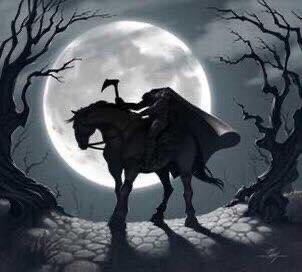
The Dullahan (pronounced DOOL-a-HAN) – also referred to as the Headless Horseman – is a type of Fae originating from Irish folklore. This sinister being appears as a man or a woman riding upon a black horse, but the rider has no head upon their shoulders. Typically, the Dullahan carries its head under its arm; the head appears dead and rotten (sometimes compared to having flesh resembling old cheese) with a demonic grin spread across its face from ear to ear.

The Dullahan carries a whip made from a human’s spine. Sometimes pulls wagon which is adorned with funeral objects (e.g., candles in skulls to light the way, the spokes of the wheels are made from thigh bones, the wagon’s covering made from a worm-chewed pall or dried human skin). When the Dullahan stops riding, that is where a person is due to die and when a Dullahan calls out the person’s name, the person immediately perishes.

There is no way to bar the road against a Dullahan—all locks and gates open to them when they approach. They do not appreciate being watched while on their errands, throwing a basin of blood on those who dare to do so (often a mark that they are among the next to die), or even lashing out the watchers’ eyes with their whips. They are however frightened of gold, and even a single gold pin can drive a Dullahan away.