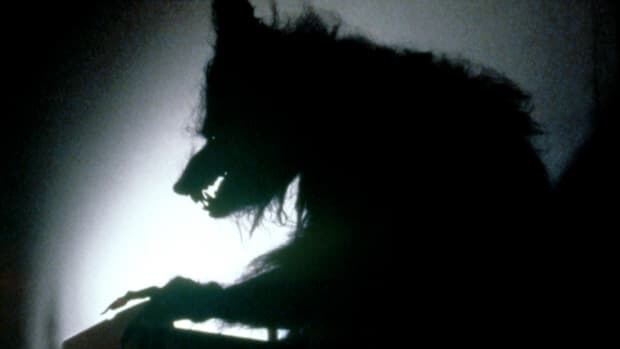
Werewolves of the Norse World

Werewolves

Vikings believed that some gods, giants, dwarves, elves, spirits, and even human beings could change shape. Examples of such shape-shifting includes Odin turning into an eagle to steal the mead of poetry; Loki turning into a mare and becoming mother to the 8-legged horse, Sleipnir; Fafnir, a dwarf whose greed turned him into a massive dragon; and other incidents of characters becoming salmon, snakes, otters, falcons, seals, swans, or bears. But one of the most common – and most terrifying – of these shapeshifters were werewolves.

Stories of werewolves and similar human-animal shapeshifters have been around for thousands of years and are found throughout the world, and so it could hardly be said that the Norse invented them. Yet, the werewolf holds a very special place in Viking lore. In their stories, we see these dark manifestations of humankind’s animal nature better explored than ever before.

The Vikings had different types of werewolves. Several appear in The Volsunga Saga.  In the fifth chapter of this long epic, Sigmund and 9 other sons of the heroic Volsung family have been captured by an evil king and bound in massive timber stocks out in the wild, black forest. Every night, an enormous she-wolf comes and devours one of the brothers while the others watch helplessly. This continues until Queen Signy – the wife of the evil king and the sister of the hapless Volsungs – smears her favorite brother’s face with honey. When the demonic wolf comes to kill Sigmund, she is distracted by the honey, and – as she licks her victim’s face and sticks her long, lolling tongue in his mouth, Sigmund bites hard and holds on. As the wolf thrashes to get free, she smashes Sigmund’s fetters – and rips her own tongue out. The hero breaks loose as the creature bleeds to death. It is later revealed this unworldly wolf is the mother of the evil king who had transformed her shape using dark arts.

Later in The Volsunga Saga, Sigmund and his son, Sinfjotli, are outlaws in the woods. Using enchanted wolf skins, Sigmund and Sinfjotli become werewolves for 9 nights at a time. While thus enchanted, young Sinfjotli is so terrifying and powerful that he can kill 11 armed men at once. This transformation affects more than just their physical strength though – in a fit of savage rage while in wolf form, Sigmund rips his own son’s throat out. Realizing what he has done, Sigmund uses all his willpower, magic, healing skill, and a little help from the gods to break out of his wolf trappings and heal his son before it is too late. The two burn their wolf mantles after that and do not go back to being werewolves.

The Volsunga Saga is one of the legendary sagas, and so is full of dragons, dwarves, and the like. Did the Vikings really believe these things, or for them, was it just a good story? Werewolves also appear in the more “realistic” Islandasagur sagas, suggesting that Vikings (or at least, many of them) did really believe in the existence of werewolves. For example, in Egil’s Saga, the hero’s father is called Kveldulf (“Evening Wolf”) for his lupine personality and the rumors that he runs with wolves by moonlight.

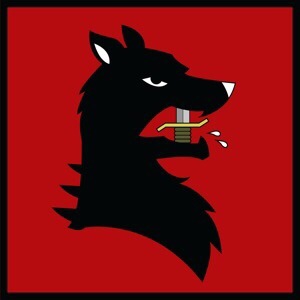
There were also real-world examples of Viking “werewolves.” Viking warbands featured berserkers – the frenzied bear-inspired warriors devoted to Odin. They also had another type of elite known as úlfheðnar (literally, “wolf-skins”). Not much is known about these Viking wolf warriors, aside from what clues appear in poetry or in art from the Viking Age and earlier Vendel period. In the depictions, these warriors appear as fearless and savage in the extreme. They take on all the qualities of the wolf and strike dread into the hearts of their enemies.

So, the Viking image of werewolves is diverse and ranges in its believability. Missing in Norse lore is the direct association between werewolves and a full moon. Indeed, one does not become a werewolf by being bitten by another werewolf. In the stories, though, one sees a clear relationship between the wolf nature and night. Especially in the case of Kveldulf, we see the “werewolf personality” of a mysterious, reclusive, abrasive, dangerous loner. As in the story of Sigmund and Sinfjotli, we see how the savage nature of the wolf takes over human nature and how the human spirit struggles to achieve some kind of control over it. All these themes are still present in the better werewolf tales of today.

Source: Sons of Vikings
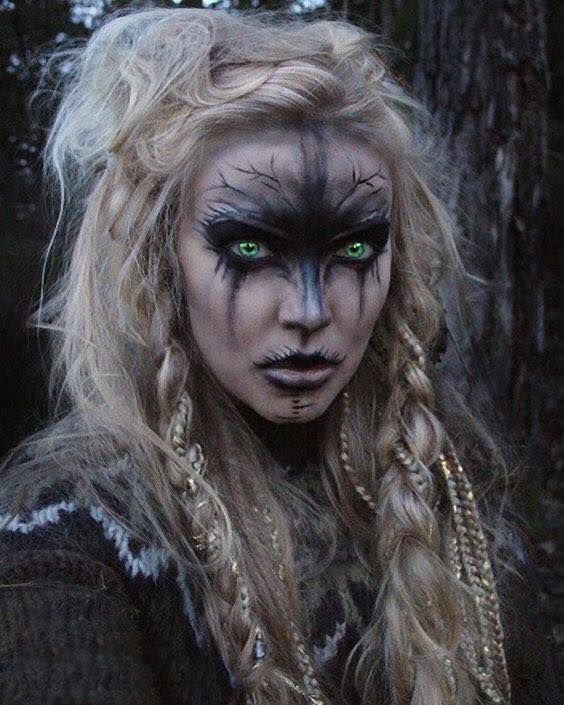
Witches of the Norse World

Witches

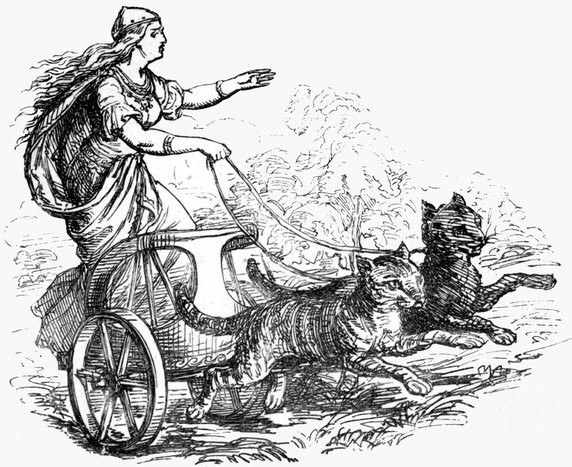
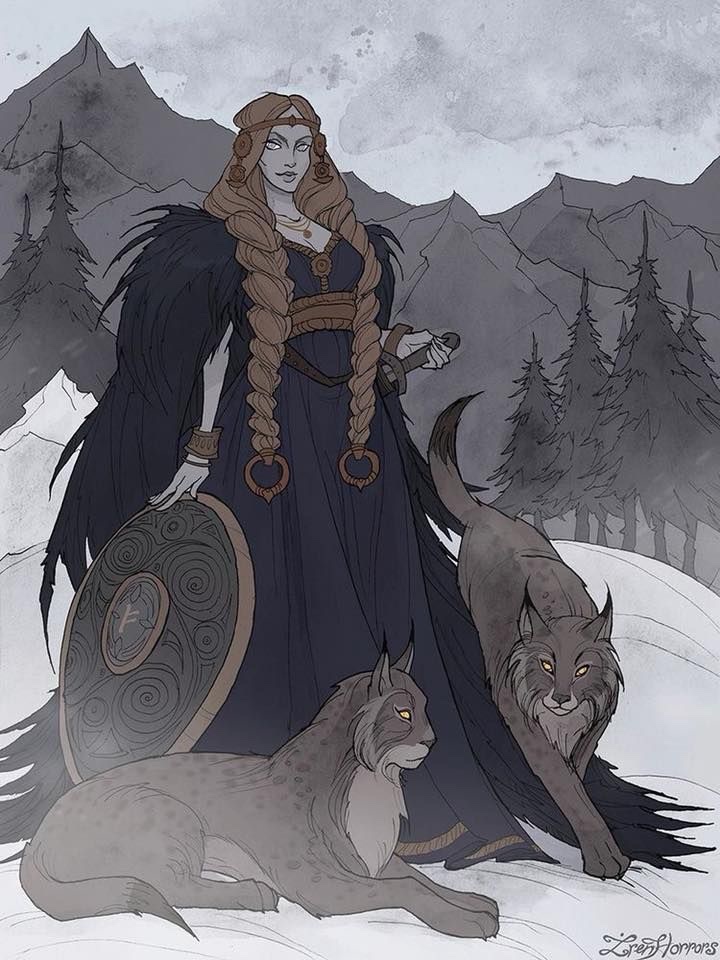
Belief in witches stretches across almost all cultures in history, and the Vikings definitely did not invent them. Vikings believed in magic and never took it lightly. There are about 40 different words for magic and magic users in their language of Old Norse, showing the range of understanding and the importance they placed on it. Freyja, the most venerated of the Norse goddesses, was a goddess of magic and taught her arcane arts to Odin. Freyja is sometimes called a witch in the Eddic poems and was much maligned for this by later Christians.  Freyja traveled in a chariot drawn by black or gray cats. These quiet, intelligent, ruthless creatures are her familiars or messenger spirits. A Viking who looked up to see a raven might see it as an omen from Odin, just as he might see a black cat as a sign that Freyja was watching.

Witches, sorcerers, and wizards were taken seriously and respected in the Viking world. This is further attested by the many Viking Age graves archaeologists have discovered that have grave goods (valuables deliberately interred with the body) associated with magic users. One tell-tale sign of a witch’s grave is an iron staff. It is thought that these iron staffs were used by Völva sorceresses in certain magic rituals, held between the thighs as the witch entered a shamanistic trance. At such times, it was thought that the witch’s layers of inner self left their outer body (what occultists now refer to as astral projection).

One passage referring to this is in the Havamal:

I know a tenth spell
If I see witches
at play in the air
I can cast this spell
So that they get lost
So they can’t find their skins
So they can’t find their minds

If the Viking Age, witches used their iron rod as a means of traveling across levels of consciousness, it is easy to see how later Medieval Christians would say that witches “flew through the air riding on brooms.”

So, the pagan Vikings respected (and feared) witches and often turned to them for help, but when the Vikings gradually became more Christian, witches were targeted as public enemies by the Church. Witchcraft never wholly died out, though. In Iceland, in particular, witchcraft survived in a well-documented line from early Viking times until the present – though it certainly changed and took on elements and influences from other cultures.

It is not just the Medieval Christian that shifted the perspective of the witch from medicine woman and soothsayer to evil, hexing hag, though. Viking lore is replete with frightening or “wicked” witches. There are at least three Eddic poems in which the speaker is a dead witch awoken by Odin or Freyja’s necromancy, and forced to lend her wisdom to the gods though she is full of spite for them. The worst of the evil witches were sometimes referred to as “Troll Wives” and were Jötnar rather than human. Like many fearsome beings in Norse lore, Troll Wives are seldom described in detail. However, the impression given fits the Halloween image of a lank-haired, green-skinned disfigured distortion of the elderly.

But it is clear that there is a broad range of witches. Only some of them could really be classified as good or evil – which is typical of the moral complexity and honesty that has made Norse lore so poignant and enduring.

Source: Sons of Vikings

Jörmungandr and the ouroboros through world mythology

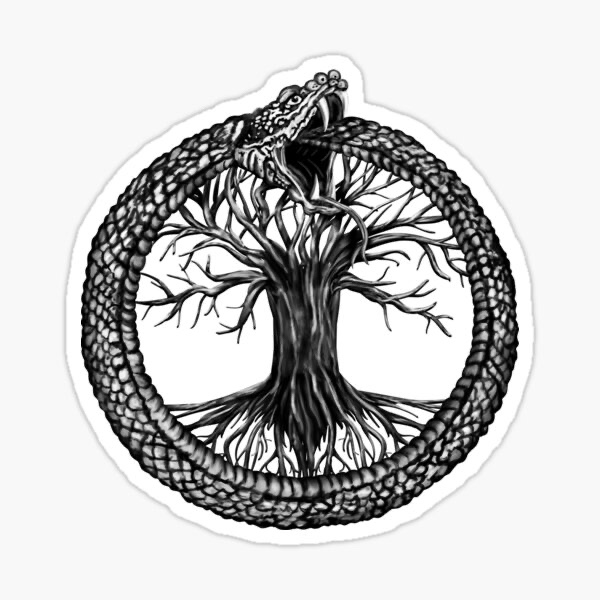
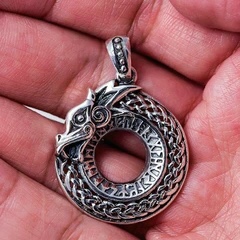
Of all the gods, giants, beasts, and spirits that stalked the Viking mental landscape, Jörmungandr – the world-coiling serpent – remains one of the most renowned. Jörmungandr is also known as the Midgard Serpent because he was a sea monster so large that he wrapped all the way around Midgard (the world of humans). When this gigantic beast stirs, storms, earthquakes, and tidal waves erupt. Jörmungandr lies in the depths of the sea, encircling the earth, holding his own tail in his mouth, waiting for the day of Ragnarok. It is said that when the serpent releases his tail and begins his attack, Ragnarok – the ‘final’ dark day for the gods – will begin.

Jörmungandr is not the only world-coiling serpent across the thousands of years and hundreds of cultures that color the human imagination. In fact, the image of a tail-swallowing dragon can be found worldwide and throughout history. This symbol of the circular snake is called the ouroboros. The earliest known ouroboros depiction is from the grave of Pharaoh Tutankhamen from the 13th century B.C. Since that time, similar images have shown up in ancient Chinese, Persian, Hindu, Greek, and Mesoamerican sites and artifacts. The ouroboros was also prominently featured in the language of mysticism amongst the Gnostics, Hermetic, and alchemists throughout Late Antiquity and the Middle Ages.

In most of these settings, the ouroboros signifies time – depicting the living, breathing cycle of ages that have no real beginning and no real end. In Roman sources, the ouroboros symbolized the god Saturn (the Greek Kronos from where we get words like chronology and chronometer). Saturn/Kronos was a god of time. He was considered by the Greco-Romans to be especially savage and terrifying. He was lord of the Titans – spirits of elemental chaos that were something like the giants (Jötnar) of Viking lore. In all this imagery, the ouroboros represents the endless cycles of creation and destruction. In fact, many scholars believe that our mathematical symbol for eternity – the sideways figure eight (∞) – is a shorthand adaptation of the ouroboros symbol.

Source: Sons of Vikings

Time to take back Viking history and Symbolism from racists and white supremacists

“All manner of Viking symbols and misconceptions about a golden age of Nordic racial purity have been appropriated by racist extremists looking to justify their xenophobia and acts of violence, according to the University of Alberta researcher.

Van Deusen said the age of racial purity never existed and she is determined to debunk the corrosive myth at every turn, especially in the classroom.

Viking symbols are everywhere among the ultra-right. When the Unite the Right rally took place in Charlottesville in 2017, some protesters carried banners featuring the Norse god Thor’s hammer, popular among the Nazis and neo-Nazi groups.

The perpetrator of New Zealand’s Christchurch massacre last year wrote, “See you in Valhalla”-referring to the great hall where heroes of Norse mythology go after they die-at the end of his manifesto.

Closer to home, the Soldiers of Odin-a Finnish white supremacist movement named after another Norse god in 2015-have recently emerged in Alberta and throughout Canada.

“The precedent was set with the Nazis,” said Van Deusen. “National Socialism and Hitler idealized the Norse people-those who lived in the Nordic areas. Even the swastika is based in part on a symbol based on Viking artifacts.”

Source: https://www.ualberta.ca/folio/2020/07/white-supremacists-are-misappropriating-norse-mythology-says-expert.html

What does the word Viking even mean?

Viking in Old Norse

Viking in Old Norse is víkingr. The ‘r’ on the end is essentially a grammatical feature of Old Norse for denoting a masculine noun. It is often dropped in English transliteration (for example, people may write the name of the god Freyr as Frey). In Old Norse, víkingr was someone who was a seaborne raider/adventurer.

Noun or Verb

Víkingr and plural forms of the word, such as víkingum or víkingar, appear as nouns describing Scandinavian seaborne raiders in the sagas, Eddic poetry, and runestones.

We see literally carved in stone the term “Viking” being used as a noun and to denote people. From the context, it does not seem that “Viking” referred to everybody, though, but to some type of traveling warrior.

Viking’ also used as a Verb in Old Norse

Viking could also be a verb in Old Norse. This verb meant the act of seaborne raiding or adventuring. So, a víkingr would víking, or in other words, a seaborne raider would raid by sea. In many historical fiction books, this is rendered “to go viking.”

There is no evidence to suggest that the verb was more prevalent than the noun or adjective. However, it is fair to say that Vikings used the terms víkingr and víking differently than we use these terms.

What Vikings Called Themselves, and What Other People Called Them

It is essential to remember that in our ancestors’ times many of the current cultural values did not exist. ideals, concepts, and information we now take for granted had not developed yet. Today, one of the strongest ways people identify is by their nationality – we are Americans, Norwegians, etc. While many of Europe’s nations began to form and organize in the Viking Age, national identity was then only in its embryonic stages. 

As the Viking Age dawned, the Nordic peoples of Scandinavia shared a common language, culture, and faith. However, they did not share a strong sense of common identity, as evidenced by their constant wars, raiding, and competition – even within the geographical boundaries of their homeland. They were divided into numerous tribes or clans.

Their societies were arranged in small units united by kinship and their allegiance was to local chieftain. The first “King of All Norway,” Harald Fairhair, did not consolidate power until a century into the Viking Age, and the political boundaries of Denmark, Norway, and Sweden would not solidify for several centuries after that.

So, while Vikings used the term víkingr for a seaborne adventurer, early medieval Scandinavian peoples had no overarching name for themselves. They did not think that way. Instead, they identified themselves by family, clan, and tribal loyalties. During the Viking Age, these intimate groups formed larger and larger networks and affected greater and greater changes far from home. 

Vikings might not have had a common term for themselves, but their enemies had many. The English and the French tended to call them all Danes. Archeology is abundantly clear, though, that the “Great Heathen Army,” the “Army of the Seine,” and these other large forces were not just Danes but mixed companies from locations wherever Vikings roamed. 

English monks, writing in Latin, also adopted the word, Wiccinga/Wiccingi (the Old English form of ‘viking’ in Latinized singular and plural forms). This capitalization in the manuscripts strongly suggests the Vikings were known by that name, and that it is not just a generic descriptor.

There were other names in other places. In Ireland, the Vikings were called “the Foreigners.” In the east – Russia, Ukraine, Belarus, the Byzantine Empire, Bulgaria, and the Mediterranean – Vikings were called Varangians (“sworn companions”) and Rus’. To the Moors of Spain and the Arabs around the Caspian, they were called Majūs.

Source: Sons Of Vikings

Who Were The Norse?

“The term ‘Norse’ is used to describe the various peoples of Scandinavia who spoke the Old Norse language between the eighth and thirteenth centuries AD. While it had eastern and western dialects it would have been generally mutually understood across the range of areas within which it was spoken. A third recognisable form was spoken on the island of Gotland.

The Old Norse language later developed into modern Danish, Faroese, Icelandic, Norwegian and Swedish. In addition, there once existed the so-called Norn languages of Orkney and Shetland that are now extinct. It was, essentially, the language of the Vikings.”

~ Martyn Whittock, from Tales of Valhalla

Yggdrasill

Yggdrasill

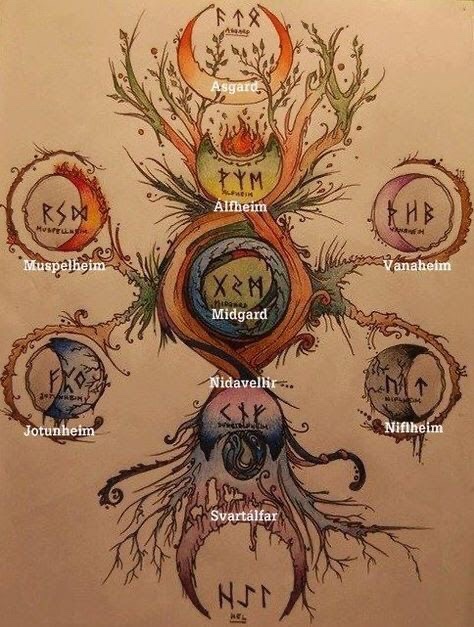
This is the cosmic tree, the “ideogram of Scandinavian mythology” (Mircea Eliade). It corresponds to the Skambha, the cosmic pillar of the Vedas, to the Saxon Irminsûl, and to the World Tree of the Sámi people in Lappland. It is also called Læraðr and Mímameiðr (“Mímir’s Tree”). It is an ash tree, the center and support of the world that it summarizes and symbolizes, the source of life and all knowledge, and all fate. Neither fire nor steel can scathe it, and its fruits heal the womb ailments of women.

Living beneath its three roots are men, frost giants, and the dead in Hel’s realm. According to one tradition, one of its roots leads to the world of the Æsir in the sky. This is where the springs of Urðr (a Norn), Mímir (a giant), and Hvergelmir (the source of all rivers) are located. The dragon Niðhöggr also lives here. The second root goes to Jötunheimr, the world of the giants, and the third to Niflheimr, the world of the dead.

An eagle perches at its top. This is most likely Hræsvelgr (“Carrion Eater”), the flapping of whose wings gives birth to the winds—as well as the falcon Veðrfölnir (“Ash Covered by the Wind”?). The squirrel Ratatoskr climbs up and down the trunk. Five stags graze on its branches: Dáinn and Dvalinn (“Death” and “Torpid”; these are also dwarf names), Duneyrr (“Downy Ears”), and Duraþrór and Eikþyrnir (“Oak-thorny”), as well as the goat Heiðrún. Eight reptiles gnaw on its roots: Niðhöggr, Góinn, Móinn, Grafvitnir, Grafvölluðr, Grábakr, Ófnir, and Sváfnir (we may note in passing that alliterations are generally a sign of the antiquity of the elements). Each day the Norns sprinkle water and light clay over Yggdrasill. The Æsir customarily hold their deliberations beneath the cosmic tree near Urðr’s fountain.

Yggdrasill ensures the vertical coherence of the world, while the Midgard Serpent guarantees its horizontal coherence.

Facts About Icelandic Ásatrú, the Ancient Religion of the Vikings
It was abandoned in favor of Christianity in the year 1000

While Ásatrú was the religion of the vast majority of the settlers of Iceland, some had been converted to Christianity while travelling in Europe. During the first centuries of Icelandic history Christianity made further inroads, and by the end of the 10th century it was clear Ásatrú was on the retreat.

It was re-recognized in 1973

Ásatrú was only re-recognized as a religion by the state in 1973. A group of people who were either practitioners of the ancient religion or its students had been meeting for some time. This group, led by Sveinbjörn Beinteinsson who later became the first high-priest of the association, decided to establish a formal congregation and request recognition from the state. This meeting was held on the First Day of Summer, a unique Icelandic holiday which marks the end of winter and beginning of summer. At the time the number of members was just 12.

It is Iceland’s fastest growing religion

According to figures from Statistics Iceland 3,583 people belonged to Ásatrúarfélagið on January 1 2017, up from 1,040 members 10 years ago. The membership has grown by 244% since 2007, making paganism the fastest growing religion in Iceland over the past decade.

No proselytizing or missionary work

This growth has come in spite of the fact that unlike other religious organizations Ásatrúarfélagið has never engaged in any form of missionary work or proselytizing.

One high priest, 10 Goðar in Iceland (Goðar = Congregation)

The organization of Ásatrúarfélagið is based on the historic organization of Ásatrú during the Viking age. Priests in Ásatrú are called Goði, with each Goði responsible for a congregation “goðorð”. While the goðorð were associated with certain geographic areas during the Viking age, people were free to choose their Goði.

All the ceremonies of Ásatrúarfélagið are open to the general public

The weekly meetings of Ásatrúarfélagið are open to the public, as are all its official ceremonies, the blót. Ásatrúarfélagið has four main blót each year: Jólablót (Yule-blót) at winter solstice in honor of the goddess Freyja, Sigurblót (Victory-blót) held on Sumardagurinn Fyrsti in the spring in honor of the god Freyr, Þingblót (Þing/assembly-blót) on Summer solstice held in honor of the laws, the Þing and human society, and Veturnáttablót (Winter-nights-blót) held on the first day of winter. Veturnáttablót is in honor of Óðinn, the god of the gods.

First pagan temple since 1000 was opened in 2018

Ásatrúarfélagið moveed into a new temple just outside downtown Reykjavík. The temple was the first heathen central temple built in the Nordic countries for more than a thousand years.

There is no prescribed dogma or scripture

Ásatrú has no prescribed dogma or scripture. However, You are however encouraged to read the Poetic and Prose Eddas written by the 13th-century chieftain and scholar, Snorri Sturluson. No one actually prays to the gods and how you might ask their intercession is entirely up to you. The gods are imperfect and not divine.

It is a religion of peace and tolerance

Ásatrú, as it has been practiced in Iceland, is a religion of nature and life, stressing the harmony of the natural world and the search for harmony in the life of individuals. It’s openness and philosophical character has led some to compare it to Unitarian Universalism.

It rejects militarism and the glorification of heroism, battles and blood

Many neo-pagan groups in Europe and the US who consider themselves observers of the religion of the Vikings, practice a religion which glorifies battles, militarism, masculine heroism and in some cases chauvinism, violence, intolerance and racism. Unfortunately some white-power groups and members of Aryan Nation gangs practice these forms of paganism. Ásatrúarfélagið rejects this as a misreading of Ásatrú.

Ásatrúarfélagið has received hate mail from reactionary heathens abroad

Ásatrúarfélagið has cut all ties with foreign associations of pagans after receiving harassment and hate mail from people who are angry with emphasis the association has placed upon equality and respect for human rights, especially LGBTQ rights.

Anyone can practice the religion, But only Icelandic residents can join Ásatrúarfélagið

Only Icelandic citizens or people who have a domicile in Iceland can become members of the Ásatrúarfélag, but anyone can practice Ásatrú, regardless of their nationality or residence. It costs nothing to join and is open to all, irrespective of race, cultural background, gender or sexual orientation.

Days of the Week: Friday

Of all the theophoric days of the week, Friday is the most controversial. Some assert that Friday is named after the Viking god Freyr. This makes sense because the 11th-century eyewitness, Adam of Bremen, describes Odin, Thor, and Freyr as forming a top-tier of gods that were often worshipped together (including at the magnificent temple at Uppsala). Freyr was a fertility god and god of plenty, and so the Vikings would probably not want to offend him by leaving him out.
Others believe that Friday is not named after Freyr but after his sister Freyja. Freyja was a goddess of war, magic, fertility, and erotic love. Still, others believe that the day is named after Frigg, Odin’s wife and the Queen of Asgard. The matter is further complicated: Freyja and Frigg have many overlapping characteristics and may have once even been the same goddess. This ambiguity has long roots, as Friday was called Frigesdaeg in some dialects but Freyjasdagr in Old Norse.

An important clue as to who the day really belongs to can be found by comparing it to the Roman model. For the Romans, the sixth day of the week was devoted to Venus, the goddess of love, beauty, and passion. If the comparison still holds, it would seem that Friday is, therefore, Freyja’s Day. We will probably never know for sure, and indeed perhaps our Viking ancestors honored all three on this day.
Days of the Week: Thursday

The Romans devoted the fifth day of the week to Jupiter, also known as Jove. Jupiter/Jove was the same as the famous Greek god, Zeus, and was the king of the gods. For the Vikings, though, the powerful, protective lord of the skies and wielder of thunderbolts was Thor, in which Thursday is named after (Thor’s Day).

Thor was known to the Anglo-Saxons as Thunar and to other Germanic tribes as Donar. While Thor was not the king of the gods in the Viking pantheon, he was probably the most powerful and the most popular. Interestingly, Tacitus equated Thor not with Jove but instead with Hercules because of the god’s strength, bravery, and conspicuous humanity. For many, Thor still retains this superhero aura.