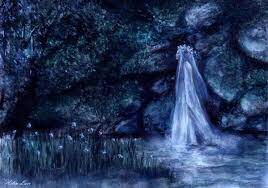
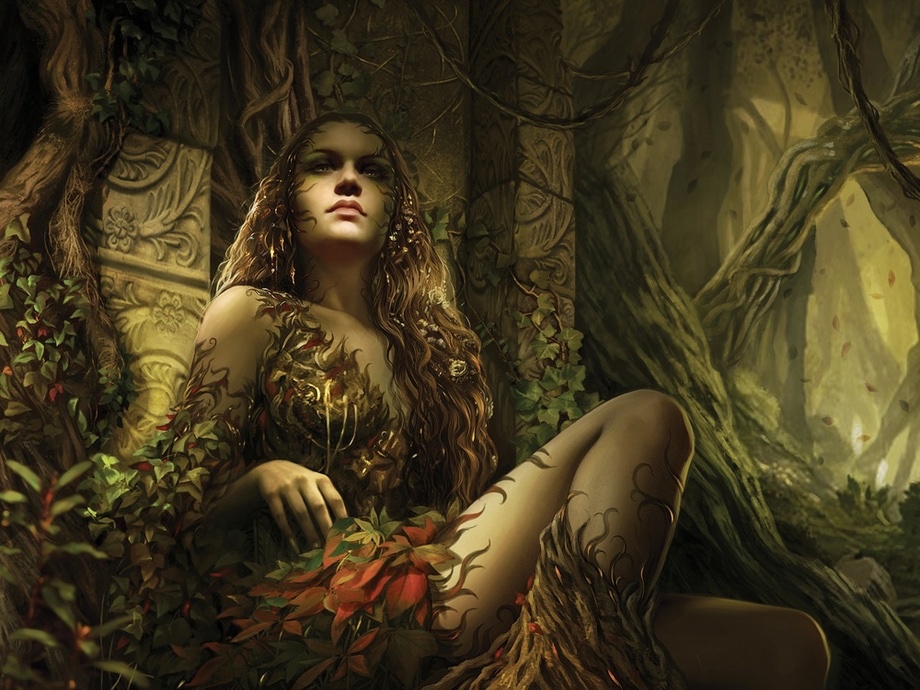
The famous Lake Maidens of Wales, their name means ‘Otherwordly women’. While many fairies who make their homes in bodies of water are at best mercurial and at worst murderous, the Gwragedd Annwn have a good reputation for kindness and gentle ways. They appear as beautiful young women and are known to make good wives when they marry human men, although like many fairy wives they usually leave if the man violates a taboo relating to them.
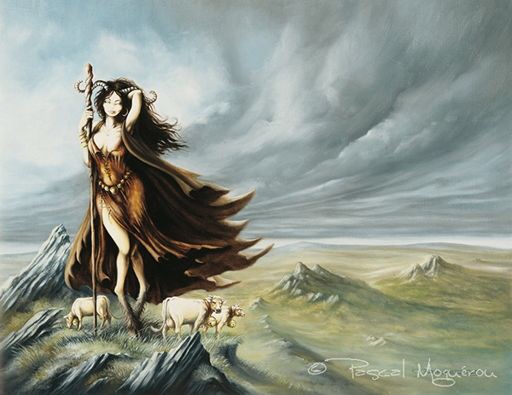
In many stories of these Lake Maidens this taboo has to do with the husband striking the wife three times. Even if they are forced to leave their family such fairy women stay involved with their children, and one Welsh family renowned for their medical knowledge claimed it had come from a long-distant Gwragedd Annwn ancestor. The Gwragedd Annwn are strongly associated with cattle, both Earthly cows and Otherworldy ones, which may be seen as symbols of abundance and blessing.
A type of fairy found in Brittany that is less of a specific kind of being so much as a general category of beings is the Corrigan. They might be loosely compared to the generic English idea of elves as small, mischievous creatures. Corrigans are social fairies who live in groups and enjoy dancing; where they dance mushroom rings are said to appear. They wear white exclusively and are the size of young children, but look like an adult in miniature.
Corrigans can be very cruel to humans in their power and they are usually less inclined to aid people, but are not always hostile towards them and will sometimes help around homes or farms. They are nocturnal fairies and only emerge at dusk and during the night-time. In most ways they are exactly like all other Celtic fairies: they are known to steal human children, to punish those who spy on them or repeat their secrets, and to reward those who please them.
Corrigans have beautiful hair and red flashing eyes. They are sometimes described as important princesses or druidesses who were opposed to Christianity when the Apostles came to convert Brittany. They hate priests, churches, and especially the Virgin Mary. They can predict the future, change shape, and move at lightning speed.
Like sirens and mermaids, they sing and comb their long hair, and they haunt fountains and water wells. They have the power of making men fall in love with them, but they then kill the ones who do. In many popular tales, they are eager to deceive the imprudent mortals who see them dancing or looking after a treasure, and fond of stealing human children, substituting them with changelings. On the night of 31 October (Samhain), they are said to be lurking near dolmens (a megalithic tomb with a large flat stone laid on upright ones, found chiefly in Britain and France) waiting for victims.
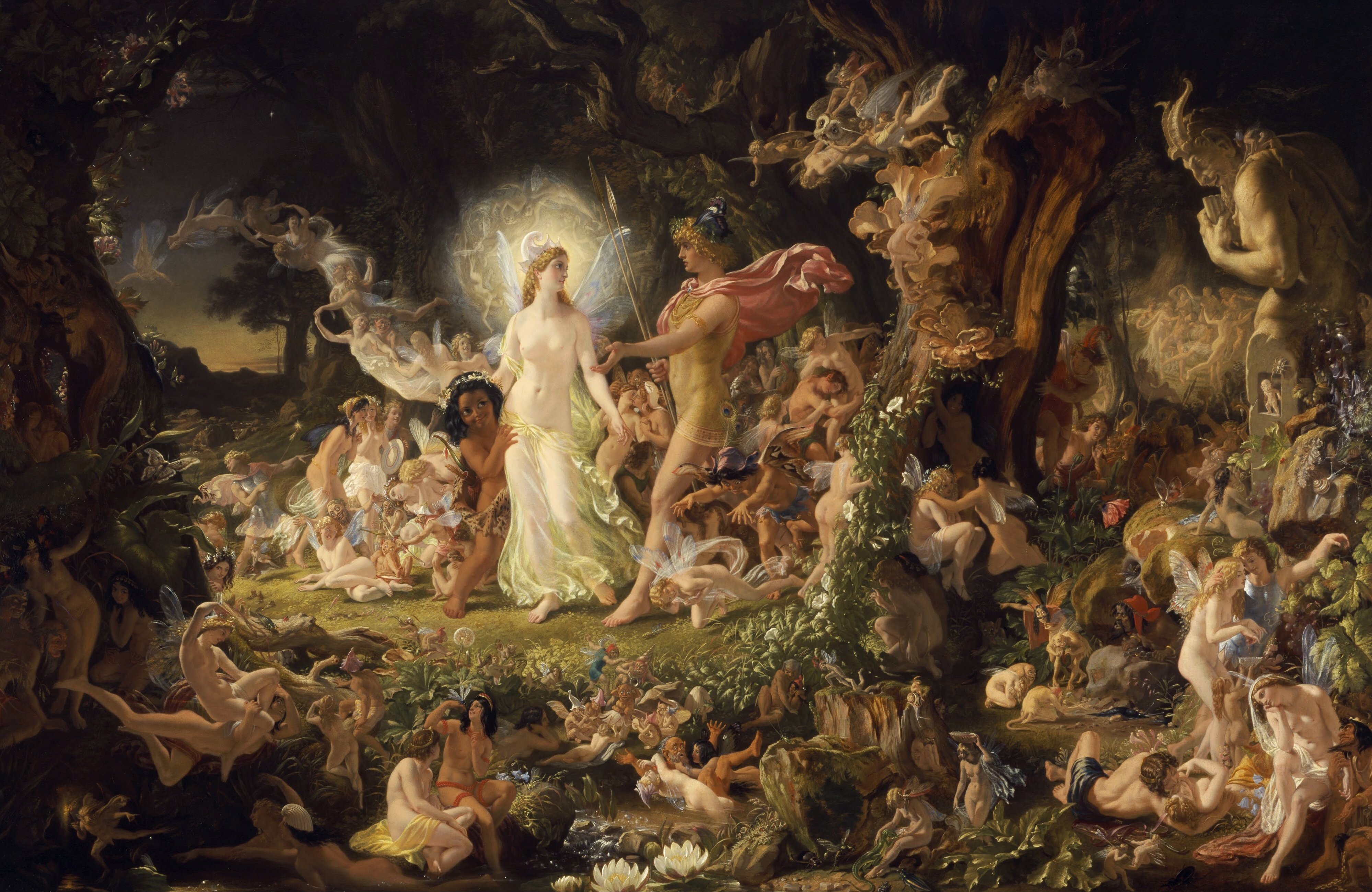
First mentioned as a King of the Fairies in a 15th century French romance, Oberon also appeared in Shakespeare’s A Midsummer Night’s Dream paired with the Fairy Queen Titania. In contrast other sources say his queen was Mab, and while Shakespeare described Oberon as human sized, in the French story he was the size of a toddler. This may reflect the shape-shifting powers of the fairies or the use of glamour to alter perceptions, or perhaps merely indicate the same name being used for two different Fairy Kings between cultures.
In Huon of Bordeaux, the first place Oberon appears as a Fairy King, he is described as small and deformed, yet extremely handsome, wearing a jeweled gown that glows. This Oberon carries a bow that never misses and a magical horn that cures all illnesses and acts as a cornucopia. A 16th century literary source described Oberon as tiny and said he could not bear sunlight and fled the light of day. The name Oberon is also strikingly similar to names used for familiar spirits during the Renaissance, including ‘Auberon’ and ‘Oberycom’; in this guise he was invoked as a spirit of luck and to gain power for the person calling him. This could mean that Oberon was a general term for a powerful male fairy that was later applied as a name for Fairy Kings. In that case, if we also view Diana/Titania as a similar generic name applied to a Fairy Queen there is a logic in pairing the two together.
One distinctive feature of Fairy is the flow of time; in most cases time in Fairy seems to move at a different pace than on Earth. We may see a single night go by in Fairy while years pass on Earth, or in one anecdote years passed for a man in Fairy while only minutes passed here. We see a variety of stories where a person joins a fairy dance for what they believe is only a single night only to find at dawn that years, decades, or even a century has passed while they danced.
In the tale of King Herla a single night of feasting in Fairy occurs while 200 years pass on mortal Earth. There is no clear predictable pattern to this, however, and the fairies themselves seem exempt from the disjointed temporal effect, as they often and regularly cross between the two worlds, even maintaining friendships with mortals over the length of the person’s lifetime, without difficulty. The same is obviously not true for mortals, or at least not without fairy aid, as we see many mortals doomed by their time in Fairy because they return to a world that is utterly changed from the one they left by nothing more esoteric than the passage of time.
A term found in the Shetland and Orkney Islands of Scotland, likely imported to there from Norse areas during occupation periods. Possibly a variant of the word trolls. Trow is considered roughly synonymous to other Scottish terms for fairies including sighean.
In some folklore Trows are described as very human in appearance, although they may appear old, shrivelled, or physically deformed. In other stories, however, they are described as clearly inhuman, unattractive, and twisted, even in sometimes appearing as a mix of human and horse. They are often described in unflattering terms as having oversized feet, large noses, flat faces, and short limbs. They can range in height from three to six feet depending on the story. They are often said to dress in grey, although sometimes they appear in green, red, white, or black.
It was claimed that the witches in these areas dealt with the trows, much as we see the witches in other areas dealing with fairies, and as in other areas the trows were known for shooting magical arrows that caused illness and death and for swapping changelings for beings they wanted. In Shetland the Trows prefer night time and fear the sun which traps them on earth until it sets. Like some other kinds of fairies Trows will make themselves welcome in human homes at night while the inhabitants are sleeping, coming in to sit by the fireside; they are known to dislike people who lock their doors for this reason. Trows live in mounds that are often called knowes and like other fairies they will steal humans, most often brides, and enjoy music and causing mischief.
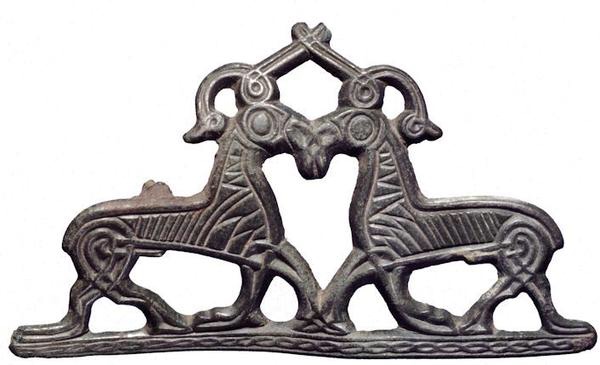
Tanngrisrnir and Tanngnjostr were the goats of Thor. They pulled Thor’s chariot across the sky. Everytime Thor crossed the sky with his goat-drawn chariot, there came the sound of thunder.
In Norse mythology, Thor killed his goats for the food. And in the following day, he would resurrect his goats with his Mjolnir hammer.
The symbol of Tanngrisrnir and Tanngnjostr also presented Thor and his presence. The goats symbolised the boundless endless and the masculinity. Modern archaeologists have excavated Viking artifact of the goats (as pictured).
The size of fairies is an often debated subject, yet folklore paints a clear, if varied, image of them. While modern depictions tend to favour small, childlike imagery looking at the wider scope of material we find everything from miniscule ant sized beings to gigantic fairies twice as tall (or more) than humans. The most common depictions fall into two main categories: those that are around 2 feet tall and those that are the height of an average human being.
What we find in many of the stories and ballads is that fairies look very much like human beings except that they have an aura of Otherworldliness to them or in some other intangible way project their fairy qualities. As Andrew Lang puts it:
“There seems little in the characteristics of these fairies of romance to distinguish them from human beings, except their supernatural knowledge and power. They are not often represented as diminutive in stature, and seem to be subject to such human passions as love, jealousy, envy, and revenge…The People of Peace (Daoine Shie [sic]) of Ireland and Scotland are usually of ordinary stature, indeed not to be recognized as varying from mankind except by their proceedings…” (Andrew Lang, 1910).”
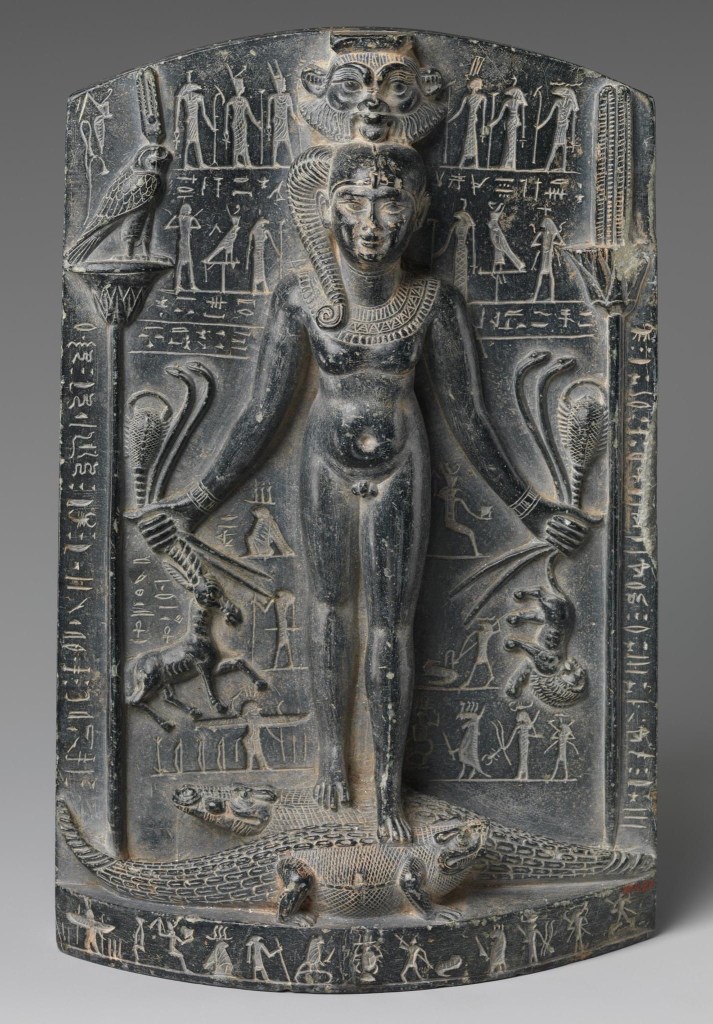
An amuletic plaque of the god Harpokrates (Horus the Child) standing in the center on the heads of two crocodiles and beneath a mask of Bes, a god especially associated with the protection of children and of pregnant women and those giving birth. In each hand Harpokrates clutches a scorpion by the stinger as well as two serpents. He also grasps a quadruped by the horns with his right while his left grips a lion by the tail. In addition, he is flanked by standards in the form of lotus and papyrus columns.
The plaque is extensively inscribed with magical spells to protect against scorpions, snakes, and the other noxious forces subdued by the god, and to heal the stings and bites of wild creatures.
The object is made of chlorite schist and is dated to the Ptolemaic Period (304-30 BCE). This type of stelae was often set up in homes, but examples have also been found in burials. This suggests that they were believed to extend their protective powers to the deceased.
This piece is now in the Metropolitan Museum of Art, New York, USA.
Titania is a Fairy Queen who appears as an important character in Shakespeare’s play ‘A Midsummer Night’s Dream’ written in the mid 1590’s. In the play she is the wife of the Fairy King Oberon and the two are fighting over a changeling child; because of the fight Titania is refusing her husband’s company and so he sets one of his servants out to make her fall in love with a foolish mortal as a punishment. Titania’s name connects to that of the goddess Diana, suggesting that Titania was meant to be an epithet for the well-known goddess. Diana is often associated by early modern writers with both fairies and witches so there is a certain logic to this idea. Titania’s name is not widely seen elsewhere in literature although it does appear in one magical text found in the British Museum.
Titania appears in a handful of works after Shakespeare, usually paired with Oberon or as a minor character; examples include a reference to her in Faust I and in an opera titled ‘Oberon, or the Elf King’s Oath’. Shakespeare’s Titania did not find widespread popularity in modern culture although she does either appear, or is referenced, in some video games and literature. Perhaps her most high profile modern appearance would be as the Summer Court Queen in the Dresden Files books, although she does also appear as the Queen of the Black Court in Dana Marie Bell’s ‘Grey Court’ series.
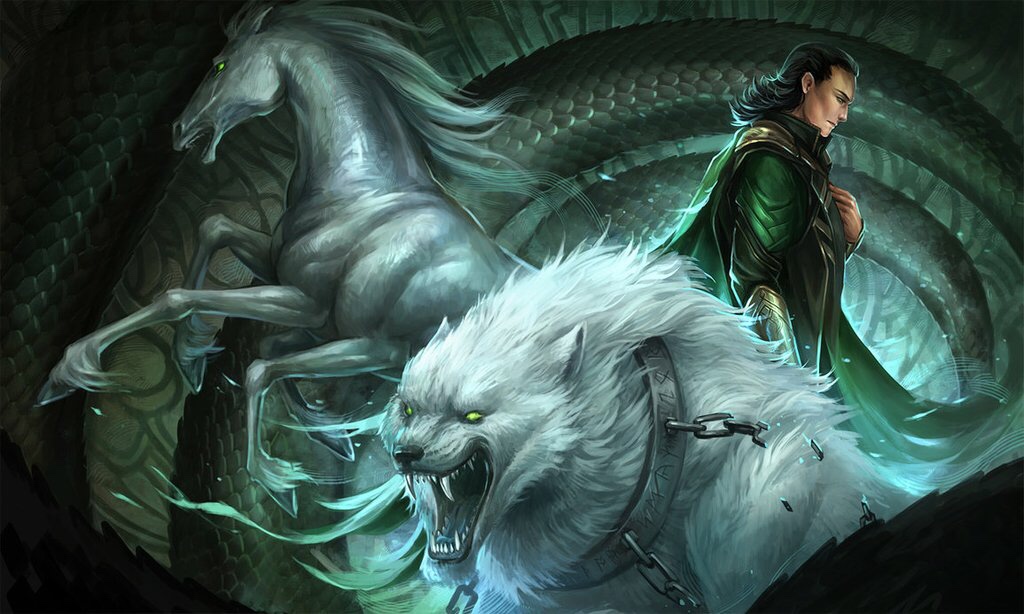
Loki the most complicated Norse character and the giantess Angrboda (“She who Brings Anguish”) had three notorious children. His first son was the Jormungandr the Midgard Serpent, the second daughter was Hel the Queen of Helheim, and the last one was Wolf Fenrir the God of Destruction.
Jormungandr
Jormungandr was also known as the Midgard Serpent. He was cast into the deep ocean by Odin the Allfather as a precaution against the Ragnarok. Deep under the ocean laid Jormungandr who quickly grew large enough to encircle the whole Midgard. Jormungandr held his own tail in his mouth. He was the sworn enemy of Thor. These two (Jormungandr and Thor) had encountered each other once before the days of Ragnarok.
As Ragnarok was looming large, Jormungandr raised from the ocean and accompanied Loki’s army to enter Asgard. This Midgard Serpent had his last battle with Thor and got killed by the blow from Mjölnir hammer. Thor, unfortunately, was slain by the venom of the dead Jormungandr.
Hel
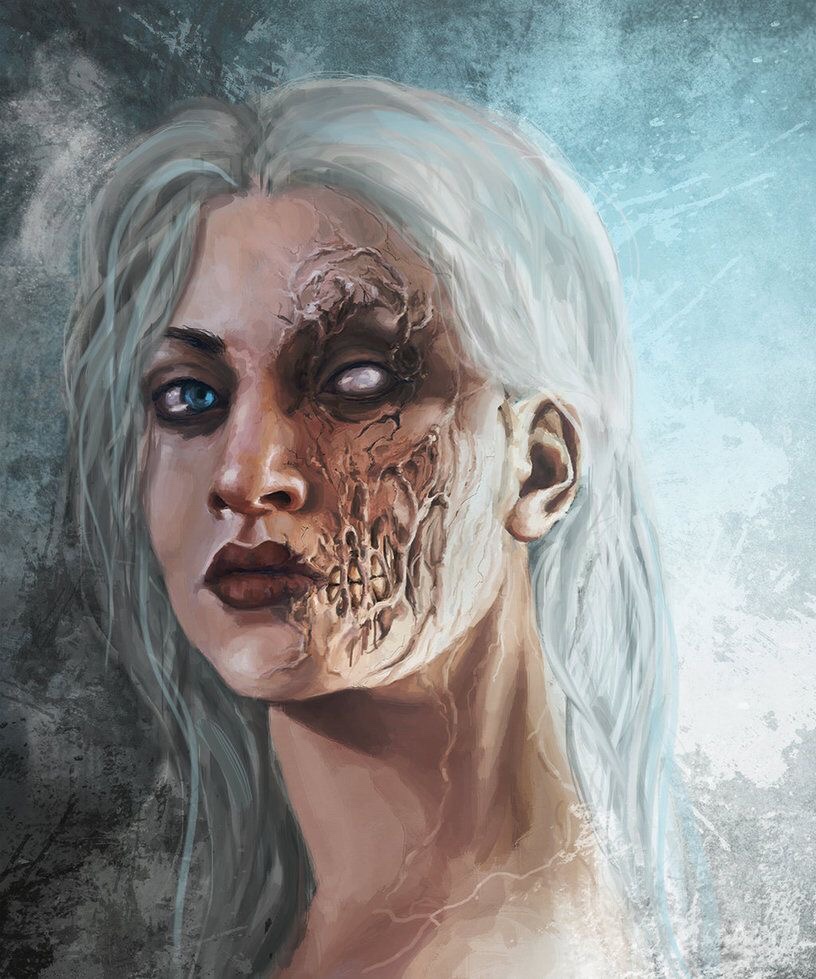
The only daughter of Loki, Hel, was banished into the land of Helheim located deep under the root of Yggdrasil tree. There, Hel built up her own kingdom of the dead and presided over that place. She was the queen of the deceased and the land of Helheim. According to the myth, if one soul belonged to Hel, without her permission, that soul could not do anything but serve in the land of Helheim. No one could ever interfere with this practice, even Odin the Allfather.
Hel joined the army of the Jotun to battle against Aesir gods. She brought the dead alongside.
Fenrir
Hardly could any villain in Norse myth rival the reputation of Wolf Fenrir. Fenrir was the worst nightmare to the Norse gods because Fenrir was predicted to swallow Odin in Ragnarok. As the gods scared that this scenario would come into being, they decided to raise the wolf by themselves. When the wolf grew up at an incredible speed, they bound Fenrir with a magical fetter. Fenrir then was sent to a middle-of-no-where place until he broke free on the threshold of Ragnarok.
In Ragnarok, Fenrir and his father, Loki, led the giant army to fight against the gods. Fenrir opened his enormous mouth with his jaw stretching from heaven to earth and swallowing anything that hindered him. When battling with Odin, Fenrir gained the upper hand and swallowed the god, proving the prophecy to be true.
Other Children of Loki
Sleipnir – Sleipnir was the result of one-night chase between Loki and a stallion Svadilfari. This happened when Loki wanted to prevent Svadilfari from finishing building Asgard Wall. Loki in disguise as a mare seduced Svadilfari to distract the stallion from finishing its task. As a result, a little horse was brought to life. Sleipnir was his name. And in fact, Loki was the mother of Sleipnir horse. Yes, Loki was the mother! Sleipnir horse then was given to Odin the Allfather by Loki. Sleipnir was a true treasure as he could travel not only on land but also over the sea and through the air. Odin rode Sleipnir into the battle of Ragnarok where he met Wolf Fenrir.
Nari and Vali – these two children of Loki had little material about them. The most well-known tale about these two was in the Punishment of Loki. The ironic story told that Vali in the form of a wolf killed his brother Nari. The gods used the entrails of Nari to bind Loki to the rocks as Loki’s most severe punishment for causing trouble to the gods.









 Mark Bere Peterson’s Counterculture, Urban Legends, Paganism & Witchcraft